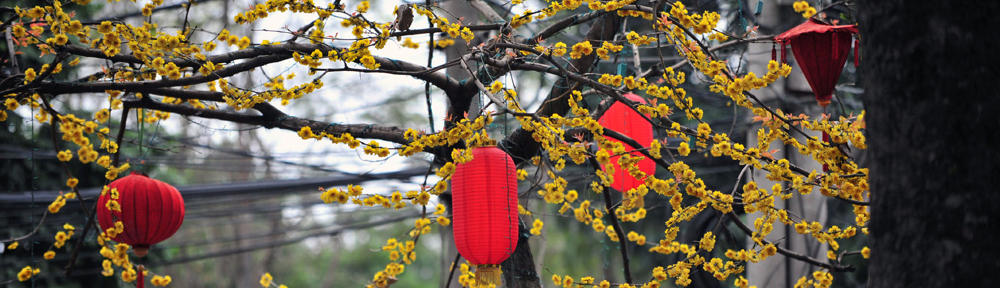
Color is bursting out all over in the Merry Month of May.

Maureen Haseley-Jones is “The English Lady.”
“The darling buds of May” is such an apt phrase for one of the most enchanting months, bloom on spring bulbs and flowering trees, the Amelanchier, the Dogwood and the Cherry to name a few and the new awakening foliage on trees winking in the sun.
By now, you have probably removed most of the winter debris, pruned broken branches and re-edged borders. However, do not apply the composted manure before the soil warms up to 60 degrees.
The soil needs to reach that temperature for the soil organisms to work with the bacteria of the manure which produces nutrients for the roots of the plants. I suggest, when shopping for garden supplies, pick up a soil thermometer to check soil temperature as I am sure the soil temperature will reach 60 degrees in a few weeks.
As I walk around my garden, I am noticing our old nemesis — weeds — emerging everywhere.
Pull these up by hand, without breaking them together with the roots. Using a tool breaks the weeds, and as a result, the broken weed pieces will take root and you will face hundreds more of these creatures to get rid of.
Follow on the weeding with an organic corn, gluten-based weed pre-emergent by Bradfield Organics; this product will keep weeds at bay for quite a few weeks.
When the soil warms to 60 degrees, apply composted manure around daffodils and other spring bulbs so that soil organisms will produce nutrients to feed the bulbs for next year’s bloom. Also, a reminder to not cut down the Daffodil foliage as the nutrition from the foliage is absorbed into the bulb for bloom next spring.
 Also in a few weeks, when the soil has warmed up, apply composted manure and a light layer of fine bark mulch to all maintained areas of the garden, again in July, and before putting the garden to bed in October. The manure and mulch will begin to build the humus component.
Regarding types of mulch … only use the natural brown wood mulch of natural, do not use the colored mulches, which contain chemicals, and do not use rubber mulch.
A word of caution on Cocoa Mulch. This product is highly toxic to dogs and cats. It is manufactured by Hershey and sold in many large garden centers. It is made from the residue of chocolate products and other ingredients and contains a lethal ingredient that has resulted in the reported deaths of cats and dogs that are attracted by the chocolate odor. This mulch contains Theobromine, which is a Xanthine compound, with similar effects to those of caffeine and theophylline. The symptoms, which animals experience, are seizures and death within hours.
I wrote about the carbon component in my April tips, but wanted to emphasize its importance by stating it again to build the humus component in your soil .
All living things, including us, are all carbon-based creatures. Humus brings carbon from the air into the soil.
Humus acts like a sponge and holds 90 percent of its weight in water. Because of its negative charge, plant nutrients stick to humus bringing nitrogen, calcium, phosphorus and other important elements to the plant, preventing these nutrients from washing away, acting like nature’s slow- release fertilizer.
Humus improves soil structure making it loose and friable, which helps plants to root in this environment with better access to nutrients, water and oxygen. Humus also helps to filter toxic chemicals from soil, much like carbon-based water filtration systems filter toxins from your water.
I also recommend that you go online to Scientific American.com/article/Weed-Whacking Herbicide to check out the dangers of Round-Up. This is the most dangerous herbicide not only because of Glyphosate, which is on the list by the WHO as a chelating agent that causes cancer, but also because of its inert ingredients. I ask that you are not swayed by the word ‘inert’ as the ingredients are anything but inert and those ingredients combined with Glyphosate are deadly to human cells.
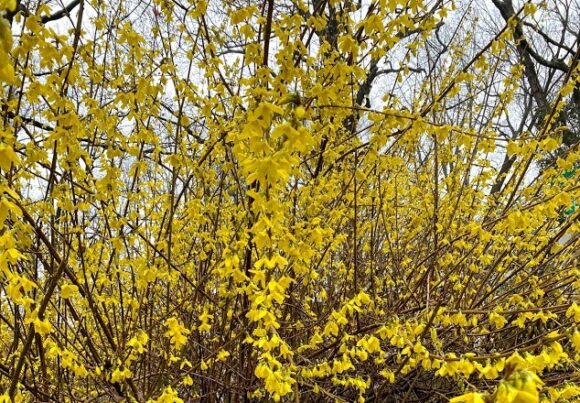
A yellow burst of color is offered by Forsythia in May.
Forsythia is in bloom, lovely fresh yellow blossoms. If the bloom on your shrub is not as prolific as in previous years, prune out the old sparse wood after bloom ends.
A favorite native tree of mine is the Amelanchier with its creamy panicle blooms, followed by small green leaves and within weeks, red fruit, which is a delicious treat for our feathered friends. Before the birds eat all the fruit, you may want to pick some of the fruit which makes a delicious jelly for your morning toast.

“The graceful Dogwood.” Photo by Tabitha Turner on Unsplash.
Here in my town of Old Lyme, the Magnolias, Cherries and Eastern Redbud are vying with one another to show their finery together with the graceful Dogwoods. Following the recent rains many of these trees are blooming at the same time or within a few weeks of one another. Their bloom will soon be over then we can look forward to rhododendrons, azaleas and followed by mountain laurel in early June.
Another favorite of mine is the Carlesii viburnum (also known as Korean Spice) is showing pink buds, opening to white flowers and their delightful fragrance fills the air outside my kitchen door. This viburnum grows to about five feet and can be tucked into many a border particularly in an area where you walk by and can enjoy the fragrance.
Covering the barn wall and scrambling up to the barn roof is my climbing hydrangea – bright green leaves emerging with hundreds of buds indicating that this beautiful climber will be laden with blossoms in summer.
Tulips, creeping phlox, forget-me-nots, primroses and candytuft are bringing much needed color to borders and rock gardens.
If you have not had the opportunity yet, for another couple of weeks you can still prune your roses. Pull back the old mulch from around the base of the roses and in two to three weeks apply manure about six inches from the trunk of the plant. Then a week later reapply a layer of the brown natural mulch on top of the composted manure.
As well as building the humus component, these layers keep the roots cool, keep weeds at bay and help retain moisture. Do not mulch right up against the base of any plants as this encourages rodents to nest and gnaw on the plants.
Beware of fungi that look like weird mushrooms in your mulch; this is a sign of Artillery fungus, which can adhere to the walls of your home and cause problems. If you notice this fungus, you will need to remove all the mulch and get it off your property.
Apply lime and manure around the lilacs, they like sweeter alkaline soil, thus the lime. By now, you may have already applied lime to the grass, which also enjoys sweeter soil and organic grub control to kill the Japanese beetle larvae – less food for moles.
If you are making an organic vegetable garden this year; a garden measuring 16 x 24 ft. can feed a family of four for a year; but keep the size within your needs and capability. Don’t work the soil if it is too wet or too dry.
Double-digging is the best way to go; it takes time and effort but its well worth it – dig down about one foot and remove the topsoil, put the soil to one side, then dig down and loosen the next six inches of soil and add about three inches of composted manure then put back the topsoil and add another three to four inches of manure.
Do not rototill the vegetable garden, as this will destroy soil structure. Gently loosened, aerated fertile soil will give an excellent yield of fruits and vegetables in the garden.
I prefer 6 x 4 ft. beds rather than rows; beds produce a larger yield of crops. In addition, beds make for ease of weeding and harvesting by having narrow compacted soil or grass paths (having removed lawn from the area) in-between the beds.
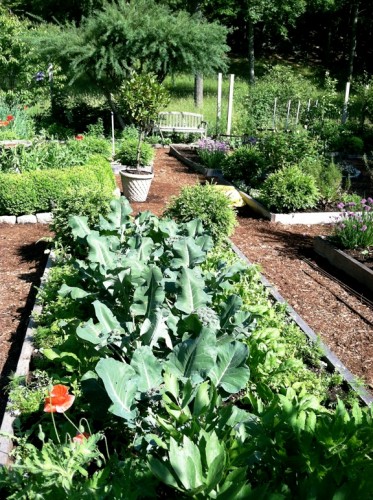
Vegetable gardens are hard work but bring great joy … and produce!
The vegetable garden should be situated on the south or southwest side of the property for maximum sun exposure.
Make sure you remove as many weeds as possible by hand, before you even begin digging.
You need a water source close by as vegetables require lots of water, particularly annual fruiting vegetables like tomatoes, which are hydroponics which means they are (mostly water).
Rotate crops, by that I mean, do not plant the same vegetables in the same place as the previous year. With this method you are preventing any soil born diseases from occurring.
In the loosened soil, plant the vegetables plants so that they are touching, this forms a natural canopy, shading out weeds and helps retain moisture.
I prefer to mulch the vegetable garden with composted manure, the reason being that manure, as mulch, does not cap. Capping is when mulch forms a crust, which does not allow water or air to penetrate to the roots of the plants.
Fence in the vegetable garden with a tall fence to keep animals out. At the base of the fence, install eight inches of fine mesh chicken wire above ground and eight inches below ground to keep out the digging and burrowing animals.
Organic insect control
Insects do not like fragrance so plant fragrant plants like marigolds, nasturtium, lavender, nepeta and honeysuckle and roses to name a few.
Encourage lacewings, which feed on aphids, by planting marigolds and sunflowers,
Attract ground beetles by laying a log or a rock on the earth, under which the beetles can hide. These useful insects are nocturnal and eat slug and snail eggs, cabbage maggots, cutworms and even climb trees to feed on army-worms and tent caterpillars.

“A vibrant shade of green. Photo by Chris Zhang on Unsplash.
Grass is now a vibrant shade of green so when mowing keep the blades of grass at about three inches; the taller blades attracts sunlight, promoting a healthier lawn. The taller blades also shade out weeds and help to retain moisture in the grass.
When mowing, leave grass clippings on the lawn, the clippings are a natural source of nitrogen. If you have clover in the grass, clover is an added benefit as clover takes nitrogen from the air and fixes it in the soil, as additional nutrients for plant growth.
After flowering is over, prune flowering shrubs by 25 percent – do this task immediately before new buds set for next year.
On a rainy day, go shopping for any garden supplies that may be needed, then when the weather is dry, you can be outdoors doing what you love and not indoors shopping. Buy good hoses, cheap ones will bend and crack.
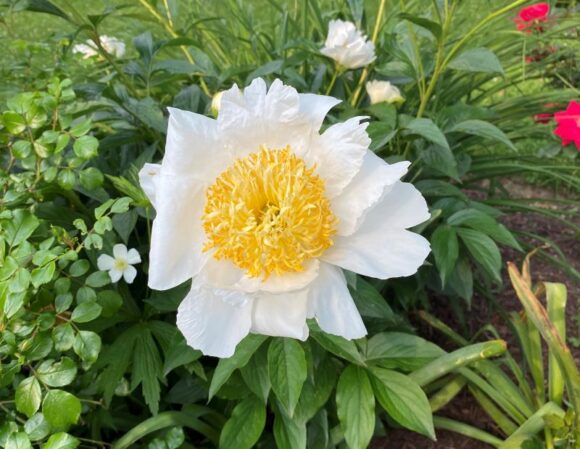
Peonies need plenty of water to produce flower buds. I had a 30-foot-long stand of Peonies in my field. The Peonies have been in the ground for over 40 years and are a sight to behold when in bloom. I gave them lots of loving care with a light dressing of aged manure in early May. In a few weeks, I pinch off the side buds while they are still small, leaving the terminal flower bud on each stalk, which will develop into a large main bloom.
Hydrangeas are a wetland plant and require plenty of water during the season, also applying manure and mulch around the base. If you have blue Hydrangeas and want a deeper color of blue, add some peat around the base of the plant, the acidity in the peat produces the bright blue color.
If you need to prune a Hydrangea, which has become too large, then prune it immediately after flowering, in early September, prune by about 1/3 of the old wood and the weakest shoots. Do not wait, as Hydrangeas begin to develop bloom buds for next year later in September. If you wait to prune it is likely that you will not have bloom for next year.

The beloved Lily of the Valley is such a sweet-scented flower,
My maternal grandmother’s favorite plant, the Lily of the Valley soon will bloom, these lovely flowers are tucked on the small hill on the west side of my apartment, and I am so looking forward to gathering a few fragrant blooms for indoors.
When the lilacs have finished blooming, pinch off the withered flower clusters, and do the same on the mountain laurel and rhododendrons in late June to ensure good blossoms next year.
In mid May, apply composted manure, a light application of peat and fine bark mulch around all evergreens and rhododendrons, mountain laurel and azaleas; these plants are shallow- rooted and the mulch will keep the roots nourished, protected, warm and moist.
Some annual seeds that may be planted outside in mid May are: Calendula, Coreopsis, Marigold, Nasturtium, Nicotiana and Zinnia.
If you purchased annuals on Mother’s Day weekend, place them in a sheltered spot on the south side of your home. Plant them no earlier than Memorial weekend as we can still get a late frost.
Tuberous-rooted begonias, caladiums, cannas and elephant ears can be moved from porch or cold frame to a part shade area as the weather becomes warmer and there is no sign of frost in the forecast.
If you staked trees, when they were planted last year, cut the stakes off at ground level do not pull them out of the roots as you could tear and therefore damage the root system.
Aphid tip: squish a few in your hand; dead aphids release a chemical that causes other aphids to drop off the plants.
Another ants and aphids tip – if you drink mint tea, any leftover tea sprinkle on the bugs, as they do not like the smell of mint.
A word of caution on mint – plant mint only in containers, mint is tremendously invasive and can take over your garden.
When planting annuals, perennials, vegetables, trees, shrubs or evergreen keep them watered.
Houseplants can be moved outdoors for their summer sojourn at the end of May. However, do not put your African Violets outdoors as they will burn, move them to a porch that is covered and shaded, or keep them indoors in a window that does not receive direct rays from the sun.
Wait until the soil warms up at the end of May to set out Dahlia tubers.

Roses are not troublesome creatures after all! Photo by Bailey Chenevey on Unsplash.
Roses are not the troublesome creatures you have been led to believe. I like to plant David Austin roses; these shrub roses are repeat bloomers with lovely fragrances. Roses need at least four hours of sun per day, good air circulation, and excellent drainage.
During their growing period from the beginning of June to mid August; add a little extra composted manure each month; it may be applied over the mulch. Stop adding the manure in August so that the roses can go into a slow dormancy.
Roses like the same growing conditions as Clematis and can be planted together in a companionship planting, growing well together, with feet in the shade and head in the sun. Before you top up the soil around the roses when planting, add water and check if the soil drains, roses need good drainage. Deep watering is recommended at least once a week.
Plenty of stuff to keep you hopping, folks, and remember to keep your eye out for any pest trouble and when you spot it get on the ball immediately to avoid further problems. Carefully discard all herbicides and pesticides; these poisons have the same effect on your health as second-hand smoke.
Your garden offers an anchor for peace and quiet enjoyment. Enjoy the warmth, the gentle breeze, the earth’s fragrance and bloom and please remember to breathe and stretch before any garden labor.
Enjoy and I will see you in your garden next month. If you would like, my son Ian of LlandscapesbyIan will be happy to talk to you and answer gardening questions or you may have him visit your home for a consult. The apple does not fall far from the tree and in my humble opinion Ian is more talented and creative than me.
About the author: Maureen Haseley-Jones is a member of a family of renowned horticultural artisans, whose landscaping heritage dates back to the 17th century. She is one of the founders, together with her son Ian, of, The English Lady Landscape and Home Company. Maureen and Ian are landscape designers and garden experts, who believe that everyone deserves to live in an eco-conscious environment and enjoy the pleasure that it brings. Maureen learned her design skills from both her mother and grandmother, and honed her horticultural and construction skills while working in the family nursery and landscape business in the U.K. Her formal horticultural training was undertaken at the Royal Botanic Gardens at Kew in Surrey.
 AREAWIDE — Ledge Light Health District has scheduled the following COVID-19 vaccine clinic, which Lyme and Old Lyme residents can attend:


 OLD LYME/NEW LONDON — This Sunday, May 22, Public Art for Racial Justice Education (PARJE) will unveil their Sister Mural at Fulton Park in New London.
 LYME — On Saturday, May 21, Lyme Public Library hosts acclaimed photographer Skip Hine from 2 to 3 p.m. to discuss his new book Memories in Hine Sight: My Life with a Camera.