
Lift your spirits in these winter months by starting to plan how you would like your garden to look in the summer or fall. Photo by Jan Canty on Unsplash.

Maureen Haseley-Jones is “The English Lady.”
Hello everyone, with all the pain and suffering we are all experiencing right now with the pandemic still upon us, I wanted to lift your spirits and cause you to begin planning for this season in your garden.
Mother Nature’s gifts of renewal, growth and nourishment tell us that in this wonderful pastime called ‘gardening,’ we can escape from the trials and tribulations of our world. Each day we move gradually from the dark into light, to a longer brighter day, and finally, we welcome spring.

Paper-white narcissi have a beautiful fragrance. Photo by Jonathan Diemel on Unsplash.
A few weeks ago, I retrieved my second batch of Narcissus from the brown paper bag in the refrigerator and planted them on pebbles, with just enough pebbles to anchor the bulbs in place or you may use potting soil. I use tall glass vases and it is most important keep the pebbles moist with enough water to cover the bottom of each bulb.
I brought my Rosemary plant indoors in September, Rosemary is not hardy outdoors in zone six. I spray the plant twice weekly with warm water and run a cold-water humidifier and two germ guardian air cleaners with UV lights for personal health and the health of my plants.
After planting the paper-white Narcissus, I placed them in a dark, cool closet until the foliage is about four inches tall. Today, I moved them from the dark closet to a cool room with indirect light and where the temperature remains at about 65 degrees. When the buds are almost ready to open, I will place them in a brighter area to be enjoyed, not only for their bloom but also the heady fragrance, which permeates the house.
The new bloom gets me out of the winter doldrums and their gentle fragrance lifts my spirits. I know that the severe changes occurring with global warming combined with pollution in the air, water and the earth, are severely damaging our planet.
Your own personal contribution to saving our planet is to tend the soil organically with compost, manure and natural brown mulch, which builds the humus component in your soil. Your plants and vegetables will thrive, as will you. Throughout the year allow your garden to anchor you, connecting heart, body, mind and spirit to Mother Nature’s life-giving bountiful gifts and spiritual energy.
The bitter cold harsh winds of January and February extract moisture from trees and shrubs, especially the evergreens. Winter winds are more harmful to plants than cold temperatures, not only causing plant breakage but also soil erosion.

Cover any roots that become exposed during the winter with topsoil. Photo by Markus Spiske on Unsplash
For that reason, it’s helpful to have a few bags of topsoil and mulch in the garage. With these items on hand, any roots can be covered when they become exposed by wind or frost heave. Roots exposed to the elements for any length of time can kill the plant, so when you notice exposed roots, quickly cover those areas with soil and mulch.
When spring arrives, and the earth warms up, the plant can be resettled in place together with composted manure and the natural brown mulch to provide protection and nutrition.
On a sunny day this month, take a walk round the garden and breathe in the freshening air and as you walk, make some notes and decide what worked for you last year and what you will never try again.
Later, when you are back indoors, relaxing in your armchair, browse through the catalogues that began arriving a few months ago. You have already begun making lists of plants that you are thinking of buying.
 A word of caution, however, when gazing at the photos, which are meant to tempt you with their lovely but “doctored up” pictures of plants. Don’t be fooled!
Instead, decide that this season in the garden will be for sensible and organized change. Do not allow your imagination to run amok and be caught up in the fantasy of the brightly-colored, high-maintenance garden pictures shown in the catalogues.
Suit your garden to your lifestyle that will work within your time frame and physical abilities. If you follow that construct, you will have the time to sit, relax and smell the roses, without being overwhelmed or disappointed.
As you sit and plan for the coming season, it’s important to keep your budget in mind. It’s hard to believe as you look outside at the muted landscape, that in a few months, sunshine and gentle breezes will warm the soil.
When the soil is dry enough to tread on, winter debris may carefully be cleared away. Then with a clean palette, make a clean edge on the borders; this simple task makes such a difference to the look of a garden. Then in mid -April, add that lovely layer of manure and compost (the ratio being three parts manure to one part compost).
With that prep done, you are ready for the fun stuff, the placing and planting!
For those of you who are vegetable gardeners and look forward to a bountiful year with fruits and vegetables; spring rain, extra irrigation and sunshine will produce a delicious bounty. As spring moves along, so will the appearance of both good and bad insects, moles, voles and other critters, that can be dealt with naturally. My remedies for these problem, I will give in an upcoming gardening letter.
Your memory of your garden from last season may be lost in the enthusiasm of a new season, therefore, I am asking you to be kind to yourself. If last year you became overwhelmed with too much gardening, and not enough time to relax and smell the roses, the following are some suggestions you might follow to avoid that problem:
For example, send some of your borders back to grass.
If you are tired of mowing all your grass areas, spread wildflower seeds in the grass and enjoy the pleasure of a prairie meadow.
Make some of the high-maintenance, perennial borders, into mixed shrub borders. To accomplish this, take out some of those high-maintenance perennials and donate them to a worthy cause.
In their place, plant small and medium size evergreen shrubs; some green, some blue and some of the lovely evergreen gold species. With these shrubs and their year-round beauty, add small flowering deciduous trees and shrubs that begin flowering in April and successively through June. The Carlesii viburnum, also known as Korean Spice, is a favorite small shrub of mine, with its white buds that open to a pale pink with the most delightful fragrance.
Add a Ben Franklin tree with its white, cup-like blooms and gold center that flowers in August through September.
Nestle three Blue Mist shrubs in the mixed border; this plant will delight with purple blooms and fragrant leaves into September.
On a fence or trellis, plant white autumn clematis.
Add a groundcover as an evergreen framework – my favorite is Myrtle with its glossy leaves and miniature blue flowers that bloom in April.
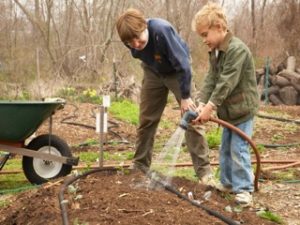
It is never too soon to introduce youngsters to the wonders of the garden.
I feel it is never too soon to introduce your children and grandchildren to the wonders of the garden and begin by introducing them to the garden fairies. Through the years, I have asked children to draw a picture of the garden fairy and make a list of questions to ask the fairies, who live in the wild patch in the garden.
We all have a wild patch in the garden; and at this point you are probably saying, “Maureen, my garden is one large ‘wild patch.’ Children became so excited and enthused about their lists and pictures of the fairies, as what you are showing them is the transformation of science into magic. These days we seem to have forgotten about fairy tales, dreams and magic; it’s way past time to bring those wonderful energies back into our lives and into the lives of our children.
In spring and on into summer I would find my children or their friends impatiently checking the garden wanting to see their planting efforts come into bloom. In the vegetable garden, they gathered to check what was ready to eat from the produce they had planted. I have found that this introduction to the garden has inspired these children when they become adults to plant and tend gardens of their own enthusiastically.
My son Ian is a great example of this as he has partnered with me through the years in the garden – and, in him, the old adage that ‘the student is better than the teacher’ has certainly proved to be correct. Ian is a designer par excellence and I invite you to check his website LandscapesByIan.com and his Facebook page for lovely examples of his work.
In my March gardening tips, I’ll offer you some suggestions of ornamental trees, shrubs and long blooming perennials. With that list in hand, it is a good idea to obtain your plants from local garden centers that carry tried and true plants that will flourish in Zone 6.
On the other hand, if you feel that over the years, you have been throwing good money after bad in your garden. You are feeling desperate as you feel that your garden no matter what you do, never looks right. If that is the case then get in touch with a landscape company (for example, LandscapesByIan.com), who will keep your budget in mind whether you want to do your own work, or wish for a design to install yourself.

Let your imagination run wild as you start to plan your garden … and then bring it back to reality as you start to consider what is really manageable.
On the other hand, when you are planning your garden for this coming season, there are important facts to keep in mind:
What are the plants requirements for sun, shade, soil, and water?
Will they survive in this zone, Zone 6?
What are the growth patterns of the plants? Do they grow fast or slow?
You do not want a 50 ft. tree up against the house with tremendous roots that will play havoc with your house foundation. Or do you want that lovely but very large, Catawbiense Rhododendron, all 10 ft. of it, climbing through your dining room window in five years?
To find those facts, either check the plants in a book, on the Internet or read the labels attached to the plants in the nursery.
Check every aspect of the plant before you buy. The red or green Lace Leaf Japanese Maple looks lovely in spring but is it something you can enjoy, without its leaves in the winter? Personally, I not only enjoy the foliage of plants and trees but also the shape and bark of trees without foliage in winter.
For those of you just beginning to garden, I must be honest and dispense with the myth that gardening is always a relaxing hobby. At the end of that first day of digging, lugging soil, manure and fertilizer, and planting everything at the proper depth; you will feel exhausted.
Then you remember that you still need to water the newly-installed plants as you drag your tired body to switch on the hose. Thank goodness, the mulching can wait until tomorrow or next weekend, right? Right!

Watering can be meditative … by any method. Photo by Anthony Lee on Unsplash.
Watering, by the way, can be meditative. Imagine that the hose is your umbilical cord so that, as you nourish the earth and the plants, the earth can nourish you.
By now the sun has gone down, and you trudge indoors muttering to yourself, “What the heck did I get myself into”? To this comment I say, “You did not have to tackle all of the garden in one day”.
In gardening, there is always tomorrow, or next week, and even though the label says to plant it by the end of May or June, believe me folks, a few weeks later does not matter, the garden will wait for you.
You may be saying to yourself at this point, “Maureen, are you trying to put us off gardening?” No folks, but I would remiss, as someone who has gardening in my blood (as well as manure!) for over 400 years to tell you, however reluctantly, not only the pleasures, but some of what can cause aches and pains.
The idea is not to bite off more than you can chew. For first-time gardeners, don’t scatter your energies all over the garden, but rather tackle and complete one area at a time. That area should be priority one until it is complete.
If you have a new home with no landscaping, some hardscape may be required. Hardscape is walls, walkways, patios, ponds, decks and so on. The sound and look of a water feature in the garden is delightful. A water feature need not be elaborate, a fountain is fine – the reflection of water is Mother Nature’s mirror.
If you are not able to do this construction yourself, get in touch with a landscape contractor now, so that a plan can be created right away, then installed and ready by spring. I say to connect now as many landscape products are short on supply this year.
All of these endeavors mean you getting yourself in shape physically, so get off that couch, put away the catalogues and your plant lists, stretch, then wrap yourself up in warm gear and take that walk.
As you walk, look at the trees in winter, the elegant shape of them, the lichen on the stonewalls, and the moss tucked in cracks and crevices. Clear your mind and allow nature’s spirit to surround you. As you walk, look at a garden or two in your neighborhood; gardens which you have admired when they were in bloom and see what they look like in winter.
I remember one of my professors when I studied at the Royal Botanic Gardens at Kew saying, “In winter, you can tell a really good landscape by its bones, without the flesh of flora and foliage.”
In spring, get in touch with those neighbors whose gardens you admired and ask them some of the secrets of their garden. They will be happy to talk with you not only of their successes but their failures – true gardeners are realists when they speak about their gardens and love to share.
Well folks, I’ve given you plenty to think about right now so enjoy your daydreaming of the season to come and I’ll see you next month in your garden.
About the author: Maureen Haseley-Jones is a member of a family of renowned horticultural artisans, whose landscaping heritage dates back to the 17th century. She is one of the founders, together with her son Ian, of, The English Lady Landscape and Home Company. Maureen and Ian are landscape designers and garden experts, who believe that everyone deserves to live in an eco-conscious environment and enjoy the pleasure that it brings. Maureen learned her design skills from both her mother and grandmother, and honed her horticultural and construction skills while working in the family nursery and landscape business in the U.K. Her formal horticultural training was undertaken at the Royal Botanic Gardens at Kew in Surrey.




 5 tablespoons extra-virgin olive oil (divided)