
‘Witness Stones Old Lyme’ Holds Installation Ceremony, Features Music, Poetry

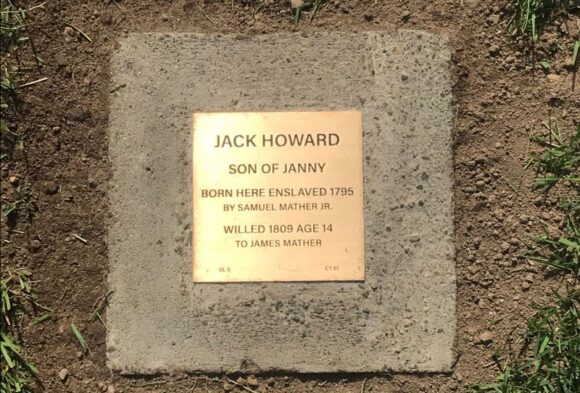
This plaque commemorating the life of enslaved person, Jack Howard, is located at 5 Lyme Street, which is the parsonage of the First Congregational Church of Old Lyme.

Celebration to Highlight Installation of Plaques Marking Sites of Enslavement in Old Lyme

OLD LYME – The Old Lyme Witness Stones Partnership will hold an installation ceremony Friday, June 4, from 10 to 11:15 a.m. celebrating the town’s newly installed Witness Stones—historical plaques commemorating the lives of 14 individuals, who were once enslaved on Lyme Street.

The project expands the understanding of local history and honors the humanity and contributions of those formerly held in bondage.

Members of the Old Lyme community will gather tomorrow on the lawn of the Old Lyme Phoebe Griffin Noyes Library to honor these people, who collectively represent just some of the individuals once enslaved along today’s Lyme Street:

  • Cato
  • Lewis Lewia
  • Humphrey
  • Caeser
  • Jack Howard
  • Jenny Freeman
  • Luce
  • Crusa
  • Nancy Freeman
  • Temperance Still
  • Jane
  • Pompey Freeman
  • Samuel Freeman
  • Arabella.

The program will include music, poetry, and words from community partners. World-renowned soprano Lisa Williamson will sing the spiritual, Deep River and the hymn, Amazing Grace.

Twelve members of the Old Lyme Middle School chorus, led by Laura Ventres, will also contribute to the program.

Distinguished Connecticut poets Antoinette Brim-Bell, Marilyn Nelson, and Rhonda Ward will read new works that capture the unheard voices of those enslaved in Lyme.
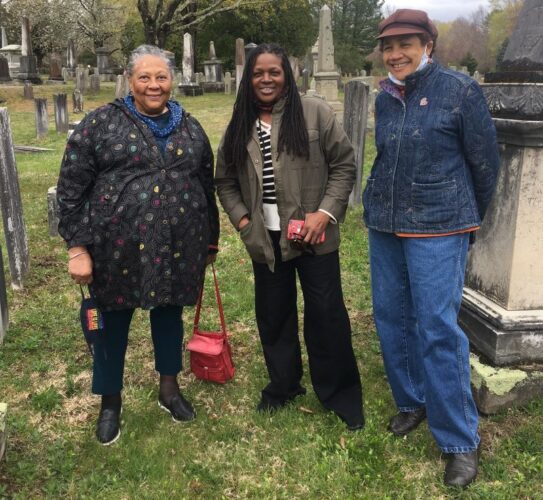
From left to right, poets Marilyn Nelson, Rhonda Ward, and Kate Rushin examine gravestones in the Duck River Cemetery in Old Lyme, where Jenny Freeman, Nancy Freeman, Pompey Freeman, and six others who lived enslaved in Lyme are buried.

These poems, by Antoinette Brim-Bell, Marilyn Nelson, Kate Rushin, and Rhonda Ward and created with support from a Health Improvement Collaborative of Southeastern Connecticut (HIC) Partnership Grant for Racial Equity, bring vividly to life experiences, attitudes, and emotions long ignored and then forgotten.

Seventh-grade students from the Lyme-Old Lyme Middle School will read biographical poems they wrote to tell the life stories of Jenny Freeman and Lewis Lewia. Using primary documents, the students researched these two enslaved town residents, making the story of local slavery tangible, personal, and relevant to their own lives.

Lyme-Old Lyme (LOL) Schools Director of Curriculum Michelle Dean commented, “The collective level of engagement and discovery of the students on this project is something you don’t get to see that often.  They have done a wonderful job.”

Meanwhile, LOL Schools Social Studies teacher Health Saia, noted, “It has been thrilling seeing the a-ha moments the students are having as they go through the primary documents and meet Jenny Freeman and Lewis Lewia.”

Olivia Hersant, a LOL Schools Language Arts teacher,  added, “It’s been exciting. The students are learning and thinking deeply about topics that we didn’t learn about until we were adults.”

Each Witness Stone on Lyme Street includes the name of an enslaved individual, along with important details about their lives and circumstances derived from land records, emancipation certificates, and other available historical documents.
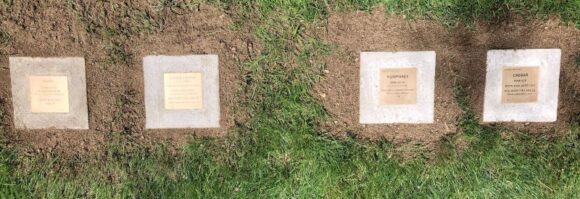
These four Witness Stones are on the lawn of the First Congregational Church of Old Lyme.

The small brass plaques, embedded flush with the ground, have been placed primarily on the west side of the street for pedestrian safety.
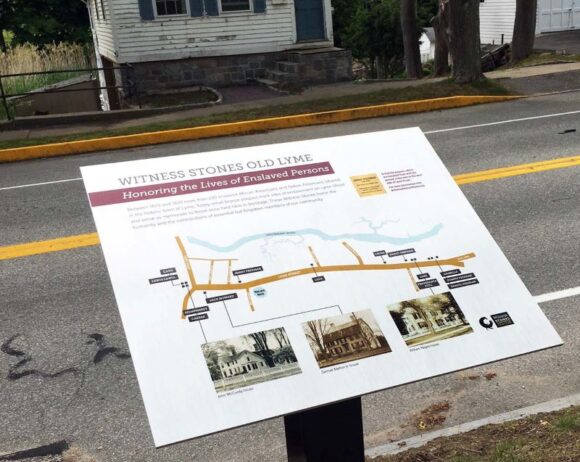
 

An interpretive sign, pictured above, has also been installed on the lawn of the Old Lyme Phoebe Griffin Noyes Library providing a map of the Lyme Street enslavement sites.

The Old Lyme Witness Stones Partnership’s goal is to expand the understanding of local history and honor the humanity and the contributions of those formerly enslaved in the community.

The partnership’s founding members include the Phoebe Griffin Noyes Library, the Florence Griswold Museum, the Lyme-Old Lyme Schools, and the First Congregational Church of Old Lyme.

Community partners include the Roger Tory Peterson Estuary Center, St. Ann’s Episcopal Church, Lymes’ Youth Service Bureau, and the Old Lyme Historical Society.

Editor’s Note: For further information on the Witness Stones project, visit their just-launched website at this link.

Still Time to Register for Lyme Church’s Mental Health First Aid Class, Starts at 5pm Today

LYME — The First Congregational Church of Lyme is offering a Mental Health First Aid class in two sessions on Friday, June 4, from 5 to 9 p.m. and Saturday, June 5, from 9 a.m. to 1 p.m.

You must attend the full eight hours to receive the certificate.

The church is hosting this class for the whole Lyme community. Pastor Susan Olsen stresses, “It’s not a religious class–please invite anyone who might be interested.”

This is an eight-hour class designed to help laypersons recognize the early signs of mental health crises, and take some steps to offer support until more advanced help arrives.  It is an engaging, interactive course that teaches important skills for members of communities and families.

Bring snacks or meals as you wish to either/both classes.

RSVP to pastorsusanolson@gmail.com.

Cost is $10. If that presents a hardship, simply ask and scholarship funds can be found.

Join a Community Work Day in Riverside Preserve to Celebrate CT Trails Day Tomorrow

Photo by Sue Cope.

LYME — The Lyme Pollinator Pathway, an initiative of the Town of Lyme, and the Lyme Land Trust invite readers to celebrate CT Trails Day by participating in a Community Work Day at Riverside Preserve tomorrow, Saturday, June 5, from 9:30 to 11:30 a.m. The Preserve is located on Salem Rd. in Lyme.

The objective of the Community Work Day is to improve the site of a Pollinator Meadow and nature trail at the Lyme Land Trust’s Riverside Preserve, a haven for butterflies and other pollinators along the bank of the Eightmile River.

Learn to recognize the native and invasive plants in the meadow. Native wildflowers that benefit pollinators will be identified and nurtured. Find out which plants are invasive and help us remove them. Leave with the knowledge and resources to create a pollinator patch of your own.

Bring tools: a pair of work gloves, clippers/loppers, a shovel, and a water bottle.

Email Sue.Cope@lymelandtrust.org to ask any questions and/or confirm your attendance


A la Carte: A Special Soup for Summer … Asparagus, of Course!

Lee White

I had promised to send you my friend Stacie’s flan recipe, but time, as often, got away from me last week. 

Perhaps I was dreaming about a  book I just finished reading, “We Begin at the End,” a sort-of growing up and murder mystery recommended by my good buddy, Rick Koster of The Day. Or maybe I was thinking about a new novel I am reading now, “The Plot,” written by an author whose books I have loved.

This one is a novel inside a novel written by an author who is writing a novel. I even went out for a late lunch/early dinner with friend Ginger Smyle.  After our meal, we got bought  ice cream in Mystic, and sat on a bench beside the Mystic River, pretending we were tourists.

But most of all, I am dreaming about vegetables, for my CSA begins in a couple of weeks.

There weren’t be many veggies ready for my weekly trip to Stone Acres in Stonington, so I drove to Trader Joe’s and bought a few packages of their frozen vegetables (almost as good as the ones we will get at the farm markets by mid-July).

And in the supermarket I bought what is still available or somewhat is local: asparagus.

I will cook as much asparagus as I can, because it will not be fairly local until next spring. And remember, those skinny stalks are not as delicious as the fat ones. Break the bottom at the point where it wants to, then use a potato peeler up to about an inch of the “flower.”

Cream of Asparagus Soup

Adapted from The Way to Cook by Julia Child (Alfred Knopf, New York, 1994)

Yield: about 2 quarts

1 cup sliced onions
3 tablespoons unsalted butter
2 pounds fresh asparagus, washed, bottom broken and peeled about an inch from top “flower”
2 quarts lightly salted boiling water
2 tablespoons flour
salt
freshly ground white pepper (black if you don’t have white)
½ cup heavy cream, crème fraiche or sour cream, optional*

Cook onions and butter until tender and translucent. In the meantime, cut the tender green from the asparagus tips; drop the tips into boiling water and boil 2 minutes, or barely tender. Dip out with a skimmer, reserving water, and refresh tips in bowl of iced water to set the color; drain and reserve.

Chop the remaining stalks into one-inch lengths and add to the onions with a sprinkling of salt. Cover and cook slowly 5 minutes.

Stir in flour and cook, stirring, 3 minutes more. Remove from heat, and, when bubbling stops, blend in the hot asparagus cooking water (I skim the water into the mixture.) Simmer, uncovered, 25 or 30 minutes, or until tender enough to puree.

When the mixture is a bit cooler (maybe 15 minutes), pour into blender (or use a soup blender). If you like the soup clearer, you can use a sieve or Foley Food Mill. The soup will be a lovely pale green color—to keep it that way, reheat it only just before serving. Carefully correct seasonings.

You can serve this soup hot or cold.

If you are using cream, crème fraiche or sour cream and serving it hot, gently reheat the soup and add the cream just before serving. If you are serving the soup cold, refrigerate the soup and swirl in the cream before serving. To decorate each bowl of soup, garnish with the asparagus tips.

*The soup does not need cream but it is delicious. Another way to use the cream is to swirl a little cream into each bowl before adding the asparagus tips.

About the author: Lee White has been writing about restaurants and cooking since 1976 and has been extensively published in the Worcester (Mass.) Magazine, The Day, Norwich Bulletin, and Hartford Courant. She currently writes Nibbles and a cooking column called A La Carte for LymeLine.com and the Shore Publishing and the Times newspapers, both of which are owned by The Day. She was a resident of Old Lyme for many years, but now lives in Groton, Conn.

Old Lyme Library Hosts Virtual Presentation on ‘The Nut Museum’ Tonight; All Welcome

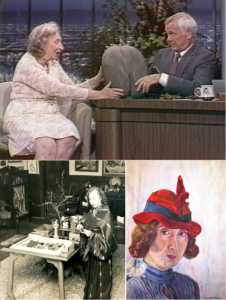
OLD LYME —  Tomorrow, Wednesday, June 2, the Old Lyme Phoebe Griffin Noyes Library presents The Nut Museum – The Visionary Art of Elizabeth Tashjian from 6:30 to 7:30 p.m. via Zoom.

Do you remember Old Lyme’s Nut Museum?  Elizabeth Tashjian (1912-2007) opened the Nut Museum in 1972 on the ground floor of her Victorian home in Old Lyme. The museum featured Miss Tashjian’s original artwork devoted to nuts, her collection of nuts, and, for her museum visitors, a capella performances of her songs about nuts.

Beginning in 1981, Miss Tashjian appeared regularly on late-night television talk shows, including twice on The Tonight Show starring Johnny Carson. In response to her new-found celebrity status, Miss Tashjian transformed herself from an academically-trained painter into an avant-garde visual and performance artist.

This talk explores the unique trajectory of Elizabeth Tashjian’s life and her eclectic artistic career.

Christopher B. Steiner, PhD, Professor of Art History & Anthropology at Connecticut College, will talk about the rescue mission and the archival process of preserving Miss Tashjian’s unique collection.

To register for this free program, visit this link.