
Op-Ed: Systemic Racism and Old Lyme — Past, Present and Future

COMENTS ARE NOW CLOSED ON THIS ARTICLE, BUT THE 20+ SUBMITTED CAN STILL BE READ.

This op-ed was written by the ministers of the First Congregational Church of Old Lyme:- Rev. Steven R. Jungkeit, Ph.D. (Senior Minister), Rev. Laura Fitzpatrick-Nager (Senior Associate Minister), and Rev. Carleen Gerber (Associate Minister.)

As the death of George Floyd, and now Daunte Wright, once again dominates the news cycle, so too local communities throughout the United States are called to continue the work of addressing the inequities and injustices caused by systemic racism.  Thankfully, in many places, that work didn’t begin with the death of Mr. Floyd – it has been happening all along.  Still, the horrific footage of that event, together with the killing of Daunte Wright, underscore both the urgency of the work, and the sheer scale of it.  The roots of systemic racism run deep, and they are pervasive.  Those roots run deep throughout the entire country, but they are especially pervasive in local communities.  Old Lyme, Connecticut, is not an exception.

To say that a community (or a country) is afflicted with systemic racism is not the same as attributing racist behaviors to individuals.  While it might be true that some individuals do exhibit racist behaviors, and while it is also true that most people possess unconscious biases in need of examination, systemic racism is far more subtle.  It has to do with who benefits most from our economic system, our educational institutions, and our business practices.  It has to do with the availability of health care, and the location and availability of housing.  It has to do with transportation and environmental resources.  Countering systemic racism involves discovering where blockages toward racial justice exist, and then doing the hard work of reshaping and reforming those structures in order to create communities that are inviting, fully responsive to the diverse needs of those who live there.

Old Lyme, along with the entirety of the Connecticut Shoreline, has a long history of systemic racism that has gone largely unnoticed and unaddressed.  Historical research discloses that the wealth of the town was built through trade with the West Indies, islands where slaves were worked to death on sugar plantations.  Barrel staves were made in Old Lyme, which were then shipped to Barbados from the Lieutenant River and the Connecticut River.  Molasses, converted from the cane sugar harvested by enslaved Africans, came back in those barrels, which was then converted into rum.  Communities all over Connecticut supplied the West Indies with agricultural products, which were then converted into molasses, and then rum, and then the purchase of human beings.  Old Lyme, together with other Connecticut towns like Old Saybrook, Wethersfield, New London, and many others, played its part in that global relay system.

But Old Lyme didn’t simply profit from a slave society that was far away.  It was a slave society.  We can document as many as 160 enslaved people – and likely more – that lived in this town alone.  Many, if not most, of the towns along the Connecticut Shoreline have similar numbers.  The first minister of the Congregational Church in Old Lyme owned at least one enslaved person, named Arabella.  A prominent member of the town in the early 18th century sold a three year old child, named Jane, away from her mother, writing in the deed of sale that she was sold in order to have and to hold, to be possessed and enjoyed.  The largest slave holding family in New England, the DeWolfs, built an integrated empire of slaving in Bristol, Rhode Island in the 18th century, but they got their start in Old Lyme – one of the early family patriarchs is buried in the Duck River Cemetery.  At least three enslaved people lived on the site where the Congregational Church now stands.  At least five enslaved people lived in the house that now serves as the parsonage.  Several more lived on the site of the town library.  More still lived at the site of what is now the Florence Griswold Museum.  That’s merely a handful of the human beings who were enslaved in Old Lyme.

But it’s not only enslavement that occurred in Old Lyme.  Redlining did too.  Property records exist from the mid-20th century that prohibit the sale of houses or land in Old Lyme to people of color.  Such records raise questions about precisely what is meant when contemporary residents deploy language about “preserving the town’s historic character.”  What does “character” mean, precisely?  Can that “character” be separated out from the history of systemic racism that took place in Old Lyme?  Given the evidence of systemic racism in Old Lyme, are there not aspects of the town’s “historic character” that we might wish to address, change, and overcome?

The Resolution on Racism as a Public Health Crisis currently before the town’s Board of Selectmen is a way of publicly acknowledging the ways structural racism adversely affects the bodily, emotional, and spiritual well-being of people of color, an acknowledgment that should not be controversial.  Passing it would acknowledge that structural racism exists throughout our country, including in places like Old Lyme.  It would send a clear message to the people of color and minorities who do live in the town that local leaders actually care about their well-being.  It would do the same for the people of color who work in town, but live elsewhere.  But more than that, passing the resolution would send a signal to those living in other communities that Old Lyme understands the conditions that far too many people face in Connecticut and in the wider United States.  Finally, it would help to acknowledge this town’s complicity in the very formation of structural racism, a complicity in which it is not alone.  Sadly, failing to affirm that Resolution declares the opposite: the desire to retain the town’s “historic character,” together with all that phrase implies.

Passing a resolution is a largely symbolic activity.  Still, we believe such passage would be a substantive step toward lasting change.  But clearly more work is needed if we are truly to address the inequities that have existed in Connecticut, and in Old Lyme.  That work would include a public education program to learn the history of enslavement in Old Lyme.  It would include building a curriculum that would teach that history to our children.  It would include an active campaign to invite people of color to live in our community, and to take part in our educational system.  And it would include a commitment to building affordable housing, which, it should be noted, would also benefit many within this community who already face precarious housing.

We believe it is time for Old Lyme to lead on issues surrounding structural racism.  The murder of George Floyd and the murder of Daunte Wright, together with the public reckoning that such violence has unleashed, has created an opening toward greater honesty, empathy, compassion, and justice.  Mr. Floyd’s death, and Mr. Wright’s, is nothing short of a tragedy.  Indeed, it is more than that – it is a national emergency.  With that tragedy and with that emergency, we have an opportunity to work toward a greater and more inclusive public good, one in which towns like Old Lyme become the hospitable and welcoming communities that we most deeply wish to be.

Editor’s Notes: We welcome comments on any article published on LymeLine.com but we would like to remind readers that our policy on comments states that you must provide your first and last name, and an email address that we can verify. Comments will not be published under a pseudonym. Personal attacks on anyone or any group or organization, especially on other commenters, are not permitted. Also, we will not publish comments that are abusive, defamatory, indecent, libelous, obscene, off-topic, pornographic, profane, threatening, unlawful, vulgar, or otherwise objectionable.
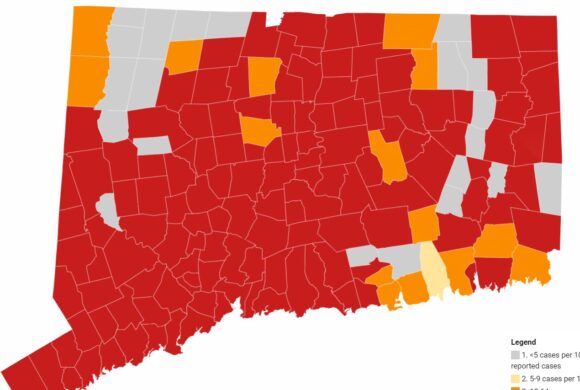

April 15 COVID-19 Update: Lyme (Gray), Old Lyme (Orange) Stay in Same Two-Week Case Rate Zones as Last Week; Two New Cases Take Lyme’s Cumulative Total to 102, OL Holds at 326

This map, updated April 15, shows the average daily rate of new cases of COVID-19 by town during the past two weeks. The Town of Old Lyme remains in the Orange (second highest) Zone, while Lyme stays in the (lowest) Gray Zone. (Only cases among persons living in community settings are included in this map; the map does not include cases among people who reside in nursing home, assisted living, or correctional facilities.)

LYME/OLD LYME — The report issued Thursday, April 15, by the Connecticut Department of Public Health (CT DPH) for the average daily rate of new cases of COVID-19 by town during the past two weeks shows a  marginal improvement for the whole state.

The number of towns in the state in the Red (highest) Zone for two-week new case rates has fallen from 142 last week to 132 this week. Both Lyme and Old Lyme remain in the Zones in which they were last week.

Old Lyme is now one of the 15 towns in the Orange (second highest) Zone remaining in that Zone for the second week in a row.

Lyme is in the Gray Zone for two-week case rates, recording a fifth straight week in the lowest zone. Thirteen towns were in this zone last week and that number has risen to 21 this week. (Four zones are specified by the CT DPH — see details below.)

Overall, the number of towns in each zone is shown below with the previous week’s number in parentheses:

  • 21 (13) towns are now in the (lowest case rate) Gray Zone
  • 1 (4) are in the (lowest but one) Yellow Zone
  • 15 (10) are in the (second highest case rate) Orange Zone.

All the remaining 132 towns are in the Red Zone — last week’s number was 142.

Lyme joins 20 other towns in the Gray (lowest rate) Zone: Ashford, Bozrah, Bridgwater, Canaan, Chester, Colebrook, Cornwall,  Franklin, Goshen, Hampton, Hartland, Lisbon, Morris,  New Canaan, Norfolk, Scotland, Union, Voluntown, and Warren. Twenty-one towns in the Gray Zone reflects a significant and encouraging increase in the number of towns in that category over last week’s number of 13.

The Yellow (second lowest rate) Zone now has only one town, namely our neighbor, East Lyme.

Old Lyme joins 14 other towns in the Orange (second highest rate) Zone : Essex, Farmington, Hebron, Ledyard, Old Saybrook, Salem, Salisbury, Sharon, Simsbury, Stafford, Stonington, Waterford, Willington and Winchester.

  • The Gray category is defined as when the Average Daily Rate of COVID-19 Cases Among Persons Living in Community Settings per 100,000 Population By Town is less than five or less than five reported cases.
  • The Yellow category is defined as when the Average Daily Rate of COVID-19 Cases Among Persons Living in Community Settings per 100,000 Population By Town is between five and nine reported cases.
  • The Orange category is defined as when the Average Daily Rate of COVID-19 Cases Among Persons Living in Community Settings per 100,000 Population By Town is between 10 and 14.
  • The Red category is defined as when the Average Daily Rate of COVID-19 Cases Among Persons Living in Community Settings per 100,000 Population By Town exceeds 15.

In all cases, this rate does not include cases or tests among residents of nursing home, assisted living, or correctional facilities.

This report is issued daily, but only updated weekly on Thursdays. The most recent report was updated Thursday, April 15; the next updated report will be issued in the afternoon of Thursday, April 22.

More Detail on Two-Week Case Rates: Lyme Down, OL Constant

LLHD Director of Health Stephen Mansfield

On Thursday, April 15, Ledge Light Health District (LLHD) also issued their latest weekly report of COVID data for the municipalities within their District.

Ledge Light Director of Health Stephen Mansfield prefaces the report with the comment, “We are heartened to see a continued decrease in new cases throughout the District, with moderate decreases in the last two reporting periods. Our contact tracers continue to report clusters associated with daycares, schools, and workplaces, and transmissions linked to social gatherings and sporting events.

He stresses, however, “Although we are making great strides with our COVID vaccination program, it is still imperative that we remain diligent in our mitigation strategies.”

The latest two-week case rates announced Thursday, April 15, (from 3/28 to 4/10) have decreased in Lyme and held constant in Old Lyme.

The two-week case rates are as follows:

  • Old Lyme from 12.6 to 12.6
  • Lyme from 9.2 to 6.1

The same report shows that the case numbers in Week 1 and Week 2 respectively and recorded for the period 3/28 to 4/10  (compared with the previous two-week case rate for 3/14 to 3/27 shown in parentheses) are as follows:

  • Lyme had(2) cases in Week 1 and(1) in Week 2
  • Old Lyme had(9) cases in Week 1 and(4) in Week 2

This data was updated April 15, 2021. The next Ledge Light Weekly Data Report for its District will be issued in the afternoon of Thursday, April 22.

Old Lyme – No Change in Cumulative Cases

The Daily Data Report for Connecticut issued Thursday, April 15, by the Connecticut Department of Public Health (CT-DPH) for data as at 8:30 p.m. Wednesday, April 14, shows that Old Lyme has a cumulative total (since the outbreak began) of 318 confirmed COVID-19 cases and EIGHT probable casesmaking a TOTAL of 326 cases.

This represents NO CHANGE in the cumulative number of confirmed or probable cases compared with those reported the previous day.

The total number of Old Lyme residents tested is 5,062, an increase of six over Wednesday’s number of 5,056.

Lyme – Cumulative Cases Up Two

Lyme has a cumulative total (since the outbreak began) of 94 confirmed cases and 8 probable cases, making a TOTAL of 102 cases.

This represents INCREASE of TWO in the cumulative number of confirmed cases compared with those reported Wednesday, April 14, and NO CHANGE in the number of probable cases.

The total number of Lyme residents tested is 1,366, an increase of four over Wednesday’s number of 1,365.

Vaccination Rates

At the request of several readers, we have started a new section reflecting the status of community vaccination rates in Lyme and Old Lyme. The data is taken from the COVID-19 Vaccinations by Town report published by CT-DPH, which is published roughly weekly.

Lyme is ahead of Old Lyme in terms of the percentage of its total population that have received a first dose, with 75.09 percent vaccinated compared with 65.78 percent in Old Lyme.

The percentages for both towns for the age segments 65-74 and 75+ are very encouraging with Lyme now having 108.76 percent of seniors 75 and above having received their first dose and 97.61 percent of the same age segment having received it in Old Lyme.

The detailed data below is the most recent and was updated April 15.

Old Lyme
Total population:  7,306
Estimated population age 65-74:  1,067
Estimated population age 75 and above:  794

[table id=12 /]

Lyme
Total population:  2,316
Estimated population age 65-74:  372
Estimated population age 75 and above:  274

[table id=11 /]

Three Fatalities in Old Lyme Since Pandemic Began, None in Lyme

According to the report mentioned above, there have now been THREE fatalities in Old Lyme. Asked Tuesday, Feb. 9, for details of this third fatality, Ledge Light Health Department Director of Health Stephen Mansfield responded, “We have not been notified of any recent deaths in Old Lyme. Keep in mind that that report is compiled by the Connecticut Department of Public Health; deaths are not reportable to local health districts.”

He added, “I can’t speak for their data sources.”

The two fatalities from Old Lyme previously reported in 2020 were a 61-year-old female and an 82-year-old male.

No fatalities have been reported in Lyme.

Connecticut Hospital Occupancy

At the request of several readers, we have added a new report showing the respective rates of hospital occupancy at local hospitals. The data for this report is obtained from the Connecticut Hospital Occupancy Report published weekly by the CT DPH and extracted from the United States Department of Health and Human Services (HHS) facility-level data for hospital utilization aggregated on a weekly basis (Friday to Thursday).

The most recent report is dated Feb. 19 and covers the two-week period from 2/12 to 2/18. No subsequent updates have been issued.

[table id=10 /]

Editor’s Note: The state issues a COVID-19 metric report daily around 4 p.m. Monday through Friday, which includes current data up to the previous evening. In light of the ongoing rise in Coronavirus cases, we publish a new weekday update reporting confirmed and probable COVID-19 cases in Lyme and Old Lyme. 

A la Carte: Savor a Hint of Hungarian with Chicken Paprikash

Lee White

Last Saturday night, for the first time since March of 2020, I had dinner inside a  restaurant. My stepdaughter, who is bicoastal (spends two weeks in Boston and the other two at her home in San Francisco), drove down and we had dinner at the Water Street Café.

My friend Amy is chef-ing there while owner/chef Walter Houlihan rehabs from a broken leg, and Walter’s wife, Stephanie, is hostess-ing. Mike, one of my favorite waiters in the whole world, took care of the two of us. I teared up to see them again. 

I have lots of friends, who will not eat inside a restaurant yet, and maybe never will. But I myself feel safe enough and want so much to help my restaurant owners and waitstaff friends. I am not sure any organization has suffered as financially during the pandemic.

For the next few weeks, though, it is back to cooking in my own kitchen. I looked through my pantry and freezer and remembered that my husband used to make chicken paprikash. I looked for his recipe among my columns but, alas, I’d never written about it.

I went onto the internet and found a recipe that looked just like his. While this one is for the slow-cooker, he used to make it in a big Le Creuset lidded pot. If you make it in the InstantPot, use the “sauté” button to sauté the chicken, onions and spices; add the broth and pressure cook it for about 20 minutes. Reduce the liquid at the end on “sauté.” 

Slow-Cooker Creamy Chicken Paprikash

Adapted from Tablespoon.com
Yield: 4 to 6 servings

4 bone-in, skin-on chicken thighs
4 chicken drumsticks
4 chicken breasts
1 teaspoon salt
½ teaspoons freshly ground black pepper
2 teaspoon olive oil
2 medium onions, halved and cut into 1/4-inch slices
4 cloves garlic, minced
3 tablespoons sweet paprika
¼ teaspoon ground red pepper (cayenne) or 1 habanero chile, seeded
1 ½ cups chicken broth
2 tablespoons cornstarch
2 tablespoons water
1 cup sour cream

Spray large slow cooker with cooking spray.

Season chicken with ½ teaspoon salt and 1/4 teaspoon of pepper; in 12-inch skillet, heat oil over medium-high heat. Place chicken skin-side down in skillet. Cook 8 to 10 minutes, turning once, until brown on both sides. Transfer chicken to slow cooker.

In the skillet on medium heat, add onions and cook about 4 minutes, stirring frequently. Add garlic, paprika, red pepper and rest of the salt and pepper; continue to cook and stir for about 1 minute. Transfer to slow cooker. Add chicken broth to skillet, scraping any brown bits on bottom of skillet. Transfer to slow cooker. Cover; cook on low 5 to 6 hours or until juice of chicken is clear when thickest part is cut to the bone (at least 165 degrees). Transfer chicken to serving platter and keep warm. Increase slow cooker to high.

In a small bowl, beat cornstarch and water with whisk until smooth. Beat into cooking liquid in slow cooker. Cover; cook about 15 minutes or until sauce is thickened. Beat sour cream into cooking liquid with whisk. Cover; cook about 5 minutes, until hot.

Serve chicken and sauce over buttered noodles.

About the author: Lee White has been writing about restaurants and cooking since 1976 and has been extensively published in the Worcester (Mass.) Magazine, The Day, Norwich Bulletin, and Hartford Courant. She currently writes Nibbles and a cooking column called A La Carte for LymeLine.com and the Shore Publishing and the Times newspapers, both of which are owned by The Day. She was a resident of Old Lyme for many years, but now lives in Groton, Conn.

April 14 COVID-19 Update: Old Lyme’s Cumulative Cases Up Two to 326, Lyme Holds at 100

LYME/OLD LYME — The Daily Data Report for Connecticut issued Wednesday, April 14, by the Connecticut Department of Public Health (CT-DPH) for data as at 8:30 p.m. Tuesday, April 13, shows that two new cases were reported in Old Lyme taking its cumulative total of COVID-19 cases since the pandemic began to 326. This number reflects an increase of nine cases since last Thursday.

Meanwhile, Lyme again reported a total of 100 cases reflecting no new cases in its cumulative total of COVID-19 cases since the pandemic began compared with the number reported the previous day.

Old Lyme – Cumulative Cases Up Two

The Daily Data Report issued Wednesday, April 14, shows Old Lyme has a cumulative total (since the outbreak began) of 318 confirmed cases and 8 probable cases, making a TOTAL ofcases

This represents an INCREASE of TWO in the cumulative number of confirmed cases and NO CHANGE in the number of probable cases compared with those reported the previous day.

The total number of Old Lyme residents tested is 5,056 an increase of 13 over the previous day’s number of 5,043.

Lyme – No Change in Cumulative Cases

The Daily Data Report issued Wednesday, April 14, shows that Lyme has a cumulative total (since the outbreak began) of 92 confirmed COVID-19 cases and EIGHT probable casesmaking a TOTAL of 100 cases.

This represents NO CHANGE in the cumulative number of confirmed or probable cases compared with those reported the previous day.

The total number of Lyme residents tested is 1,366, an increase of one over the previous day’s number of 1,365.

Two-Week New Case Rates Show Marginal Improvement for State, Local Towns

The number of towns in the state in the Red (highest) Zone for two-week new case rates has fallen from 146 last week to 142 this week. Old Lyme, which last week was in the Red Zone, is now one of the 10 towns in the Orange (second highest) Zone.

Lyme remains in the Gray Zone for two-week case rates, recording a fourth straight week in the lowest zone. Thirteen towns were in this zone last week and that number is the same this week. (Four zones are specified by the CT DPH — see details below.)

Overall, the number of towns in each zone is shown below with the previous week’s number in parentheses:

  • 13 (13) towns are now in the (lowest case rate) Gray Zone
  • 4 (2) are in the (lowest but one) Yellow Zone
  • 10 (8) are in the (second highest case rate) Orange Zone.

All the remaining 142 towns are in the Red Zone.

Lyme joins 12 other towns in the Gray (lowest rate) Zone: Ashford, Canaan, Chaplin, Chester, Cornwall, Eastford, Franklin, Hampton, New Canaan, Norfolk, Scotland, and Warren.

The Yellow (second lowest rate) Zone now has four towns: Essex, Lisbon, Salem and Willington.

Old Lyme joins nine other towns in the Orange (second highest rate) Zone : Barkhamsted, Canton, East Lyme, Pomfret, Sharon, Simsbury, Stafford, Stonington, and Waterford.

  • The gray category is defined as when the Average Daily Rate of COVID-19 Cases Among Persons Living in Community Settings per 100,000 Population By Town is less than five or less than five reported cases.
  • The yellow category is defined as when the Average Daily Rate of COVID-19 Cases Among Persons Living in Community Settings per 100,000 Population By Town is between five and nine reported cases.
  • The orange category is defined as when the Average Daily Rate of COVID-19 Cases Among Persons Living in Community Settings per 100,000 Population By Town is between 10 and 14.
  • The red category is defined as when the Average Daily Rate of COVID-19 Cases Among Persons Living in Community Settings per 100,000 Population By Town exceeds 15.

In all cases, this rate does not include cases or tests among residents of nursing home, assisted living, or correctional facilities.

This report is issued daily, but only updated weekly on Thursdays. The most recent report was updated Thursday, April 8; the next updated report will be issued in the afternoon of Thursday, April 15.

More Detail on Two-Week Case Rates

Ledge Light Health Director Stephen Mansfield

On Thursday, April 8, Ledge Light Health District (LLHD) also issued their latest weekly report of COVID data for the municipalities within their District. Ledge Light Director of Health Stephen Mansfield prefaces the report with the comment, “We continue to see relatively steady case numbers within our jurisdiction. Our contact tracers report clusters associated with daycares, schools, and workplaces, and transmissions linked to social gatherings and sporting events.”

He stresses, however, “Although we are making great strides with our COVID vaccination program, it is still imperative that we remain diligent in our mitigation strategies.”

The latest two-week case rates announced Thursday, April 8 (from 3/21 to 4/3) have decreased in both Lyme and Old Lyme.

The two-week case rates are as follows:

  • Old Lyme from 15.5 to 12.6
  • Lyme from 12.2 to 9.2

The same report shows that the case numbers in Week 1 and Week 2 respectively and recorded for the period 3/21 to 4/3  (compared with the previous two-week case rate for 3/14 to 3/27 shown in parentheses) are as follows:

  • Lyme had 2 (2) cases in Week 1 and 1 (2) in Week 2
  • Old Lyme had 9 (7) cases in Week 1 and (9) in Week 2

This data was updated April 8, 2021. The next Ledge Light Weekly Data Report for its District will be issued in the afternoon of Thursday, April 15.

Vaccination Rates

At the request of several readers, we have started a new section reflecting the status of community vaccination rates in Lyme and Old Lyme. The data is taken from the COVID-19 Vaccinations by Town report published by CT-DPH, which is published roughly weekly.

Lyme is now ahead of Old Lyme in terms of the percentage of its total population that have received a first dose, with 54.36 percent vaccinated compared with 48.63 percent in Old Lyme.

The percentages for both towns for the age segments 65-74 and 75+ are very encouraging with Lyme now having 105.47 percent of seniors 75 and above having received their first dose and 95.09 percent of the same age segment having received it in Old Lyme.

The detailed data below is the most recent and was updated April 1.

Old Lyme
Total population:  7,306
Estimated population age 65-74:  1,067
Estimated population age 75 and above:  794

[table id=12 /]

Lyme
Total population:  2,316
Estimated population age 65-74:  372
Estimated population age 75 and above:  274

[table id=11 /]

Three Fatalities in Old Lyme Since Pandemic Began, None in Lyme

According to the report mentioned above, there have now been THREE fatalities in Old Lyme. Asked Tuesday, Feb. 9, for details of this third fatality, Ledge Light Health Department Director of Health Stephen Mansfield responded, “We have not been notified of any recent deaths in Old Lyme. Keep in mind that that report is compiled by the Connecticut Department of Public Health; deaths are not reportable to local health districts.”

He added, “I can’t speak for their data sources.”

The two fatalities from Old Lyme previously reported in 2020 were a 61-year-old female and an 82-year-old male.

No fatalities have been reported in Lyme.

Connecticut Hospital Occupancy

At the request of several readers, we added a new report showing the respective rates of hospital occupancy at local hospitals. The data for this report is obtained from the Connecticut Hospital Occupancy Report published weekly by the CT DPH and extracted from the United States Department of Health and Human Services (HHS) facility-level data for hospital utilization aggregated on a weekly basis (Friday to Thursday).

Since the most recent report is dated Feb. 19 and no subsequent updates have been issued, we have discontinued publishing this report until a new update is issued.

Editor’s Note: The state issues a COVID-19 metric report daily around 4 p.m. Monday through Friday, which includes current data up to the previous evening. In light of the ongoing rise in Coronavirus cases, we publish a new weekday update reporting confirmed and probable COVID-19 cases in Lyme and Old Lyme. 

Wedding Band Found in Old Lyme, Looking for Owner

OLD LYME — We have been notified that last Sunday, April 11, a LymeLine.com reader found a wedding band outdoors on the property of the former Bee and Thistle Inn in Old Lyme. The reader has asked for our help to find its owner.

If the wedding band is yours, you are requested to phone (860) 388-7069 with a description of the ring so that it may be returned to its rightful owner.