Environmental ‘Estuary’ Magazine Celebrates First Anniversary, Secures $50K Grant to Promote Greater Collaboration Among CT River Watershed Non-Profits 

OLD LYME — In its first year, Estuary, a quarterly magazine headquartered in Old Lyme, Conn., available in both print and online versions, has published over 50 in-depth stories about science (in lay-reader terms), history, personalities, wildlife and opportunities for recreation in  the Connecticut River watershed.

The magazine also reports on major environmental trends and current events in the watershed. 

This environmental start-up recently partnered with the Connecticut River Conservancy in Greenfield, Mass. to raise $50,000 in a seed grant from The Endeavor Foundation of New York City, N.Y. 

The grant was awarded to the Center for International Management Education (CIME), a 501(c)3 based in Old Lyme, which was founded in 1990 by Barbara and Dick Shriver to, “Promote democracy and free enterprise inside the Soviet Union.”  

The CIME non-profit is the parent of Old Lyme’s Mentoring Corps for Community Development (MCCD).  Dick Shriver is the president of CIME.

Dick Shriver, Publisher of ‘Estuary’ magazine and president of Center for International Management Education (CIME).

The intent of the $50,000 grant is to develop the rationale, and lay the groundwork for, a ‘Connecticut River  Watershed Ecological Restoration and Stewardship Collaborative,’ says Dick Shriver, the publisher of Estuary.

In addition to CIME and the Connecticut River Conservancy, the concept-development team also includes Audubon Vermont in Huntington, Vt.

Asked whether the grant would deal with any specific restoration efforts, Dick Shriver explained that was not the case, but rather, “The grant intends to demonstrate that greater collaboration between all of the governmental and non-profit efforts in the watershed — plus greater promulgation of what’s working — will improve the collective result [of their efforts.]

That result in turn, Shriver added, will hopefully, “… warrant a large multi-year Master Grant to institutionalize such collaboration and promulgation.”

The concept team is developing the case to attract a group of foundation and government funders to invest $25-$50 million in the watershed over a period of 10 years.

The collaborative is expected to operate as a pass-through grant with a bare-bones organization that evaluates proposals and distributes funds to restoration and stewardship projects, which maximize the future well-being of the Connecticut River watershed.  

The watershed in this instance, Shriver noted, refers to, “The entire river, all tributaries, and the land that extends to the divide between neighboring watersheds such as the Housatonic, Hudson or Thames.”

Shriver commented, “We are extremely gratified by this contribution by The Endeavor Foundation to a brighter future for the 2 million people and incredible natural resources and wildlife of the watershed.”

Estuary’s delivery months for its print version are March, June, September and December; back  issues and a blog are accessible online on its website at estuarymagazine.com.  

For additional information about the seed grant, contact the project coordinator, Dr. Andrew  Fisk, Executive Director, Connecticut River Conservancy, at afisk@ctriver.org

For subscription information for Estuary magazine, visit estuarymagazine.com or contact Kyle Hudson, Director of Subscriptions at kyle@estuarymagazine.com.

March 11 COVID-19 Report: Old Lyme Moves Back Into Yellow (2nd Lowest) Zone for Two-Week Case Rate, Lyme Stays in Red (Highest); Cumulative Cases in OL Up Two to 288, Lyme Holds at 91

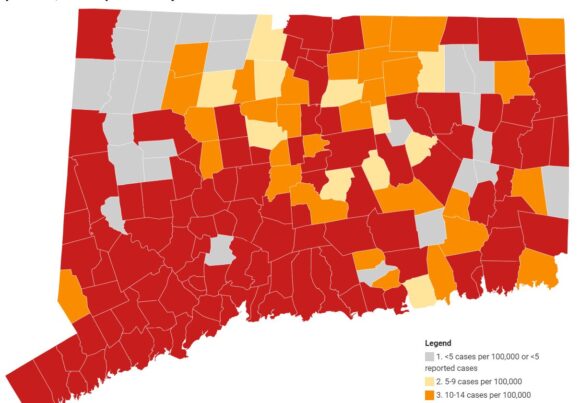
This map shows the average daily rate of new cases of COVID-19 by town during the past two weeks. The Town of Old Lyme has moved back into the (second from lowest) Yellow Zone (it was in the lowest Gray Zone last week), while Lyme remains in the (highest) Red Zone. (Only cases among persons living in community settings are included in this map; the map does not include cases among people who reside in nursing home, assisted living, or correctional facilities.)

LYME/OLD LYME — The Daily Data Report for Connecticut issued Thursday, March 11, by the Connecticut Department of Public Health(CT-DPH) for data as at 8:30 p.m., Wednesday, March 10, shows that cumulative cases (confirmed and probable) since the pandemic began increased by two in Old Lyme to 288 and held steady in Lyme at 91 when compared with the numbers reported Tuesday, March 9.

The next CT DPH Daily Data Report for Connecticut will be issued in the afternoon of Friday, March 12.

Old Lyme Moves Back into Yellow (Lowest but One) Zone for Two-Week New Case Rate, Lyme Remains in (Highest) Red Zone

The report issued Thursday, March 11, by the Connecticut Department of Public Health (CT DPH) for the average daily rate of new cases of COVID-19 by town during the past two weeks contains disappointing news for both Lyme and Old Lyme.

This report is issued daily, but only updated weekly on Thursdays. The most recent report was updated yesterday, Thursday, March 11; the next updated report will be issued in the afternoon of Thursday, March 18.

It shows that Old Lyme has moved back into the (second lowest) Yellow Zone from the (lowest) Gray Zone reflecting an increased case two-week case rate  over the previous week.

Lyme remains in the ‘Red Zone’ — the category with the highest rate of new cases.

(Four zones are specified by the CT DPH — see details below)

Overall, the report contains fairly good news for the whole state with the number of towns in the Gray and Yellow Zone increasing this week (the previous week’s figures shown in parentheses) but the Orange Zone shows an increase:

  • 25 (18) towns are now in the (lowest case rate) Gray Zone
  • 11 (10) are in the (lowest but one) Yellow Zone
  • 30 (36) are in the (second highest case rate) Orange Zone.

All the remaining towns are in the Red Zone, but this still represents a dramatic improvement from the map published in November when every town in the state was in the Red Zone.

This report shows that Old Lyme now joins 10 other towns — Bolton, Columbia, Farmington, Granby, Marlborough, Morris, New Hartford, Portland, Simsbury, South Windsor, and Willington — in the Yellow (second lowest rate) Zone.

The Gray (lowest rate)  Zone includes Andover, Ashford, Barkamsted, Bethany, Bethlehem, Bridgewater, Canaan, Chaplin, Colebrook, Cornwall, Deep River, Eastford, Franklin, Goshen, Hartland, Morris, North Canaan, Norfolk, Roxbury, Salem, Sprague, Scotland, Sharon, Voluntown, Warren, and Washington,

  • The gray category is defined as when the Average Daily Rate of COVID-19 Cases Among Persons Living in Community Settings per 100,000 Population By Town is less than five or less than five reported cases.
  • The yellow category is defined as when the Average Daily Rate of COVID-19 Cases Among Persons Living in Community Settings per 100,000 Population By Town is between five and nine reported cases.
  • The orange category is defined as when the Average Daily Rate of COVID-19 Cases Among Persons Living in Community Settings per 100,000 Population By Town is between 10 and 14.
  • The red category is defined as when the Average Daily Rate of COVID-19 Cases Among Persons Living in Community Settings per 100,000 Population By Town exceeds 15.

In all cases, this rate does not include cases or tests among residents of nursing home, assisted living, or correctional facilities.

More Detail on Two-Week Case Rates

LLHD Director of Health Stephen Mansfield

On Thursday, March 11, Ledge Light Health District (LLHD) also issued their latest weekly report of COVID data for the municipalities within their District. Ledge Light Director of Health Stephen Mansfield prefaces the report with the comment, “We are encouraged to see relatively steady numbers within our jurisdiction.”

He stresses, however, “Although we are making great strides with our COVID vaccination program, it is still imperative that we remain diligent in our mitigation strategies.”

The latest two-week case rates announced Thursday, March 11, for the period 2/21 to 3/06 per 100,000 population (compared with the previous two-week case rate for 2/07 to 2/20) have increased in both Old Lyme and Lyme.

The two-week case rates are as follows:

  • Old Lyme from 4.8 to 6.8
  • Lyme from 15.3 to 18.3

The same report shows that the case numbers in Week 1 and Week 2 respectively and recorded for the period 2/14 to 2/27  (compared with the previous two-week case rate for 2/07 to 2/20 shown in parentheses) are as follows:

  • Lyme had(2) cases in Week 1 and 3 (3) in Week 2
  • Old Lyme had 2 (2) cases in Week 1 and 5 (3) in Week 2

This data was updated March 11, 2021. The next Ledge Light Weekly Data Report for its District will be issued in the afternoon of Thursday, March 18.

Old Lyme – Cumulative Cases Up Two

Old Lyme has a cumulative total (since the outbreak began) of 281 confirmed COVID-19 cases and SEVEN probable casesmaking a TOTAL of 288 cases.

This represents an INCREASE of ONE in the cumulative number of confirmed cases and an INCREASE of ONE in the number of probable cases compared with those reported Wednesday, March 10.

The total number of Old Lyme residents tested is 4,784, up 12 from the Tuesday’s number of 4,772.

Lyme – No Change in Cumulative Cases

Lyme has a cumulative total (since the outbreak began) of 84 confirmed cases and 7 probable cases, making a TOTAL of 91 cases.

This represents NO CHANGE in the cumulative number of confirmed or  probable cases compared with those reported Wednesday, March 8.

The total number of Lyme residents tested is 1,288, an increase of three over Tuesday’s number of 1,285.

Vaccination Rates

At the request of several readers, we are starting a new section today reflecting the status of community vaccination rates in Lyme and Old Lyme. The data is taken from the COVID-19 Vaccinations by Town report published by CT-DPH, which is published roughly weekly.

Old Lyme is marginally ahead of Lyme in terms of the percentage of its total population that have received a first dose, with 35.94 percent vaccinated compared with 33.12 percent in Lyme. The percentages for both towns for the age segments 65-74 and 75+ are very encouraging with Old Lyme now having 96.22 percent of seniors 75 and above having received their first dose and 83.58 percent of the same age segment having received it in Lyme.

The detailed data below is the most recent and was updated March 1.

Old Lyme
Total population:  7,306
Estimated population age 65-74:  1,067
Estimated population age 75 and above:  794

Total population 1st dose administered:  2626 (2,115)
1st dose administered as % of total population:  35.94% (28.95%)

1st dose administered age 65-74:  945 (835)
1st dose administered as % of age 65-74 population:  88.57% (78%)

1st dose administered age 75 and above:  764 (730)
1st dose administered as % of age 75 and above population:  96.22% (92%)

Lyme
Total population:  2,316
Estimated population age 65-74:  372
Estimated population age 75 and above:  274

Total population 1st dose administered:  767 (605)
1st dose administered as % of total population:  33.12% (26.12%)

1st dose administered age 65-74: 281 (244)
1st dose administered as % of age 65-74 population: 75.54% (66%)

1st dose administered age 75 and above: 229 (222)
1st dose administered as % of age 75 and above population: 83.58% (81%)

Three Fatalities in Old Lyme Since Pandemic Began, None in Lyme

According to the report mentioned above, there have now been THREE fatalities in Old Lyme. Asked Tuesday, Feb. 9, for details of this third fatality, Ledge Light Health Department Director of Health Stephen Mansfield responded, “We have not been notified of any recent deaths in Old Lyme. Keep in mind that that report is compiled by the Connecticut Department of Public Health; deaths are not reportable to local health districts.”

He added, “I can’t speak for their data sources.”

The two fatalities from Old Lyme previously reported in 2020 were a 61-year-old female and an 82-year-old male.

No fatalities have been reported in Lyme.

Connecticut Hospital Occupancy

At the request of several readers, we are adding a new report today showing the respective rates of hospital occupancy at local hospitals. The data for this report is obtained from the Connecticut Hospital Occupancy Report published weekly by the CT DPH and extracted from the United States Department of Health and Human Services (HHS) facility-level data for hospital utilization aggregated on a weekly basis (Friday to Thursday).

[table id=10 /]

Editor’s Note: The state issues a COVID-19 metric report daily around 4 p.m. Monday through Friday, which includes current data up to the previous evening. In light of the ongoing rise in Coronavirus cases, we publish a new weekday update reporting confirmed and probable COVID-19 cases in Lyme and Old Lyme. 

Basketball Update: Old Lyme Boys Defeat Valley 67-57 After OL Buzzer Beater Forces Overtime, Lose to Cromwell

OLD LYME — Old Lyme’s Jacob Ritchie hit a buzzer-beating three to force overtime against Valley Regional last Monday, March 8, enabling the Wildcats ultimately to pull off a remarkable 67-57 victory.
Colbe Andrews scored 13 of his 23 points during that overtime period, including going 10 for 10 from the line.
Jacob Ritchie had five steals and 13 points; Maverick Swaney also notched 13 points and Colbe Andrews had 12 rebounds for Old Lyme.
Valley Regional was led by James Marsden with 23 points and Saagar Patel with 14.
Last night, March 11, the Old Lyme boys had a disappointing follow-up to Monday’s success. Coach Kirk Kaczor told LymeLine, “Cromwell played an outstanding game and beat Old Lyme 74-36.”
Cromwell was led by James Grudziki with 19 points while Old Lyme’s top scorer was Jacob Ritchie with 12.

March 9 COVID-19 Update: Cumulative Cases in Lyme up One to 91, Old Lyme’s Hold Steady at 285

LYME/OLD LYME — The Daily Data Report for Connecticut issued Tuesday, March 9, by the Connecticut Department of Public Health(CT-DPH) for data as at 8:30 p.m., Monday, March 8, shows that cumulative cases (confirmed and probable) since the pandemic began increased by one in Lyme to 91 and held steady in Old Lyme at 285 when compared with the numbers reported Sunday, March 7.

It should be noted that Monday reports always include data for the previous three days because reports are not issued on Saturdays or Sundays. All the other days reports are issued (Tuesday through Friday), the reporting period is 24 hours.

The next CT DPH Daily Data Report for Connecticut will be issued in the afternoon of Wednesday, March 10.

Lyme – Cumulative Cases Up One

Lyme has a cumulative total (since the outbreak began) of 84 confirmed cases and 7 probable cases, making a TOTAL of 91 cases.

This represents an INCREASE of ONE in the cumulative number of confirmed cases and NO CHANGE in the number of probable cases compared with those reported Monday, March 8.

The total number of Lyme residents tested is 1,285, an increase of three over Monday’s number of 1,282.

Old Lyme – No Change in Cumulative Cases 

Old Lyme has a cumulative total (since the outbreak began) of 279 confirmed COVID-19 cases and SIX probable casesmaking a TOTAL of 285 cases.

This represents an INCREASE of TWO in the cumulative number of confirmed cases and NO CHANGE in the number of probable cases compared with those reported Friday, March 5.

The total number of Old Lyme residents tested is 4,766, up 22 from the previous day’s number of 4,744.

Vaccination Rates

At the request of several readers, we are starting a new section today reflecting the status of community vaccination rates in Lyme and Old Lyme. The data is taken from the COVID-19 Vaccinations by Town report published by CT-DPH, which is published roughly weekly.

Old Lyme is marginally ahead of Lyme in terms of the percentage of its total population that have received a first dose, with 28.95 percent vaccinated compared with 26.12 percent in Lyme. The percentages for both towns for the age segments 65-74 and 75+ are very encouraging with Old Lyme now having 92 percent of seniors 75 and above having received their first dose.

The detailed data below is the most recent and was updated March 1.

Old Lyme
Total population:  7,306
Estimated population age 65-74:  1,067
Estimated population age 75 and above:  794

Total population 1st dose administered:  2,115
1st dose administered as % of total population:  28.95%

1st dose administered age 65-74:  835
1st dose administered as % of age 65-74 population:  78%

1st dose administered age 75 and above:  730
1st dose administered as % of age 75 and above population:  92%

Lyme
Total population:  2,316
Estimated population age 65-74:  372
Estimated population age 75 and above:  274

Total population 1st dose administered:  605
1st dose administered as % of total population:  26.12%

1st dose administered age 65-74: 244
1st dose administered as % of age 65-74 population: 66%

1st dose administered age 75 and above: 222
1st dose administered as % of age 75 and above population: 81%

Old Lyme Now in Gray (Lowest) Zone for Two-Week New Case Rate, Lyme Remains in (Highest) Red Zone

The report issued Monday, March 8, by the Connecticut Department of Public Health (CT DPH) for the average daily rate of new cases of COVID-19 by town during the past two weeks contains good news for Old Lyme … but not Lyme.

This report is issued daily, but only updated weekly on Thursdays. The most recent report was updated Thursday, March 4: the next updated report will be issued in the afternoon of Thursday, March 11.

It shows that Old Lyme has moved from the (second lowest) Yellow Zone down into the (lowest) Gray Zone reflecting an even lower case rate than the previous week.

Unfortunately, Lyme remains in the ‘Red Zone’ — the category with the highest rate of new cases.

(Four zones are specified by the CT DPH — see details below)

Overall, the report contains good news for the whole state with the number of towns in each Zone increasing this week in every case (the previous week’s figures shown in parentheses):

  • 18 (10) towns are now in the (lowest case rate) Gray Zone
  • 10 (7) are in the (lowest but one) Yellow Zone
  • 36 (28) are in the (second highest case rate) Orange Zone.

All the remaining towns are in the Red Zone, but this represents a dramatic improvement from the map published in November when every town in the state was in the Red Zone.

This report shows that Old Lyme now joins 17 other towns — Barkamsted, Bethlehem, Bridgewater, Canaan, Chester, Colebrook, Cornwall, Eastford, Franklin, Hartland, Morris, Norfolk, Roxbury, Scotland, Sharon, Voluntown and Warren — in the Gray (lowest rate)  Zone.

The Yellow (second lowest rate) Zone includes Bolton, Canton, Easton, Farmington, Granby, New Hartford, Plymouth, Tolland, Woodbury and Willington.

  • The gray category is defined as when the Average Daily Rate of COVID-19 Cases Among Persons Living in Community Settings per 100,000 Population By Town is less than five or less than five reported cases.
  • The yellow category is defined as when the Average Daily Rate of COVID-19 Cases Among Persons Living in Community Settings per 100,000 Population By Town is between five and nine reported cases.
  • The orange category is defined as when the Average Daily Rate of COVID-19 Cases Among Persons Living in Community Settings per 100,000 Population By Town is between 10 and 14.
  • The red category is defined as when the Average Daily Rate of COVID-19 Cases Among Persons Living in Community Settings per 100,000 Population By Town exceeds 15.

In all cases, this rate does not include cases or tests among residents of nursing home, assisted living, or correctional facilities.

More Detail on Two-Week Case Rates

LLHD Director of Health Stephen Mansfield

On Thursday, March 4, Ledge Light Health District (LLHD) also issued their latest weekly report of COVID data for the municipalities within their District. Ledge Light Director of Health Stephen Mansfield prefaces the report with the comment, “We are encouraged to see relatively steady numbers within our jurisdiction.’

He stresses, however, “Although we are making great strides with our COVID vaccination program, it is still imperative that we remain diligent in our mitigation strategies.”

The latest two-week case rates announced Thursday, March 4, for the period 2/14 to 2/27 per 100,000 population (compared with the previous two-week case rate for 2/07 to 2/20) have fallen in both Old Lyme and Lyme.

The two-week case rates are as follows:

  • Old Lyme from 6.8 to 4.8
  • Lyme from 24.4 to 15.3

The same report shows that the case numbers in Week 1 and Week 2 respectively and recorded for the period 2/14 to 2/27  (compared with the previous two-week case rate for 2/07 to 2/20 shown in parentheses) are as follows:

  • Lyme had(5) cases in Week 1 and 3 (3) in Week 2
  • Old Lyme had 2 (4) cases in Week 1 and 3 (3) in Week 2

This data was updated March 4, 2021. The next Ledge Light Weekly Data Report for its District will be issued in the afternoon of Thursday, March 11.

Three Fatalities in Old Lyme Since Pandemic Began, None in Lyme

According to the report mentioned above, there have now been THREE fatalities in Old Lyme. Asked Tuesday, Feb. 9, for details of this third fatality, Ledge Light Health Department Director of Health Stephen Mansfield responded, “We have not been notified of any recent deaths in Old Lyme. Keep in mind that that report is compiled by the Connecticut Department of Public Health; deaths are not reportable to local health districts.”

He added, “I can’t speak for their data sources.”

The two fatalities from Old Lyme previously reported in 2020 were a 61-year-old female and an 82-year-old male.

No fatalities have been reported in Lyme.

Connecticut Hospital Occupancy

At the request of several readers, we are adding a new report today showing the respective rates of hospital occupancy at local hospitals. The data for this report is obtained from the Connecticut Hospital Occupancy Report published weekly by the CT DPH and extracted from the United States Department of Health and Human Services (HHS) facility-level data for hospital utilization aggregated on a weekly basis (Friday to Thursday).

[table id=10 /]

Editor’s Note: The state issues a COVID-19 metric report daily around 4 p.m. Monday through Friday, which includes current data up to the previous evening. In light of the ongoing rise in Coronavirus cases, we publish a new weekday update reporting confirmed and probable COVID-19 cases in Lyme and Old Lyme. 

Coral Reefs are Topic of Opening Virtual Lecture in RTPEC’s 2021 CT River Series, Tonight

Dr. Mark Hixon presents a virtual lecture on coral reefs Thursday, March 11. This virtual lecture is hosted by RTPEC and free of charge, but registration is required in order to obtain the Zoom link.

LYME/OLD LYME  — Throughout the past challenging year, the Roger Tory Peterson Estuary Center (RTPEC), which is is part of Connecticut Audubon Society, has still found many ways to continue its work in environmental education, conservation, research, and advocacy.

It has offered small group programs like bird walks and owl prowls, a virtual Connecticut River ecology course, seasonal nature crafts for kids via Zoom, and more.

The RTPEC continues its mission with the announcement of their Spring 2021 Connecticut River Lecture Series.

A mainstay of the organization’s adult programming, the Connecticut River Lecture Series introduces scientists, researchers, writers, and artists who inform us about the biodiverse coastal and estuarine ecosystems of our region and planet.

In 2021, the RTPEC will celebrate the series’ seventh year with Zoom presentations from three prominent scientists, each focusing on a critical environmental issue. The programs are free, but registration is required and space is limited.

All the programs start at 6 p.m.

Thursday, March 11
Coral Reefs: Rainforests and Canaries of the Sea
Mark Hixon, Ph.D., Professor in the School of Life Sciences at the University of Hawai’i at Manoa.

Dr. Mark Hixon

A leading expert on coral reefs, Dr. Hixon will discuss what is happening to them, why they are important, and how we can help preserve them.

Mark Hixon is the Sidney and Erika Hsiao Endowed Chair in Marine Biology and Chair of the Zoology Graduate Program at the University of Hawai’i at Manoa. His research analyzes what determines the number of fish in the sea, how so many species naturally coexist, and how marine reserves and artificial reefs help conserve sea life and enhance fisheries.

A Fulbright Senior Scholar, Aldo Leopold Fellow, and Fellow of the International Coral Reef Society, Dr. Hixon serves on the editorial boards of multiple scientific journals. Past chair of both the Marine Protected Areas Federal Advisory Committee for NOAA and the Ocean Sciences Advisory Committee for the National Science Foundation, Mark has given TED talks and appeared on the PBS TV show “Saving the Oceans.”


Details of the second lecture are as follows:

Thursday, April 8
Butterflies: Monarchs, Migrations, and Conservation
Robert Michael Pyle, Ph.D., conservation biologist and author of The Audubon Society Field Guide to North American Butterflies, will be interviewed by Evan Griswold.  

As a foremost authority on butterflies and other invertebrates, in 1971 Dr. Pyle founded The Xerces Society for Invertebrate Conservation, an international nonprofit organization that protects the natural world through the conservation of butterflies and all invertebrates and their habitats.

Evan Griswold will interview Dr Pyle about his life’s work on invertebrates and monarch butterfly migration and conservation.

Robert Michael Pyle grew up and learned his butterflies in Colorado. He earned his Ph.D. in butterfly ecology at Yale and worked as a conservation biologist in Papua New Guinea, Oregon, and Cambridge, England.

He has written 22 books including The Audubon Society Field Guide to North American Butterflies, winner of the 1987 John Burroughs Medal for Distinguished Nature Writing and the 2007 National Outdoor Book Award. His book about Pacific Northwest forests and origins of the legends of Sasquatch was recently made into a movie.

Dr. Pyle has also published a book of poetry and his newest book, Nature Matrix, is a collection of essays, expressions of a life immersed in the natural world.

Evan Griswold, a Yale School of The Environment/School of Forestry classmate of Dr. Pyle’s, is a former Executive Director of the Connecticut Chapter of the Nature Conservancy and a prominent Connecticut conservationist.

Details of the third and final lecture are as follows:

Thursday, April 29
The Secret Life of Plankton: The Base of the Marine Food Web
Hans Dam, Ph.D., Professor in the Department of Marine Sciences at the University of Connecticut

Plankton, a single cell organism, is the base of the marine food web. Hans Dam will speak about the evolutionary ecology of plankton and its vulnerability to climate change. He will describe the macro-power of its micro-organisms and his efforts to better understand the invisible life teeming in a tablespoon of river or Sound water.

Hans Dam is a biological oceanographer interested in the ecology and evolution of planktonic organisms: tiny creatures that control the biology of the sea. His current research focuses on how copepods, the most abundant animals on Earth, adapt to the ocean’s warming and acidification.

Another area of work is the evolutionary “arms race” between grazers and toxic plants. Dr. Dam has published more than 100 papers and trained a generation of oceanographers. He has also spent 20 years advising the State of Connecticut about water quality in Long Island Sound.

This year’s Lecture Series includes a special offer: a dinner available for pick-up on the day of the event prepared by renowned chef Ani Robaina, formerly chef to the Gates foundation, and currently owner and chef at Ani’s Table. The cost is $75.

For additional information and Zoom registration, visit https://www.ctaudubon.org/rtp-programs-events/ or call 860-598-4218.