
Death Announced of William “Billy” Francis Rando, 68, of Old Lyme; Remembered for his “Dependability, Quick Wit and Distinctive Personality’

OLD LYME – William “Billy” Francis Rando, 68, of Old Lyme passed away at home Thursday, Feb. 4, 2021, defying a daunting cancer prognosis for nearly a decade.

Billy is survived by his devoted wife, Nancy Berry Rando and their four children: Kacie, Jesse, Carly and her husband James Wood and Caroline and her boyfriend JJ; in addition to sister Connie and husband William Mitchell; and brother Tom and wife Pat Rando …

… Billy met his future wife, Nancy, at a party when his t-shirt sparked a conversation about the Yankees. They would have celebrated their 39th anniversary in May. They built their first home in Lyme where they resided for 15 years. It was there where they became parents to four children, eventually moving to the home Billy built by the shore in Old Lyme …

… Billy will be remembered by his dependability, quick wit and distinctive personality …

Visit this link to read the full obituary published Feb. 7, in The Day.

Lyme Academy Enters New Era, Names Mora Rowe as Executive Director to Launch Programs, Re-engage With Community

Mora Rowe is the new Executive Director of Lyme Academy of Fine Arts.

OLD LYME — Lyme Academy of Fine Arts (LAFA) in Old Lyme is on the brink of an exciting new era — and yet, at the same time, it is, in essence, a renaissance of the principles on which the Academy was founded.

After 18 months of strategic planning and a recent change in leadership on the board of trustees, the LAFA Board of  Trustees has structured a new plan reflective of the Academy’s original mission and hired both an Executive Director and an Artistic Director in anticipation of reopening with new programming in September 2021.

On Feb. 8, 2021, Mora Rowe joined Lyme Academy as Executive Director for the school. Most recently, she served as the director of economic development for the City of Auburn, Calif., and was previously the executive director and chief executive officer of Placer County Visitors Bureau in Auburn, Calif. She relocated to Essex in December 2019. 

Rowe spoke with LymeLine yesterday saying, “It’s been a wonderful, though somewhat exhausting, week. The staff has done a fantastic job [during the period since the University of New Haven withdrew from its relationship with LAFA], but now we will be working rapidly to reengage with our stakeholders and the community. We are fortunate to  have an active, passionate board that is ready to go.”

Asked how she felt about her appointment, Rowe responded, “I am honored and excited for the role,” adding that she was eagerly looking forward to, “Implementing the Board’s plan for LAFA and supporting the artistic vision of our new Artistic Director, Jordan Sokol.” 

She added, “I have many ideas for community engagement and look forward to working with the other established organizations in the region.” 

In terms of her management style, Rowe explained, “I’ve always looked at management and leadership as a servant role,” noting, “Instead of people working to serve a leader, the leader works to serve the organization.”

The Board has developed a 10-point manifesto for, “The revival of the Lyme Academy of Fine Arts as it plans for its 50th anniversary in 2026,” said Michael Duffy, who was elected board chair in December. 

The plan includes adhering to the mission of founder Elisabeth Gordon Chandler, an acclaimed sculptor, who founded the school in 1976 based on her philosophy that artists needed to be educated in the fundamentals of representational and figurative art forms, a curriculum she believed was in danger of disappearing in contemporary art education.

“There is a need for Lyme Academy’s mission today, as an academy, not a college,” said Duffy.  These are the first two points of the manifesto and reflect the board’s desire to reestablish the academy model at LAFA rather than an accredited College.

A delighted Duffy, who lives in Old Lyme, commented on Rowe’s appointment, saying exclusively by email to LymeLine, “[She] is exactly the right person to lead the Lyme Academy: she is hard-working, brimming with ideas and passionate about the Academy’s mission.”

He expanded on that mission, saying, “Our vision is that by Lyme Academy’s 50th anniversary in 2026, it will be known nationally and internationally for the excellence of its teaching and that it will once again become a beloved and vibrant hub of the Old Lyme community.”

Duffy concluded, “Working with our Artistic Director, Jordan Sokol, Mora’s leadership will help to bring that vision to life.”

Laura Lee Miller of Lyme, LAFA Board of Trustees Vice Chair, continued Duffy’s positive theme in an email saying enthusiastically, “With energetic new leadership and a fully engaged Board of Trustees, Lyme Academy of Arts is prepared to relaunch with robust art programming in fall 2021 and with a renewed commitment to the towns of Lyme and Old Lyme and our cultural partners in the community.”

She added, “We want to re-activate our campus as a center of fine arts education and a community hub and we welcome ideas from our neighbors in Lyme and Old Lyme.”
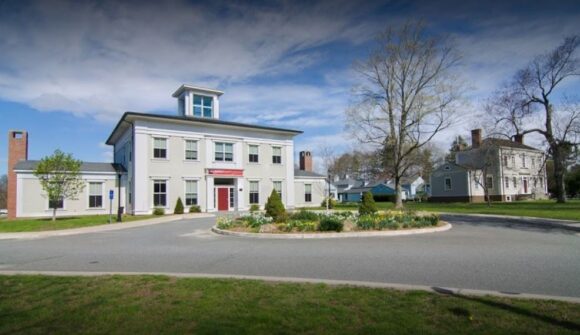
Lyme Academy of Fine Arts is entering an exciting new era with the appointment of Executive Director Mora Rowe and Artistic Director Jordan Sokol. File photo.

The new LAFA program will look to enroll full-time students each year in what is expected to be a two-year core program. As the exact programming evolves, the tuition will be determined.  

Other goals in the manifesto include “serving the needs of many kinds of students,” which will include young artists programs and classes open to the public, reconnecting with the Academy alumni and investing in career development for graduates of the Academy. 

Rowe added, “We are interested in ideas and activities that could transform the LAFA campus into a vibrant community hub. This might include a seasonal Farmer’s Market, concerts on the green, or an invitation to read a book while sitting in one of our colorful Adirondack chairs on campus. There are so many possibilities for our campus in town.”

Standing together in the Sculpture Studio at Lyme Academy are noted painter Jordan Sokol (right) and his wife, Amaya Gurpide, an acclaimed artist. Sokol is the new Artistic Director and Deane Keller Chair at the Academy and Gurpide will serve as the Academy’s Director of Drawing. Photo by Rick Lacey III.

Jordan Sokol, a painter, is the newly appointed Artistic Director for the school, and his wife, artist Amaya Gurpide, will serve as the director of drawing at the school. The couple have a four-year-old son and have relocated to Old Lyme from Jersey City where Sokol served as academic director of The Florence Academy of Art and also an adjunct professor at the New York Academy of Art.

Sokol said that when he was a student, the model of an academy — as opposed to a college — fulfilled the type of education for which he was looking. Having  studied at the Florence Academy of Art in Florence, Italy, and taught there after he graduated. he noted, “I find that a lot of my students are not interested in the degree, they’re interested in learning how to paint so that they can pursue their dream and so [a degree] is not as important as the skills they acquire.”

Rowe added that the academy model reflected trends in the marketplace. “So many industries are going back to the crafts and trades, learning a set of skills,” she said. “This is foundational, and I don’t think that goes out of style. It is becoming more popular and it is more affordable.”

She concluded emphatically, “The fact that you are working with exceptional artists in their own right — I don’t think that’s a hard sell.”

About the Lyme Academy of Fine Arts: Founded in 1976 by esteemed sculptor Elisabeth Gordon Chandler, the Lyme Academy of Fine Arts is located in historic Old Lyme, CT, which has been a vibrant center for the arts and artists in Southeastern Connecticut for more than 100 years. Lyme Academy upholds the standard of a Classic Fine Arts education offering a variety of programs under the guidance of master artists, who share a deep respect for both traditional and innovative forms of teaching. The Academy has been providing students with the necessary foundation and skills to develop their own unique visual expression for nearly 50 years. 

Lyme Academy of Fine Art is located at 84 Lyme Street, Old Lyme, Connecticut.

For more information about Lyme Academy’s past, present and future, visit lymeacademy.edu or call 860.434.5232.

Editor’s Note: This article is based in part on a press release issued by Lyme Academy of Fine Arts.

CT DPH Releases Available Race/Ethnicity COVID Vaccination Data, “Points to Need to do More to Vaccinate Black, Other High Risk Populations” 

While warning of limitations of the data, DPH says it points to need to do more to vaccinate Black and other high risk populations 

HARTFORD, CT – (Press Release issued by Ledge Light Health Department (LLHD) on behalf of the CT Department of Public Health (DPH)) The CT Department of Public Health (DPH) today released data showing how  vaccines in Connecticut have been administered throughout the state across race/ethnicity as  of Feb. 3.

The data, while limited, mirrors what states across the country have seen: that  disparities exist in vaccine administration across racial lines, with Black populations lagging  behind White and Hispanic populations. 

DPH cautioned that the data should be interpreted with several caveats: 

  • While reporting of race/ethnicity is required for all vaccine providers, there are some  gaps, which is the case across all vaccines and not unique to COVID-19 vaccines. Providers and individuals have the option of selecting “Other,” “Multiple Races” or “Not  Reported,” which makes analysis and comparisons across races difficult 
  • Providers use multiple means to report data to DPH, which then must be aggregated  and analyzed, which can lead to missing or under-reported data 

DPH also noted that data quality issues are not unique to Connecticut and are being seen across  the country. Recently, the Centers for Disease Control and Prevention (CDC) noted that 50 percent of the data reported by vaccine providers across the country did not contain race/ethnicity data. 

Despite these limitations, DPH Acting Commissioner Dr. Deidre Gifford noted that the data does  suggest that disparities exist in the administration of vaccines to historically underserved  communities, particularly Black populations.

“As we open up the vaccine program to individuals 65 and over, we are redoubling our efforts  to ensure that vaccine is reaching the communities and populations who have been  disproportionately impacted by COVID-19,” said Commissioner Gifford.

She continued, “We are re-allocating  additional vaccine to communities with large minority populations, encouraging our vaccine  providers to conduct outreach and implement other measures to ensure that individuals from  underserved communities have equitable access to vaccinations.” 

Commissioner Gifford pointed to several other steps being taken to address disparities in  vaccine administration, including: 

  • Ensuring adequate vaccine supply. Underserved cities and towns are home to 60 percent of  CT’s population, and DPH is allocating vaccine to ensure there is no shortage of doses.
  • Targeting an additional roughly 10 percent of the state’s allocation to go to what are known as  “high SVI towns” for use at clinics targeted for senior housing, congregate settings and  other locations with populations that might not have easy access to vaccine
    • Those towns/cities are identified using the CDC’s social vulnerability index (SVI),  which seeks to identify municipalities where a number of factors, including  poverty, lack of access to transportation, and crowded housing may weaken a  community’s ability to respond to a public health crisis, like a pandemic.
  • Launching 60 pharmacy locations this week
    • 2/3 are in high SVI towns
    • 1/3 are in rural, underserved communities
  • Establishing the state’s Vaccine Appointment Assist Line, 877-918-2224, to broaden  access to residents without Internet or with technology issues and for non-English  speaking residents 
  • Deploying Community Outreach Specialists – bilingual, with existing relationships in  local communities – to serve as vaccine ambassadors  
  • Launching a trusted messenger Train the Trainer Program for community leaders,  starting with outreach to underserved communities 
  • Supporting a multi-lingual education and social media campaign to boost vaccine  confidence (communications materials are translated into Spanish, Portuguese, Polish  and Haitian Creole, other languages on request) 

Due to a constrained vaccine supply which limits the number of vaccines administered weekly  combined with the relatively unreliable nature of the race/ethnicity data, DPH does not have  plans at this time for a regular release of this data.

In the coming weeks, as the number of  individuals receiving their first dose of vaccine becomes more robust and data reporting more  reliable, DPH will announce a regular schedule for the release of the race/ethnicity data.

Feb. 11 COVID-19 Update: Lyme Moves Out of New Case Rate ‘Red Zone’ for First Time Since Dec. 18, Old Lyme Still Red

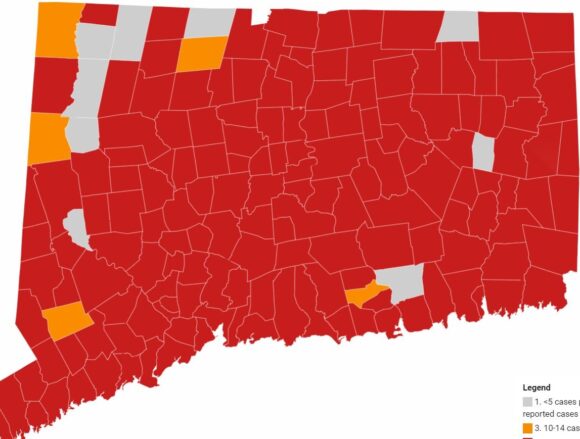
This map shows the average daily rate of new cases of COVID-19 by town during the past two weeks. The Town of Lyme is now recorded in the Gray Zone while Old Lyme continues in the Red Zone. (Only cases among persons living in community settings are included in this map; the map does not include cases among people who reside in nursing home, assisted living, or correctional facilities.)

LYME/OLD LYME — The report issued Thursday, Feb. 11, by the CT DPH for the average daily rate of new cases of COVID-19 by town during the past two weeks shows that Old Lyme is still in the state-identified ‘Red Zone’ with the highest rate of new cases, where it has been since early December 2020.

Lyme, however, has moved back into the Gray Zone — the zone which has the lowest rate of new cases — for the first time since Dec. 18, 2020.

As of the Feb. 11 report, Lyme now joins Bridgewater, Canaan, Cornwall, Colebrook, Norfolk, Scotland, Union and Warren  in the Gray Zone, while Deep River, Barkhamsted, Kent, Redding and Salisbury move into the Orange Zone –.

  • The gray category is defined as when the Average Daily Rate of COVID-19 Cases Among Persons Living in Community Settings per 100,000 Population By Town is less than five or less than five reported cases.
  • The orange category is defined as when the Average Daily Rate of COVID-19 Cases Among Persons Living in Community Settings per 100,000 Population By Town is between 10 and 14.
  • The red category is defined as when the Average Daily Rate of COVID-19 Cases Among Persons Living in Community Settings per 100,000 Population By Town exceeds 15.

In all cases, this rate does not include cases or tests among residents of nursing home, assisted living, or correctional facilities.

The Daily Data Report for Connecticut issued Thursday, Feb. 11, by the Connecticut Department of Public Health (CT DPH) for data as at 8:30 p.m., Wednesday, Feb. 10, shows that Old Lyme’s COVID-19 cumulative case numbers since the pandemic began decreased by one to 272 compared with Tuesday’s number of 273.

According to the report mentioned above, there have now been THREE fatalities in Old Lyme. Asked Tuesday, Feb. 9, for details of this third fatality, Ledge Light Health Department Director of Health Stephen Mansfield responded, “We have not been notified of any recent deaths in Old Lyme. Keep in mind that that report is compiled by the Connecticut Department of Public Health; deaths are not reportable to local health districts.”

He added, “I can’t speak for their data sources.”

The two fatalities from Old Lyme previously reported in 2020 were a 61-year-old female and an 82-year-old male.

Lyme’s cumulative total stayed constant at 78 in Wednesday’s CT DPH report holding at Tuesday’s number. (Monday reports always include data for the previous Friday, Saturday and Sunday.)

Two-Week Case Rates

On Thursday, Feb. 11, Ledge Light Health District (LLHD) also issued their latest two-week  report of COVID data for the municipalities within their District. Ledge Light Director of Health Stephen Mansfield prefaces the report with the comment, “We are encouraged to see a moderate decrease in cases for the 4th consecutive reporting period, and are hopeful that this trend will continue.”

The latest two-week case rate per 100,000 population announced Thursday, Feb. 11, has fallen in both Lyme and Old Lyme, which, in turn, reflects the fact that the number of cases has fallen in both towns over the two week-period.

The two-week case rate for the period 1/24 to 2/06 decreased (compared with the previous two-week case rate for 1/17 to 1/30)  as follows:

  • Lyme from 21.4 to 12.2
  • Old Lyme from 38.8 to 25.2.

The same report shows that the number of cases recorded for the period 1/24 to 2/06 also decreased (compared with the previous two-week case rate for 1/17 to 1/30 shown in parentheses) as follows:

  • Lyme had(5) cases in Week 1 and 2 (2) in Week 2
  • Old Lyme had 17 (23) cases in Week 1 and (17) in Week 2

This data was updated Feb. 11, 2021.

Old Lyme – Confirmed Cases Down One

Old Lyme now has a cumulative total (since the outbreak began) of 265 confirmed COVID-19 cases and SEVEN probable cases, making a TOTAL of 272 cases.

This represents an DECREASE of ONE in the cumulative number of confirmed cases over the number reported Wednesday, Feb. 10, (266) and NO CHANGE in the number of probable cases (7) over the number reported the same day.

The total number of Old Lyme residents tested is 4,536, an increase of 13 over the previous day’s number of 4,523.

Lyme – Confirmed Cases Up One

Lyme has a cumulative total (since the outbreak began) of 73 confirmed cases and FIVE probable cases, making a TOTAL of 78 cases.

This represents an INCREASE of ONE in the number of confirmed cases over Wednesday’s number (77) and no change on the number of probable cases from the number reported Wednesday, Feb. 10.

There have been no fatalities in Lyme.

The total number of Lyme residents tested is 1,221, an increase of three over the previous day’s number of 1,218.

Connecticut Hospital Occupancy

At the request of several readers, we are adding a new report today showing the respective rates of hospital occupancy at local hospitals. The data for this report is obtained from the Connecticut Hospital Occupancy Report published weekly by the CT DPH and extracted from the United States Department of Health and Human Services (HHS) facility-level data for hospital utilization aggregated on a weekly basis (Friday to Thursday).

[table id=10 /]

Editor’s Note: The state issues a COVID-19 metric report daily around 4 p.m. Monday through Friday, which includes current data up to the previous evening. In light of the serious rise in Coronavirus cases, we started a new weekday update reporting confirmed and probable COVID-19 cases in Lyme and Old Lyme. The next CT DPH Daily Data Report for Connecticut will be issued in the afternoon of Friday, Feb. 12.

A la Carte: Celebrate Black History Month by Making ‘Peace Through (Puerto Rican-Style Shepherd’s) Pie,’

Lee White

Even though I was born in New York State, and went to college there, too, I have always considered myself a New England girl. My husband and I met in New York City and we lived in New Jersey for a few years, but as soon as we could, we moved to New England, first to Massachusetts and then to our home in Connecticut.

I have always had a subscription to Yankee magazine and we liked two- or three-day weekends much more than going somewhere for a whole week. On those weekends we would drive to Maine, Vermont and New Hampshire. Two days at a hotel in Boston was divine. As for Rhode Island: we would have dinner at Al Forno or, sometimes, just drive to Providence for dinner on Federal Hill.

These days, with a pandemic and with fewer friends to drive with, I often snuggled into bed with Yankee magazine and dream about the places we had been, or wished we’d visited. 

A few nights ago, after two hours of Longmire on television, I went to bed with the January/February issue of Yankee. It was all about pies.  In a wonderful article by Nadine Nelson about Common Ground, a New Haven, Conn., high school, urban farm and environmental education center, she wrote about Martin Luther King Jr. Day and the Peace Through Pie project, a national nonprofit and communities fundraising movement, in February — Black History Month. 

The article was great, but which pie to make? Samosa-style potpies, root vegetable cheese tart, pear-cranberry cheddar pie with hazelnut crumble, or how about a casserole-like pastelon, a Puerto Rican dish that includes plantains, which are now available in most of our shoreline supermarkets.

Next week another pie: Civil Rights Spiced Sweet Potato Pie, also for Black History Month.

Puerto Rican-Style Shepherd’s Pie


From Yankee magazine, January/February 2021

Yield: 6 to 8 servings

2 teaspoons kosher salt
4 ripe plantains (yellow with black spots), peeled and halved crosswise
3 tablespoons salted butter, plus more for the pan (unsalted butter is fine)
3 tablespoons olive oil
1 pound ground beef
1 teaspoon adobo seasoning*
1 medium onion, diced
1 small green bell pepper, diced
½ teaspoon ground cumin
½ teaspoon paprika ( preferably smoked)
½ teaspoon dried oregano
1 cup tomato sauce
1/3 cup pimento-stuffed green olives, sliced
2 teaspoons capers (optional)
2 large eggs, beaten
1 ¼ cups shredded Monterey Jack, mozzarella or cheddar cheese

Season a medium pot of water with salt and bring to a boil over high heat. Add plantains and simmer until tender, 15 minutes. Transfer plantains to a bowl and mash with 3 tablespoons butter until smooth. Set mixture aside.

Preheat oven to 400 degrees. Butter a medium baking dish; set aside.

Heat olive oil in a large skillet over medium-high heat. Add beef and adobo seasoning and cook, breaking up with a wooden spoon, until it is browned. Remove beef from pan and transfer to a bowl. Reduce heat to medium and add onions, pepper, cumin, paprika and oregano; cook stirring until translucent, about 6 minutes. Return beef to skillet and add tomato sauce, olives and capers and simmer, stirring occasionally, until liquid evaporates. Remove from heat.

To assemble casserole, spread meat mixture in the bottom, Pour eggs over meat mixture, then spread plantains over that. Top with cheese. Bake, uncovered, until cheese is golden brown, 30 minutes.

*I did not have adobo seasoning, but I did have chipotle in adobo, so I used a teaspoon of that instead.

About the author: Lee White has been writing about restaurants and cooking since 1976 and has been extensively published in the Worcester (Mass.) Magazine, The Day, Norwich Bulletin, and Hartford Courant. She currently writes Nibbles and a cooking column called A La Carte for LymeLine.com and the Shore Publishing and the Times newspapers, both of which are owned by The Day. She was a resident of Old Lyme for many years but now lives in Groton, Conn.