Two Ministers – Jack Madry of New London, David Good of Old Lyme – to Speak at Old Saybrook March for Justice This Evening

The Old Saybrook March for Justice meets every Wednesday at 6 p.m. in front of ‘the Kate’ in old Saybrook to hear speakers and then march down Main St.

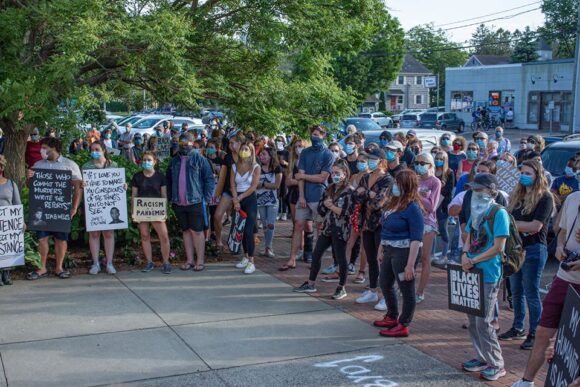
OLD SAYBROOK/LYME/OLD LYME — The Old Saybrook March for Justice is an inclusive and welcoming coalition of friends and neighbors, who care deeply about basic human rights. The group gathers each Wednesday evening at 6 p.m. in front of the Katharine Hepburn Cultural Arts Center in Old Saybrook — the Kate — where they listen to speakers and then, immediately following the speeches, march peacefully up and down Main St. All are requested to wear masks.

Their mission statement says, ” We are outraged by centuries of structural racism in this country. We stand with Black Lives Matter. We listen, learn and act. We understand that silence is not an option and we will not be bystanders to white supremacy.”

The statement continues, “We aim to be allies and antiracist. We are respectful, nonpartisan and inclusive. We welcome all who share our values. We educate ourselves and join in weekly marches.”
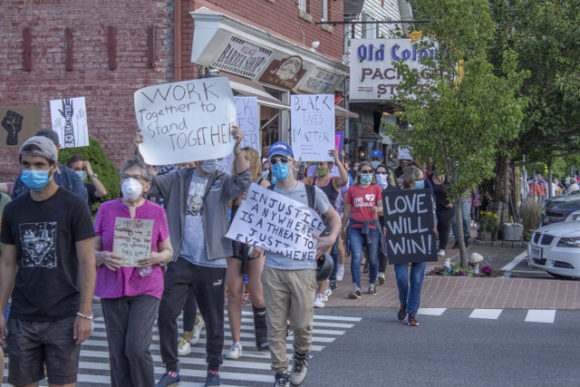
Signs were held high at a previous rally as the marchers crossed Main Street in Old Saybrook.

Today, Wednesday, July 8, all are welcome to meet at the Kate at 6 p.m. for a teach-in followed by a march.

Rev. David W. Good, Minister Emeritus of the First Congregational Church of Old Lyme

The speakers at this evening’s event will be Rev. Jack Madry from New London and Rev. David Good from Old Lyme. The question they will address is: “What role should the faith community be playing in advancing our national movement on racial justice?”

Rev. Jack Madry is the pastor of the Madry Temple, a predominantly Black congregation in New London, named in honor of Pastor Jack’s father.  Rev. Jack Madry is also an accomplished jazz pianist and for many years performed at Mashantucket. 

Rev. David W. Good is the Minister Emeritus of the First Congregational Church of Old Lyme, a predominantly White congregation. 

Through many years of interracial friendship, the two congregations have shared picnics, jazz concerts, volleyball games and church banquets.  Their ministers have preached in each others’ pulpits and shared Christmas and New Year’s Eve worship services.

Out of this friendship, the two congregations have partnered with Habitat for Humanity, building houses in New London County, starting first with a home on Pattagansett Road in East Lyme on land donated by Judy and Phil Simmons, members of the Old Lyme church. In Salem, members and friends of both churches had the honor of working side by side with Rachel Robinson — wife of Jackie Robinson, the great player and pioneer in racial justice — on land she donated to Habitat for Humanity.  

Representatives of each church then traveled to South Africa, along with Rachel Robinson and Emmanuel Red Bear (a proud descendant of Sitting Bull) to take part in the Jimmy Carter Work Project for Habitat for Humanity, working side by side with Black choir members from Soweto and Johannesburg. 

To celebrate Nelson Mandela’s release from prison and the end of Apartheid, Madry Temple and The First Congregational Church of Old Lyme organized the “World House Tour” for a 50-member choir from South Africa that performed throughout New England and New York, including the Garde Theater in New London. 

“World House” came from Martin Luther King Jr.’s book, “Chaos or Community: Where Do We Go From Here?”  In the last chapter, Dr. King recommended that all imagine that the human race had inherited a large house — a World House — in which all the races, religions and nationalities had to learn how to live together in peace.
Old Lyme’s Whippoorwill Rd. Parking Lot Closed Resulting in Changes to Open Space Access

OLD LYME — The Old Lyme Open Space Commission has announced in a statement that the parking lot on Whippoorwill Rd. used by visitors to the Ames Open Space and McCulloch Family Open Space properties was closed July 1, 2020.

The owner of the parking lot has graciously allowed the town use his private property for many years for parking, but recently rescinded permission in anticipation of a possible land sale.

In response, the Old Lyme Open Space Commission is actively exploring the feasibility of a new parking area on town land along the pentway (driveway) leading to the McCulloch property, adjacent to the former parking area.  As this may involve an archaeological assessment, survey and engineering work, land clearing and lot construction, it will likely become a future property amenity.

In the meantime, the Open Space Commission has announced the following access changes to trails:

Ames Open Space

  • The Whippoorwill Rd. access to the Ames Open Space will be closed until further notice.  This trail connector has been periodically flooded, rendering it unusable for periods of time in the past. Closure will resolve this issue and also allow beavers to occupy open space property without disturbance.
  • Ames Open Space trails may be accessed from the existing Evergreen Rd. entrance.

McCulloch Family Open Space

  • The yellow trailhead in the McCulloch Family Open Space will be accessible only by pedestrian and bicycle access.  Vehicle parking on the pentway leading to this trailhead is prohibited.
  • The yellow trail remains fully accessible for visitors and hikers, but without a parking area. This trail may also be accessed via either the property’s Tree in the Gap or Flat Rock Hill Rd. entrances, both of which remain fully open.
  • Maps showing the alternate open space entrances are available on the town website.

Florence Griswold Museum Reopens to Public with 24-Hour Advance Tickets Only; New ‘Fresh Fields’ Exhibition on View

OLD LYME — The Florence Griswold Museum and Café Flo have reopened to the public.  Admission to the Museum is limited and by 24-hour advance online ticketing only. Check the Museum website for admission requirements and details of how to purchase tickets. Café Flo is open by reservation only.

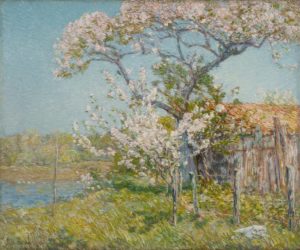
Childe Hassam, Apple Trees in Bloom, Old Lyme, 1904. 25 x 30 in., Florence Griswold Museum, Gift of the Vincent Dowling Family Foundation in Honor of Director Emeritus Jeffrey Andersen.

Visitors to the Museum will be greeted with a new exhibition, Fresh Fields, which is a celebration of the Museum’s most beloved landscape paintings created by Impressionist artists who visited Old Lyme. The exhibition opens July 7 and runs through Nov. 1.

The selection highlights major recent acquisitions, such as Childe Hassam’s Apple Trees in BloomOld Lyme (1904), and emphasizes ongoing research about the local landscape that informed development of the Artists’ Trail.

Paintings, drawings, archival materials, and photographs will shed light on the history and ecology of Old Lyme, which caused it to become a gathering place for artists.

The exhibition also calls upon the knowledge and viewpoints of outside experts to build an interdisciplinary understanding. In addition to the Museum’s own curators and art history scholars, contributors will include an ecologist, members of the local Native American community, and experts on women’s history and African-American history.

Fresh Fields relies on those with expertise in these areas to help create a more complete understanding of the human history, culture, and values that shaped these Impressionist landscapes.

Editor’s Note: Remember that the Museum grounds are open and in bloom now — no need to wait for the reopening of the Museum to enjoy them!

A New Independence Day Parade Tradition Starts on Rogers Lake

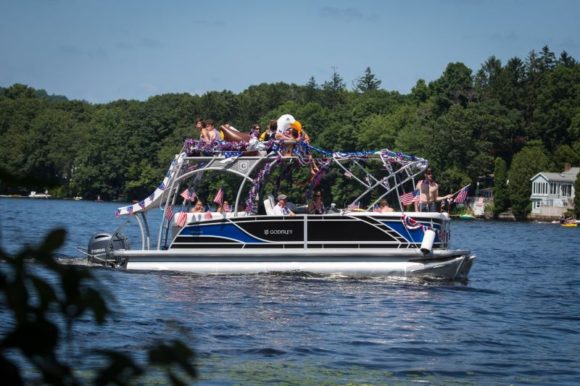
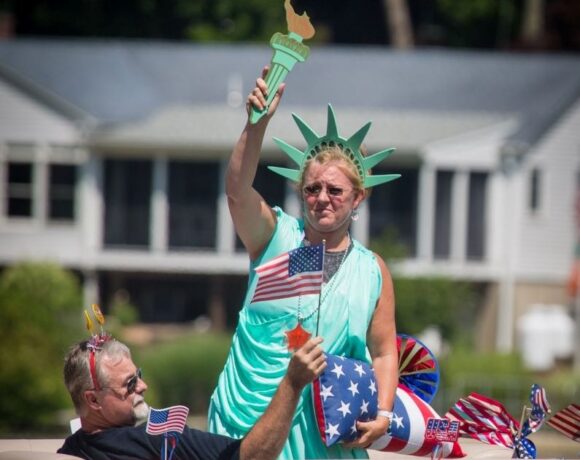
In the spirit of Independence Day, Lady Liberty stood tall on board one of the boats.

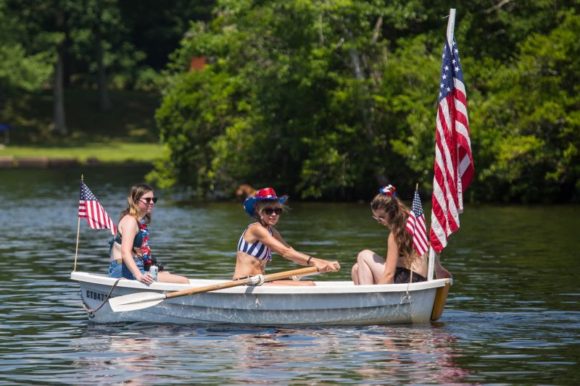
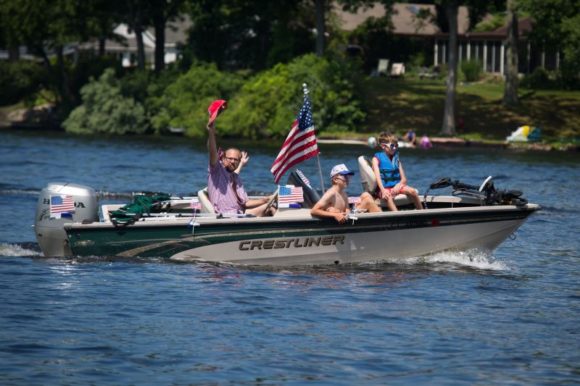
OLD LYME — Undoubtedly disappointed that both the Sound View and Lyme Independence Day parades were cancelled this year due to COVID-19 concerns, Rogers Lake residents took matters into their own hands and came up with an inspired solution to the social distancing issue associated with parades.

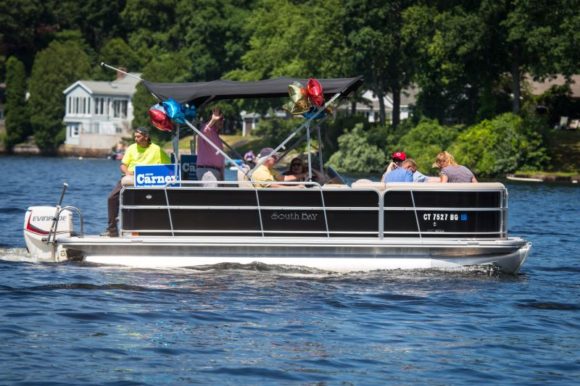
Rogers Lake West Shores Association President Dave Evers (standing center) waved cheerfully to the lakeside onlookers.

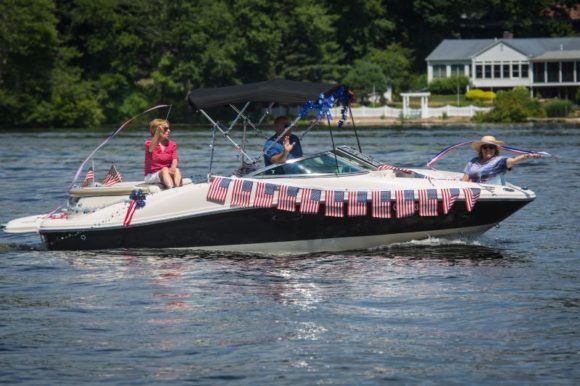
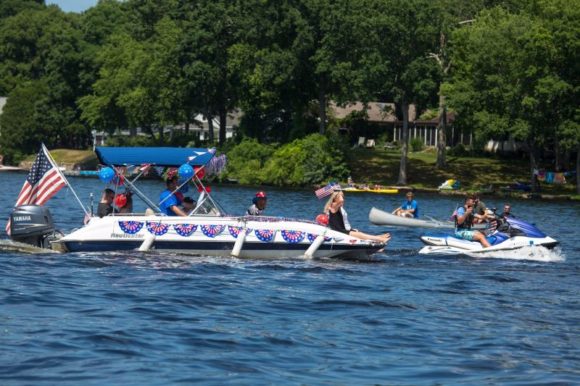
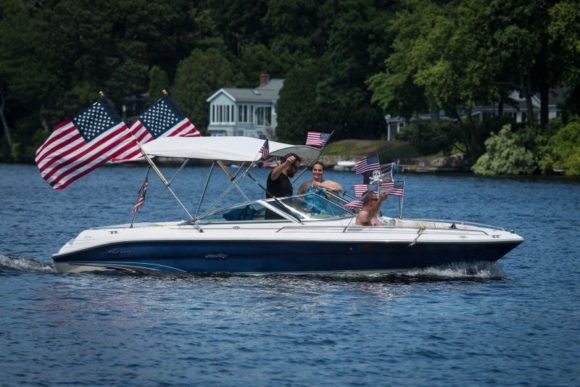
They organized at very short notice the “1st Annual Rogers Lake 4th of July Boat Parade,” which was held Saturday morning. It lasted over and hour and was in the words of the Rogers Lake West Shores Association (RLWSA) Facebook page author, “a complete success.”

Appropriately-decorated boats of all shapes and sizes joined the cheerful parade, which Maureen Plumleigh described succinctly to LymeLine as, “Colorful, noisy and just plain fun.”

State Rep. Devin Carney (R-23rd) took the opportunity to enjoy the day out on the water … and do a little campaigning for the upcoming election!

We are very grateful to the RLWSA for sharing their great photos with us of this wonderful new tradition so that our readers can now enjoy the event too!

Flags … and fun!


Reading Uncertainly? ‘Code Red’ by E.J. Dionne

Would you be eager to read a book that is sub-titled “How Progressives and Moderates Can Unite to Save Our Country?

If you lean to the right, probably no; to the left, sure. But as I am a determined independent, I paused.

Dionne is a well-known commentator on evening news programs, a columnist for the Washington Post, and on the faculty of both Georgetown  and Harvard Universities. Whenever I have heard him on the news he has been clear, challenging and articulate.  So I read this book.

We seem to hear nothing but complaints and savage accusations these days, gloom and potential doom; the few of “us” fighting of all of “them.” Dionne opens his treatise with “a spirit of hope, but with a sense of alarm.” Not “doom” but alarm. And that dual sense dominates his entire argument.

He writes, “In a democracy, there are no final victories – or defeats.” We simply evolve imperfectly and with stuttered steps. Dionne suggests that one possible course of action is to try and enlist two “groups” – the moderates and the progressives – to work more closely together for necessary changes in this country.

First, a problem of labels: why are we so willing to plant a defining title on almost everyone? This denies the inherent complexity of each one of us.

Far too often we are assigned a label: left; right (but not up or down!); alt-right; conservative; moderate; progressive; lefty; socialist. The Scandinavian states are labeled “socialist” but many of us might well prefer to live in those societies rather than in our tumultuous group of states.

Dionne notes “… our tendency to confuse labels and reality,” denying our natural human individuality. We are also too quick to assign each one of us to a “class,” another artificial sorting that brings confusion and increasing distance.

Well into his thesis, Dionne quotes Stephen Pearlstein, “ The wealth of nations depends on the vigorous pursuit of self-interest by individuals whose natural and productive selfishness is tempered by moral sentiments such as compassion, generosity and a sense of fair play.” That’s our continuing difficulty: dealing with our natural human altruism and selfishness.

Dionne doesn’t dump all those to his right, but he suggests a first step begin with bringing two “groups” together in an effort to change things. His three themes: First, “a more democratic political structure” reducing the power of money and “the influence of the connected”. Second, addressing “the fraying of community and family bonds”, and third, to “experiment with more ambitious regional and place-based policies”.

In other word, decentralize: more responsibility for states, cities, and towns. It is “our obligation to challenge a system that guarantees only the freedom that money can buy.” Dionne’s suggestion: “the politics of visionary gradualism.” Slow but sure …

Dionne wants to replace a nation of numerous and fractious labels, snarling at each other through social media, with “a sense of ‘we’ … belonging and connectedness … provide the fiber for a health democratic polity.” This requires mutual respect and a willingness to listen, politely, to each other.

Is this possible? Dionne concludes his challenge, “This book offers what might be called articles of conciliation … We must learn to say, ‘We’ about all of our fellow-citizens – and mean it.”

Time to start?

Editor’s Note: ‘Code Red’ by E. J. Dionne is published by St. Martins Press, New  York 2020

Felix Kloman

About the Author: Felix Kloman is a sailor, rower, husband, father, grandfather, retired management consultant and, above all, a curious reader and writer. He’s explored how we as human beings and organizations respond to ever-present uncertainty in two books, ‘Mumpsimus Revisited’ (2005) and ‘The Fantods of Risk’ (2008). A 20-year resident of Lyme, Conn., he now writes book reviews, mostly of non-fiction, a subject which explores our minds, our behavior, our politics and our history. But he does throw in a novel here and there.
For more than 50 years, he’s put together the 17 syllables that comprise haiku, the traditional Japanese poetry, and now serves as the self-appointed “poet laureate” of Ashlawn Farm Coffee, where he may be seen on Friday mornings. His late wife, Ann, was also a writer, but of mystery novels, all of which begin in a village in midcoast Maine, strangely reminiscent of the town she and her husband visited every summer.