A Different Memorial Day Ceremony, But One Still Marked with Tradition, Respect and Gratitude

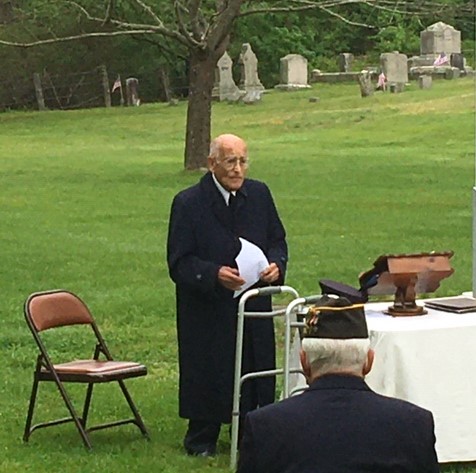
Old Lyme Fire Department Chaplain Mervin Roberts reads the Homily at the Memorial Day Service hosted by the local VFW and held in Duck River Cemetery.

OLD LYME — UPDATED MAY 27 — Members of the local Veterans of Foreign Wars (VFW) held a short Memorial Day ceremony yesterday morning in Duck River Cemetery in Old Lyme. They were joined by around 20 members of the public despite the unseasonably chilly conditions.
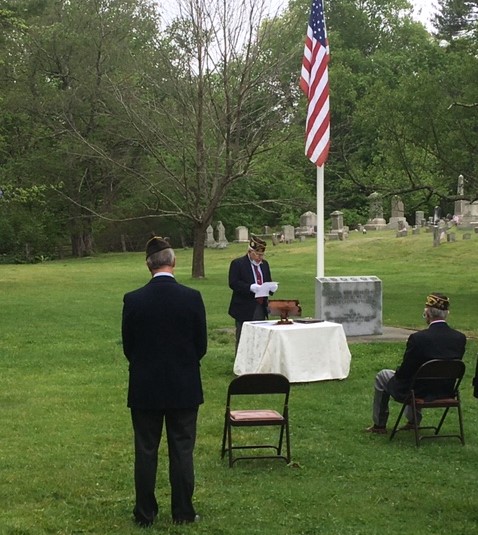
VFW Commander David Griswold, pictured above, started with a short business meeting, which included both a prayer and the observation that what makes America best is its people.


Retired Navy Captain Larry Olson of the USS Maine, pictured above, served as Master of Ceremonies. He noted his Navy service lasted 37 years under 15 different commands and commented, “I thought each one was the best and the greatest of all.”

Olsen said he believed that Navy personnel are characterized by, “character, daring, and resourcefulness.“

Stressing , “The pandemic can’t stop us from uniting,” Olsen then paraphrased the words of President John F. Kennedy saying we should never forget that what is important is not to utter words, but to live by them. He also cited The Bible, which states, “The greatest love is to lay down one’s life for one’s friend.”
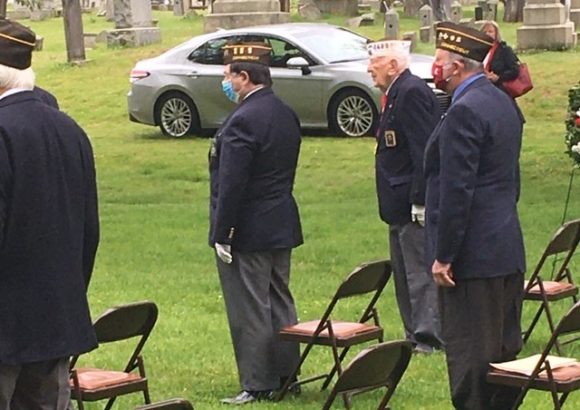
VFW member Bob Roser, center in photo above, led the group in the Pledge of Allegiance.
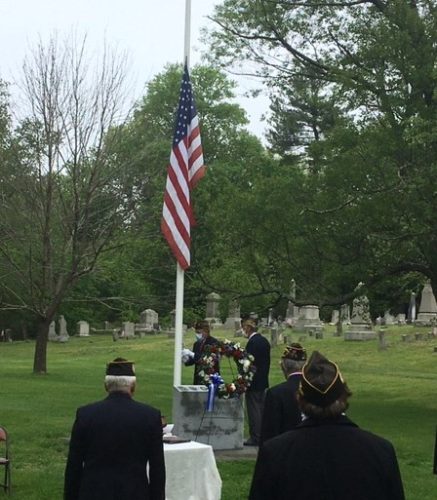
Old Lyme First Selectman and VFW member Tim Griswold (left at flagpole) and VFW member Ed Shyloski raise the flag from half staff …
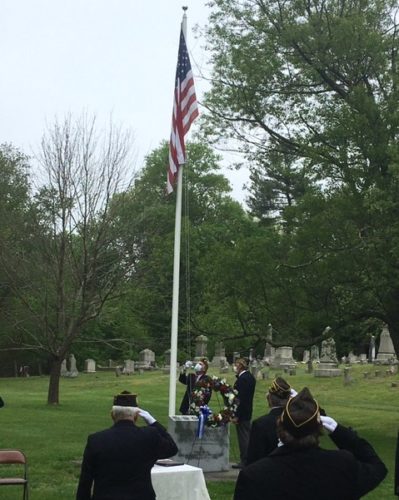

… to full staff as fellow VFW members salute.
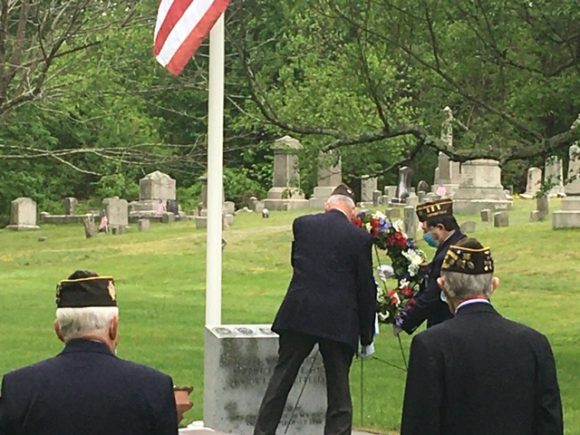

VFW members Ron Boremski and Joe Lacasse placed the wreath commemorating all those who had made the ultimate sacrifice while serving in the US Armed Forces.
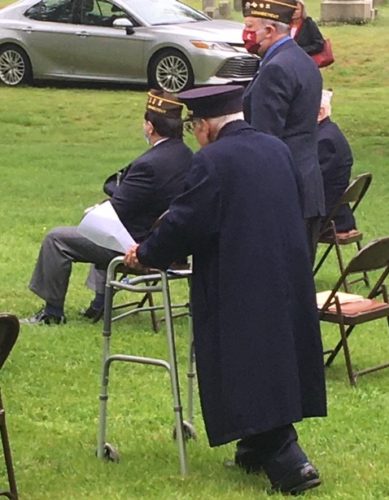

Then the Old Lyme Fire Department (OLFD) Chaplain, 98-year-old Mervin Roberts, began to make his way to the podium to give the Homily.
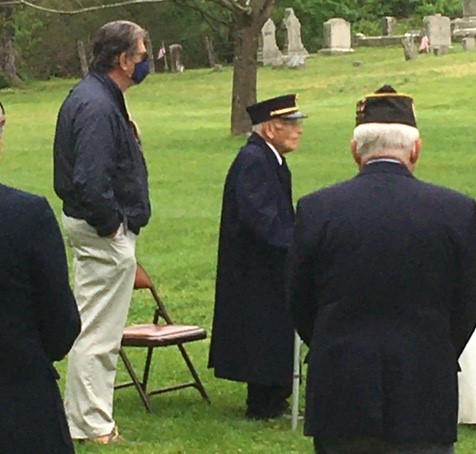
Roberts, who has served as Chaplain for 50 years, read the Homily. A video of him reading it was made prior to the service since it was uncertain whether he would be able to attend the ceremony. View the video at the link below.

After he had read the Homily, Roberts was presented with an award (see below) for his service to the VFW.
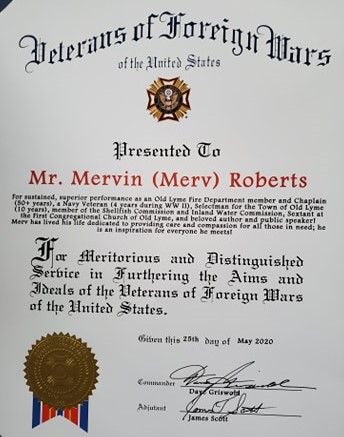
Watch a video of the presentation at the link below.

Ret. Navy Captain Larry Olsen ended the ceremony with these words, “In conclusion, this year we not only remember fallen heroes, we thank all who served and all who say thanks to us for serving. But besides the military, this year we thank all in healthcare, lab workers, police and fire personnel, teachers who meet the challenge in this new environment, elected officials all who grow and serve food, all citizens who do right. They are all part of the fabric that makes this the greatest nation.”

After the ceremony, Roberts’s friend and fellow OLFD member Bob Doyen (left in photo below) walked with Roberts back to his car following receipt of his award. Doyen, who is Old Lyme’s current Citizen of the Year, was ready to stand in and deliver his Homily for Roberts should the latter not have been able to speak at the ceremony.
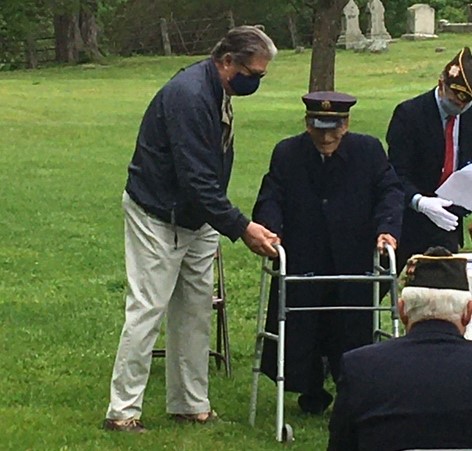
We are all delighted that Mr. Roberts was able to be there along with members of his family, who requested to express their thanks through LymeLine to the VFW for allowing Mr. Roberts to participate.

The text of the Homily read by Roberts is as follows:

As I review my previous Memorial Day homilies, I’ve come to realize that there is a pattern unfolding.  Taken together, they help to tell us why we are here again in this cemetery. I’ve had the occasion, and the challenge, to explore with you how and why we voluntarily meet here on this designated day to celebrate the lives and mourn the passings of preachers, teachers, siblings, parents, ancestors, neighbors, heroes, government officials, duck hunters, bird watchers, conservation commissioners, friends, lovers, spouses, artists, musicians, fishermen, cow farmers and others.

Truly a web of life.

There were people I knew who sometimes quit too soon and some who might have done better if they quit sooner. Perhaps it is our very individual differences that are a clue to our overall success as a species.  Certainly we are not all alike. In this world full of predators, parasites, and unforeseen diseases, if we were all alike, we would all have succumbed to whatever it was that struck.

But that has not been the case and somehow I suspect our fate lies elsewhere.

So let’s revel in glories of our various lives, our music and other arts, our religious faiths and, high on my list, our love for each other, for certainly what others have done for us should be an inspiration to all to keep up their good work. Here in Lyme and Old Lyme we have homes or resting places of so many people who lived here and left us with something to remember them by.  Let me mention a few in no particular order:  

  • Jim Noyes, who participated in beach landings in the Mediterranean In World War II, and  
  • Belton Copp, who left an arm in the Philippines, and 
  • Silver Star awardee Jack Appleby, and
  • Ezra Lee who was esteemed by Washington, and
  • Clara Noyes who drew thousands of women into World War 1 as nurses, and
  • Roger Tory Peterson, who helped us appreciate birds, and
  • Amy Henry, who taught hundreds of our children how history matters, and
  • E. Lea Marsh, who gave us whole generations of Borden Elsies.

They are not alone. 

From my own life, I would recount just one example.  My late wife Edith and I had born to us six children, the last being William John, named for one of his grandfathers.  Billy had Down syndrome. He was loving, kind, generous, sociable, and academically very limited. We could have had him live in an institution as was the common practice at that time, but instead we kept him home.  Here the Lyme Old Lyme Board of Education provided as much help as he could benefit from and, lo and behold, limited as he surely was, we, his family and our neighbors accepted him for what he was.

Now Dick and Jane Bugbee knew us. Dick and I were both duck hunters. Dick painted houses.  Jane taught piano. Although our homes were about one-half mile apart, Billy would occasionally meander over to visit Jane.  We didn’t take him there, or even show him the way or even suggest his movement.  He just found his own way and Jane would phone Edith that her son Billy was there having a cup of tea, and when he was through, Jane would see him start on his own way back home. 

No alarm of lost child, no social worker, no emergency, just Billy Roberts visiting for a cup of tea.  This is but an example of how this web of life worked for us. We certainly owe the people of Old Lyme our gratitude for everyone’s help. 

Incidentally, Billy was a strong supporter of the Old Lyme Fire Department and was elected an Honorary Member. 

On a personal note, I’ve been a member of this same Department since 1960, but now frail in my 98th year, I can no longer remain active as Chaplain. This, then, will probably be my last homily. 

I thank you for the opportunity to serve.

Reading Uncertainly? ‘How Democracies Die’ by Steven Levitsky and Daniel Ziblatt

Two learned Harvard professors open this provocative challenge to many of our conventional beliefs with a brief sentence: “We feel dread  …” Their worry – that “democracy” as we have known it may be seriously threatened: “Democracies may die at the hands not of generals but of elected leaders … who subvert the very process that brought them to power.”
They cite Hitler, Chavez, Castro, Putin, and Erdogan, among past and current elected leaders who trashed democracy, even when some of them retained popular support.

What is democracy?

These professors define it as “a system of government with regular free and fair elections, in which all adult citizens have the right to vote and possess basic civil liberties such as freedom of speech and association.”

But, given the enormous explosion of human population and the way social media can manipulate many of us, are the precepts of democracy and our “Madisonian system of checks and balances,” still workable?

Our system in this country seems to be based on a desired but frequently non-existent “balance” among executive, legislative, and judicial branches of government, at local, state, and national levels

They continually pose difficult questions in this book:

  • Are “political parties democracy’s gatekeepers?” Are only two the best course (as in the U.S. and U.K.), or are many better (13 now in Switzerland)?
  • Who or what is an “extremist”? Do open primary elections encourage “extremists’? Do they encourage an enormous flow of money?
  • Are we in the midst of a “collective abdication” of the rules of democracy”?
  • Do “neutral arbiters” (the judiciary, for example) even exist?
  • Do “national referenda even serve a useful purpose, when society is fractured and when social media can move large numbers of voters in different directions almost instantly?

One of the authors’ fascinating chapters is a study of elected authoritarians, citing Peron (Argentina), Correa (Ecuador), Orban (Hungary), Berlusconi (Italy), Fujimori (Peru),  Kaczynski (Poland), Putin (Russia), Erdogan (Turkey), Chavez (Venezuela) and, perhaps to come, AMLO in Mexico.

These Cambridge skeptics conclude (properly!) with more questions:

  • Is the “fundamental problem facing American democracy (our) extreme partisan division?”
  • Is a  “multiethnic democracy in which no ethnic group is in the majority” truly possible? See Switzerland now …
  • Is it possible to be “both multiracial and genuinely democratic”?
  • Is trust possible?

There seem to be two critical norms for the continuation of “democracy”: the first is institutional forbearance (don’t try to control and manage everything) and natural toleration (respecting the opinions and habits of other others), but far too often religious beliefs and ethnic habits tend to corrupt our political universe.

Editor’s Note: ‘How Democracies Die’ by Steven Levitsky and Daniel Ziblatt is published by Broadway Books, New York 2018.

About the Author: Felix Kloman is a sailor, rower, husband, father, grandfather, retired management consultant and, above all, a curious reader and writer. He’s explored how we as human beings and organizations respond to ever-present uncertainty in two books, ‘Mumpsimus Revisited’ (2005) and ‘The Fantods of Risk’ (2008). A 20-year resident of Lyme, he now writes book reviews, mostly of non-fiction, a subject which explores our minds, our behavior, our politics and our history. But he does throw in a novel here and there.
For more than 50 years, he’s put together the 17 syllables that comprise haiku, the traditional Japanese poetry, and now serves as the self-appointed “poet laureate” of Ashlawn Farm Coffee, where he may be seen on Friday mornings. His late wife, Ann, was also a writer, but of mystery novels, all of which begin in a village in mid-coast Maine, strangely reminiscent of the town she and her husband visited every summer.

Lyme-Old Lyme High School, Middle School Announce Quarter 3 Honor Rolls

Lyme-Old Lyme High School
Quarter 3 Honor Roll 2019-2020

HIGH HONORS

Grade 12:

Charles Ames, Emma Bass, Audrey Berry, Madison Cann, Faith Caulkins, Rory Cavicke, Emilia Cheesman, Elizabeth Cravinho, Arianna DelMastro, Maria Denya, Raymond Doll, Theodore Enoch, Nicholas Fava, Leah Fouquette, Tanner Griffin, Samuel Guenther, Grace Hanrahan, Parker Hubbard, Lauren Huck, Jeffy Joshy, Caroline King, Renate Kuhn, Rachael Larson, Brenna Lewis, Connor Maguire, Melissa Mauro, Thomas McCarthy, Ryan McTigue, Natalie Meyers, Maxwell Morrissey, Chandler Munson, Kyle Myers, Samantha Olson, Cajamarca Pelaez, Carter Popkin, Jenna Porter, Andre Salkin, Jane Scheiber, Brady Sheffield, Garrett Smith, Emily Speckhals, Alec Speirs, Evan St.Louis, Olivia Stack, Haley Stevens, Olivia Tetreault, Taylor Thompson, Lydia Tinnerello, Sydney Trowbridge, Kiera Ulmer, Jackson Warren, Theodore Wayland, Trevor Wells, Nicholas White, Anna Williams, Anna Williams, Maggie Wisner, Conner Wyman, Katherine Zelmanow

Grade 11:

Juliette Atkinson, Rachel Barretta, Maxwell Bauchmann, Ava Berry, Emma Boardman, Kyuss Buono, Kate Cheney, Hunter Collins, Emerson Colwell, Megan Cravinho, George Danes, Sadie Frankel, Fiona Frederiks, Eveliz Fuentes, Jackson Goulding, Schuyler Greenho, Emma Griffith, Isabella Hine, Isabella Hine, Paige Kolesnik, Avery Lacourciere, Grace Lathrop, Owen Macadam, Luke Macy, Elle McAraw, Riley Nelson, Connie Pan, Lauren Pitt, Ezra Pyle, Jacob Quaratella, Hayden Saunders, Tait Sawden, Jesper Silberberg, Tessa St.Germain, Lian Thompson, Katrina Wallace, Lauren Wallace, Kelly Walsh, Alison Ward

Grade 10:

John Almy, Grace Arnold, Hannah Britt, Anne Colangelo, John Conley, Elias D’Onofrio, Elizabeth Duddy, Eleanor Dushin, Samantha Geshel, Ethan Goss, Austin Halsey, Madison Hubbard, Fiona Hufford, Zoe Jensen, Julia Johnston, Nevin Joshy, Kian Kardestuncer, Cora Kern, Robyn King, Michael Klier, Felse Kyle, William Larson, Reese Maguire, Abigail Manthous, Stephanie Mauro, Jacob Meyers, Evan Morgan, Elle Myers, Brendan O’Brien, Michael O’Donnell, Bella Orlando, Jacob Ritchie, Margaret Rommel, Lloret Sala, Olivia Schaedler, Calvin Scheiber, Abby Speckhals, Drew St.Louis, Nikolai Stephens-Zumbaum, Victoria Stout, Maverick Swaney, Aidan Ward, Melanie Warren, Ellie Wells

Grade 9:

William Barry, Callie Bass, Livie Bass, Cooper Bowman, Gillian Bradley, Ava Brinkerhoff, Jamie Bucior, Gretchen Burgess, Sarah Burnham, Hayley Cann, Liam Celic, Grace Colwell, William Danes, Anna Davis, John Eichholz, Zachary Eichholz, Alexis Fenton, Clarence Hinckley, Willa Hoerauf, Karissa Huang, Aidan Kerrigan, Phoebe Lampos, Theodore Lampos, Jonah Lathrop, Marielle Mather, Madalyn McCulloch, Caden Monte, Calvin Monte, Cooper Munson, Alexander Olsen, Olivia Powers, Kelsey Pryor, Izzadora Reynolds, Benjamin Roth, Rhyleigh Russell, Anders Silberberg, Alyssa Spooner, Tova Toriello, Kaitlyn Ward, Harry Whitten, George Williams

HONORS

Grade 12:

Anabella Arias, Callum Astley, Emily Balocca, William Bartlett, Chloe Cahill, Sarah Conley, Ty Dean, Emily Evers, Araselys Farrell, Jada Fuentes, Sophia Griswold, Darin Hamou, Kamber Hamou, Connor Hogan, Benjamin Kelly, Daniel Kendall, Jared Ritchie, Colby Sides, Summer Siefken, Megan VanSteenbergen, Clair Wholean

Grade 11:

Kaylee Armenia, Sonia Bair, Keenan Burr, Martinez Carcamo, Chloe Cleveland, Jackson Cowell, Patrick Dagher, Paige Davis, Francette Donato, Corah Engdall, Leslie Farrell, Lillian Grethel, Regan Kaye, Mackenzie Machnik, Emma McCulloch, Brendan McTigue, Marina Melluzzo, Michael Milazzo, Timothy O’Brien, Sophia Ortoleva, Olivia Papanier, Gavin Porter, Aidan Powers, Julie Rudd, Isabella Smith, McKenzey Thompson, Katelyn Zbierski

Grade 10:

Mason Bagwell, John Caulkins, Evan Clark, Ryan Clark, Chadwick Coughlin, James Creagan, Lauren Creagan, Michael DeGaetano, Victoria Gage, Nicolette Hallahan, Lillian Herrera, Olivia Lecza, Langley Marshall, Emily Mesham, Samuel Mullaney, Adeline Riccio, Aidan Russell, Frank Sablone, Abigail Sicuranza, Parker Sprankle, Parker Sprankle, Daniel Stack, Daniel Stack, Olivia Turtoro, Evan Visgilio, Riley Warecke, Riley Warecke, Mary Wholean, Paige Winchell, Avery Wyman

Grade 9:

Whitney Barbour, Luke Celic, Alexander Chrysoulakis, Kylie Dishaw, Archer Evans, David Evers, Mason Freer, Arber Hoxha, Owen Ingersoll-Bonsack, Madison Krol, Karleigh Landers, Monique Lavoie, Ford Macadam, Sophia Marinelli, Joseph Montazella, Alain Pecher-Kohout, Jacob Rand, Santiago Rodriguez, Eli Ryan, Dylan Sheehan, Ned Smith, Joseph Steinmacher, Samantha Tan, Quinn Williams, Lea Wilson

Lyme-Old Lyme Middle School
Quarter 3 Honor Roll 2019-2020

HIGH HONORS

Grade 8:

Emma Bayor, Oliver Berry, Alis Bicic, Drew Brackley, Natalie Buckley, Sarah Colangelo, Ava Cummins, Ella Curtiss-Reardon, Eric Dagher, Lucas DaSilva, Eva D’Onofrio, Amelia Gage, Ryder Goss, Sydney Goulding, Nyla Goulis, Alexis Grasdock, Justin Green, Katherine Gryk, Abby Hale, Nathaniel Heon, Agatha Hunt, Beatrice Hunt, Sabina Jungkeit, Emmerson Kaye, Brodie Lippincott, Anna McAdams, Griffin McGlinchey, Delaney Nelson, Isabelle O’Connor, Jack Porter, Luisa Raby, Cailin Ruhling, Owen Snurkowski, Hannah Thomas, Gabriel Tooker, Louisa Warlitz, Mason Wells, Summer Wollack

Grade 7:

Christopher Anderson, Emma Arelt, Quinn Arico, Ella Austin, Natalie Barndt, Molly Boardman, Chase Calderon, Andrew Clougherty, Tabitha Colwell, Chloe Datum, Andrea DeBernardo, Zoe Eastman-Grossel, Caeli Edmed, Anna Eichholz, Grace Ferman, Benedict Frazier, Hoshena Gemme, Marcella Gencarella, Ava Gilbert, Henry Griswold, Jonathan Harms, Kaela Hoss, Rowan Hovey, Kyle Ingersoll-Bonsack, Simon Karpinski, Olivia Kelly, Ella Kiem, Peter Kuhn, Ada LaConti, James Lahot, Elise Leonardo, Evan LeQuire, Andrew Liu, Hannah Miller, Abigail O’Brien, Kanon Oharu, Sophie Pennie, Mutia Quarshie, Drea Simler, Morgan Standish, Kathleen Walsh

Grade 6:

Charlotte Antonino, Zoe Brunza, Alec Butzer, Makayla Calderon, Tyler Cann, Julia Clark, Colman Curtiss-Reardon, Christopher Dagher, James Dahlke, Sophia D’Angelo, Synthia Diaz, Rose Dimmock, William Donnelly, Gabrielle Field, Arthur Fusscas, Eric Fusscas, Chase Gilbert, Alexander Glaras, Benjamin Goulding, Scarlette Graybill, Christopher Kachur, Thomas Kelly, Katherine King, Jade Lawton, Maya LeQuire, Jayden Livesey, Emily Looney, Ian Maeby, Elise Marchant, Yanza Marin, Yanza Marin, Samuel Masanz, Bridget McAdams, Carter McGlinchey, Jeremiah Miller, Ryan Miller, Eiley Montanaro, Sybil Neary, Nina Nichols, Ryan Ortoleva, Quenten Patz, Jenna Salpietro, Luca Signora, Emma Singleton, Charlotte Spiegel, Addison Spooner, Carson St.Louis, Andrew Taylor, Margaret Thuma, Lucian Tracano, Madeleine Trepanier, Connor Vautrain, Eve Videll, Elisabeth Viera, Warren Volles, Edith Williams, Julius Wilson, Oliver Wyman, Carl Zapatka, Katherine Zhang

HONORS

Grade 8:

Peighton Andrews, Elliot Bjornberg, Douglas Griswold, Grady Lacourciere, Luke Legein, Matthew Miller, Katherine Mullaney, Ronald Olin, Haley Shaw, Keara Ward, Tyler Wells

Grade 7:

Micah Bass, Gavin Biega, Nathaniel Bradley, Mark Burnham, Hannah Johnston, Elizabeth Lopez, Colette Marchant, Filip Pecher-Kohout, Audrey Spiegel

Grade 6:

Alexa Donovan, William Landon, Sebastian Lopez-Bravo, Michael Nickerson, Ryan Olsen, Madeline Power, Isabella Presti, Jacob Prokopets, Taylor Quintin, Tanner Snurkowski, Meredith Thompson, Gabriel Waldo

Letter From Paris: Thoughts on Life Under Lockdown in Fontainebleau, How France Has Coped With COVID-19

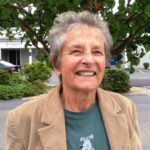
Nicole Prévost Logan in Paris prior to the lockdown.

There have been many deadly pandemics in the history of the planet but this is the first time ever that one has affected so many people. COVID-19 forced half the world population – or more than three billion – into confinement. I guess this is the price one has to pay for living in a globalized world. Each country handled the coronavirus crisis in a different way.

How did Europe, and more particularly France, manage the virus outbreak, both during the stay-at-home period and after the relaxation of the rules?

Like many people, I escaped the approaching lockdown of large cities – in my case the French capital of Paris.

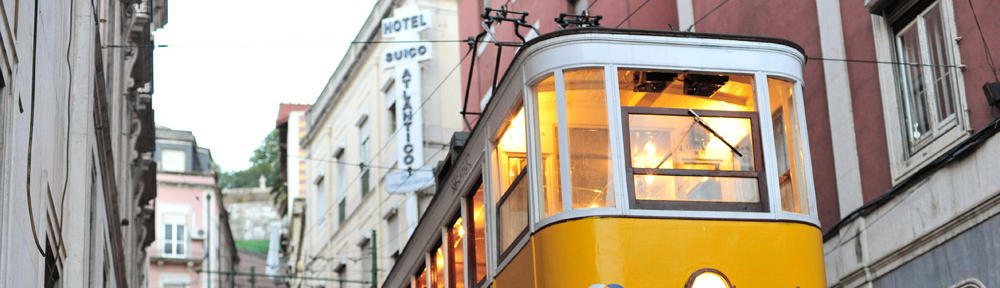
The famed Château de Fontainebleu. Published under the terms of the GNU Free Documentation License.

On March 16, I left Paris on what I thought would be an extended weekend but turned out to be eight weeks, and was fortunate enough to stay with my daughter in Fontainebleau.  Only a 40-minute train ride south east from Paris, Fontainebleau is a lively town of 15,000 inhabitants, famous for its 12th century chateau restored and enlarged by generations of kings.

During the period of “confinement” – as the lockdown is called here – technology became quite helpful. People exchanged news and jokes across the globe, using WhatsApp; some did yoga or gym watching  YouTube; meetings took place via  Zoom;  people on Skype remained safely behind the screen while they urged other to stay home, and a French actor read La Fontaine fables on Instagram. In other words  globalization had not ended … it just had become virtual.

A feeling of anguish never went away. Week after week, one watched hospital scenes with medical staff and caregivers hovering over patients disappearing under respirators, ventilators, machines of all types connected by wires and tubes. We, the spectators, became numbed by so much suffering.

Every night the head of the health  department gave frightening, sometime confusing information. On TV all we saw were doctors, surgeons, epidemiologists, and doctors specialized in intensive care. Politics, economy, even social conflicts had been moved to the back burner.

In France, late March was the most frightening time. We were at the bottom of the curve showing an acceleration of the virus and feared a tsunami . It was on March 23 that the stock market fell to the lowest point, losing 40 percent from its high. The world was collapsing around us.

I attempted to read “The Plague” by Albert Camus, published  in 1947. Bad idea! The  description of the ghastly symptoms and of the panicked Oran population became unbearable. The story resonated too much with what we were going through.

The epidemic in France started in the Grand Est. A group of 2000 evangelists had gathered for a week of fasting in Mulhouse.  The area became the epicenter of the outbreak. Very soon it was joined by the heavily-populated Ile de France with Paris at its center.

France has been one of the countries hardest hit by the virus. Actually it ranks as fifth for the number of deaths, after the US, Russia, Italy and the UK.

The objective of the French government was to make sure that the medical facilities would be able to absorb the sudden surge of infected people. Chaos was avoided thanks to planning ahead. At the height of the crisis, transfers of patients were organized to areas less affected by the virus, and to other countries like Germany or Switzerland. Helicopters, fast trains, military planes, boats … all means of transports went into action.

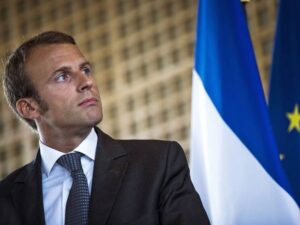
French President Emmanuel Macron.

The Macron government showed compassion during this difficult time, expressed gratitude toward the caregivers, and showed humility in its limited ability to cope with such an  unprecedented situation. In other words it appeared human … while also gaining a few points in the polls.

The government took unparalleled measures compared to most other countries. It gave temporary unemployment status – with up to 90 percent of a person’s salary covered – to one out of three wage earners – or 13 million people. Some taxes were cancelled, and bonuses distributed. The total of this largesse reached 120 billion Euros. The Maestrich Treaty rule of capping European Union (EU) members’ deficit at 3 percent is now forgotten. The French national debt, usually limited to 60 percent of the Gross Domestic Product, doubled.

The management of the coronavirus crisis did not go without a number of hiccups however. The main one was the shortage of masks. It has been a source of irritation throughout. On the advice of medical experts, the government kept saying that the masks were useless except when used in public  places. It stressed that priority should be given to the medical staff who are battling the disease on the front line.

The real reason for this policy soon exploded into a scandal; in reality, there were not enough masks. Frantic orders were placed in other countries, mainly China. At one point, one witnessed a real war of the masks. Some shipments were burglarized, other rerouted.  One shipment intended for Italy was confiscated on its arrival at Prague airport and, in another case, France took over a shipment on its way to Sweden. On the eve of the “deconfinement” masks were still hard to find.

Another criticism of  the crisis management has been the insufficient  number of testing facilities.

One does not want to be old at a time of pandemic because statistics do indeed show that older people are most vulnerable to the disease. At one point, a rumor started that “our fragile seniors” should remain locked up long after the rest of the population.

Fortunately for all the older people, Bernard Pivot, a most popular and entertaining moderator of a literary show on TV, rebelled one day. He was so funny and convincing that the government changed its policy and replaced age discrimination by health criteria.

It is a fact though that real carnage has taken place in nursing homes and retirement homes with assisted-living.

The stay-at-home rules were quite strict in France. Public gardens and forests (like the forest of Fontainebleau) were off-limit. Only a one-hour walk was allowed and no further than one kilometre from the person’s residence. A signed document and ID were required at all times. Dispensation was only granted for the imperative need to purchase food or medicine.

By mid-April, one began to see the light at the end of the tunnel when Macron gave May 11 as the date for the end of our, “deconfinement.”

The gradual opening up of society after that date was a cautious, arduous and very gradual process.  Prime Minister Edouard Philippe and his key ministers  spelled out the rules in a 60-page Protocol. A map showed France divided between red and green zones. The hardest task was to organize public transport in heavily populated areas as well as re-opening of the schools. Today there is a limit of 60 miles for travel from one’s residence. Cafés and restaurants remain closed in the red zones.

On June 3, the government will reassess the impact of loosening the rules. About 30 small “clusters” of contamination are popping out around France. Several of them are where people work in in slaughter-houses. But nothing to worry about (as yet).

At the outset of the COVID-19, France was just pulling out of months of strikes and social turmoil following the government’s structural reforms intended to modernize the country. The crucial retirement system was being debated in the Parliament. Overall, progress had been made under the Macron mandate: the economy was sound and unemployment at its lowest levels in years.

Then progress and turmoil came to a full stop almost overnight because of the pandemic.

Culture felt the brunt of the crisis. Cinemas, theaters, opera houses, concert halls, museums and festivals will stay closed until June.  The cancellation of the Cannes Festival was the worst blow.

Europe has been slow in tackling the coronavirus.  Ursula von der Leyden , president of the European Commission acknowledged that fact herself. A gigantic stimulus is being negotiated by the  EU members. Thierry Breton, European Minister of Internal Trade said, “Only solidarity can help the EU get back on its feet.”

But the “North countries” like The Netherlands and some Eastern European countries, including  Hungary, are balking at the idea of helping those hardest hit by the virus. On May 19, an accord between Macron and Germany’s Angela Merkel was a real breakthrough with a proposal to create a bond of 500 billion to help the EU recovery.  The 27 members have still to agree to it.

How did the French accept the lockdown? Surprisingly well … at least at first. But as the anxiety diminished, the opposition found its voice again, public opinion resumed its usual pastime of scrutinizing and criticizing every move by the government.

Bruno Lemaire, the French Minister of the Economy declared, “The hard part is ahead of us.” The main priority will be to assist three sectors:  aeronautics, the car industry and tourism. It is a unique opportunity to redirect the economy to be carbon-free.

But the future looks like a black hole with the economy under perfusion.

Let’s end with good news though. Beaches have reopened and travel restrictions are set to disappear in July and August … just in time for vacation!

Editor’s Note: This is the opinion of Nicole Prévost Logan.

Nicole Prévost Logan

About the author: Nicole Prévost Logan divides her time between Essex and Paris, spending summers in the former and winters in the latter. She writes a regular column for us from her Paris home where her topics will include politics, economy, social unrest — mostly in France — but also in other European countries. She also covers a variety of art exhibits and the performing arts in Europe. Logan is the author of ‘Forever on the Road: A Franco-American Family’s Thirty Years in the Foreign Service,’ an autobiography of her life as the wife of an overseas diplomat, who lived in 10 foreign countries on three continents. Her experiences during her foreign service life included being in Lebanon when civil war erupted, excavating a medieval city in Moscow and spending a week under house arrest in Guinea.

Lyme-Old Lyme $2.28 Million School Turf Field Moves Forward (from The Day)

OLD LYME — After receiving unanimous approval from the town’s Inland Wetlands and Watercourses Commission on Tuesday evening, it appears a proposed $2.28 million synthetic turf field project the Region 18 Board of Education is considering building is moving forward.

The 143,000-square-foot, all-weather, multipurpose field, if eventually approved by the Board of Education, will be located …

Read the full article by Mary Biekert and published on theday.com at this link