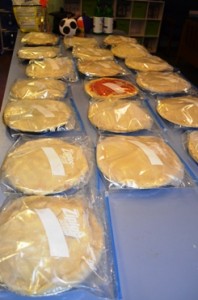
LYME — An old-fashioned Pie and Ice Cream Social will be held at the newly air-conditioned Lyme Public Hall on Sunday, Aug. 18 from 6:30 to 8 p.m.
Home-made pies of all kinds will be available for enjoyment. The cost per person is $5, with children age 6 and under free.
Pies will also be available for sale while they last. Entertainment will be provided by the Eight Mile River Band.
This event is sponsored by the Lyme Public Hall & Local History Archives, Inc.
It is a throwback to the early 20th century, when the Hall sponsored many such gatherings for the community.
The Lyme Public Hall is located at 249 Hamburg Rd. (Rte. 156) in Lyme, Conn. For more information, visit www.lymepublichall.org
The Lyme Public Hall & Local History Archives, Inc. is a non-profit organization dedicated to the appreciation of Lyme’s history, culture, and community through the preservation and use of the historic hall, its archives and historical programs.
All the fun of the Hamburg Fair ends today, Sunday, Aug. 16, at 6 p.m.
LYME, CT — Milestone Midway Carnival rides, kids games, food concessions, oxen-pull, arts and crafts, and top local musicians are among the favorite attractions for visitors attending the annual Hamburg Fair, now celebrating its 118th year. Hosted by The Lyme Grange, the fair takes place rain or shine Friday, Aug. 16, from 5 to 10:30 p.m., Saturday, Aug. 17, from 9 a.m. to 10:30 p.m. and Sunday, Aug. 18, from 9 a.m. to 6 p.m. at 1 Sterling City Road, Lyme, Conn. (located at the intersection of Rte. 156 and across from Reynolds’ Subaru).
General admission to the fair is $7 per person, children up to age 12 are free. Senior Citizens and Active Service men and women receive a reduced rate of $5 per person (ID required). Tickets are available for purchase at the entrance and $5 parking is offered on and nearby the site.
The three-day family friendly fair showcases many agricultural fair traditions including entries and exhibits for flowers, photography, crafts, quilts, fruits, vegetables and more. The intimate size of the fair makes for easy navigation, parking and crowd control.
Llamas are to love … at the Hamburg Fair!
Young fairgoers will enjoy children’s games offered on Saturday from 11 a.m. to 1 p.m., which will include a watermelon eating contest, face-painting, a three-legged race and prize-winning contests. Visitors are invited to watch the traditional horse pull on Saturday at 10 a.m., 4 p.m. and a new three-horse pull at 8 p.m. The oxen pulls will take place throughout the day on Sunday, beginning at 9 a.m.
Free on-stage music talent and entertainment has become part of the Hamburg Fair tradition. From country to rock, fiddlers to funk, there is something for everyone who enjoys live music.
The fair kicks off Friday evening music with performances in the amphitheater from country music favorites Charlie Marie and Nashville Drive.
See many local young artists hosted by Music Now and Nightingale’s Showcase on Saturday afternoon followed by A Completely Different Note – an a capella singing group from UConn featuring Braiden Sunshine, who will warm the stage up for Chris MacKay and the Toneshifters Saturday evening.
Sunday afternoon opens with something new – The Pickin’ Party, an all-inclusive musical experience where participants play and sing together as a group led by Ramblin’ Dan Stevens concluding with the traditional Bristol Old Time Fiddlers.
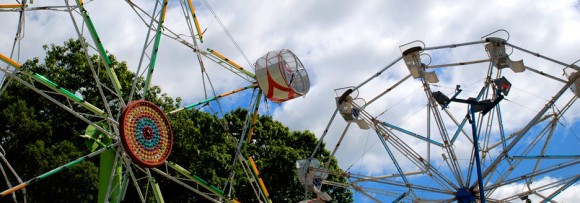
Rides are always a major attraction at the Fair.
The full musical entertainment line-up is as follows:
Friday
6:00-8:00pm: Charlie Marie – Country Music Duo
8:30-10:30pm: Nashville Drive – Rockin’ Modern Country Band
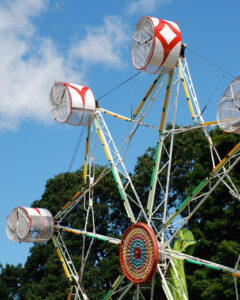
The ferris wheel at Hamburg Fair is always a popular attraction.
Saturday
1:00pm -5:45pm: Music Now/Nightingale’s Showcase – Up and coming local talent
1:00-1:20 Michael DeGaetano
1:25-1:45 Emily May
1:50-2:20 Jess Kegley
2:25-2:55 Chris Gregor
3:00-3:30 Drew Cathcart
3:40-4:15 Shook
4:20-4:55 Sophia and Addie
5:05-5:45 Whiskey and Aspirin
6:00-7:00pm: A Completely Different Note – Acapella singing group from UConn featuring Braiden Sunshine
7:30- 9:30pm: Chris MacKay and the Toneshifters – upbeat eclectic mix of rockabilly, swing and blues
Sunday
1:00-3:00pm: The Pickin’ Party – an all-inclusive musical experience where participants play and sing together as a group led by Ramblin’ Dan Stevens
3:00-6:00pm: Bristol Old Time Fiddlers
Highlighted Sponsors of the Hamburg Fair include Reynolds’ Subaru, Hamilton Point Investments, GeoMatrix, Maddy Mattson Coldwell Banker Bank, Benedetto Heating & AC LLC, Bogaert Construction, Guilford Savings Bank, Middlesex Health, LymeLine.com, Lyme Public Hall Association, Block Design Build, Sapia Builders, Allyson Cotton William Pitt/Sotheby’s, and New England Power Equipment.
Visit www.hamburgfair.org for fair schedule, exhibit entry, and more information.
The 118th Hamburg Fair is hosted by Lyme Grange #147 and organized by many local volunteers to build community relationships and create lasting family memories. Money raised from the event proceeds are used to fund the Grange Association, Lyme Fire Association and Lyme Ambulance Association.
It was the railroad trip from hell: the hottest day of the year, stuck for five hours on a sold-out Amtrak train where only half the cars had air conditioning.
The ride to Washington days earlier had been uneventful, almost on time and pleasantly cool, even though I’d made the mistake of taking a Northeast Corridor train, not Acela. Its older Amfleet cars, though recently refurbished on the inside, are still 50-years-old.
But coming back from Washington on a torrid Sunday, by cheaping out for the slower, less expensive train I got what I’d paid for. Put another way, I didn’t get what I’d paid for.
Already a half-hour late arriving in Washington from Newport News Va., train #88 arrived on one of DC’s low-level platforms, meaning boarding passengers had to cue up for about 30 minutes before even being allowed on the platform to board.
One of the station agents said that “extra cars” had been added in Washington, so I immediately headed to the front of the train where I assumed the new cars would be empty. It was already 98 degrees in DC, heading for a “feels like” high that day of 110, so I was looking forward to the super-AC Amtrak is known for.
No such luck, as even the newly added cars were only slightly cooler than outside. That’ll improve when we get going, I thought.
Wrong!
By Baltimore it was getting hot and the fan system was intermittent. Pleas for help to the conductors brought nothing more than promises that “they’ll try to reset the system in Philly,” another hour away.
In desperation I turned to social media, Tweeting sarcastically about Amtrak’s new “Sauna Cars”. Direct messaging to @Amtrak brought no response.
The train was getting later and later on its schedule, partly because of the heat’s adverse effect on the power lines and potential warping of the rails. Knowing there’d be a lot of passengers getting off and on in Philly, I plotted my move to one of the few cars with breathable air. Success … a cooler, though not cold, car with seats.
At Philadelphia, nothing changed, though we did learn that five of the 10 cars on this train bound for Boston carrying 700+ passengers were without air conditioning.
The DC conductor crew never apologized, though they did offer small, free bottles of water, which quickly ran out. But when a new set of conductors boarded in New York, the tone changed significantly.
“We apologize folks. This is not the kind of service we want to provide or you deserve. Please call 1-800-USA-RAIL and register a complaint. If the cars don’t reset after New York, we’ll try again at New Haven,” said one conductor on the PA system.
We got off in Stamford, arriving 90 minutes late, so I don’t know if the cars ever did get cooler during the next four hours run to Boston.
The next day I called Amtrak Customer Service. A 20+ year veteran agent commiserated, empathized and got me a refund voucher.
“Those old Amfleet cars shouldn’t be refurbished, they should be retired,” she said. “Their air conditioning is either on or off. There’s no moderating the temperature. Next time you should take Acela,” she added.
Never mind that Acela costs twice as much. Its AC works and it’s mostly on time! I’ve learned from my mistakes.
Posted with permission of Hearst CT Media
About the author: Jim Cameron is founder of The Commuter Action Group, and a member of the Darien RTM. The opinions expressed in this column are only his own. You can reach him at CommuterActionGroup@gmail.com For a full collection of “Talking Transportation” columns, visit www.talkingtransportation.blogspot.com
Okay, I am having more fun this summer than I have in, at least, two years.
Last year was fine, too, as was the summer before. But this year, I am pain-free, since I had my hip replacement on July 1. A couple of Sundays ago I went to our boules party and saw people I rarely see except during the summer and our Christmas party in early December. I am not on a team this year, but I was able to throw a couple of boules (the game itself is called pétanque, while the stainless steel balls are called boules, but we all call the game boules, too). If they need a fill-out a team for the next two games, I can actually play.
I am also having such a good time with my CSA (Community Supported Agriculture) produce. Unlike most farms, I can pick anything I want that is available at the farm stand. Last week I bought about eight pounds of tomatoes, some green frying peppers, a big loaf of bread (made by the chef of the Oyster Club in Mystic) and almost three bags of baby carrots.
Now, let us talk about baby carrots. The carrots I bought were about the length of my pinkie finger, but even thinner, and the carrot tops were still attached. They are nothing like the “baby carrots” you buy at the supermarket. Those carrots are pared and thrown into a machine to make them look as if they are all the same size.
Sure, they are really carrots, but the ones I bought are tiny, sweet and still taste like the soil they grew in. I ate a lot them, then made a carrot soup I chilled and served with a dollop of sour cream (or crème fraiche.) I found the recipe online, but added a few fillips.
Of course, feel free to use big or smaller supermarket carrots.
Chilled Baby Carrot Soup
3 tablespoons of extra virgin olive oil 1 mediumsweet onion, chopped 3 tablespoons fresh ginger, sliced thin 3 cloves fresh garlic, minced 1 pound of carrots, pared and diced (if they are really baby carrots, just clean them of tops and soil) 1 carton of low-salt chicken stock or vegetable stock One-half teaspoon each of salt and yellow curry (I was out of Indian curry so I added a little red chili paste) One-quarter teaspoon red pepper flakes (use less if you don’t like things too spicy) 1 can unsweetened coconut milk Salt and pepper to taste
In a heavy-bottomed stock pot, add oil over medium heat. Add onion, ginger and garlic. Cook until just translucent, about 5 minutes. Add diced carrots and cook for another 3 or 4 minutes. Add stock and cook until just boiling, then reduce heat and add salt and yellow curry (or a quarter teaspoon or less red or yellow chili paste and/or red pepper flakes). Cook on medium-low for about 30 minutes. Remove from the heat and let cool for at least an hour.
Using an immersion stick (which I do not have, I used my big Ninja), purée the soup. Put it back on the heat and add a can of coconut milk. Cook until hot and taste for seasoning. You can serve the soup hot, but I chill it and serve it cold with a dollop of sour cream or crème fraiche.
About the Author: Lee White, a local resident, has been writing about restaurants and cooking since 1976 and has been extensively published in the Worcester (Mass.) Magazine, The Day, Norwich Bulletin, and Hartford Courant. She currently writes Nibbles and a cooking column called A La Carte for the Times and Shore Publishing newspapers, and Elan, a quarterly magazine, all of which are now owned by The Day.
Stanford University’s Francis Fukuyama always challenges our minds. From his The End of History and the Last Man, addressing our futures after the end of the Cold War (1992), and continuing with The Origins of Political Order (2011) and Political Order and Political Decay (2014), two monster 600+ page tomes, his newest, and briefest (a slim 183 pager!) is Identity.
Who on earth are we? Fukuyama sees we humans as trying to manage, simultaneously, two conflicting pressures. The first is “isothymia,” — “the demand to be respected on an equal basis with all other people,” and “megalothymia” — “the desire to be recognized as superior.” This disparity has “historically existed in all societies; it cannot be overcome; it can only be channeled or moderated.”
He continues: “Contemporary identity politics is driven by the quest for equal recognition by groups that have been marginalized by their societies. But that desire for equal recognition can easily slide over into a demand for recognition of the group’s superiority.”
His themes are thymos (the third part of the soul), recognition, dignity, identity, immigration, nationalism, religion and culture. He calls on many earlier observers: Socrates, Luther, Rousseau, Kant, Hegel, Hobbes, Locke, Mill, Nietzsche, Herder, Adam Smith, Sartre, Freud, and Kahneman, arguing that the demand for dignity, “should somehow disappear is neither possible nor desirable.” Resentment at indignities remains a powerful force, a “craving for recognition” we must learn to understand and balance.
National identities are “critical for the maintenance of a successful political order.” They begin with a “shared belief in the legitimacy of the country’s political system, whether that system is democratic or not.” They include physical security, quality of government, economic development, “a wider radius of trust,” and strong social safety nets, all of which eventually make possible “liberal democracy itself.”
His chapter on religion and nationalism is particularly challenging. Can people who share a particular culture and language be subsumed into a global belief system (Hinduism; Buddhism; Communism; Islam; Christianity)? Probably not, but these systems continue to try. The advent of social media makes “identity” now the property of groups, not individuals.
Fukuyama cannot resist a comment of Trump, a “political figure who almost perfectly describes … narcissism: narcissism led Trump into politics, but a politics driven less by public purposes than his own inner need for public affirmation.” And “Trump (is) the perfect practitioner of the ethics of authenticity that defines our age: he may be mendacious, malicious, bigoted, and un-presidential, but at least he says what he thinks.”
“What is to be done?” he asks. One, ”confusion over identity” is a “condition of living in the modern age.” Two, a “pan-European identity may someday emerge.” Three, “education is the critical ingredient”, but it must include a process of universal not parochial values, economic mobility, interdependence, and a growing exposure to other humans and their customs.
We humans seem to be simultaneously breaking down walls and building new ones!
Editor’s Note: ‘Identity’ by Francis Fukuyama was published by Farrar, Strauss and Giroux, New York 2018
Felix Kloman
About the Author: Felix Kloman is a sailor, rower, husband, father, grandfather, retired management consultant and, above all, a curious reader and writer. He’s explored how we as human beings and organizations respond to ever-present uncertainty in two books, ‘Mumpsimus Revisited’ (2005) and ‘The Fantods of Risk’ (2008). A 20-year resident of Lyme, he now writes book reviews, mostly of non-fiction, which explores our minds, our behavior, our politics and our history. But he does throw in a novel here and there. For more than 50 years, he’s put together the 17 syllables that comprise haiku, the traditional Japanese poetry, and now serves as the self-appointed “poet laureate” of Ashlawn Farm Coffee, where he may be seen on Friday mornings. His late wife, Ann, was also a writer, but of mystery novels, all of which begin in a village in midcoast Maine, strangely reminiscent of the town she and her husband visited every summer.

 LYME — An old-fashioned Pie and Ice Cream Social will be held at the newly air-conditioned Lyme Public Hall on Sunday, Aug. 18 from 6:30 to 8 p.m.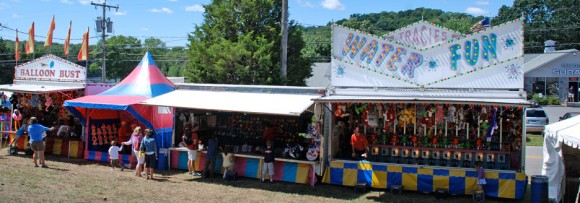


 3 tablespoons of extra virgin olive oil
 About the Author: Lee White, a local resident, has been writing about restaurants and cooking since 1976 and has been extensively published in the Worcester (Mass.) Magazine, The Day, Norwich Bulletin, and Hartford Courant. She currently writes Nibbles and a cooking column called A La Carte for the Times and Shore Publishing newspapers, and Elan, a quarterly magazine, all of which are now owned by The Day.
  Stanford University’s Francis Fukuyama always challenges our minds. From his The End of History and the Last Man, addressing our futures after the end of the Cold War (1992), and continuing with The Origins of Political Order (2011) and Political Order and Political Decay (2014), two monster 600+ page tomes, his newest, and briefest (a slim 183 pager!) is Identity.