Reading Uncertainly? ‘Why Homer Matters’ by Adam Nicolson

Our son, a teacher of English and a sailor, recommended this new study of the Homeric poems, the Iliad and the Odyssey. I had read them in the Robert Fagles translations, the first in 1996, the second a year later. Nicolson’s learned and lyrical commentary brings these 4,000-year-old stories into a fresh perspective of how memory, epic and history are important to us.

He argues that Homer “makes the distant past as immediate to us as our own lives.” In addition, the author is an accomplished sailor, adding to his understanding of Odysseus’s peregrinations throughout the Mediterranean.

These poems present a “plunging perspective into the ancient,” seeking “a form of reassurance that in the end there is some kind of understanding in the world … a braided stream of possibilities pouring into the present out of the past.” Nicolson adds, “no place for Homer is more filled with tragedy than the beach, ”a point of transition for the Greeks transforming themselves from a land-based horde to sea-faring seekers.”

But who was Homer?

Nicolson suggests, “there was no human being called Homer; his words are the descendants of memory and power, the offspring of the muse who had a beautiful voice.” Stories were created, then passed along from generation to generation through memory and song, always modified to fit more current conditions.

“Homer was an ancient inheritance in the eighth century BC … already a thousand years old … The Homeric poems, or at least versions of them, were written down … perhaps about 725 BC, or maybe as much as a century later.” And even then successive scribes often altered the written versions. “Homer is haunted by the threat of transience, by the way memory fails and meanings drift in the face of time.”

To Nicolson the Iliad is “ … a tapestry of sorrow, in which the noncity is set against the city, where the marginal and contingent confront the settled and the secure … the loved against the abused, the creative against the destructive forces of life.” And, yes, even today!

The Greeks attacking Troy were northerners, Indo-Europeans, “their roots in the steppelands of Eurasia … semi-nomadic pastoralists” exhibiting “the hero complex: maleness, heroic individuality and dominance.”  Their theme: “… we are all vagabonds on earth, nothing belongs to us, our lives have no consequence and our possessions are dross. We are wanderers, place shifters, the cosmic homeless.” The settled, affluent, and wealthy Trojans didn’t have a chance.

Much of this recurs in the Odyssey: “the heart of the poem is this contingency, the absence of any over-riding permanence,” the continuous search for meaning..

Nicolson’s frequent allusions to sailing are almost elegiac. Here is one about the Odyssey: “They won’t be wrecked on the illusions of nostalgia, the longing for that heroized, antique world, because . . . to live well in the world, nostalgia must be resisted; you must stay with your ship, stay tied to the present, remain mobile, keep adjusting the rig, work with the swells, watch for the wind-shift, watch as the boom swings over, engage, in other words, with the muddle and duplicity and difficulty of life. Don’t be tempted into the lovely simplicities that the heroic past seems to offer.”

Solid counsel for some of our politicians today!

While the Homeric poems illustrate the horrific mores of some 4000 years ago, “ . . . the usefulness of violence, the lack of regret at killing, the subjection and selling of women, the extinction of all men in a surrendering city or the sense that justice resides in personal revenge,” “what is valuable and essential in these poems is the opposite of that: the ability to regard all aspects of life with clarity, equanimity and sympathy, with a loving heart and an unclouded eye.”

Homer “provides no answers, ”… but simply illustrates, “the complexity of life, the bubbling vitality of a boat at sea, the resurgent energy, as he repeatedly says, of the bright wake starting to gleam behind you.”

To conclude: “So now, each time the wind fills in, and you roll your headsails out and get the main up, and you feel the boat starting to gather way, to pick up its skirts, unable to resist the pull of the wind, you will know something essential of the Homeric world. Here under the bow you can listen, like the Phaeacians carrying Odysseus home, to the water surge and fall, that repeated hoosssh-hoosssh of a hull at speed.

And here, as you make your way between the blue islands, the boat heeled far over and the curves of the headsails bellied out to leeward, you can begin to know and sense the power of possibility in the well-balanced, well-benched ship, equipped with all it needs, acquiring the world, stretching the idea of what it means to be alive, leading men to adventure, home or war.”

Isn’t it time to read Nicolson and reread the Iliad and the Odyssey?

Editor’s Note: ‘Why Homer Matters’ by Adam Nicolson was published by Henry Holt & Co., New York 2014.


Felix Kloman
About the Author: Felix Kloman is a sailor, rower, husband, father, grandfather, retired management consultant and, above all, a curious reader and writer. He’s explored how we as human beings and organizations respond to ever-present uncertainty in two books, ‘Mumpsimus Revisited’ (2005) and ‘The Fantods of Risk’ (2008). A 20-year resident of Lyme, he now writes book reviews, mostly of non-fiction, which explores our minds, our behavior, our politics and our history. But he does throw in a novel here and there. For more than 50 years, he’s put together the 17 syllables that comprise haiku, the traditional Japanese poetry, and now serves as the self-appointed “poet laureate” of Ashlawn Farm Coffee, where he may be seen on Friday mornings. His late wife, Ann, was also a writer, but of mystery novels, all of which begin in a village in midcoast Maine, strangely reminiscent of the town she and her husband visited every summer.

Today’s Hearing on Act Proposing Creation of Tax Authorities in CT for School Towns/Districts with Less Than 15,000 Students to be Televised

Today at noon, the state legislature’s Planning & Development Committee will hold a public hearing on House Bill 7319, An Act Concerning The Fiscal Independence Of School Districts.  The hearing will be televised on CT-N.

The bill requires local and regional school districts with fewer than 15,000 students to become taxing authorities, separate from any municipality.

The bill was introduced by the Planning & Development Committee and is applicable to all local and regional school districts in the state, except for five: Hartford, Bridgeport, New Haven, Waterbury and Stamford.

For more information on the broad topic of forced school regionalization, visit HandsOffourSchools.org or their associated Facebook group, Hands Off Our Schools, which is strongly opposed to the proposals made to date.

Lyme-Old Lyme Education Foundation Hosts 7th Annual Trivia Bee Tonight, Last-Minute Team Registrations Still Being Accepted

Time for a night out!

Join with community members, friends, and family for the 7th Annual Trivia Bee held on March 15, at 7 p.m. in the Lyme-Old Lyme High School (LOLHS) auditorium.  Admission is free!

The 2019 Trivia Bee is a unique opportunity to support Lyme-Old Lyme Education Foundation (LOLEF) while having a terrific time.  There will be raffles and prizes.  Plus, the LOLHS, musical group, Tuesday Afternoons, will provide entertainment.

Teams of four will compete for the Golden Bee Trophy, by testing their knowledge of trivia questions supplied by Trivia Academy.  Last year, students, local business owners, and teachers were among those who formed teams for the competition. So, brush up on your trivia knowledge, get together with some friends or colleagues, and register your team for the Bee! 

And, if you are interested in sponsoring as Region 18 faculty or student team, just visit the LOLEF website and sign up.  All funds raised at the Trivia Bee will be returned to the community in the form of grants for Lyme-Old Lyme Schools and other local non-profit organizations.

Whether as a team demonstrating your far-flung trivia knowledge or as a member of the audience, all are welcome on March 15 at the LOLEF Trivia Bee!

The LOLEF is a charitable organization that provides financial support for educational projects, enrichment programs and innovative initiatives not typically funded by Regional District 18 or other governmental entities. LOEF has awarded grants for educational initiatives benefiting our youngest students to our senior citizens.  You can find out more about the grants that have been awarded, as well as how to apply for a grant, at www.loef.org.

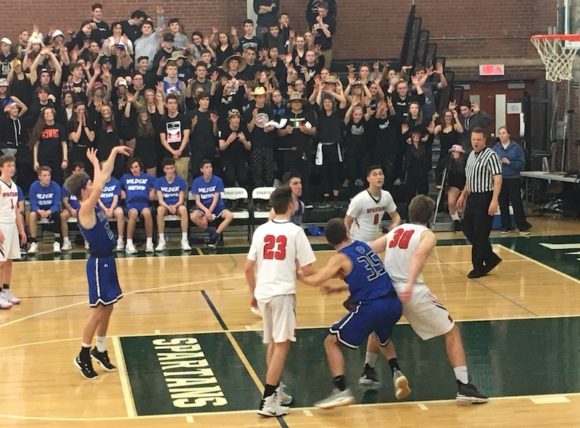
Old Lyme Boys Defeat Somers, Advance to State Basketball Final for First Time in Program History

Brady Sheffield shoots during Thursday night’s semifinal game against Somers.  All photos by Emily Gerber Bjornberg.

Old Lyme defeated Somers 69-53 in last night’s semifinal game played at Maloney High School in Meriden. Junior Ray Doll was top scorer for the Wildcats with 24 points for the Wildcats while junior Aedan Using had 23.

Wildcat coach Kirk Kaczor watches as junior Aedan Using shoots during Thursday’s semifinal game.

The Wildcats will now meet top-seeded Innovation in the championship final on Sunday at 10:30 a.m. at Mohegan Sun Arena.

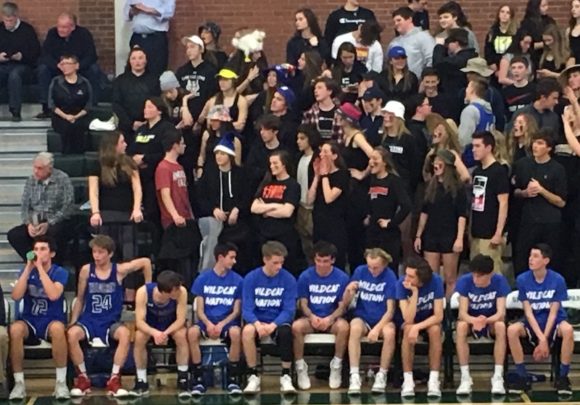
The Old Lyme bench anxiously awaits the next call to go on court.

Visit this link for game highlights by Peter Huoppi published Wednesday, March 13, on theday.com.

Courtney, Blumenthal, Murphy Welcome Increase in Summer Flounder Quotas for CT Commercial Fishermen 

Today, Congressman Joe Courtney (CT-02), Senator Blumenthal, and Senator Murphy highlighted the announcement from last week’s Mid-Atlantic Fishery Management Council (MAFMC) meeting that the MAFMC would be recommending changes to the Fishery Management Plan Summer Flounder that increase the quota for Connecticut commercial fishermen.

Before the meeting, Courtney, Blumenthal, and Murphy wrote a letter to the MAFMC and the Atlantic States Marine Fisheries Commission (ASMFC) urging increased quotas be allocated to Connecticut fishermen. 

“We believe that the MAFMC continues to shortchange New England states when it comes to commercial summer flounder quotas,” Courtney, Blumenthal, and Murphy argued in their letter.“New England fishermen—including many of our constituents who have spent their lives fishing in southern New England Waters—have consistently voiced their concerns regarding summer flounder quotas set by the MAFMC.”   

Last week, the MAFMC and the ASMFC increased the annual commercial quota for summer flounder for 2019-2021 to 11.53 million pounds. The groups also set new state commercial allocations for quota that exceed 9.55 million pounds. Rather than the inequitable allocation on quota up to 9.55 million pounds for New England fishermen, the new allocation of additional summer flounder quota is equally distributed among mid-Atlantic and southern New England states. 


Source: Atlantic States Marine Fisheries Commission 

Warming ocean temperatures are causing some fish stocks that had formerly been more prevalent in the mid-Atlantic to migrate further north than they had before, including popular targets for fishermen such as summer flounder. The changing migration patterns of fish stocks mean that many fishermen from mid-Atlantic states, such as North Carolina, are now regularly venturing farther north from their traditional fishing grounds, bringing them into direct competition with New England vessels operating off the coasts of Connecticut and Rhode Island.  

Fishing regulations for different fish stocks in U.S. waters are managed by a series of Regional Fishery Management Councils. Among the specific items that these councils regulate are the fishing quotas, or amount of a specific fish species that a fishing boat may catch.

The mid-Atlantic fishermen, under the jurisdiction of MAFMC, can harvest substantially more summer flounder, black seabass, and scup than the northeast fisherman, who are a part of the New England Fisheries Management Council. While New England fishermen are catching more and more of these species in their nets, they are forced to continually throw many of these fish back into the water.

The mid-Atlantic fishermen operating in the same area can at times legally take more than 10 times the catch of the New England vessels. Courtney, Blumenthal, and Murphy, along with several colleagues from Connecticut and Massachusetts, first wrote to the U.S. Department of Commerce about these inequities in 2016.