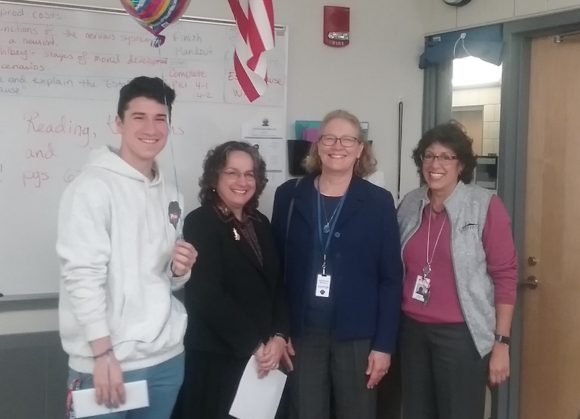
Celebrating Raymond Doll’s selection as the Lyme-Old Lyme Chamber of Commerce December 2018 Business Student of the Month are (from left to right) Doll, Leslie Traver, Lyme-Old Lyme High School Business Department Chair; Jean Wilczynski, Lyme-Old Lyme Chamber of Commerce Board member, and Jeanne Manfredi, Lyme-Old Lyme High School Assistant Principal.
Lyme-Old Lyme (LOL) High School junior Raymond Doll has been named the LOL Chamber of Commerce Business Student of the Month for December 2018.
The LOL Chamber Business Student of the Month program continues the Chamber tradition of recognizing members of the junior class for demonstrating outstanding initiative in and out of the classroom.
The Chamber established the N. Rutherford Sheffield Memorial Award for Entrepreneurial Promise & Achievement for Lyme-Old Lyme High School juniors in 1999 as a way to honor Mr. Sheffield, a 50+ year member of the Chamber who was highly regarded in our Lyme-Old Lyme community.
Thirty-five juniors at Lyme-Old Lyme High School were recognized through this program.
How would you respond to a bearded gentleman greeting you in Lahore, Pakistan, with these words: “Excuse me, sir, but may I be of assistance?” Followed by these, “Ah, I see I have alarmed you. Do not be frightened by my beard: I am a lover of America. I noticed that you were looking for something, more than looking, in fact you seemed to be on a mission, and since I am both a native of this city and a speaker of your language, I thought I might offer you my service.”
Mohsin Hamid, a native Pakistani, a graduate of Princeton University, and a former employee of a financial services firm in New York, serving clients in the Philippines, and Chile, who now lives and writes in Oxford, has created a character with similar experience to his own. The character greets this American in his native city, wines and dines with him, all while delivering his life story.
We read only the words of Changez, the name of the narrator and guide, telling us of how his views of the United States and its inhabitants have been materially altered by events at the turn of the century. It is an increasingly critical analysis. What do we citizens of this country, protected by two oceans and enormous wealth, really know what others around this globe think of us?
Consider these quotes:
“ … my ability to function both respectfully and with self-respect in a hierarchical environment, something American youngsters – unlike their Pakistani counterparts – rarely seemed trained to do.”
“I had always thought of America as a nation that looked forward; for the first time I was struck by its determination to look back … What your fellow countrymen longed for was unclear to me – a time of unquestioned dominance? Of safety? Of moral certainty? I did not know — but that they were scrambling to don the costumes of another era was apparent.”
“Yes, my musings were bleak indeed. I reflected that I had always resented the manner in which America conducted itself in the world; your country’s constant interference in the affairs of others was insufferable. Vietnam, Korea, the straits of Taiwan, the Middle East, and now Afghanistan: in each of the major conflicts and standoffs that ringed my mother continent of Asia, America played a central role … (and) finance was a primary means by which the American empire exercised its power.”
“It seemed to me then … that America was engaged only in posturing. As a society, you were unwilling to reflect upon the shared pain that united you with those who attacked you. You retreated into myths of your own difference, assumptions of your own superiority. And you acted out these beliefs on the stage of the world. So that the entire planet was rocked by the repercussions of your tantrums … “
This is a compelling and enlightening one-sided conversation, leading to a stunning conclusion.
As the author himself comments in an addendum to this novel, “I believe that the core skill of the novelist is empathy: the ability to imagine what someone else might feel. And I believe that the world is suffering from a deficit of empathy at the moment … We need to stop being so confused by the fear we are fed; a shared humanity should unite us with people we are encouraged to think of as enemies.”
Incidentally, Hamid has written a second novel, Exit West*, which received solid reviews here and in Europe. I’ve read it, but I consider The Reluctant Fundamentalist his jewel.
Challenge your thinking!
Editor’s Notes: i) ‘The Reluctant Fundamentalist’ by Mohsin Hamid is published by Houghton Mifflin & Harcourt, New York 2007
ii) ‘Exit West’ by Mohsin Hamid was the Eastern Connecticut ‘One Book One Region’ selection for 2018.
Felix Kloman
About the Author: Felix Kloman is a sailor, rower, husband, father, grandfather, retired management consultant and, above all, a curious reader and writer. He’s explored how we as human beings and organizations respond to ever-present uncertainty in two books, ‘Mumpsimus Revisited’ (2005) and ‘The Fantods of Risk’ (2008). A 20-year resident of Lyme, he now writes book reviews, mostly of non-fiction that explores our minds, our behavior, our politics and our history. But he does throw in a novel here and there. For more than 50 years, he’s put together the 17 syllables that comprise haiku, the traditional Japanese poetry, and now serves as the self-appointed “poet laureate” of Ashlawn Farm Coffee, where he may be seen on Friday mornings. His late wife, Ann, was also a writer, but of mystery novels, all of which begin in a village in midcoast Maine, strangely reminiscent of the town she and her husband visited every summer.
Many, many years ago, I did a radio show with Johnny London on WICH out of Norwich, Connecticut. We began with an hour and, after the first year, it turned into two hours.
I grew up with radio, although my parents did get a television in 1948. But we had radios everywhere in our house—we had clock radios, a radio in the kitchen and a “console” radio in our dining room. My mother liked to iron, and we had an ironing board that came out of the kitchen wall.
When I was little, I would sit on the linoleum and play with my toys. One was a little truck or engine that you could spin back and forth a dozen times, then let it go and it would flew into my parents’ master bedroom, usually hitting on a door, the bottom of their bed or into a closet. After a few years, the linoleum in the kitchen had to be replaced.
While my mom ironed and I played with toys, I listened to the radio. In the evening, it was Dr. Christian and Jack Benny and Red Skelton. On Sunday morning, I would lie on dining room rug and read the “funnies” as the mayor of Albany read the Times-Union the same way Mayor LaGuardia did in New York City.
But back to my own radio show: I had guests in the room with me, or I would talk on the phone to chefs, cookbook authors and restaurant owners. And readers would call with questions.
Often Johnny asked me if I would run out of recipes. But, like the music made from just seven notes, one never runs out of recipes. This was a great year for cookbooks, but choosing my favorite wasn’t difficult.
Sweet Chili Chicken Thighs
From “Everyday Dorie” by Dorie Greenspan (Houghton Mifflin Harcourt, Boston and New York, 2018)
2 tablespoons canola or neutral oil 1 medium onion, finely chopped and dried 1 and one-half to 3 peeled fresh ginger, minced 2 garlic cloves, germ removed and minced Fine sea salt One-quarter cup white wine 8 chicken thighs, with or without skin and/or bones, patted dry Freshly ground pepper One-half cup Thai sweet chili sauce* One-third cup soy sauce 2 tablespoons Dijon mustard 1 to 1 and one-half teaspoon Sriracha* Sliced scallions and crushed red pepper flakes, for serving (optional)
Warm 1 tablespoon of oil in a Dutch oven over medium heat Add onion, ginger and garlic, season with salt, and cook, stirring until they soften a bit and are translucent but not browned, about five minutes
Add wine, increase the heat and cook, stirring, until most of the wine evaporates, about three minutes. Again, don’t color the onion mixture. Transfer ingredients to a bowl.
Return pot to medium heat and add remaining oil. Place thighs in the pot and brown on all sides, adding more oil if necessary. (If the thighs will be crowded, do this in two batches.) Pour and discard oil. If you have burnt bits of the bottom of the pots, remove chicken and scrub the pot, then return chicken to it.
Return the onions mixture to the pot, along with any juices that accumulated, add the chili sauce*, soy sauce, mustard and Sriracha* and stir to blend. Season lightly with salt and pepper and clap the lid on.
Turn heat down top low and cook, basting occasionally, for 30 minutes, or until chicken is opaque in the center; an instant-read thermometer inserted into the thickest part of the thigh should register 165 degrees.
Transfer to a platter (or serve right on the pot) and spoon over some of the juice. Add scallions and pepper flakes (optional). Pass the rest of the sauce at the table.
*I always have both sweet chili sauce and Sriracha in my pantry.
We felt an update on the Halls Road Improvements project would be timely since several related things have occurred since our last post on the subject.
Firstly, we have received quite a number of thoughtful and constructive comments from readers on the topic, some of which we have already published and others that were sent to directly to us and anonymity requested. We are now publishing them all in their entirety below.
We still welcome further comments and will continue to respect people’s anonymity if requested.
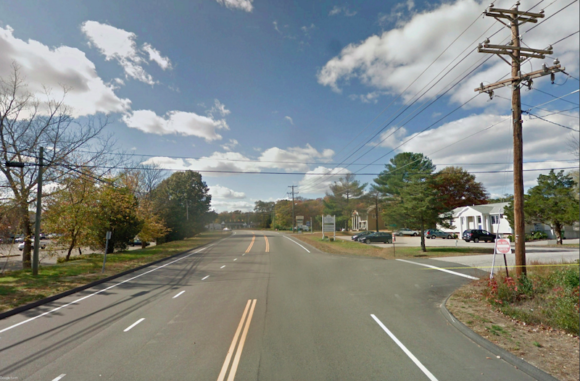
Halls Road today. Photo from Yale Urban design Workshop presentation given on Dec. 6, 2018..
Secondly, the Halls Road Improvements Committee has now published the Dec. 6 Yale Urban Design Workshop presentation on the Town of Old Lyme website at this link. There is also an opportunity to comment on the proposed plans at this link.
Thirdly, the folk at SECoast.org have published their report of the Dec. 6 meeting at this link. They are also soliciting comments on the proposal on their Facebook page at this link.
Finally, there is an Old Lyme Board of Selectmen’s meeting this afternoon at 4 p.m. in the town hall meeting room, which includes an update on the project on its agenda.
Comments on the proposal received to date from readers are as follows:
Author; John Stratton:
For more than a century there’s been no comprehensive plan for the use and appearance of lower Boston Post Road (now known as Halls Road). The 1911 auto bridge and the 1948 realignment of the Boston Post Road essentially created the present patchwork. It’s time for a set of guidelines which are proactive from the standpoint of creating a single, attractive, town destination, preferably one that blends economic, residential, and community spaces. Yes, problems may arise, and careful rezoning will have to anticipate them. In 1990-1993 the initial proposals for the new I-95 bridge and interchange were seen to consume a lot of our shopping center. People reacted with concern and the invasive roadway plans were altered— but no new plan emerged to redefine the Halls Road streetscape as a “town center.” This is our chance to build that plan.
Author: Anonymous
I think the Town’s effort is great. It is for plans such as these that we have Town committees and staff in the first place. They are doing their job, and thinking long term about what kind of Old Lyme we want to have. As said by one of the representatives (and I paraphrase), when we let the developers lead, we end up with an ugly mishmash of structures … just like we have on Halls Road now.
What the Town is proposing is reasonable. Over the next 30 years, there will be development one way or the other. The town is just saying, hey let’s all have a say in defining what we want to wind up with at the end of the day. The Town is not saying let’s spend a whole lot of tax money up front, or even in the long term. They are just saying let’s all agree on what we want, and let private developers fill in the blanks as they see future economic opportunities. The Town might provide a few dollars, but it sounds like it is more intent on offering zoning benefits, and seeking to access State grant money.
At the end of the day, this is a 30 year plan. We have 30 years to monitor it, and to make revisions if necessary. Give it a try. Otherwise Halls Road will remain a blight.
Author: Thomas D. Gotowka
Christina and I attended both public meetings hosted by Old Lyme’s Halls Road Improvements Committee, and conducted by members of the Yale Urban Design Workshop. Yale presented the Committee’s vision statement and several conceptual renderings of what fully realizing that vision might yield. The article in the New London Day accurately summarized the vision.
The audience was skeptical of the immense breadth and scope of that vision; – requiring twenty- five or more years to complete. Several concerns were raised about cost and the impact on taxes.
We left with a few thoughts and concerns. It was not apparent to us that current Halls Road business owners and the professionals occupying office space had participated to any extent in developing that vision. It is absolutely important to get their buy-in. Essex Bank did state that any of their future development would take Old Lyme’s plan into consideration.
We found Alan Plattus’ presentation to be a bit glib. This is important stuff, and some of the vision could be lost in presenter style. Also, know the names of our local landmarks, especially if they factor into the plan. (i.e. it’s the “Bow Bridge” that used to cross the Lieutenant River). But, after all; they’re Yale, not Harvard.
Our suggestion: parse the plan into achievable shorter- range projects that will yield some early successes. Start with the hiking/biking paths along the Lieutenant River, rebuild the foot bridge, and create the new Halls Road village green.
Author: J. David Kelsey
I strongly believe a municipality’s best service for economic development is to create a flexible crucible allowing for creative use of people’s property and to support it with reasonable infrastructure. A good starting point is indeed a big picture vision of what could be – the work of the Yale is a helpful guide to figure out what zoning flexibility might be added and to identify infrastructure improvements (sidewalks, rational street signs, crosswalks) that might be undertaken.
What is not clear is the level of involvement of the town in changing the nature of existing buildings – are we talking about the town purchasing certain parcels and eminent domain strategies so that the town (instead of existing private owners) determines what might happen? I would advocate for a clear statement soon of how the town proposes to be involved, and I would hope it would be a light touch of reducing setbacks, requiring rear parking, introducing mixed-use zoning and working with DOT early to see what actual changes could be made for street parking (it is a unique stretch of US-1 with unusually high volume during frequent detours), sidewalks and hardscape improvements. Private owners could then determine what makes sense economically for changes to existing buildings and for new construction.
If the goal is for the town to control actively in some manner the types of use and nature of construction, that is a very large role to undertake, since this part of town is economically vibrant already with buildings that are close to full already with businesses, despite being less aesthetically desirable in the case of some buildings. I hope we get a clear picture that is public of the long-term town plan, rough ideas of costs to the town and a timetable once the community feedback for Yale’s draft plan is complete. A great start at very low cost and quickly achieved would be consolidating or eliminating street and traffic signs and at least having them stand up straight.
For more than a century there’s been no comprehensive plan for the use and appearance of lower Boston Post Road (now known as Halls Road). The 1911 auto bridge and the 1948 realignment of the Boston Post Road essentially created the present patchwork. It’s time for a set of guidelines which are proactive from the standpoint of creating a single, attractive, town destination, preferably one that blends economic, residential, and community spaces. Yes, problems may arise, and careful rezoning will have to anticipate them. In 1990-1993 the initial proposals for the new I-95 bridge and interchange were seen to consume a lot of our shopping center. People reacted with concern and the invasive roadway plans were altered— but no new plan emerged to redefine the Halls Road streetscape as a “town center.” This is our chance to build that plan.
Author: Ron Breault
I attended the Dec 6 meeting. My comments
1) When asked about the planning assumption regarding possible DOT changes to I-95, the Yale Urban Design response was that, despite recognition that traffic delays and congestion already exist, there would be no area changes in I-95 in the next 20 years.
Since this is already a significant thru traffic problem which can only get worse, changes envisioned by the ‘plan’ for Halls Rd that include on Halls Rd parallel and/or diagonal parking, increased commercial density and pedestrian use, increased recreational use and pedestrian crossing and stop signs will aggravate, perhaps dangerously, the Halls Rd environment.
2) There appeared to be no consideration given for a more limited, ‘modest’, less expensive improvement of Halls Rd, ie’, sidewalks, bike paths, a return of the pedestrian crossing bridge over the Lieutenant River, elimination of ‘leaning’ power line poles with unattractive heavy looping wires and electrical equipment. Maybe some street lighting, and buried wires?
3) One of the meeting attendees commented that she had lived in Nantucket for 25 years and, because of development, ‘Nantucket is no longer Nantucket’. Paraphrased, her concern was the extensive multi story commercial/residential development plan presented for Halls Rd would mean Old Lyme would no longer be Old Lyme. I think this was a shared feeling by many at the meeting.
Author: Ted Mundy
Unfortunately I did not attend the meeting. Nonetheless, the previous comments and SE Coast write-ups provide a good base of information.
Rule One for architects is to live in what they intend to design. Of course, this is impossible until built. However, they should visit at least twice during the calendar year. The first is a summer Friday night when I-95 gets jammed. The overflow of traffic makes 156 and Rt-1 very congested. If there is an accident southbound, Rt-1 after Exit 75 is backed up from Laysville south to the Hall’s Road traffic lights. Some traffic goes down Lyme Street, which is the heart of what makes Old Lyme great. Imagine shopping on Hall’s Road during these incidents. We avoid it.
The second time to visit is in early December. The town is relatively quiet especially the shore communities. One wonders how some of the Hall’s Road merchants make it at all. With the exception of the Big Y, foot traffic is slow in my judgment.
This gets to the final point. Do we want to change the character of Old Lyme? If the Mundys shop for goods other than necessities, we go on-line or visit Old Saybrook. Let’s leave Old Lyme the way it is and save government funds for infrastructure repair and reduce our tax burden.
A ‘Messiah’ Sing or Listen, Christmas Section, will be sponsored by Cappella Cantorum on Sunday, Dec. 16, at 4 p.m. at The Katharine Hepburn Cultural Arts Center, (the Kate), 300 Main St., Old Saybrook 06475. There will be a short rehearsal for singers at 3:30 p.m.
Soloists will be Soprano Danielle Howard, Mezzo-Soprano Rachel Abrams, Tenor William Sorenson and Baritone Kenneth Holton. The Sing is open to all, under the direction of Barry Asch and accompanied by Deborah Lyon.
Bring ‘Messiah’ scores if you have them or they will be provided. There is a $12 fee for singers and audience. Singers will sit in sections, the audience is invited to sit in the back, witness the short rehearsal, and then the Sing will begin at 4 p.m.
Tickets will be available online at www.thekate.org and through the Box Office, 869-510-0453, open Tues–Fri 10 a.m. –2 p.m., no reserved seats.
For more information, call Barry Asch at 860-388-2871.



 A ‘Messiah’ Sing or Listen, Christmas Section, will be sponsored by Cappella Cantorum on Sunday, Dec. 16, at 4 p.m. at The Katharine Hepburn Cultural Arts Center, (the Kate), 300 Main St., Old Saybrook 06475. There will be a short rehearsal for singers at 3:30 p.m.