Old Lyme Town Meeting Tonight Includes Vote on Town Contribution of $1.75M for OL-PGN Library Upgrades

A vote on the Town of Old Lyme’s contribution of $1.75 million for renovations and upgrades to the Old Lyme-Phoebe Griffin Noyes Library is planned for July 23, at a Special Town Meeting.

UPDATED, July 23: A Special Town Meeting will be held tonight, Monday, July 23, at 7:30 p.m. in the Meeting Hall of the Old Lyme Town Hall at 52 Lyme St. to consider a proposal to appropriate $1.75 million towards the cost of the capital construction project being undertaken at the Library by the Old Lyme-Phoebe Griffin Noyes Library Association, Inc.  It is anticipated that a vote will be taken on the proposal at the meeting.

Asked why the library needed renovating, OL-PGN Library Director Katie Huffman explains, “The current building was renovated  nearly 25 years ago and many of the mechanical systems are nearing the end of their natural life expectancy. These include several rooftop HVAC units, two boiler pumps, and the lighting fixtures.” She adds, “The carpet, paint, furnishing, and other finishes have likewise not been updated since 1995.”

Huffman also notes that significant changes have occurred in our culture and the way people gather information in the past 25 years.  The advent of social media and smartphones, the decreasing cost of technology, and a dramatic increase in publishing and the availability of information have changed people’s information needs.  She points out that perhaps surprisingly to some, “Rather than decreasing dependence on the Library, these changes have resulted in a 70 percent increase in reference questions since the new building opened in 1996.”

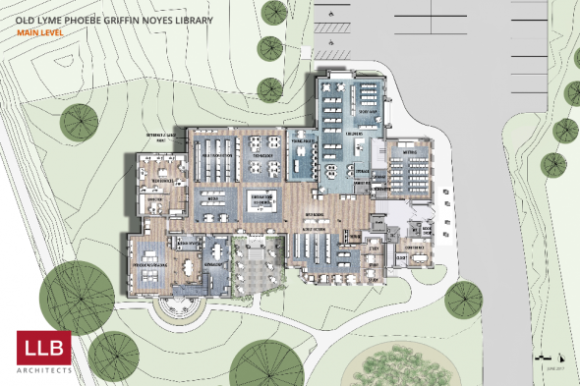
This plan shows the proposed layout of the main floor after the renovation is complete.

She continues, “During this time the Library has already added services, including one-on-one technology assistance, new e-collections, and more programs (a 90 percent increase), which in turn, are attended by even more people (a 140 percent increase).

Finally, Huffman says, “Input from survey and focus groups during long-term planning begun in 2013 identified opportunities to meet patrons’ needs and expectations better.” This means that many of the goals set by the library in response to those needs and expectations require changes to the library’s space.

The total project cost will be $3.05 million.  This cost will include both construction and soft costs, such as furnishings, technology, and shelving.  It also includes a built-in construction contingency fund.  Significantly, the library has secured a $1.0 million construction grant from the Connecticut State Library, thus dramatically reducing the impact of the funding required for the project on Old Lyme taxpayers.  Moreover, the library has committed to raising $300,000 through its own efforts.

The library is requesting $1.75 million from the Town of Old Lyme.  If this request is passed at Monday’s Town Meeting, the impact on the owner of a house appraised at $347, 200 is estimated conservatively at $24 for the 2019-20 tax year.  The respective number for a house appraised at $540,200 is $38.

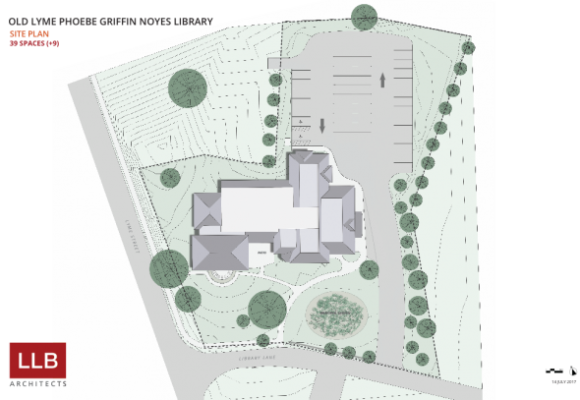
The site plan of the proposed renovation which shows no change to the current footprint of the library.

It is anticipated that if the request for funding passes this evening, construction will start in early 2019 and be completed by the fall of the same year.

For more information on the library renovation proposal including the opportunity to view the library’s slide show presentation, visit this link.

The second item on the agenda for the Special Town Meeting is a proposed ordinance to amend the Town’s Harbor Management Plan.  This ordinance will create a procedure for the Harbor Management Commission to recommend variances from the Harbor Use Zone Standards of the Plan to a state or local permitting authority acting on an application to conduct activities affecting the waters of Old Lyme.

A copy of the proposed ordinance is posted on the Town’s website and paper copies are available for review in the office of the Town Clerk.  

If approved by the Town Meeting, this ordinance will be effective 15 days after its publication in a newspaper having a circulation in the Town of Old Lyme.

Talking Transportation: ‘Train Time is Your Own Time’ … True or False?


Train time is your own time” was the old marketing slogan of Metro-North, encouraging commuters to kick back and enjoy the ride while reading, working or taking a snooze.

But in reality, train time is shared time.  They don’t call it “mass transit” for nothing as passengers much share their space with a hundred other commuters on each railcar.

Assuming you get a seat, this means you’re squeezed in next to one or two fellow riders.

Usually commuters are respectful of each other and don’t blare their radios or carry on loud conversations, with each other or on cell-phones.  Or so we’d hope.

It was almost 20 years ago that Amtrak first introduced the concept of The Quiet Car, following suggestions of daily commuters riding to DC.  It was such a success that quiet cars were soon added to other Northeast Corridor trains and Acela.

The concept was simple, as conductors reminded passengers on every trip:  maintain a “library like atmosphere”.  That meant no cell phone calls and only quiet, subdued conversation.  You want to yuck it up over a beer, go to the Café Car.  Got an important phone call … sit in any other coach.

Other commuter railroads picked up Amtrak’s cue … but not Metro-North. While serving on the CT Metro-North Commuter Council, I regularly beseeched the railroad to give us a break and dedicate just one car to peace and quiet, convinced it would attract riders.  Finally in 2011, the railroad took the hint and launched such a car, branded as a “Quiet CALMmute”.

Victory for the sonically overloaded?  Not by a long shot.  This is Metro-North and if anyone can screw up a good idea, they can.

First, they offered the worst car location on the train to their CALMmute:  the last car in-bound and the first car out-bound from GCT.  And there were no signs indicating which car was “quiet”.  Worst of all, conductors all but refused to enforce the quiet rules, leading to altercations between passengers.

Conductors have no trouble enforcing other rules:  luggage on the overhead racks, no feet on the seats, no smoking etc.  But asking people to keep down the chatter was apparently too much.  All they would do, at first, was hand “Shhh cards” to offenders.

In 2016 the quiet car program was expanded to two cars per train, peak and off-peak.  But, still no signage (until just recently) and no enforcement.

Now, a major change.  The railroad announced that effective immediately there would be only one quiet car per off-peak train.  And the PR team at MNRR spun the story so well that some local media made it sound like the program was being expanded, not cut in half.  Brilliant.

There was no explanation for the cut in quiet cars though one official told me, “We have had no reports of quiet car demand exceeding availability in the off-peak.”  In other words, people who ride off-peak just prefer to yap.

That’s an amazing PR “spin” on what is really an admission of failure.  Metro-North never wanted quiet cars and clearly didn’t want to enforce the rules.  The people have literally “spoken” and the Quiet CALMmute won’t be as accessible anymore.

This is what happens when you have a monopoly, answerable to nobody, especially its customers.  I’d raise my voice in protest but … I’m in the quiet car.

Posted with permission of Hearst CT Media

Jim Cameron

About the author: 

Jim Cameron is founder of The Commuter Action Group, and a member of the Darien RTM.  The opinions expressed in this column are only his own.  You can reach him at CommuterActionGroup@gmail.com

For a full collection of “Talking Transportation” columns, visit www.talkingtransportation.blogspot.com

Posted with permission of Hearst CT Media.

Affordable Housing Public Hearing Deadline Extended Again, This Time to Sept. 10


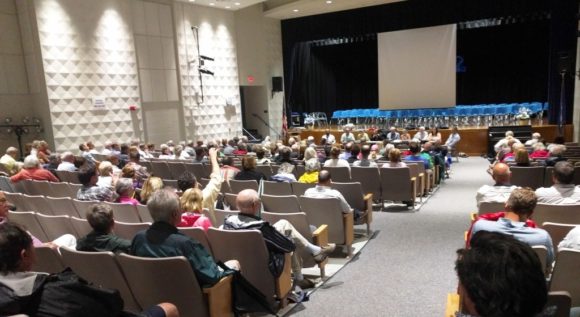
UPDATED 7/20, FULL REPORT NOW ADDED: Around 270 people showed up at Lyme-Old Lyme Middle School Tuesday evening for the third Public Hearing held by the Old Lyme Zoning Commission on the 37-unit Affordable Housing development on Neck Rd. proposed by HOPE and the Women’s Institute.  At the end of the almost three-hour sometimes contentious, sometimes rambling meeting, the commission voted at the applicant’s request to continue the Public Hearing to their next regular meeting on Sept. 10.

The meeting opened with commission member Jane Marsh reading from a letter submitted by Old Lyme Selectwoman Bonnie Reemsnyder, who was unable to attend the meeting. Reemsnyder had requested the letter be read into the zoning commission’s record.

In her letter, Reemsnyder explained the reason she had felt it necessary to write was because, “There are a range of accusations I feel must be directly addressed.”  She said the first was, “A conflict of interest,” and after explaining her position on the Advisory Council of HOPE was non-voting, she stated, “I have no personal stake in this development nor do I serve on any of the boards that must approve this application. By any standard, this does not even qualify as a perceived conflict of interest.”

The second accusation she cited was,“I brought this to our town.”  In answer to that, Reemsnyder wrote, “I support affordable housing for Old Lyme because it is a serious need and statutory mandates. Hence I have supported the mission of HOPE for years, never being secretive about it.”   She elaborated on the process that has been followed and clarified, “It is my longstanding and consistent policy to maintain the independence of our boards and commissions and to refrain from attempting directly to influence their decisions … I provided no comments, discussions or requests to any land use commission members.”

Finally, Reemsnyder noted she had seen an email stating, “The fix is in” suggesting this proposal is “… not going through the proper process.”  She responded in the letter, saying, “I have no idea what this refers to but if it is an allegation that someone is applying pressure to the zoning commission that would surely be news to me.”  Reemsnyder added, “The rumor that there has been an effort by me to “speed things along” with the town is “categorically untrue,” noting, “It is disturbing to see the misinformation going around about the application and the applicants.”

Reemsnyder concluded, “In the end it is you, the commission members, who have to abide by the rules for approving or denying affordable housing … I support each one of you.”
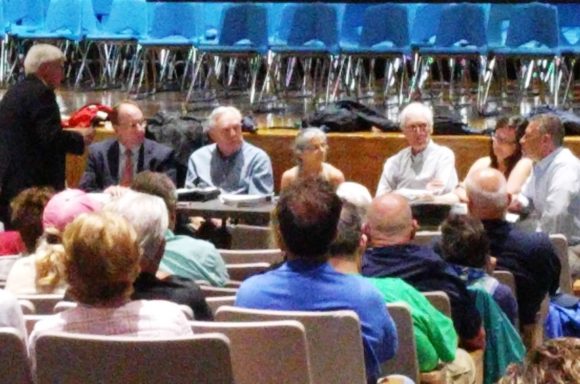
David Royston, who serves as attorney for HOPE and the Women’s Institute, makes a point during his preamble to a request being made by the Women’s Institute for an extension to the Public Hearing through Sept. 10.

Attorney David Royston, who represents the applicant, namely HOPE and the Women’s Institute, then took close to an hour to explain why he would be requesting an extension to the Public Hearing, primarily because several reports, which required responses from the applicants, had only been received in the last few days.  These included reports from the Old Lyme Fire Marshal David Roberge and the Town Engineer, Tom Metcalf.  Royston added he had also hoped to receive comments regarding the septic approval prior to the meeting, but that had not occurred.

Royston emphasized that “the position of the applicant” is not to “object in any fashion to scrutiny regarding health and safety issues” but rather that, “We understand fully the concerns of the community regarding the access driveway and the safety issues regarding emergency vehicles.” He stressed, “We want to assure you [Zoning Commission members] that every item raised will be addressed.”

Noting that an important concern of Metcalf was the entry driveway, Royston explained the applicant needed more time, “to allow these matters to be fully and professionally addressed.”

Kristen Anderson of the Women’s Institute made the official request for the extension on behalf of the applicant noting that continuing the Public Hearing to the zoning commission’s next regular meeting on Sept. 10 retained the application within the required legal timeline.  The Hearing would have to be closed on that date and a decision then given by the commission within 65 days after the meeting.
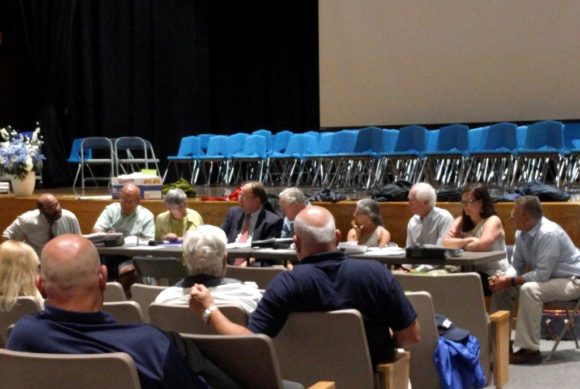
Land Use Coordinator Keith Rosenfeld (extreme left) listens intently as Zoning Commission Chairwoman Jane Cable (third from left) solicits input from other members of the commission during Tuesday’s Public Hearing.

Asking the audience to “Be kind” and “Don’t repeat,” Commission Chair Jane Cable then opened the floor to public comment.  Pamela Hamilton spoke first commenting initially on, “the bucolic and historic nature of Old Lyme,” and then noting that she had seen too many towns and villages, which had “frittered away their charm.” She stated firmly, “It is not elitist to treasure charm, history and beauty,” which drew spirited applause, adding, “The people of Old Lyme are a generous lot … they do not want to say,’We do not want affordable housing.’” She maintained their message was simply, “Build in some other location,” while adding in a questioning tone, “One wonders what the motivation is [for this site.]

Before calling the next speaker, Cable reminded the audience that the commission can only consider health and safety aspects of the proposal and urged speakers to restrict their comments to those matters.

An Old Lyme resident then went to the podium and questioned, “Have any of you stood on Sands Dr.? [the road almost opposite the Exit 70 exit ramp on Rte. 156/Neck Rd.] This is a public safety issue …  I just don’t see how this project has got this far.” He added, “You cannot do away with the safety problems it {the proposed development] will cause.  There is just no way.”

Old Lyme former First Selectman Tim Griswold, who noted he had served for 14 years, asked if the Zoning Commission had received a formal recommendation [regarding the proposed development] from the Old Lyme Selectmen’s Office or the State Police in Westbrook since the First Selectwoman and/or the Resident State Trooper “have jurisdiction over speeds, Stop signs.” Commission members indicated this was not case to which Griswold responded, “This is a deficiency that should be corrected.”

Hope’s Board of Directors President Tony Lyons, an Old Saybrook resident, said he wanted “to dispel” a couple of the points that were being communicated about the proposed development. First, he stated it is not “profit-motivated’ and second that HOPE” is looking to help people already here” rather than people from outside the area. He surmised, “Everyone in this room knows someone who has a housing issue … the millennial on your couch, the senior who has no senior housing.”

Lyons prompted jeers when he said, “This is not about traffic … traffic will be negligible.” He asked the audience where they have been for the past four years while HOPE has been looking for a site for affordable housing, saying, “We have been an open book.  We are a completely transparent organization.” Lyons also said the audience should think about the alternative if this project is not approved, speculating that “It will not be 37 units but 137 units,” built by a property developer.

In a more conciliatory tone, he said, “We are looking for help from everyone in this room to make this project the best we can.”

A resident of Wolcott Lane wondered whether additional police would be required for the increased town population resulting from the development.

Old Lyme resident Jill Pilgrim read the Fire Marshal’s letter, which had been submitted the previous day, into the record.  The letter raised nine comments, which required attention by the applicant, and its conclusion was, “Based upon its current submitted design(s) and our noted nonconformance to the Connecticut Fire Safety and Fire Prevention Codes, this Office cannot support this project at this time.”

One speaker noted it is possible to rent in Old Lyme and “you can find places to rent,” while a second commented, “There’s plenty of affordable housing in this own … that needs to be explored a little more.” He also suggested that the rents at River Oak Commons sounded high.

Speaker after speaker urged HOPE to reconsider the location of the development with possible sites proposed at the Ryefield Senior Housing and its environs and also on Hartford Ave. in Sound View. Concerns ranged from whether the end of a school bus picking up students would extend to the foot of the Exit 70 off-ramp, how children are going to cross Rte. 156 in order to reach Hall’s Rd., “a catastrophic accident,” and who will pay for the subsequently needed traffic lights and a rotary.  One resident described the locations “dangerous and absurd.”

Tom Ortoleva, a resident  of Old Lyme and a board member of HOPE, spoke passionately in support of the project noting he had never had difficulty turning right from the Exit 70 off-ramp and that, “Families that want to stay local [in Old Lyme] have to go to other towns … college students are moving away.” He surmised that Old Lyme would not be able to support volunteer Fire or Emergency Medical Technician Departments if this situation continued.

Ortoleva also stressed that concerns the development would turn into a “drug haven” were unfounded.  He had explored with the Old Saybrook Police Chief Mike Spera whether the Affordable Housing development at Ferry Crossing in that town had experienced higher crime rates than other parts of the town and the answer had been a definitive “No.”  Spera said there had been “no violent crimes or drug incidents at Ferry Crossing.”

Wes Swanson, another HOPE board member and pastor of St. Paul Lutheran Church in Old Saybrook, urged the audience to consider the aspect of “health” in relation to River Oak Commons in the context of a “healthy community,” that is, one which is diverse and hospitable.  He submitted that “This proposal will enrich and enhance Old Lyme and contribute to the community’s well-being and growth.”

Dominic Pappa, an abutter of the proposed development, drew applause when he summed up many of the concerns of those objecting saying, “Affordable Housing is needed but it’s obvious to everyone in this room that this site has a health and safety issue.” He urged the commission not to extend the public hearing but rather to have a vote and, “make a decision.”

When evaluating the evidence before making their decision, Michael Fogliano recommended the commission should take care only to consider, “objective data.”

Finally, after more than two and a half hours of testimony and some confusion in the final minutes, the commission voted unanimously to extend the hearing to Sept. 10 as requested by the applicant.

Editor’s Note: Links to our stories on previous meetings regarding this Affordable Housing proposal are respectively at Boisterous Crowd Packs Middle School Auditorium to Listen to, Give Opinions on HOPE’s Affordable Housing Proposal published June 8, and At HOPE’s Request, Old Lyme Zoning Extends Affordable Housing Hearing Deadline to July 17 published June 13. There are also numerous Letters to the Editor on the subject in our Letters section and opinions in our Op-Ed’s section. The articles themselves also stimulated a wide variety of comments.

‘Blues Meets Pink’ Charity Benefit to Support the Fight Against Breast Cancer, Aug. 9

The American Cancer Society is encouraging residents throughout New London County to purchase tickets to the upcoming Blues Meets Pink Charity Benefit at Stonington Vineyards on Thursday, Aug. 9, to help support the Making Strides Against Breast Cancer Walk of New London County. Doors open at 5:30 p.m. Tickets are $40 each and must be purchased in advance at www.acsbluesmeetspink.eventbrite.com.

This one of a kind summer evening will feature light fare at no additional cost from local restaurants and vendors including Mystic Oysters from Noank, a cash bar, and a selection of food trucks with food for purchase. Guests of this charity event are encouraged to bring blankets or chairs to enjoy performances from local blue artists on the lawn. Performances include a set from New York and Connecticut Blues Hall of Fame recipient Tom “the suit” Forest and a set from the Chris Leigh and the Latin Essence Jazz Quartet.

Dollars raised from the Blues Meets Pink event will benefit the Making Strides Against Breast Cancer Walk of New London County, which will be held on Sunday, Oct. 21 at Rocky Neck State Park in Niantic. The local Strides walk unites the community to honor those touched by breast cancer and raises awareness and funds to support the American Cancer Society’s mission of eradicating breast cancer.

For more information on the Blues Meets Pink Charity Benefit ticketing, visit https://www.facebook.com/ACSBluesMeetsPink/ or email Margie Elkins at mdelkins23@gmail .com

To learn more about Making Strides Against Breast Cancer of New London County, visit  www.MakingStridesWalk.org/NewLondonCT

Follow the ‘Vision Box’ Trail This Summer!


Through the balance of the summer, the public can follow the trail of Vision Boxes installed at four sites throughout Old Lyme. The boxes are up for three months — at the end of the project, the boxes will be auctioned. Resulting funds will be contributed to programs that bring urban youth to visit wilderness parks or refuges in the local area and give them the opportunity to draw in the field.

Working in collaboration with non-profit land trusts, the Open Space Commission, individual stewards and local artists, Ana Flores designed the Vision Box project.

Flores is the first Schumann Foundation Visiting Artist at the University of New Haven’s Lyme Academy College of Fine Arts. She is an award-winning “ecological artist” probing the relationships between the human and natural history in different geographies. One of her goals as an artist is to encourage the public’s awareness of their local landscapes, deepening their connections to place because if we don’t care about something we will not help protect it.

This spring she has been teaching Environmental Art, introducing students to ecological artists and having them create projects that involve ecology, community engagement, and activism. She has also been exploring the unique environment of Old Lyme in preparation for a public art project. The Old Lyme landscape, with its conjunction of river, marshes, fields, and forests served as the inspiration for the American Impressionist movement in the early 20th century. For over three decades, well known painters traveled here to document the estuary landscape with its particular quality of light.

Flores believes there is a connection between the sustained gaze of these artists and the extraordinary efforts in conservation in the area. She says, “The artists gave the land value for its irreplaceable natural beauty and since the mid 1960’s Old Lyme citizens have been working hard to preserve some of the habitat that lured artists here. The Vision Box project reminds us that we cannot take for granted open space, mature trees, or a clean river – they exist only because of visionary stewardship and in the case of Old Lyme, inspiration from artists’ vision.”

There will be an Opening Reception for the Vision Box project Thursday, July 19, from 5 to 7 p.m. at Lyme Academy College of Fine Arts, 84 Lyme Street, in Old Lyme.  All are welcome.

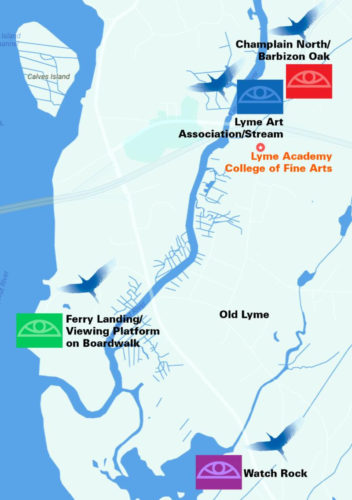
The Vision Boxes can be found at these locations:

  1. Ferry Landing Park:
    Walk to end of boardwalk, box on viewing platform.
  2. Watch Rock Preserve:
    Entrance at end of Joel Road, take Yellow trail 0.4 mile, box faces West over water.
  3. Lyme Art Association:
    Box faces stream, located near back parking area.
  4. Champlain North:
    Turn on Wyckford Road, go to end. Open space trails are not private. Take Red trail, bear right, 0.4 mile to Barbizon Oak and box.

The project is made possible with support and funding from the Robert F. Schumann Foundation and Lyme Academy College of Fine Arts of the University of New Haven.

Special thanks for their support of the project are given  to:

  • Patricia Shippee,
  • Deborah Quinn-Munson,
  • Sara Drought Nabel,
  • Rosamund Christison

Partners include:

  • Old Lyme Open Space Commission
  • Old Lyme Land Trust
  • CT Dept. of Energy and Environmental