Zoning Commission Meets Tonight to Continue Public Hearings on Affordable Housing Proposal

The Old Lyme Zoning Commission will convene this evening for its regular meeting at 7:30 p.m. in the Lyme-Old Lyme Middle School (LOLMS) auditorium to continue the Public Hearings related to the two Affordable Housing applications submitted by HOPE Partnership for 18-1 Neck Road (formerly 16 Neck Road) for a total of 37 dwelling units.  The property, which will be known as River Oak Commons I and II, falls under Connecticut General Statutes 8-30g and is currently owned by Graybill Properties, LLC.

The agenda for the meeting states, “Public Hearing is recommended to be closed tonight [Monday, June 11] as the Application was received by the Zoning Commission on 4/9/2018 and must be decided upon within 65 days of ~receipt (6/12/2018)]”

When these Public Hearings were opened at a Zoning Commission Special Meeting last Tuesday, more than 500 people showed up for the meeting, which had to be ended before public comment had finished due to janitorial time constraints at LOLMS.

Editor’s Note: We will seek to clarify the latest date by which a decision can be made by Zoning on the application and publish that information as soon as it is available.

Letter to the Editor: Two “Inescapable Facts” About Affordable Housing in Old Lyme

To the Editor:

In considering the debate over the suitability of 16 Neck Road for development of affordable housing under CT 8-30g as proposed by the HOPE Partnership, there are two inescapable facts in play.

First, Old Lyme has a woefully inadequate supply of affordable housing. As a result, the people who teach our children, respond to our 911 calls, earn wages in local businesses or are starting an independent life often cannot afford to live in the community in which they work and serve, and where they may have grown up. The beneficiaries of this project could be our children, or our parents. This reality seems to have been lost on June 5.

Second, 8-30g is specifically written to encourage towns like Old Lyme to develop affordable housing, and, importantly, to accelerate and simplify the path to approval of such developments. The chair of the zoning commission, Ms. Cable, was clear on June 5 when she reminded the commission members that, in considering any denial of an application under 8-30g, the role of the commission was effectively reversed, and that the burden of proof was on the commission, not the applicants.

While there have been legitimate concerns cited about traffic safety and the water supply that should be resolved, there have also been attempts to artificially raise the bar for this application, and to transfer the burden to the applicants. This includes attempts to link affordable housing to eliminating the need to own and operate an automobile. In rural southeastern Connecticut, this is, as we all know, frankly absurd. There is no requirement that that affordable housing must include development of a pedestrian mall. I also doubt that scare tactics about surface soil contamination near interstate highways would be employed if this development involved multi-million dollar homes. Concerns about the all-to-frequent times when accidents on I-95 cause increased traffic on Rt. 156 are not specific to the proposal, as this affects all intersections and properties along 156 west, south, and east. The commission should not and cannot be influenced by red herrings.

Regarding the tenor of the meeting on June 5, suffice to say that the 11-13 year old students that typically use the Middle School auditorium are held to a higher standard of behavior than was demonstrated by some members of the public. Thanks to the commission, particularly Chairwoman Cable, and to the HOPE Partnership presenters for maintaining composure and decorum in the face of that behavior. Volunteer public servants on the zoning commission, and the HOPE Partnership applicants whose only interest is doing good works in good faith deserve better. I hope that the continuation of the meeting on June 11 can be a more civil discourse.

I can’t help but think that if the creativity, time and expense that have been marshalled in opposition to this project were used to solve problems rather than create them, we would all be, quite literally, in a better place.

Sincerely,

Michael Fogliano,
Old Lyme.


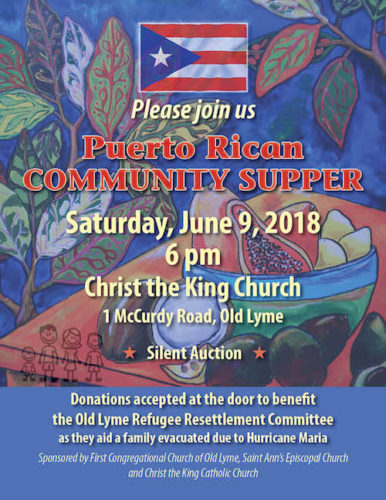
All Welcome at Community Supper Tonight To Support Local Puerto Rican Family Relocated After Hurricane

The First Congregational Church of Old Lyme (FCCOL), Christ the King Church and Saint Ann’s Episcopal Church will hold a joint community supper – featuring traditional Puerto Rican music and delicious dishes – at 6 p.m., this evening, Saturday, June 9, at Christ the King Church to help support the churches’ efforts to relocate the Colon family from Vega Baja, Puerto Rico.

The family of four – Adrian and Lismarie Colon and their two children, Adrian Jr.(age 12) and Gustavo (age 2) – was relocated to Old Lyme in late December, after losing their home, their jobs, and all of their belongings to Hurricane Maria. “We watched the water just pour into our house through all the windows,” said Adrian Colon, Sr. “We lost everything!”

The Old Lyme Refugee Resettlement Committee – a group of volunteers representing all three churches and the greater community – has helped the family find new housing, support services, jobs and schools, as they start life over here on the mainland.

There is no specific charge to attend the supper. Admission is free. However, donations will be accepted at the door, and a silent auction will be held to encourage contributions to the committee’s ongoing efforts to relocate families in need.  Adrian Colon, Sr., and volunteers from all three churches will prepare the delicious and authentic Puerto Rican meal.

First Congregational Church Senior Minister Steve Jungkeit said, “We are proud to link arms with our friends at Christ The King and Saint Ann’s to support the resettlement of the Colon family, and welcome them as our new neighbors.  We are proud of all the efforts made by the Old Lyme community to help this family in need. I invite everyone to join us for the fund-raising supper – an evening of great food, warmth and camaraderie that comes from neighbors helping neighbors. ”

The three churches and the Old Lyme Refugee Resettlement Committee encourage residents who have questions or would like to make a donation to communicate with any of the church offices via email: FCCOL: fccol@fccol.org; Christ the King Church: ctkoldlyme@aol.com; Saint Ann’s Episcopal Church: office@saintannsoldlyme.org.

Letter to the Editor: Old Lyme Clergy Speak Out in Support of Affordable Housing

To the Editor:

On Tuesday evening, June 5, a public hearing was held in the Middle School Auditorium concerning the proposed affordable housing project, sponsored by the Hope Partnership.  As the clergy from the First Congregational Church and St. Ann’s Episcopal Church, we sat through the meeting and listened to a very thoughtful and careful proposal from Hope, and from its team of planners.  We appreciated the structure of the meeting outlined by the Zoning Commission.  We also heard, by contrast, the comments and catcalls of residents, many of whom were vitriolic, spiteful, and willfully disruptive.  It was not a proud moment for Old Lyme.  It was, in fact, quite embarrassing, for it revealed some of the most dreadful tendencies that can emerge in small towns such as the one in which we all reside. 

It was apparent in the hearings that some residents had spent considerable intellectual energy to challenge the work that Hope Partners put into their proposal.  We can only wish that those same individuals used that energy to solve problems of housing, or poverty, rather than disrupting the work of a trustworthy organization focused on providing housing for everyone from firefighters to returning veterans, postal workers to retail workers and far more.  We could hope that they might have used their knowledge to solve some of the issues they claim to have uncovered.  We still hope that those individuals might use their wisdom and experience to help move a worthy project forward, helping to diversify our community, that others might enjoy what is truly good about this town.

As clergy, we believe we’re called to a better and higher way.  We believe there’s room for dialogue, respect, and civil disagreement in public forums.  And we believe that there are better angels within us all that may yet emerge.

We also believe that Old Lyme needs affordable housing.  We further believe that Hope Partners have carefully and thoughtfully selected an appropriate site for such housing in Old Lyme.  To provide shelter is an injunction and virtue at the center of all the Abrahamic faith traditions.  But it stands at the center of our democratic tradition as well.  There are those in our midst who desperately need shelter.  Some are elderly, as one person courageously reminded us on Tuesday.  Some are young families struggling to get by.  Some are recent college graduates, working several jobs to get a foothold in a shrinking labor market.  Some come to us from different parts of the world, striving to make a new life in the United States.  Affordable housing is a powerful way of providing shelter, when shelter is in short supply.

Every Christmas, each of our congregations rehearses the story of Mary and Joseph, turned away from their own quest for shelter because, the story tells us, “there was no room for them in the inn.”  We appeal to our fellow residents to seek a different, and better response, one that says, “There is room in our inn.  There is room in the town of Old Lyme.”

We believe that’s what the better angels of our humanity call us to in a moment such as this.

In faith.

Sincerely

Rev. Dr. Steven R. Jungkeit, Senior Minister, The First Congregational Church of Old Lyme
Rev. Mark K. J. Robinson, St. Ann’s Episcopal Church, Old Lyme
Rev. Laura Fitzpatrick-Nager, The First Congregational Church of Old Lyme
Rev. Carleen Gerber, The First Congregational Church of Old Lyme

Op-Ed: Higher Ground; More Thoughts From SECoast on the Old Lyme Affordable Housing Proposal

This Op-Ed was written by Gregory Stroud, Executive Director, SECoast

Location … location … location … as the saying goes. Why build an affordable housing development wedged beside the Exit 70 off-ramp — one of the more problematic stretches of road in southeastern Connecticut?

About a month ago, we put this directly to Hope Partnership and Women’s Institute in a meeting with board members and project leaders. And we didn’t really get a clear answer.

We do know that in the process of joining forces with Old Lyme Affordable Housing Corp., Hope Partnership promised to prioritize a project in Old Lyme. Tom Ortoleva and Lauren Ashe described an ongoing search for suitable properties, which apparently included a query at some point to the owners of Cherrystones, four miles to the south on Route 156.

Of course, it’s not often that a property of this size comes on the market at this price. And although we don’t know the exact terms of the proposed sale by Graybill Properties, it’s likely relatively modest.

But 16 Neck Road is not the only property at that general price point, and in fact we have been contacted by one local property owner with 20 acres already zoned for multifamily housing, and eager to sell. The property has ample green space, nearby jobs, a nearby park, and beach. In fact, the property has everything that many people would pay much more for, so what’s the catch?

At this point, we have to admit, we’re not entirely sure. We have asked… without any solid answer. What’s the appeal of a development at Exit 70?

Let’s start with the obvious. 16 Neck Road is slightly over 1500 feet from the nearby Halls Road shopping district. Take a look at Hope’s own literature on affordability, and you’ll see that affording a car is almost as much a burden for families as affording housing. Two cars make the burden that much greater. With tolls and higher gas taxes on the horizon (yes, they’re coming), easing the burden of transportation simply makes sense. Walkability–it’s a goal we support.

Unfortunately, although Old Lyme is obligated to provide affordable housing — also a goal we support — there just aren’t very many opportunities to build walkable affordable housing in Old Lyme.

But here’s the problem. When you re-zone, and build a project on a foundation of walkability, the developer, and the town, and the state (remember Route 156 is a state road) are obligated to provide a timely and safe walkable solution.

The easiest rebuttal would be to say that 16 Neck Road is no less walkable than most any other property in Old Lyme. Which is fair and true…. however… expectation matters, and brings with it not only a legal responsibility (liability), but also an ethical responsibility (safety).

People being people… children being children… the location being what it is… the cost of a second car being what it is… there is no doubt that with this development will come significant numbers of people daily, at peak times, and at night, crossing Route 156 near Exit 70 on foot.

This is not an extraneous argument, but rather an issue which gets to the heart to what 8-30g is all about — what’s called a “competition of goods.” By that, we don’t mean “goods” like groceries… we mean “goods” like worthy goals. In a legal sense, there are lots of worthy goals: The environment is a worthy goal. Pedestrian and traffic safety is a worthy goal. Historic preservation is a worthy goal. Open space is a worthy goal.

There is nothing in 8-30g which says that any of these goals no longer matter. In fact, just the opposite. The law states, that zoning approval may be based on “health, safety or other matters which the commission may legally consider.” 8-30g has not transformed the Zoning Commission into a Health and Safety Commission. It’s still Zoning.

But here’s the catch. All worthy goals — “goods,” if you will — aren’t created equal. And the law, 8-30g, establishes a clear priority for the purposes of Zoning approval. In the competition of goods, affordable housing has a higher priority than most. So… for example, Historic Preservation can still be considered, but Historic Preservation alone is unlikely to outweigh the public good of affordable housing.

In practice, the courts have established a trio of key competing concerns: Affordability, Health, Safety.

That said, 8-30g does not provide a shortcut on procedure and law. The applicant still needs to file the correct forms on issues small and large. The applicant still needs to gather the appropriate permits and approvals in a timely manner. Every portion of the law still applies. Zoning can still consider all the issues zoning normally considers. It’s just that after jumping through all the appropriate hoops, and after following all the governing laws, just like every other applicant and for everything other project, good or bad, the Town of Old Lyme pretty much can’t deny approval without a reason or set of reasons which “clearly outweigh the need for affordable housing.” In a legal sense, that’s a high bar. And it’s a bar we support.

Our frustration with Hope Partnership and Women’s Institute, and with proponents of the plan, is not with the issue of affordable housing. We strongly support that goal.

Our frustration is that proponents have chosen to ignore or breezily dismiss every single other worthy and competing goal, even the other portions of the trio… health and safety.

If the issue of pedestrian safety can be solved, then solve it. If you can’t solve it, then explain how the benefits of this particular project outweigh the dangers to pedestrians. That’s how 8-30g is meant to work. That’s a competition of goods. That’s an honest discussion.

After a month of asking, a responding Op-Ed by Hope Partnership in Lymeline, and an hour and a half of presentation, how is it possible that neither project leaders for Hope Partnership and Women’s Institute, nor their extraordinarily-experienced traffic advisor, have even once mentioned the words “pedestrian” or “pedestrian crossing”?

We’ve looked at the latest traffic report, submitted at the last minute, and there too, no mention of pedestrians. In fact, the latest study only makes matters worse, with the apparent failure to approve a stop sign in place of the yield at Exit 70. If I-95 traffic does not matter for this development, nothing is a clearer statement of the opposite than CTDOT’s unwillingness to add an extra stop sign (much less a traffic signal) at the intersection of Exit 70 and Route 156.

And when we questioned the basic accuracy of statements by Hope Partnership regarding Fire Code approvals, didn’t it amaze you — it amazed us — that not one proponent of the project bothered to raise a hand, to rebut our statement, or to care? We actually wanted to be proved wrong, and instead… crickets.

To be clear, if there is some balance between the cost and the procedures and requirements of Fire Code, why not just explain it? A competition of goods…here’s how we justify our approach…

We’ve heard numerous comments from proponents of the plan that the audience, and the commissioners themselves, were uncivil (or worse). And as much as we encouraged the public to turn out — 503 people is a remarkable number — we will not stand to defend the behavior and motives of every member of that audience. However…

Instead of focusing on hurt feelings, isn’t it remarkable how little concern has been shown for any other issue than affordability? Isn’t it remarkable that no one has said, you know, we care about fire safety, and we’ll get to the bottom of this? Isn’t it remarkable that no one has even bothered to say, you know, we care about children crossing a busy road, and we won’t build this project until we have a real solution in hand?

From our perspective, that’s what the moral high ground looks like. It’s a realization that the right choices, that moral decisions, are complicated; that even the best intentions and the better goals, often face worthy, competing, even contrary claims; that the heaviest and hardest moral burdens come often with challenging the ones and things you love the most.