Organization Stresses Support of Affordable Housing
This Op-Ed was written by Gregory Stroud, Executive Director, SECoast
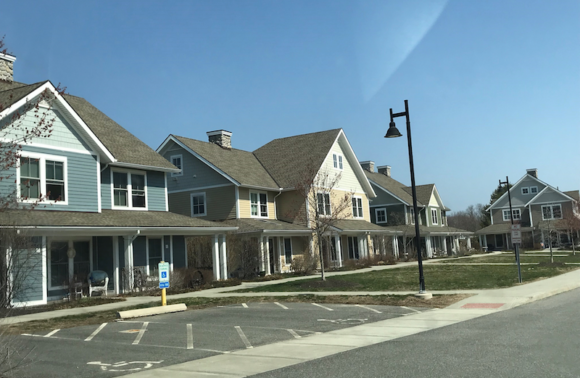
This photograph shows a representation of Hope Partnership’s ‘model’ Ferry Road development six years after completion. Photo by Gregory Stroud.
No doubt by now, most of you have heard of the Hope Partnership housing development planned for 16 Neck Road. It’s a subdivided property tucked in beside the northbound I-95 exit 70 into Old Lyme, a wooded 12.5 acre lot with a steep entrance road, and a long stretch of deep-water access to the Long Island Sound. The property once assessed for $1.2 million, was purchased by a local developer on December 31, 2015 for a relative song—$455,500.
As things stand today, our expectation is that the purchaser, Graybill Properties, will keep and develop the back two lots for private houses, with river views and water access, and will sell the front two lots facing Neck Road for development as “affordable housing,” all told perhaps 37 or 41 two- three- and four-bedroom units, twelve buildings, and 113 parking spaces.
The development falls under a state law, commonly known as 8-30g, which doesn’t exactly give for-profit and non-profit developers carte blanche, but it does place a heavy burden of proof on local government to stop them, if a town fails to meet a very narrowly-tailored threshold of 10 percent deed-restricted affordable housing stock. Old Lyme currently stands at 1.56 percent, and by this method of counting, it’s not at all clear that the town can or will ever meet or sustain the minimum threshold of affordability.
To be sure, affordable housing has a checkered 30-year history in Connecticut, with often wealthy enclaves successfully gaming the system to shirk their statutory responsibilities, and sometimes unscrupulous developers gaming the system to build luxury apartment complexes, and harvest tax advantages, wherever profitable. In our particular case, we feel confident in saying that neither is the case, but that does not mean our current debate has not been colored on various sides by these broader frictions and frustrations.
Proponents of the project have at times avoided a serious discussion of the project by out-of-hand dismissing legitimate local concerns as NIMBY (Not In My Back Yard)—a form of name-calling rather than logical argument. Opponents of the project have frequently suggested darker motives for the development, without evidence. Town leaders have pitched the project as an effective defense against less scrupulous developers, despite the obvious truth that this project will not nearly allow Old Lyme to meet its near-impossible 10 percent obligation. There has no doubt been anger and ugliness, and more than a few transitory facts and figures in and around the project. We can do better.
Although we have significant and still unaddressed questions concerning the genesis of this project, the methods for choosing and advancing this project, how it fits into broader unstated plans of profit, funding, and development for Old Lyme, nevertheless we are confident that the two primary organizations behind it—Old-Saybrook-based Hope Partnership, and their statewide partner The Women’s Institute—are motived not by profit, but by a genuine, if perhaps overriding, philanthropic mission.
Nor does Old Lyme—despite its reputation among some as a haven of wealth and privilege—have a history of skirting the law or blocking affordable housing projects. In fact, in this case First Selectwoman Bonnie Reemsnyder and Selectwoman Mary Jo Nosal, have invited and actively encouraged the development of this project in Old Lyme. We have little doubt that many in Old Lyme will bend over backwards to help see this project to completion.
But now putting all that aside, we are left with two basic questions: Is this a ‘good’ project? And do our concerns about health, safety, or other legally reviewable matters, clearly outweigh a need for affordable housing?
To the first question, we say largely not. To the second question, we say that it remains unresolved. For this reason, while we have decided to remain neutral at present on this project—we will neither promote, nor actively endeavor to block it—it is our view that the project leaves such substantial details and questions unresolved that it would constitute an act of negligence for zoning, planning, wetlands, or other town commissions to give this project approval, or even conditional approval, without significant additional scrutiny and assurances.
To this end, we spent more than two hours on May 2 with board and staff members of Hope Partnership, and The Women’s Institute, which was followed by numerous hours reviewing evident and serious issues of pedestrian and traffic safety, fire code, environmental, and other concerns. We followed up with an additional nearly hour-long conversation with Kristin Anderson, the development manager for the project, as part of The Women’s Institute. We remain deeply, and sincerely troubled by the project, and the feasibility of addressing these concerns.
We leave our detailed criticism to later public comment, but that said, it is telling we think, that the bulk of assurances which we did receive, regarding the goodness, the compliance with fire code, and the traffic and pedestrian safety of the project, are premised on a series of troubling and doubtful assumptions as follows:
- that some un-proposed and unfunded redevelopment of Rte. 156 and Halls Road may in the future allow for safe pedestrian access between the development and the nearby Halls Road Shopping District;
- that the 2018 State Building and Fire Safety Codes would drop a mandate for sprinklers by a vote in the legislature on July 1;
- that CTDOT will alter the traffic signs and the terminus of Exit 70 in a manner, and time, which will allow for safe vehicle access to the site.
To be frank, all that we are really sure of here, is that this project has sailed through a number of planning, zoning, and wetlands meetings, with the strong backing of elected local officials, an array of ephemeral facts and arguments, an ever-growing scope, and a heck of a lot of good intentions.
But for all the good intent, the stubborn present reality of this project remains an essentially regressive model of suburban tract housing, with no clear safe access on foot, by bicycle, school bus, or public transit, awash in blacktop, skirting requirements of septic within the watershed and at the mouth of the Connecticut River, exempted from requirements of open space for land which will later be developed, and by an Old Lyme Plan of Conservation and Development, which is two sentences from nonexistent.
This is a project, as currently drawn, which reaches toward a lower common denominator of fire code. If requirements for sprinklers are dropped, should we cheer? It’s a plan at present, which encourages children to play inside, and burdens struggling families with the necessity of two cars.
Of course, no project can meet every ideal measure, and many families happily live out their days without sidewalks and within suburban tract housing. Should we hold affordable housing to a higher standard? Aren’t affordability and good intentions, reason enough? It’s an argument more often we’ve seen used for hot dogs and hamburgers in school lunches.
The reality is that 16 Neck Road is not just a housing development, it’s the entrance to the town. 16 Neck Road is the first step, a driving force, a funding source and point of leverage for a much larger unspoken and questionably-coordinated redevelopment of Old Lyme. Are we in such a rush, that without any real detail, this is how we choose to begin?
Believe me, the public hearing on May 14 isn’t just another hoop, it’s the moment when Hope Partnership and the Town of Old Lyme decide whether to pull the trigger.
We say, yes to affordable housing in Old Lyme, but only with a better affordable plan.

 The Connecticut Audubon Society’s Roger Tory Peterson Estuary Center is hosting a three-part Spring Lecture Series through May 17.
 This is, at one and the same time, a work of fiction and the author’s actual family history, selectively combined and embellished. It is the story of Michael Chabon’s grandfather and grandmother, recreated as a totally engaging novel, covering more than five decades in Germany, Philadelphia, Baltimore, New York City, Florida and California. He “recreates” these two antecedents, beginning with his grandfather’s work with the Office of Strategic Services (O.S.S.) in Germany in the waning day of World War II, followed by the meeting with his grandmother in Baltimore