
The End of an Era … but the Journey Continues: Jeff Andersen Retires From the FloGris Museum After 41 Years

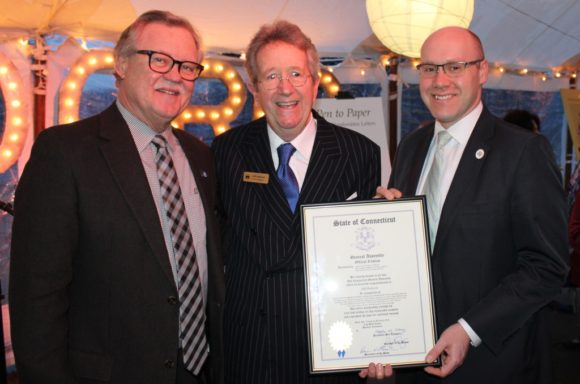
Retiring Florence Griswold Museum Director Jeff Andersen stands between State Senator Paul Formica (left) and State Rep. Devin Carney holding the State Citation with which the two legislators had presented him.

There wasn’t a parking spot to be found Sunday afternoon at the Florence Griswold Museum, nor come to that at the Lyme Art Association. And the reason?  Despite torrential rain, it seemed as if the whole town had come out to say a fond farewell to Jeff Andersen, the much beloved Director of the Florence Griswold Museum, who was retiring after an amazing 41 years in that position.
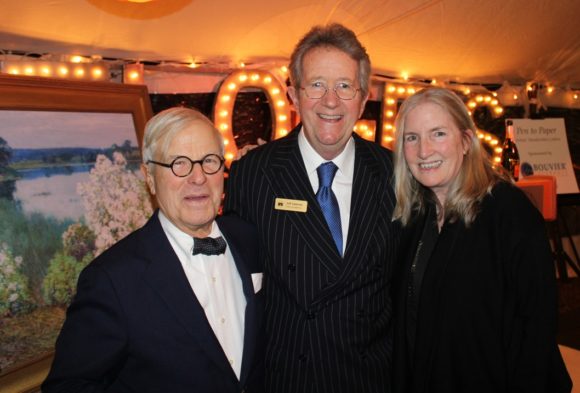
Jeff Anderson stands with Charter Trustee George Willauer and New York Times best-selling author Luanne Rice alongside the Willard Metcalf painting, “Kalmia,” which the board has now dedicated to Andersen in honor of his 41 years service.

The Museum hosted a wonderful party to celebrate Jeff and his wife, Maureen McCabe, and both Marshfield House and the tent situated in the courtyard outside were packed almost to capacity. Federal, state and local dignitaries were there along with Museum trustees, staff, volunteers, friends and pretty much anyone who had ever had a connection with Jeff, Maureen or the Museum — well over 400 people in total.

The formal segment of the event was emceed by Charter Trustee Jeff Cooley, who opened the proceedings by introducing Senator Richard Blumenthal. Describing the Florence Griswold as “a world-class Museum,” Blumenthal went on to present Andersen with a Certificate of Recognition from the US Senate, which he noted to considerable laughter, “was approved by an overwhelming bi-partisan vote.” He thanked Andersen warmly for, “Your immense public service … and your values.”
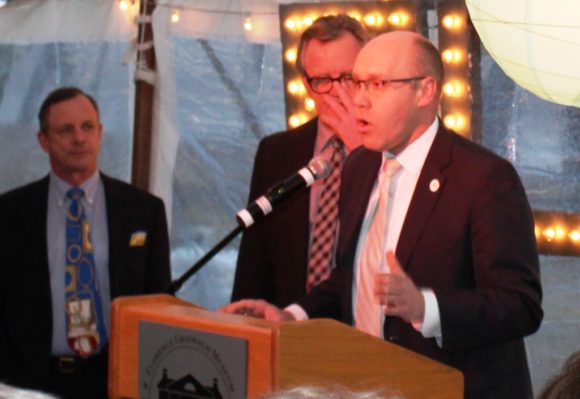
State Rep. Devin Carney says, “It all started with just one … and that was, you, Jeff.”

State Senator Paul Formica (R-20th) and State Representative Devin Carney (R-23rd) stepped up next the podium and Carney noted poignantly, “It all started with just one … and that was you, Jeff.”  Carney was referring to the fact that 41 years ago, Andersen was the Museum’s first — and only – employee whereas now the Museum has 20 staff, 255 volunteers, 3,000 members and 80,000 visitors annually.

Saying, “I truly want to thank you, Jeff, for doing so much good for the economy as a whole,” Carney pointed out that many of the visitors to the Museum, “come, stay and shop,” in Old Lyme and the surrounding area, adding, “You did a great job at the Museum … but you also stopped a train!”  This latter was a reference to the Federal Railroad Administration’s proposal to route a high speed train through the center of Old Lyme, which Andersen actively worked to defeat.
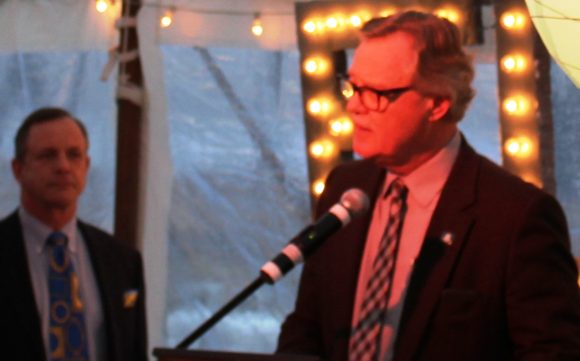
State Sen. Paul Formica reads the Citation from the state in honor of Jeff Andersen.

Formica then presented Andersen with a Citation from the Connecticut House and Senate, which recognized Andersen for his “passionate dedication directing, restoring and revitalizing the Florence Griswold Museum,” noting, “For 40 years you shared your vision and inspired countless volunteers and workers to help fulfill this vision expanding exhibits, gardens and collections making it into the reputable attraction we know today.” The Citation concluded, “We want to thank you for your tireless leadership and congratulate you on your retirement.”

Following the legislators was Old Selectwoman Bonnie Reemsnyder, who immediately confessed, “Frankly, I have to say I didn’t think there would ever be a time when Jeff wouldn’t be here.”  She continued, “It’s good for him [Jeff] and all of us to be aware of all you have done.  You’re part of our DNA, you’re the heart of our culture,” and then announced that the Town of Old Lyme was declaring Feb. 11 as “Jeff Andersen Day,”  adding to loud applause and much laughter that it was a unanimous vote.
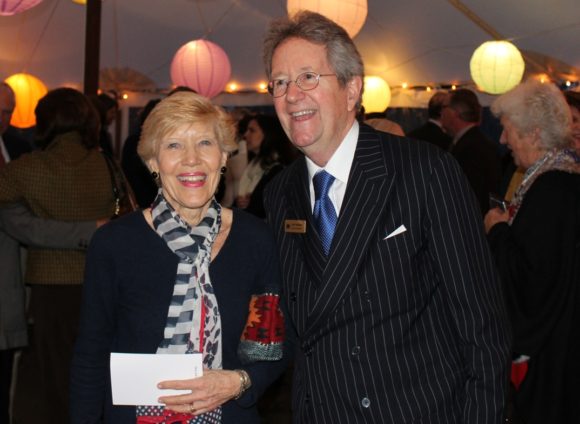
Andersen mingled freely with the more than 400 guests gathered to say their goodbyes.

She read a Proclamation from the Town which stated, “Since he began working with the Museum in 1976, the Florence Griswold Museum has grown from a small seasonal house museum where he was the only staff member to a nationally recognized center for American art.” The Proclamation also noted that, “Jeff is recognized today as the pre-eminent scholar on the historic Lyme Art Colony … and has helped grow the Museum’s modest collection of works of American Impressionism into a deep and distinguished regional collection of American art.”  Describing Andersen as a “visionary Leader,” with a “thoughtful devotion to excellence,” Reemsnyder concluded, still reading from the Proclamation, that Andersen’s, “tireless advocacy for the Museum and its uniquely Connecticut story has transformed the Florence Griswold Museum into one of the state’s most important and beloved cultural destinations.”
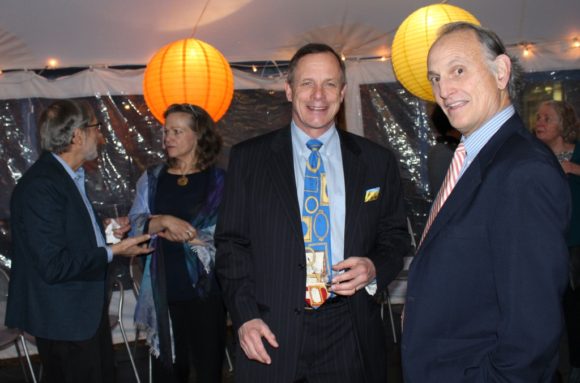
Jeff Cooley (center) emceed thw formal proceedings at the party. His wife Betsy stands to his left.

Charter Trustees George Willauer and Cooley then unveiled the beautiful 1905 painting titled, “Kalmia,” by Willard L. Metcalf to which a plaque had been attached stating that it now honored Andersen’s 41 years of service during which he “transformed” the Museum “through his unswerving devotion to preserving the legacy of the Lyme Art Colony.”
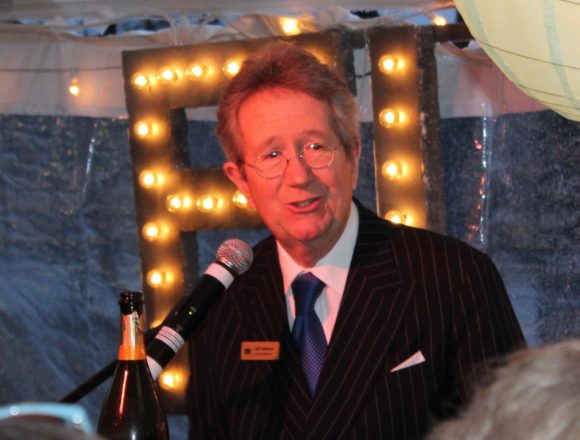
Jeff Andersen addresses the at capacity audience.

A clearly emotional Andersen then addressed the audience, which by now was overflowing the tent, saying simply, “We are feeling the love …”  He gave a long list of thank you’s, noting that he and his wife had, “felt such affection and regard since announcing his retirement.” Andersen then shared his opinion that, “whatever you give to the Museum – whether time, talent or money – it is returned to you many fold.”  He said, “Not many get the opportunity to have a career in one place [in his case, from age 23 to 64] and for that I am deeply grateful and humble.  Stressing, “Be assured the future is bright,” he commented almost wistfully, “What an incredible journey this has been … but the journey continues.”
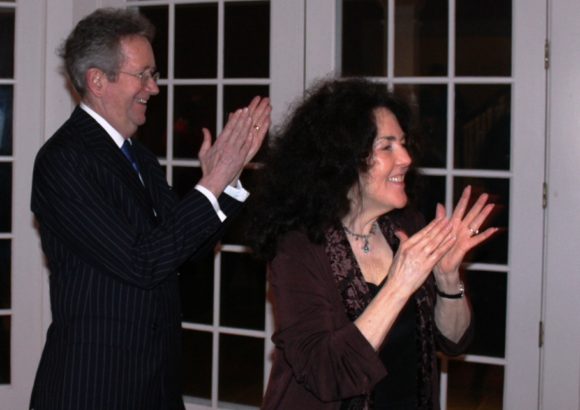
Jeff Andersen and his wife Maureen McCabe applaud the pianist after he played a tune to which they had danced together at the very end of the party.

And with that, Cooley proposed a toast to Jeff and Maureen, glasses were raised, Prosecco was drunk and then vigorous applause and loud cheers erupted all around.
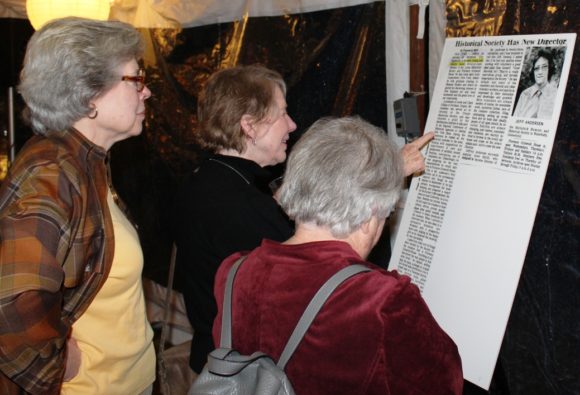
Florence Griswold Museum docent Linda Ahnert points out a detail from the newspaper cutting to fellow doscents.  The cutting announced Andersen’s arrival as the Museum’s first director — and then only employee — 41 years ago.

We here at LymeLine.com can only add our deep and personal thanks to Jeff and Maureen for an extraordinary career in which so much given with such incredible warmth and humility.  Rep. Carney said it best so we’ll end by echoing his words, “The Florence Griswold is truly a treasure, but so are you … Miss Florence would be really proud of you.”
Ruth Ann Heller Music Foundation Announces Scholarship Awards to 26 Lyme-Old Lyme Students

The Ruth Ann Heller Music Foundation (RAHMF) has recently awarded scholarships to 26 Lyme-Old Lyme students.

As one of many supporting organizations in our towns, the RAHMF awards scholarships to instrumental students participating in Lyme-Old Middle and High Schools band programs. The 501(c)3 non-profit foundation was formed in 1999 after the retirement of Ruth Ann (King) Heller, who had a long-lasting impact on the district’s band program that continues to thrive today under the dedicated and talented efforts of Jay Wilson at the high school and Carrie Wind at the middle school.

Scholarships are exclusively for private lessons and paid directly to student-selected teachers. One-on-one instruction time provides a valuable opportunity for the students to develop their musical skills and subsequently enhance the quality of the band performances.

The RAHMF is celebrating 15 years as a non-profit organization. Over $50,000 has been granted to 310 students since its inception. These awards are merit-based.

The Foundation welcomes reader’s interest and, if possible, donations in any amount.

For more information, visit www.rahmf.org or email info@rahmf.org.

Old Lyme Selectmen Schedule Public Information Meeting Tonight, 6pm, on Blight Ordinance

The Old Lyme Board of Selectmen approved a Proposed Blight Ordinance to address the many concerns expressed by citizens about blight in the community. The proposed Blight Ordinance was approved after many meetings with land use officials, including the Zoning Enforcement Officer, the Fire Marshal, the Building Official, and Sanitarian, to ensure that the final document was what was needed and best for our community.

In addition, it has been reviewed with the Town Attorney to assure compliance with State Statutes.

The Board of Selectmen has scheduled a Public Information Meeting to review the Proposed Blight Ordinance with interested residents and voters, and to afford an opportunity to comment on the proposed ordinance.

The meeting is scheduled for Monday, Feb. 12, at 6 p.m. in the Town Hall Meeting Hall.

Printed copies of the ordinance will be available at the meeting, but can also be viewed online at this link.

If you are unable to attend the meeting, readers are invited to share your thoughts with the Selectmen by emailing the Selectman’s Office at this address or or by writing to the board of selectmen at 52, Lyme St., Old Lyme CT 06371. All comments will be shared with the members of the board of selectmen.

Hear Sen. Formica, State Rep. Carney, Lyme & OL Town Leaders Speak at Business Breakfast Tomorrow

The Lyme-Old Lyme Chamber of Commerce and the Town of Old Lyme are hosting a Business Breakfast tomorrow in Lyme-Old Lyme High School starting at 7:45 a.m.

State Senator Paul Formica, State Rep. Devin Carney, Old Lyme First Selectwoman Bonnie Reemsnyder and Lyme Selectman John Kiker will be speaking on Behind the Headlines: What’s Happening in our Towns and State?  Each speaker will make a short presentation and then there will be a Question and Answer session.

The Future Business Leaders of America (FBLA) Club at the high school will host the event at which a light breakfast will be served.

All are welcome and admission is free.  Please RSVP to email@lolcc.com or selectmansoffice@oldlyme-ct.gov so that the organizers have an idea of numbers.


Letter From Paris: Book That Wins France’s Top Literary Prize Raises Chilling Questions About WWII History

Nicole Prévost Logan

Coincidence or not ?

The prestigious French literary Prix Goncourt came out came just a few weeks before the election of 31-year-old Sebastian Kurtz as chancellor of Austria.  Many would say that election marked another step by the European Union along the road toward nationalism.

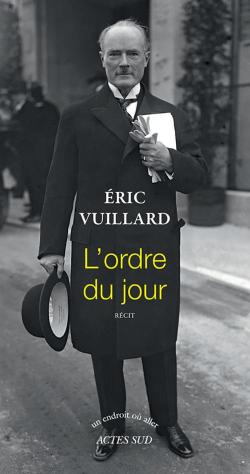
The topic of the novel is the Anschluss.  With devastating sarcasm the author, Eric Vuillard, puts the magnates of German industry on trial for profiting from the Nazi regime and the Austrian people for welcoming the invading German army on March 12  1938. The title itself is ironic since L’Ordre du Jour – which translates as ‘the order of the day’ or ‘the agenda’ – refers to a democratic assembly, which in the book will soon be abolished by Hitler.

It is a very short book (only 150 pages) printed in an unusual miniature format.  But it is a striking story, beautifully written, leading the reader through shocking scenes in which cruel humor is mixed with great despair.  Vuillard, is also a film maker, which explains the way he stages the story as seen through a camera, with colorful images, a sound track, leading actors and supporting crowds.

The action starts on February 20th, 1933, in Potsdam.  Twenty-four managers of the German industry – Gustav Krupp, Wilhem von Opel, Günther Quandt, Kurt Schmitt and others – are waiting in the ante-chamber of the Reichstag at the pleasure of its president, Hermann Goering.  The 24 grey-haired gentlemen, dressed in formal black or brown coats, with stiff shirt collars and striped pants, resemble the bare trees lining the Spree river in the winter.

Goering is late but the visitors wait patiently.

When he finally shows up, the guests raise like lizards on their hind legs.  Hitler – appointed chancellor just one month before – makes his entry and greets his guests.  At the end of the meeting, as expected from them, the managers obsequiously make their meager contribution of several millions Deutschmarks to help the Nazi war effort.

Vuillard turns the Anschluss into a farce. Using threats, lies, and brutal intimidation, Hitler manipulates the Austrian chancellor Kurt von Schuschnigg, making him totally helpless, bulldozed by the Nazi timetable.

February 12, 1938, is the second decisive date in Vuillard’s story.  Hitler has invited Schuschnigg for a secret lunch at Berchtesgaden, his mountain retreat in the Bavarian Alps.  It is an ominous sequence.  When the doors close behind the guest, the reader feels a sense of foreboding.

Overwhelmed by the hypnotic personality of Hitler, Schuschnigg caves in and has to agree to all his  demands: appointment of the Nazi Seyss-Inquart to the post of minister of the Interior;  amnesty of those condemned for the assassination of the Austrian chancellor Dollfuss in 1934; rehabilitation of all national socialist officials.  Having said that, Hitler reaffirms the independence of Austria.  Wasn’t that the ultimate?  asks Vuillard.

On the eve of the planned invasion, Mr and Mrs Ribbentrop (he is the German foreign minister) are invited to dinner at Downing Street.  The author describes in detail the menu of French cuisine and the wine list.  The conversation is light and animated.  All seem interested in tennis and the performance of Bill Tilden, who won the Davis cup seven times.

Toward the end of the dinner, a staff member brings a note to Prime Minister Neville Chamberlain, who becomes preoccupied.  Vuillard writes: “Winston Churchill opens his big cocker spaniel eyes.”  The Chamberlains are getting impatient but, out of sheer British politeness, do not show it.  Guests start leaving but the Ribbentrops linger on, saying endless goodbyes.

The camera jumps to the car where the German couple is now on its way home.  They burst out laughing.  They knew all along what was in the note … German troops have just crossed the Austrian border.

The story reaches its climax when the German forces are ready to pounce on Vienna on March 12, 1938.  The sky is a bright blue but it is freezing cold.  The Panzers are massed by the border but a problem arises — they run out of gas and a monumental traffic jam occurs.  It is hard to pull out a tool kit by the side of the road in sub-zero temperatures.

Hitler, who at first was elated by the prospect of entering Vienna with cheering crowds waving small flags and  blond-braided, young girls throwing flowers at the German soldiers, is now stuck on the road along with hundreds of armored cars.  When an army experiences a breakdown en route, ridicule is guaranteed.

Hitler cannot contain his anger and keeps shouting. By dusk, his Mercedes reaches Linz, the town where he spent his youth.  On March 15, the poor Austrian population, abused, but finally submissive, stands in front of Sisi’s palace to hear Hitler’s hoarse voice vociferate insults.  In a referendum, Austrians voted 99.7 percent in favor of the annexation by the Reich.

What happened to the 24 captains of industry we met in 1933?

During the war years, they made an incredible amount of money by employing cheap labor from Auschwitz, Ravensbrück, Buchenwald or Dachau.  They may have died of old age, but their empires live on, stronger than ever … BMW, BASf, Bayer, IG Farbem, Siemens, Tellefunken, Opel, and Thyssen-Krupp.

Exaggerated or not, the fact is that such a novel gives the reader a major jolt.  It is a literary feat, which revives dark moments of history that one should never forget.