Talking Transportation: Why I Support Malloy’s Plan for Tolls, Gas Taxes

Am I the only person in the state who thinks Gov Malloy’s plan for tolls and gas taxes makes sense?  Probably.  But let me try once again to overcome the usual objections and explain why Malloy’s plan is fair and necessary.

TOLLS ARE TAXES:
No, tolls are users fees.  Train fares aren’t taxes, are they?  If you don’t want to pay a few pennies a gallon more for gasoline, don’t drive.  Join us on the train and pay the highest commuter rail fares in the US.  There is no free ride.

I ALREADY PAY ENOUGH TAXES:
That may be your perception.  But in 1997 when legislators cut the sky-high gas taxes by 14 cents, why didn’t they tell us that would lose us $3.7 billion in needed transportation funding?  The bill has come due.

BUT I ALSO PAY A PROPERTY TAX ON MY CAR:
Sure, but it doesn’t go to fixing the roads.  That’s a town / city tax.  If you don’t like it, tell City Hall.

WE ALREADY HAVE THE HIGHEST GASOLINE TAXES:
Not so anymore.  Connecticut’s 39 cents per gallon tax is third highest in the Northeast, trailing Pennsylvania (59 cents) and New York (44 cents) and just ahead of New Jersey (37 cents).

THE ROADS SHOULD BE FREE:
And just where in the Constitution does it say that?  This isn’t the pioneer West:  we’re talking about I-95 and the Parkways!  Driving is not like going to an all-you-can-eat buffet.  Think of the new paradigm as an a la carte restaurant where you pay for what you eat.

TOLLS AREN’T SAFE:
Another myth since the days of the “fiery truck crash” in Milford in 1983.  Tolls don’t require barriers or booths anymore.  They’re electronic gantries over the highway reading your EZPass or license plate without slowing down.

TOLLS WILL DIVERT TRAFFIC TO LOCAL ROADS:
Maybe, for the first week.  Then people will decide if they want to waste time in traffic or pay a few cents to get where they’re going.

IF WE RAISE THE GAS TAX WHY DO WE NEED TOLLS?:
Because raising the gasoline tax can be done in weeks.  But tolls will take 2-4 years to install and by then upwards of half of all cars will be electric, paying no gas tax.  Why should a Tesla driver get a free ride?

OK, BUT JUST TOLL SOMEONE ELSE:
Sure, something like 34 percent of all traffic in Connecticut is from out-of-state.  But building tolls just at our borders is unconstitutional (and unfair).  We can offer a discount to Connecticut residents, but can’t charge those driving through our state while we pay nothing.

MALLOY STOLE MONEY FROM TRANSPORTATION:
True, money has been regularly “reapportioned” from the Special Transportation Fund for years, by Rowland and Rell as well as Malloy.  You’ll get the chance to stop that in November when there’s a referendum question on the ballot for a “lock box” on the STF.

THE REAL PROBLEM IS STATE EMPLOYEE UNION CONTRACTS:
That may be so, but the SEBAC contracts were just renegotiated and approved by the legislature, so how do we undo that before the STF goes belly-up next year?

I’VE HAD ENOUGH!  I’M LEAVING THE STATE:
Sorry to see you go.  But when you say goodbye, remember you’ll have to pay tolls to NY, MA or RI on your way out.

Posted with permission of Hearst CT Media
Jim Cameron

About the author: Jim Cameron is founder of The Commuter Action Group, and a member of the Darien RTM.  The opinions expressed in this column are only his own.  You can reach him at CommuterActionGroup@gmail.com

For a full collection of “Talking Transportation” columns, visit www.talkingtransportation.blogspot.com

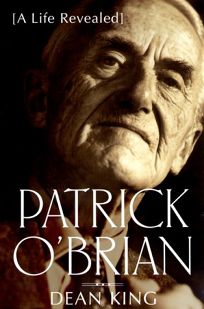
Reading Uncertainly? ‘Patrick O’Brian: A Life Revealed’ by Dean King

This is a confession of an addict.

In early 1993, I was urged by a long-time sailing friend to begin reading a series of novels by Patrick O’Brian about an English skipper and his shipboard surgeon set in the Napoleonic Wars.

I did.

By now I’ve read – three times, no less –all 21 of the famous Jack Aubrey-Stephen Maturin novels, plus six of his other books, plus King’s 2000 biography. And I’ve just finished a second read of this biography, learning even more about a compelling writer, now acknowledged by many as one of the two best 20th Century tellers of sea stories (Joseph Conrad being the other.)

A re-read is often even more enlightening than the first, and so it was this time.  For Patrick O’Brian was a consummate “storyteller” in both senses of the word. First, he was not “Patrick O’Brian”, an Irish novelist. He was Richard Patrick Russ, the grandson of a German who moved to London in 1842 to seek his fortune as a furrier. He served in the ambulance corps during World War II and divorced his first (Welsh) wife immediately thereafter, taking his new wife Mary (English, but divorced from her Russian husband) first to Wales and then to southern France, as his writing career blossomed.

Patrick was indeed a well-read and curious man, whose “ … love of nature, literature, and writing arrived early, whose love of solitude would endure, and whose obsession with privacy would infuse his eventual literary tour de force, the Aubrey-Maturin novels.”

But his worlds were mostly vicarious, experienced through his reading, not through actual sea experience. While his stories give us detailed and factually-correct stories of the sea and many of the battles, skirmishes, and life at sea during the wars between 1800 and 1820, plus the intrigues of life in England at that time, they were a result of his reading and research plus his remarkable memory.As far as we know, O’Brian never went to sea in any sort of vessel!

O’Brian avoided publicity whenever he could: As he had his alter-ego, Stephen Maturin, say in Truelove: “Question and answer is not a civilized form of conversation … It is extremely ill bred, extremely unusual, and extremely difficult to turn aside gracefully or indeed without offense.”

But he was, above all, a writer: “ … he found his most life-affirming moments in this fluid act of creation … For him, the creative process was largely an inexplicable one, some magical combination of conscious, and subconscious, of instinct and intellect, all clicking at once.” In addition to his English, he was fluid, “to some extent, in Italian, French, Spanish, German, Catalan and Irish and had a good background in Latin and Greek.” He also, “possessed extraordinary powers of retention and integrated this information into his lively ken.” King concludes that O’Brian had “ … an ego of iron beneath a surface of humility.”

My connection with O’Brian’s work goes beyond his novels and biographies.  Two of us went to the Princeton Club in New York City in the fall of 1993 to hear O’Brian talk about his novels and read from one of them. Mesmerizing, but the high point was when we asked him to autograph copies of his latest work. With an impish smile he proceeded to do so: one with his right hand and the other with his left!

Most of his novels have beguiling conclusions, somewhat abrupt, if only to lead the reader toward the next “installment.” But he explained his endings in a conversation about writing with Maturin and a friend one evening on the rail of a ship in the Pacific in the Nutmeg of Consolation: “La betise c’est de vouloir conclure (the absurd thing is the desire to come to a conclusion.) The conventional ending, with virtue rewarded and loose ends tied up is often sadly chilling; and its platitude and falsity tend to infect what has gone before, however excellent.”

I noted that passage when I first read it and used it for the end of my own autobiography.  King also cites it.

Mary O’Brian died in France in March 1998. Patrick O’Brian died, incongruously, in Dublin, Ireland, in January 2000. But his stories live on …

Editor’s Note: ‘Patrick O’Brian: A Life Revealed,’ by Dean King is published by Henry Holt & Co., New York 2000.

Felix Kloman

About the Author: Felix Kloman is a sailor, rower, husband, father, grandfather, retired management consultant and, above all, a curious reader and writer. He’s explored how we as human beings and organizations respond to ever-present uncertainty in two books, ‘Mumpsimus Revisited’ (2005) and ‘The Fantods of Risk’ (2008). A 20-year-resident of Lyme, he now writes book reviews, mostly of non-fiction that explores our minds, our behavior, our politics and our history. But he does throw in a novel here and there. For more than 50 years, he’s put together the 17 syllables that comprise haiku, the traditional Japanese poetry, and now serves as the self-appointed “poet laureate” of Ashlawn Farms Coffee. His wife, Ann, is also a writer, but of mystery novels, all of which begin in a bubbling village in midcoast Maine, strangely reminiscent of the town she and her husband visit every summer.

Letter From Paris: Book That Wins France’s Top Literary Prize Raises Chilling Questions About WWII History

Nicole Prévost Logan

Coincidence or not ?

The prestigious French literary Prix Goncourt came out came just a few weeks before the election of 31-year-old Sebastian Kurtz as chancellor of Austria.  Many would say that election marked another step by the European Union along the road toward nationalism.

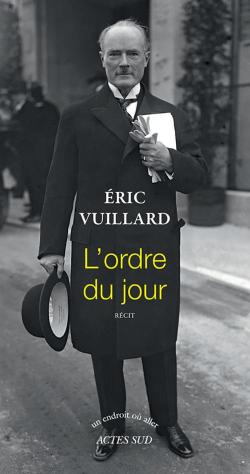
The topic of the novel is the Anschluss.  With devastating sarcasm the author, Eric Vuillard, puts the magnates of German industry on trial for profiting from the Nazi regime and the Austrian people for welcoming the invading German army on March 12  1938. The title itself is ironic since L’Ordre du Jour – which translates as ‘the order of the day’ or ‘the agenda’ – refers to a democratic assembly, which in the book will soon be abolished by Hitler.

It is a very short book (only 150 pages) printed in an unusual miniature format.  But it is a striking story, beautifully written, leading the reader through shocking scenes in which cruel humor is mixed with great despair.  Vuillard, is also a film maker, which explains the way he stages the story as seen through a camera, with colorful images, a sound track, leading actors and supporting crowds.

The action starts on February 20th, 1933, in Potsdam.  Twenty-four managers of the German industry – Gustav Krupp, Wilhem von Opel, Günther Quandt, Kurt Schmitt and others – are waiting in the ante-chamber of the Reichstag at the pleasure of its president, Hermann Goering.  The 24 grey-haired gentlemen, dressed in formal black or brown coats, with stiff shirt collars and striped pants, resemble the bare trees lining the Spree river in the winter.

Goering is late but the visitors wait patiently.

When he finally shows up, the guests raise like lizards on their hind legs.  Hitler – appointed chancellor just one month before – makes his entry and greets his guests.  At the end of the meeting, as expected from them, the managers obsequiously make their meager contribution of several millions Deutschmarks to help the Nazi war effort.

Vuillard turns the Anschluss into a farce. Using threats, lies, and brutal intimidation, Hitler manipulates the Austrian chancellor Kurt von Schuschnigg, making him totally helpless, bulldozed by the Nazi timetable.

February 12, 1938, is the second decisive date in Vuillard’s story.  Hitler has invited Schuschnigg for a secret lunch at Berchtesgaden, his mountain retreat in the Bavarian Alps.  It is an ominous sequence.  When the doors close behind the guest, the reader feels a sense of foreboding.

Overwhelmed by the hypnotic personality of Hitler, Schuschnigg caves in and has to agree to all his  demands: appointment of the Nazi Seyss-Inquart to the post of minister of the Interior;  amnesty of those condemned for the assassination of the Austrian chancellor Dollfuss in 1934; rehabilitation of all national socialist officials.  Having said that, Hitler reaffirms the independence of Austria.  Wasn’t that the ultimate?  asks Vuillard.

On the eve of the planned invasion, Mr and Mrs Ribbentrop (he is the German foreign minister) are invited to dinner at Downing Street.  The author describes in detail the menu of French cuisine and the wine list.  The conversation is light and animated.  All seem interested in tennis and the performance of Bill Tilden, who won the Davis cup seven times.

Toward the end of the dinner, a staff member brings a note to Prime Minister Neville Chamberlain, who becomes preoccupied.  Vuillard writes: “Winston Churchill opens his big cocker spaniel eyes.”  The Chamberlains are getting impatient but, out of sheer British politeness, do not show it.  Guests start leaving but the Ribbentrops linger on, saying endless goodbyes.

The camera jumps to the car where the German couple is now on its way home.  They burst out laughing.  They knew all along what was in the note … German troops have just crossed the Austrian border.

The story reaches its climax when the German forces are ready to pounce on Vienna on March 12, 1938.  The sky is a bright blue but it is freezing cold.  The Panzers are massed by the border but a problem arises — they run out of gas and a monumental traffic jam occurs.  It is hard to pull out a tool kit by the side of the road in sub-zero temperatures.

Hitler, who at first was elated by the prospect of entering Vienna with cheering crowds waving small flags and  blond-braided, young girls throwing flowers at the German soldiers, is now stuck on the road along with hundreds of armored cars.  When an army experiences a breakdown en route, ridicule is guaranteed.

Hitler cannot contain his anger and keeps shouting. By dusk, his Mercedes reaches Linz, the town where he spent his youth.  On March 15, the poor Austrian population, abused, but finally submissive, stands in front of Sisi’s palace to hear Hitler’s hoarse voice vociferate insults.  In a referendum, Austrians voted 99.7 percent in favor of the annexation by the Reich.

What happened to the 24 captains of industry we met in 1933?

During the war years, they made an incredible amount of money by employing cheap labor from Auschwitz, Ravensbrück, Buchenwald or Dachau.  They may have died of old age, but their empires live on, stronger than ever … BMW, BASf, Bayer, IG Farbem, Siemens, Tellefunken, Opel, and Thyssen-Krupp.

Exaggerated or not, the fact is that such a novel gives the reader a major jolt.  It is a literary feat, which revives dark moments of history that one should never forget.

Editor’s Note: This is the opinion of Nicole Prévost Logan.

Nicole Prévost Logan

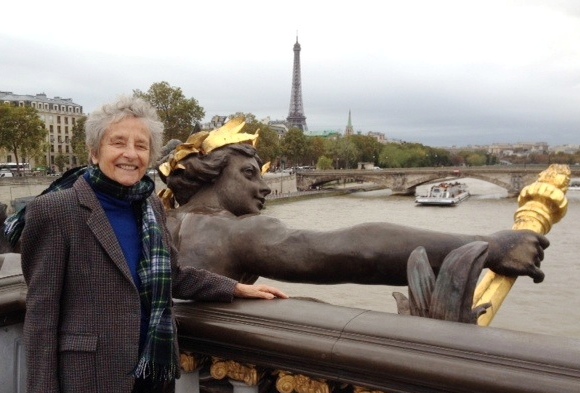
About the author: Nicole Prévost Logan divides her time between Essex and Paris, spending summers in the former and winters in the latter. She writes a regular column for us from her Paris home where her topics will include politics, economy, social unrest — mostly in France — but also in other European countries. She also covers a variety of art exhibits and the performing arts in Europe. Logan is the author of ‘Forever on the Road: A Franco-American Family’s Thirty Years in the Foreign Service,’ an autobiography of her life as the wife of an overseas diplomat, who lived in 10 foreign countries on three continents. Her experiences during her foreign service life included being in Lebanon when civil war erupted, excavating a medieval city in Moscow and spending a week under house arrest in Guinea.

Old Lyme Celebrates Renewal of ‘HEARTSafe Community’ for 7th Year

As the Town of Old Lyme enters its 7th year of certification as a HEARTSafe Community by the State Department of Public Health (DPH), citizens and visitors can view the red and white HEARTsafe road signs proudly proclaiming the award throughout town.               

“The HEARTSafe Communities program is designed to increase the awareness of the signs and symptoms of sudden cardiac events by ordinary citizens,” according to the DPH. “Old Lyme has demonstrated its commitment toward ensuring that its residents and visitors receive the early lifesaving response proven to increase the chances of survival”

A HEARTSafe Community promotes and supports cardiopulmonary resuscitation (CPR) training in the community, public access to defibrillation through strategic placement of automated external defibrillators (AEDs) for use by public safety professionals and other community members and early advanced care.

First Selectwoman Bonnie Reemsnyder notes, “Not only have most of our Town employees received certification, but other organizations like the OL-PGN Library, Lyme-Old Lyme High School (LOLHS) and many local businesses and civic groups have endeavored to certify as many individuals as possible. I applaud all of their efforts on behalf of the citizens of Old Lyme.”

Emergency Medical Technicians (EMTs) Colleen Atkinson and Doug Lo Presti, responsible for the training and organization of the town’s effort for the award, credit the Selectwoman’s dedication and commitment to the program for their training of more than 1,000 rescuers in Old Lyme, far in excess of the state requirement. “The recent addition of more defibrillators in our town, bringing the total to 24, greatly increases the odds that one will be available to a member of the public at large when needed,” notes Lo Presti.

The two EMTs, also American Heart Association Instructors, state Emergency Medical Services Instructors and founders of Critical Skills Education & Training, once again taught CPR with the use of an Automated Electronic Defibrillator (AED) s0 to the entire junior and senior classes at LOLHS in January. Atkinson comments that the result will produce hundreds of graduates who enter their community knowing how to give a victim of Sudden Cardiac Arrest the best chance of survival.

With the renewal comes the commitment to continue to increase the number of CPR-trained community rescuers and AEDs throughout Old Lyme. Anyone interested on learning, renewing or sponsoring CPR or willing to install an AED in their place of business can contact the EMTs through the Selectwoman’s office in Old Lyme Town Hall or call 860-304-8471 directly.