Florence Griswold Museum Offers Art Opportunity to Adults Learning English

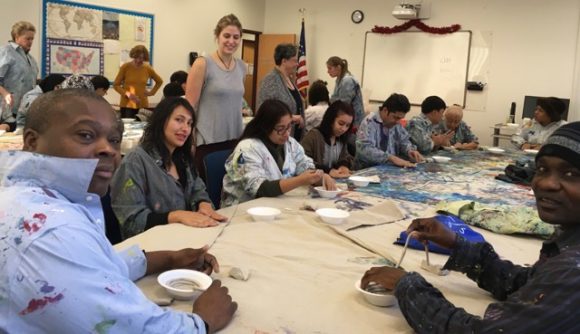
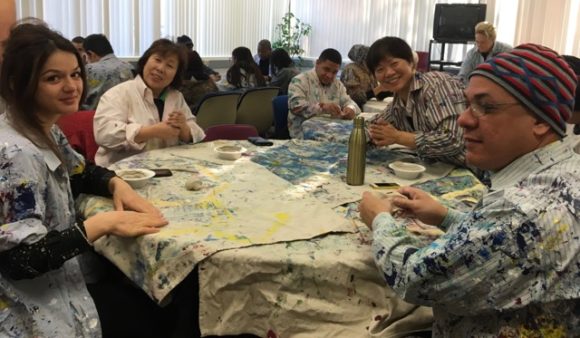
Adult English Language learners develop new skills while, in some cases, building on established ones during art classes taught by the Florence Griswold Museum.

Starting in November 2017, Florence Griswold Museum Art Education Director Julie Garvin Riggs and her assistants have been leading art classes with Adult English Language Learners from New London Adult Education.

Exploring new art skills is educational … and fun!

Each month, the art educators present different techniques and mediums such as print making, ceramics, mask-making, and collage to culminate in a show to be held at Expressiones Gallery in May under the direction of Jose Garaycochea.

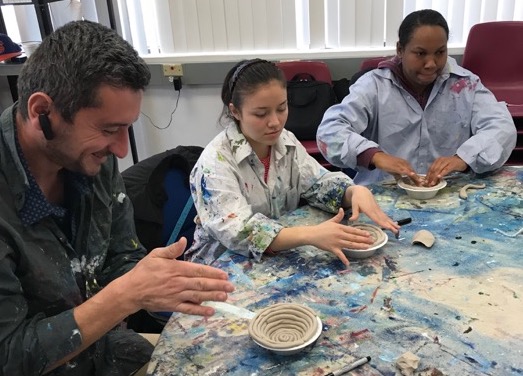
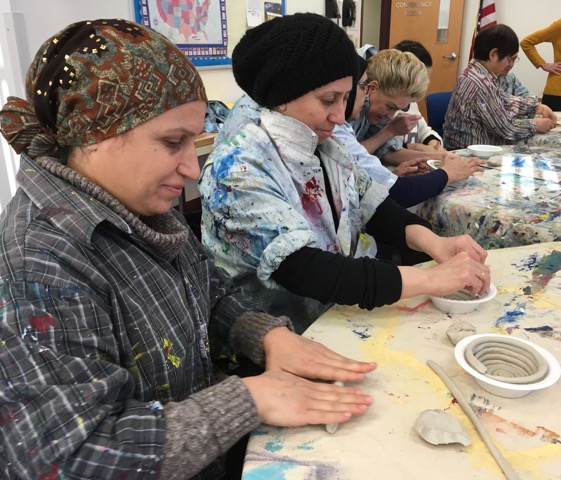
The students try their hand at creating coil pots with clay.

It is part of the Expressiones’ mission to be a community gallery and an opportunity to “give voice” and “expression” to adults challenging themselves to learn English. The project demonstrates clearly how the students not only grow in their abilities, but also experience great joy as their exposure to art increases. For some, it is their first time creating art or visiting a museum such as the Florence Griswold or both. For others, their baking, cooking, sewing or masonry experience translates well into fine motor skills applicable to art. And for those leading and supporting this project, they find it equally rewarding to see students flourish with their innate or experienced talent.

During the most recent January session, students worked with clay to make coil pots (see photo above), which will air dry before being painted. A number of the bowls were very elaborate and even decorated with snails.

Op-Ed: In Light of Current Events, Head of The Country School Confirms, Defends School’s Mission

By John D. Fixx, Head of School at The Country School

Dr. Martin Luther King, Jr. Day is a moment in which people in the United States and throughout the world celebrate a gentleman who gave his life striving for equality and the principle that all people are created equal.

Our country has stood for generations as an example of hope for people throughout the world. Many relatives of our families and teachers arrived here recently or generations ago. Some arrived as slaves. Some arrived voluntarily to seek a better life of freedom, opportunity, and the pursuit of happiness.

I am concerned that students have recently been hearing from the White House, the entertainment world, and the sports world that not all people are created equal. I send this letter, therefore, to make it clear how language and actions in the news today are counter to our mission at The Country School — to make it clear that as educators we will honor forthright questions from inquisitive students while striving to respect parental prerogative and disparate political viewpoints. It should not be controversial to deplore language and actions that undermine the bedrock on which the United States has been built and has prospered.

Our students might be reading on their phones and hearing stories about the mistreatment of women in Hollywood, on Olympic teams, and by influential men in broadcasting and elsewhere, while also hearing reports of hateful, racist, dangerous words from Washington that are inappropriate to use anywhere on our campus or use, many would argue, anywhere in a polite, civil society.

The Country School’s mission reads, “We nurture every student’s unique role in the community,” and that means that we value their differences. We live our mission daily by “encouraging students to embrace differences, explore new perspectives, and find common ground in a multicultural world.” We honor this ethos especially through our IDEA (Interpreting Diversity Education through Action) Day and Theme Day workshops, but also every day when we teach empathy and kindness.

I am tremendously proud of The Country School’s increasing diversity, as measured in terms of race, culture, family structures, religion, nationality, socio-economic status, and so forth. Our students’ families come from at least 27 different countries and their parents and grandparents speak some 17 languages at home. Our community spans the world, from Poland to Portugal and from China to Cambodia, from India to Israel to Italy to Ireland to Iceland, from Taiwan to Texas, from Lima to London, from Hungary to Sudan, and from California to Colombia. As educators, we cannot defend the idea that some families’ countries are worse or better than other countries.

Our core values state that our students “practice empathy by considering different perspectives and making all members of the community feel welcomed, included, and respected.” The Country School’s Mission Statement speaks to character and leadership development. As we teach our students in the Elmore Leadership Program, there are many ways to lead, and the best leaders bring disparate groups together to accomplish more than any individual could achieve on her or his own. And as part of the Elmore Leadership Program, we also teach students that leaders should use elegant, elevated language, and they should avoid profanity, misogyny, and similar “locker room” language.

We routinely answer questions as candidly and cleanly as we can, keeping our politics as adults as neutral as possible. I write this not to address specific tax policies or the Russian investigation, or a Mexican border wall, or trade agreements, or North Korean missiles, and so forth.

Rather, I want to make clear that it is part of our leadership mission at The Country School to ensure that our students understand that people can disagree agreeably, can use civil and respectful language, and — whether in Connecticut, Washington D.C., New York, or Hollywood — can always follow our primary school rule:

        1. Be kind.

Editor’s Note: Founded in 1955, The Country School serves 215 students in PreSchool to Grade 8 on its 23-acre campus in Madison. See our community in action during our Open House on January 28 from 1-3:30 p.m. Learn more at www.thecountryschool.org.

A Rally to Remember — Women (Mostly) Gather to Call Attention to Power of Peaceful Protest

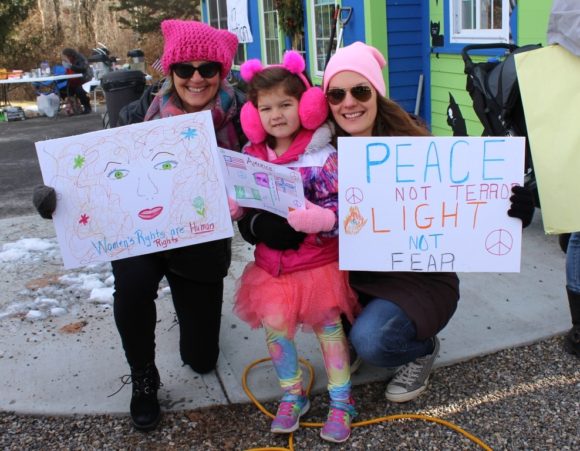
Three generations fighting for freedom: from left to right, Dale Griffith of Ivoryton takes time out from the rally for a photo with her five-year-old granddaughter, Eva Levonick, and her daughter (Eva’s mom) Becky Petersen, both of Old Lyme.

More than 400 warmly dressed people gathered Saturday morning under clear skies on the forecourt of the Two Wrasslin’ Cats cafe in East Haddam to stand in solidarity with all the other Sister Marches taking place all over the country … and beyond.  The event was organized by Together We Rise CT (TWRCT) and facilitated by Theresa Govert, founder and chair of TWRCT.
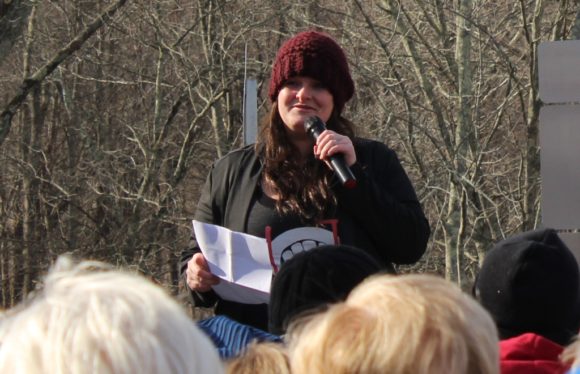
Govert, pictured above, spoke passionately to the assembled crowd, which spanned both age and gender, reminding members that it was precisely one year since President Trump took office and to look back on all the things his presidency had changed and to be cognizant of all the things that are in line for change.  She emphasized the need at all times for peaceful protest and was emphatic about never responding to violence.

Govert is a recently returned United States Peace Corps Volunteer. She served for three years in Botswana, where she worked with her community to organize thousands for a national campaign to end gender-based violence, started a small business as an alternative economic employment opportunity for female sex workers and presented to participants of the White House Mapathon on the importance of free, accessible data.

In 2016, she was selected to receive the prestigious John F. Kennedy Service Award, awarded every five years to six individuals.
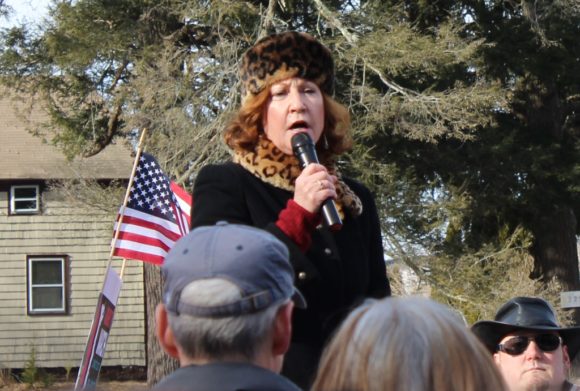
Christine Palm gave an impassioned speech to the attentive crowd.

The keynote speaker was Chester resident Christine Palm, who is Women’s Policy Analyst for the General Assembly’s Commission on Women, Children and Seniors and also principal of Sexual Harassment Prevention, LLC.

Palm opened by reminding those gathered that, “One year ago, many people predicted the Women’s March would fizzle out — that we couldn’t sustain the momentum,” but then pointed out that, in fact, the opposite has happened, and, “In this past year, it’s only grown broader and deeper and more ferocious and more inclusive, and now nothing coming out of Washington escapes our notice, or our resistance.”
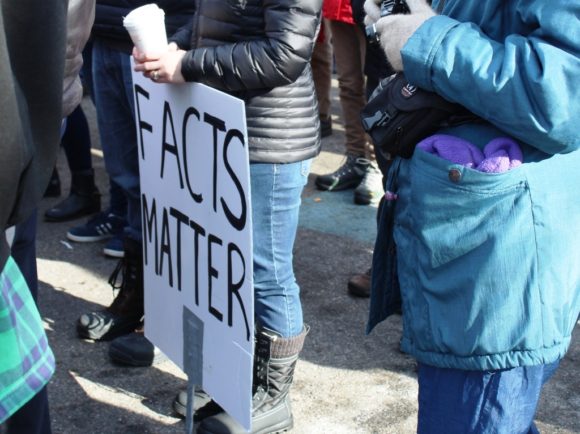
Noting, “It has not escaped our notice that this administration is defunding programs for veterans, kicking brave transgendered soldiers out of the military, and attacking women’s reproductive rights  that have been in place for decades,” Palm added, “We have paid attention to the fracking, back-stabbing … money-grubbing and gerrymandering,” before declaring, “The Women’s March has grown to encompass it all.”

Recalling the words of the renowned African-American civil rights lawyer Constance Baker Motley, who lived locally in Chester, Palm said, “There appears to be no limit as to how far the women’s revolution will take us,” pointing out, “That’s why we’re all still here, a year later.”
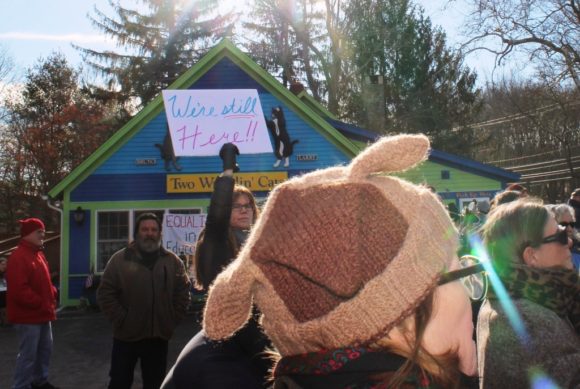
After thanking all those attending for “paying attention to what’s going on in our fractured, frightened world,” and acknowledging the work of all “the new, well organized progressive groups,” Palm expressed her gratitude to, “the hard-core folks who have kept vigil at this enlightened business, Two Wrasslin’ Cats, through rain and sweltering heat, every Saturday, for a year.”
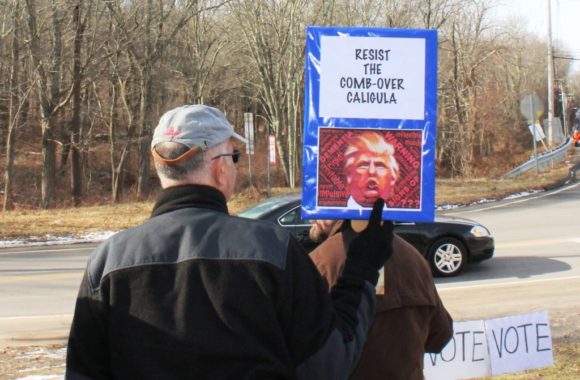
Palm urged everyone not to give up, commenting on the fact that for the older people present, “it seems, we’ve been boycotting, and protesting, and working to right what is wrong,” for a very long time, but she noted, “We are buoyed not only by one another, but in remarkable new ways, by a smart, hardworking and committed group of young people.”  She thanked the Millennials for their “passion and energy,” which she determined, “cannot be overestimated.”
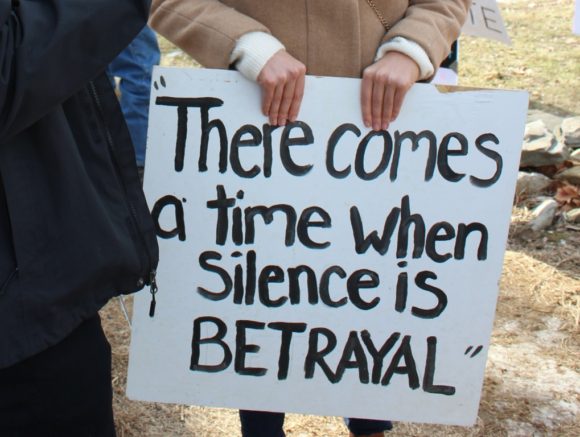
Palm gave a list of practical steps out of which she proposed everyone present could find at least one to follow.  Her suggestions included, “If you’re old enough to vote, do it. Don’t forget the municipal elections, which  have been lost and won by a handful of votes. If you are unaffiliated, please consider registering with a party so you can vote in the primary,” and “If you have a driver’s license and a car, offer to drive an elderly voter to the polls in November.”
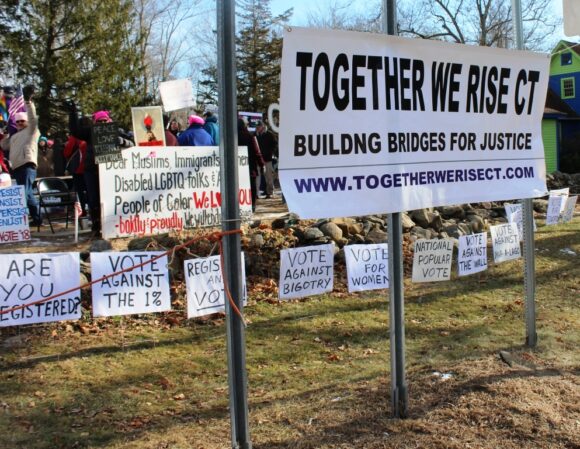
She continued, “If you have any disposable income, support candidates you believe in. If you can walk, knock on doors. If you can hear, make telephone calls. If you like to cook, make food for a house party. If you speak a language other than English, offer to translate for an immigrants’ rights group. If you can write, pen an op-ed or a letter to the editor. If you teach, welcome difficult conversations in the classroom.”

Finally, she offered the idea, “If you can speak into a mic, testify at the Capitol,” before closing with the rousing call to all to, “Stay vigilant.  But stay hopeful, too,” and …
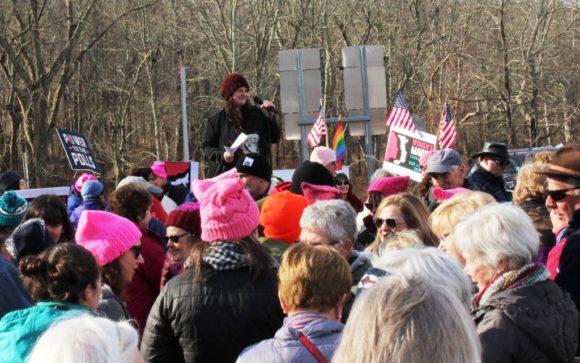
Pink “pussy” hats were much in evidence at the rally.

… “Above all, stay together.”

Cappella Hosts Spring Concert Featuring Haydn’s ‘Creation,’ April 22

Cappella Cantorum Masterworks Chorus will present their spring concert, Sunday, April 22. The concert will feature Haydn’s masterpiece, “The Creation,” that includes the well-known “The Heavens are Telling the Glory of God.”
It will be performed with professional soloists and orchestra with Simon Holt of the Salt Marsh Opera directing.

For more information visit www.CappellaCantorum.org or call 860-526-1038.

Reading Uncertainly? ‘The Undoing Project’ by Michael Lewis

No, this is not the story of a baseball team savant, who doubted conventional statistics and reused them with extraordinary success (Moneyball). It is not a personal disclosure of the seamy underbelly of financial markets (The Big Short; Flash Boys; Liar’s Poker).
Rather, it is the story of learning how our minds work, of behavioral economics, and of the unusual and highly prolific working relationship of two Israeli academics, who first met in 1960. It is the story of how an extrovert, Amos Tversky, and an introvert, Daniel Kahneman, stimulated and prodded each other over almost 40 years, first in Israel and then teaching  in the United States on the West coast, then in the Midwest, and finally in the East, uncovering and describing the numerous biases that confuse our thinking.

Each challenged the ideas of the other.

As the author describes an early intellectual collision, “Theories for Amos were like mental pockets or briefcases, places to out the ideas you wanted to keep. Until you could replace a theory with a better theory–a theory that better predicted what actually happened—you didn’t chuck a theory out. Theories ordered knowledge, and allowed for better prediction … But (Amos) left Danny’s seminar in a state of mid unusual for him: doubt. After the seminar, he treated theories that he had more or less accepted as sound and plausible as objects of suspicion.”

Kahneman: his “defining emotion is doubt.”

Tversky:  his interest is psychology: “why people behaved as they behaved, and thought as they thought,” never entirely “rational.”

Kahneman:  “He thought of himself as someone who enjoyed, more than most, changing his mind.”

Tversky: “People live under uncertainty whether they like it or not.”

Kahneman:  “It is the anticipation of regret that affects decisions, along with the anticipation of other consequences. This is why we seem to be instinctively ‘risk averse’.”

Tversky: “Reality is a cloud of possibility, not a point.”

Kahneman:  “The basic rules of undoing, however, apply alike to frustration and regret. They require a more or less plausible path leading to an alternative state.”

Together these two thinkers described the numerous biases that both confuse and enlighten our thinking: hindsight, anchoring, availability, small numbers, context, framing, the endowment effect, and many others. As Lewis explains it, “ they would learn to evaluate a decision not by its outcomes—whether it turned out to be right or wrong—but by the process that led to it. He then concludes: “ … the brain is limited. There are gaps in our attention. The mind contrives to make those gaps invisible to us. We think we know things we don’t. We think we are safe when we are not.”

In 1996, Amos Tversky died. In 2002, Daniel Kahneman won a Nobel Prize, one that almost certainly would have been awarded to Amos as well, had he been alive.

Do read this fascinating story of two thinkers, and go further and read Kahneman’s Thinking, Fast and Slow (2011).  And consider my own personal haiku, one that forces me to rethink all the time:

Pause for a moment:
Doubt, then curiosity.
Try another path.

Editor’s Note: ‘The Undoing Project’ by Michael Lewis was published by W. W. Norton, New York, in 2017.

About the Author: Felix Kloman is a sailor, rower, husband, father, grandfather, retired management consultant and, above all, a curious reader and writer. He’s explored how we as human beings and organizations respond to ever-present uncertainty in two books, ‘Mumpsimus Revisited’ (2005) and ‘The Fantods of Risk’ (2008). A 20-year resident of Lyme, he now writes book reviews, mostly of non-fiction that explores our minds, our behavior, our politics and our history. But he does throw in a novel here and there. For more than 50 years, he’s put together the 17 syllables that comprise haiku, the traditional Japanese poetry, and now serves as the self-appointed “poet laureate” of Ashlawn Farms Coffee, where he may be seen on Friday mornings. His wife, Ann, is also a writer, but of mystery novels, all of which begin in a bubbling village in midcoast Maine, strangely reminiscent of the town she and her husband visit every summer.