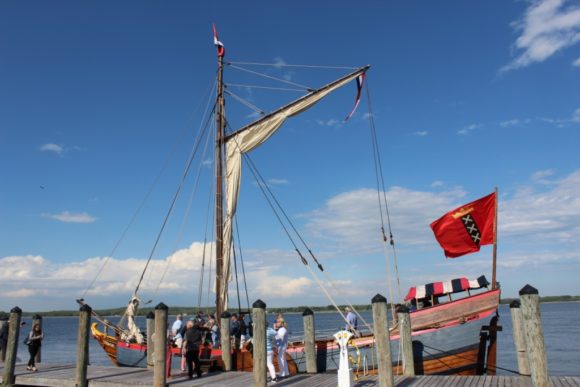
On Board the ‘Onrust;’ Famed Re-creation of Adriaen Block’s Boat Sails up Connecticut River

The ‘Onrust’ docked at Saybrook Point Inn and Spa.

It was “a momentous occasion,” according to Connecticut River Museum Executive Director Chris Dobbs when a group of dignitaries and invited guests gathered to board the re-creation of Adriaen Block’s boat Onrust last Thursday.  Dobbs pointed out that it was, “400 years ago — 403 to be precise” since the original Onrust commenced its exploration of the Connecticut River ultimately exploring it upstream to just a little further north than present-day Hartford — a distance of approximately 60 miles from Long Island Sound.
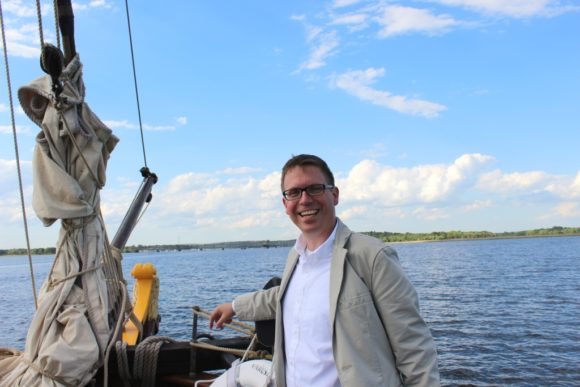
Connecticut River Museum Executive Director Chris Dobbs takes a brief break from his duties as host on board the ‘Onrust.’

While overwintering (1613-1614) in New York Bay, the Dutch explorer Block’s first ship, the Tyger (Tiger), caught fire and burned to the waterline.  Working through the frigid winter, Block built a new ship from the salvaged remnants and named it the Onrust, Dutch for ‘Restless.’
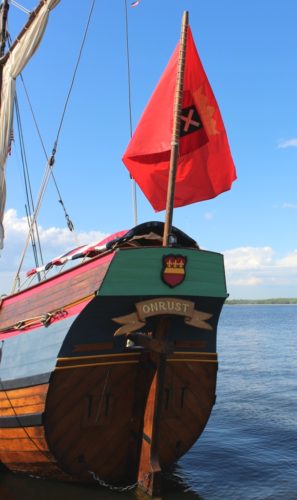
It was the first vessel built by Europeans in New York State and the first yacht built in the New World.  In 1614, Block and his crew set off to explore coastal New York, Long Island, Connecticut, and Rhode Island with the intent of developing trade partnerships with Native Americans.  During his time on the water, Block became the first known European to travel up the Connecticut River  

The re-created Onrust was launched in 2009 by The Onrust Project, an all-volunteer non-profit out of New York, which built the vessel after painstakingly researching traditional Dutch shipbuilding techniques.  

To reach the Saybrook Point Inn at Old Saybrook, Conn., where the guests boarded the ship, the Onrust followed a similar path to the one that Block took in 1614.  It departed from Kingston, N.Y., traveled to New York Bay, traversed the treacherous Hell Gate, entered Long Island Sound and sailed to the mouth of the Connecticut River. 

While preparations were made to launch, Connecticut River Museum Board Chairman Tom Wilcox told the guests now assembled on board the Onrust, “This is a most auspicious occasion,” and correctly predicted they would have, “a lovely sail.”  Despite an earlier threat of rain, the weather cooperated completely with warm temperatures and clear skies.
Steven Tagliatella, owner of the Saybrook Point Inn and Spa, addressed the guests on board the ‘Onrust.’

Another guest on board was Steven Tagliatella, owner of the Saybrook Point Inn, who spoke effusively about the upcoming trip to the Connecticut River Museum describing the Onrust as “a spectacular sight.”  He also took the opportunity to mention the new tourism coalition he has formed to promote tourism in the state, noting that the Onrust offers “a wonderful opportunity” for tourism.
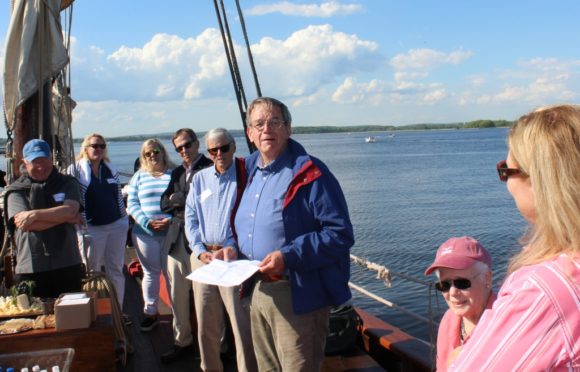
Connecticut State Historian Walter Woodward speaks on the theme of ‘restlessness,’ echoing the name of the boat — ‘Onrust’ translates from the Dutch to ‘restless.’

Walter Woodward, Connecticut’s State Historian, really spoke for everyone aboard when he said, “To be on this boat on this day is so exciting,” but then asked the guests to take themselves back in time to the spring of 1614 when Block brought the boat he had built the previous winter and named Onrust – Restless – to the mouth of the river the natives call Quinitticut. Woodward declared that Block, “was as restless as his little vessel,” explaining, “The 47-year-old trader-explorer was anxious to make up the losses he had experienced the previous winter, when his ship the Tyger had accidentally caught fire.”

Woodward pursued the theme of ‘restlessness’ as he continued, saying, “Then as now, the word restless had many meanings … A generation of restless Europeans … both Dutch and English would come to this river, first in search of trade with the indigenous people, and soon after, in the quest for their land and resources.”
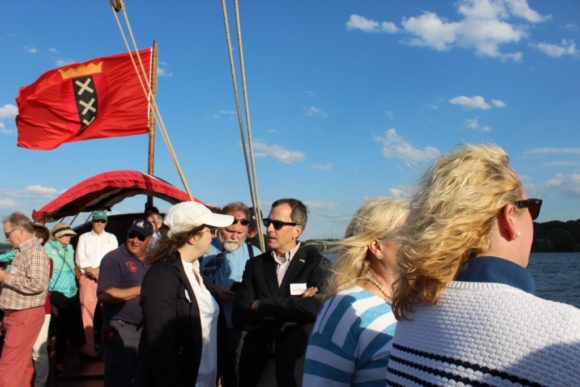
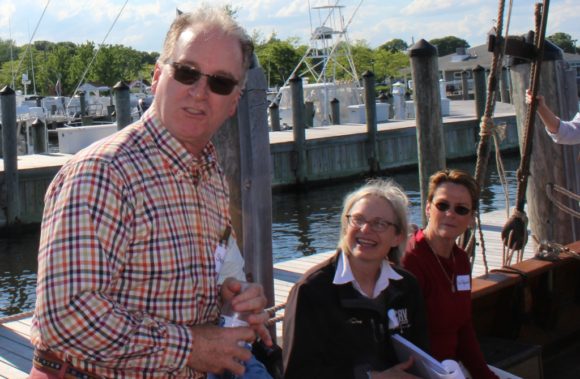
Old Saybrook First Selectman Carl Fortuna (center in sunglasses) chats with a guest during the trip up the Connecticut River.

Woodward added, “Some were restless too in a godly way – troubled in mind and spirit, seeking a place to serve God as their consciences demanded.”

He also noted that, “For those already here, the arrival of the Onrust heralded a new native restlessness – first, as the indigenous people jostled with each other for control of the distribution of European trade goods … and later to fight the efforts of these insurgents to drive them from their homes.”
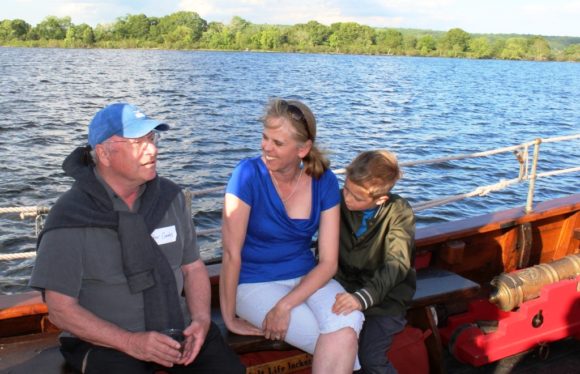
Jennifer White-Dobbs enjoys the glorious river views with her son (right) and a guest.

Keeping to his theme, Woodward ended with the words, “I know you are restless to get underway, so let me conclude by saying it is a privilege to be here today to mark the moment in time, when Adriaen Block and his Onrust entered the river he named Fresh River, and a world-transforming era of restless change began.”
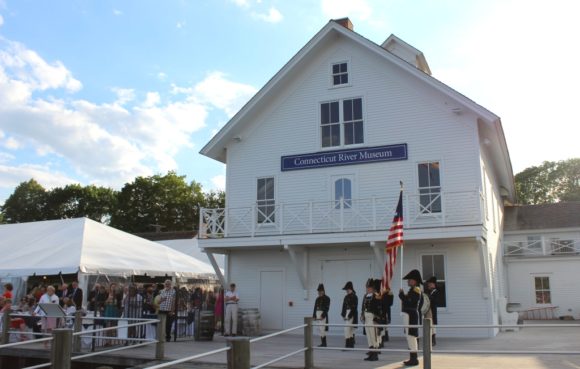
The Essex Sailing Masters of 1812 greeted the ‘Onrust’ with bright melodies in front of the Museum.

Before introducing the next speaker, Dobbs noted, “The amount of research to build this vessel was amazing,” and also that it had taken, “Around 250 people to build the Onrust.” He explained that the Onrust will be a floating exhibit at the Museum through early October, open for dockside tours, school and Scout programs, along with public cruises and charters.
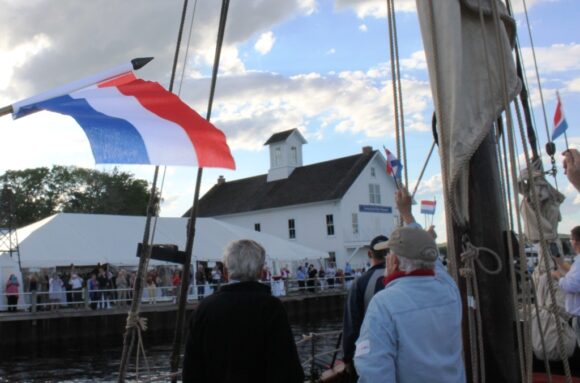
The guests vigorously waved Dutch flags as the ‘Onrust’ pulled into the Connecticut River Museum’s dock.

Dobbs then presented Emily Boucher, who brought a message from Senator Chris Murphy, which she read aloud to the guests on the Onrust. In the message, Murphy expressed the wish that he could join everyone on the trip, and noted he was pleased with the financial assistance the state had given the Museum which, “was going to allow it [the Museum] to not float away.”
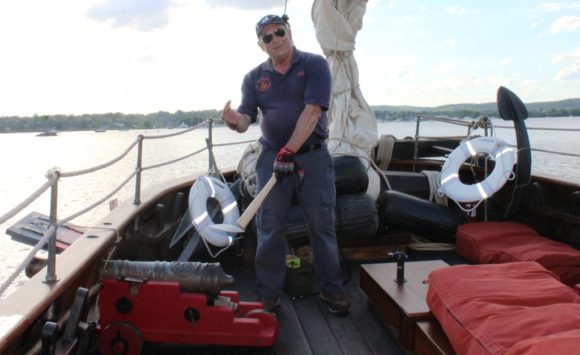
A crew member prepares to fire the cannon to announce the boat’s arrival at the Connecticut River Museum.

Finally the Onrust departed from Saybrook Point inn and sailed serenely up the Connecticut River offering spectacular views in all directions. As the three-man crew prepared for arrival at the Museum during the first hour of the popular RiverFare event, one crew member fired a celebratory cannon. Meanwhile, Essex’s very own Sailing Masters of 1812 provided a cheery, musical fanfare as the historic vessel approached the Museum’s dock. 

It was indeed a wonderful and “momentous” voyage!

For more information on the Connecticut River Museum and the Onrust, visit the Museum’s website.  The Museum extends special thanks to Saybrook Point Inn, Marina & Spa, Essex Meadows, the Sailing Masters of 1812, and The Onrust Project for their efforts in arranging the vessel’s arrival. 

The Connecticut River Museum is located on the Essex waterfront at 67 Main Street in Essex and is open daily from 10 a.m. to 5 p.m. The Museum, located in the historic Steamboat Dock building, offers exhibits and programs about the history and environment of the Connecticut River. For a full listing of Museum programs or to buy tickets for the Onrust, RiverFare, and many other events go to www.ctrivermuseum.org or call 860-767-8269.
Tonight, CT Valley Camera Club Hosts Director of Photography from ‘The Day’

A well-known photo by Sean Elliot, who will speak at the Connecticut Valley Camera Club, Monday, June 5.

AREAWIDE — The June 5 meeting of the Connecticut Valley Camera Club (CVCC) will feature a presentation by Sean Elliot, Director of Photography at The Day in New London, Conn.  The meeting will be held at 7 p.m. at the Lyme’s Senior Center, 26 Town Woods Rd., Old Lyme, Conn.

In addition to overseeing The Day’s staff of visual journalists, Elliot retains responsibilities as a photographer, documenting life in southeastern Connecticut. He started his career at The Day as the paper’s Digital Imaging Technician (a position now titled: night photo editor) in 1993. He was hired as a staff photographer in 1994 and became Chief Photographer in 2002 and was named Director of Photography in 2016. Prior to The Day, Eliot had internships in Lima, Ohio and Brigeport, Conn.

Elliot was born in Norwalk, Connecticut but raised in Eugene, Oregon. He returned to New England where he graduated from the Boston University College of Communications with a degree in journalism.

He has won numerous awards from the National Press Photographers Association Region One, New England Associated Press News Executives Association, Connecticut Society of Professional Journalists and the New England Press Association (NEPA). In 1994 he was the NEPA Rookie of the Year and in 2000, the NEPA Photographer of the Year. In 2007 he was given the Community Photojournalism award by the New England Society of Newspaper Editors. He has served on the board of the National Press Photographers Association, including two terms as that association’s President and chairs the NPPA Ethics Committee.

You can also follow him on Twitter @seandelliot and on Instagram @sdelliot

The Connecticut Valley Camera Club is dedicated to offering its membership the opportunity to become better photographers.  We offer a variety of presentations and interactive workshops to help our members expand their technical and creative skills.  We welcome photographers of all levels of experience.  The club draws members up and down the river, from Middletown to Old Saybrook;  from East Hampton to Old Lyme;  and along the shoreline from Guilford to Gales Ferry.

For more information, visit the club’s website.  CVCC meeting dates, speakers / topics and other notices are also published on the club’s Facebook page at http://www.facebook.com/CTValleyCameraClubPage/

Candlelight Vigil Held on White Sand Beach in Memory of Timothy Buckley

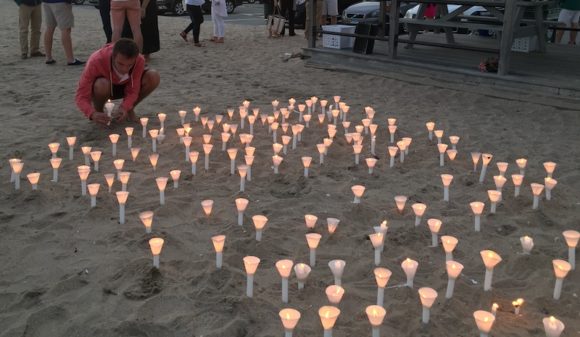
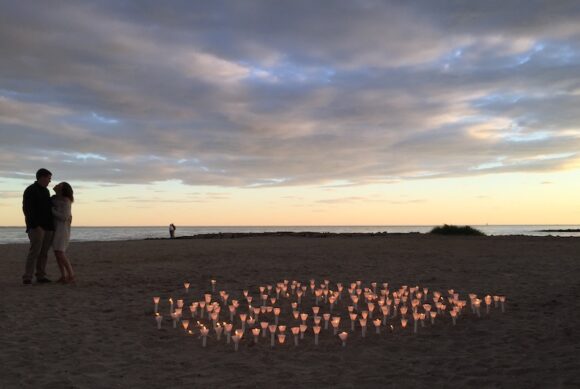
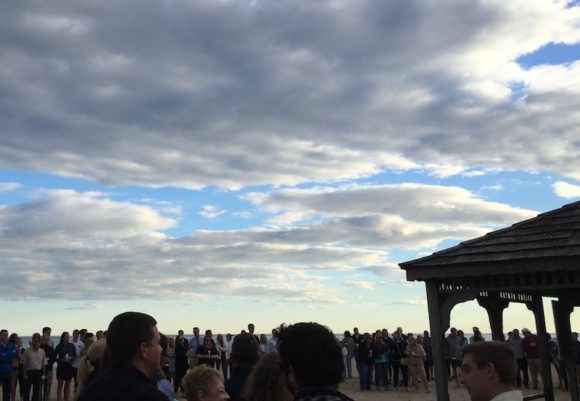
The clouds swirled overhead as people gathered below on White Sand Beach to remember Tim Buckley.

More than 200 people of all ages gathered on White Sand Beach in Old Lyme Saturday evening to participate in a candlelight vigil in loving memory of Timothy Buckley, who passed away earlier this week.

Jack Berger places a candle in the sand at the end of yesterday’s vigil.

There were members of Tim’s family, his friends, teachers, neighbors, and people who — along with everyone else — just wanted to be there to show support for the Buckley family during this unimaginably difficult time.

A couple embraces on the beach as the candles in honor of Tim Buckley flicker in front of them.

The vigil was hosted by Lymes’ Youth Service Bureau.

New Exhibition Devoted to Environmentally-Conscious Artists on View at Florence Griswold Museum

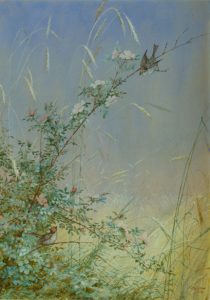
Fidelia Bridges, Wild Roses Among Rye, 1874. Watercolor and gouache over pencil on paper, 13 1/2 x 9 in. Florence Griswold Museum, Gift of The Hartford Steam Boiler Inspection and Insurance Company, 2002.1.13

The Florence Griswold Museum in Old Lyme, Conn., presents a major exhibition entitled Flora/Fauna: The Naturalist Impulse in American Art, on view June 3 through Sept. 17, 2017. Drawn extensively from the Museum’s collection, as well as many public and private lenders, the 101 works in the exhibition survey the history of environmentally-conscious artists in the United States from the dawn of the 19th century through the mid-20th century.

Flora/Fauna begins with early-American artists such as the Peale family, John James Audubon and their contemporaries, then examines the naturalist impulse in works by the Hudson River School, American Pre-Raphaelites, and American Impressionist artists before featuring select 20th-century artist-naturalists such as Roger Tory Peterson, creator of widely-used bird guides.

Works in the exhibition reveal how artistic production corresponded with social developments in American history, from an early concern with establishing a national identity distinct from Europe; to reflecting Americans’ shifting philosophies on evolution and the human relationship to the environment; to the growth of the conservation movement in the United States.

The Artist-Naturalist in Early America

The birth of natural history in America coincided with the founding of the country. Such artists as Mark Catesby, William Bartram, the Peale family, Alexander Wilson, and John James Audubon participated in the American Enlightenment by pioneering many of the country’s firsts—the first natural history publications, institutions, and environmental experiments. Scientists quickly realized that they needed the assistance of artist-naturalists to give visual form to their discoveries and disseminate that knowledge through books, botanic gardens, lectures, and museum displays.

During this age of Enlightenment, many political leaders, including Thomas Jefferson, looked to natural history to help forge the identity of the new nation. Not surprisingly, the country’s first scientific center developed in and around its first capital. Philadelphia attracted the brightest intellectual, scientific, and artistic minds that formed a network of new professionals. Works in this section by the Bartram, the Barton, and the Peale families reveal that the forging of an American natural history was often a ‘family affair’ facilitated by personal relationships.

Titian Ramsay Peale’s, Monarch Butterfly [No. 16], 1817 (American Philosophical Society Library) a work from an entomological sketchbook, demonstrates how artists participated in the discovery, documentation, and collection of natural specimens. The sketch shows the monarch at different stages of life. Beneath the illustration, he wrote his scientific observation: “Went into the Chrysalis state on the 4th of September­—and became perfect on the 13th of the same month.”

Nature’s Nation: The Hudson River School

Building on the documentary and aesthetic achievements of the artist-naturalists before them, the Hudson River School painters sought to capture what was unique about the American land—its vast, untouched wilderness. The group who has become known as the Hudson River School first took up this task around the mid-19th century. Based in and around New York City, they traveled to such areas as the Hudson River Valley of New York and the White Mountains of New Hampshire to experience expansive American scenery firsthand.

Their resulting paintings symbolically linked the natural landscape to concepts of nationalism and environmentalism, equating the American landscape with American identity. For Hudson River School painters, pictorializing nature in the United States became a mode of social and environmental criticism that reflected scientific and ecological questions of the time, and laid the roots for the American conservation movement as well as the national park system.

Beginning with Thomas Cole’s allegorical admonitions about man’s intrusion on nature, others such as Asher B. Durand and Frederic Church evolved to value realism over metaphor, reflecting their firsthand observations of American scenery in highly detailed paintings both modest and vast—finding beauty in nature’s growth and decay.

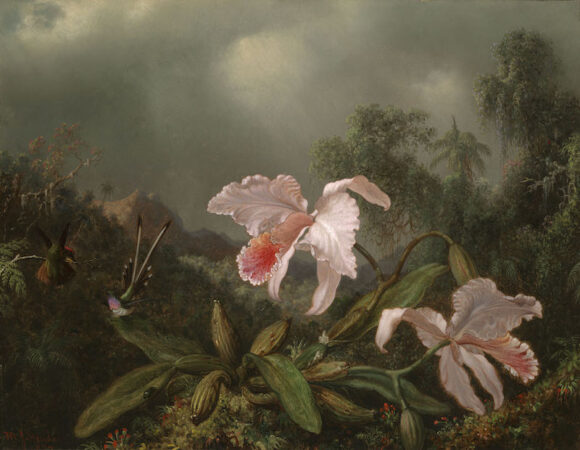
Martin Johnson Heade, Jungle Orchids and Hummingbirds, 1872. Oil on canvas, 18 1/4 x 23 in. Yale University Art Gallery, Christian A. Zabriskie and Francis P. Garvan, B.A. 1897, M.A. (Hon.) 1922, Funds

Martin Johnson Heade can be called a quintessential artist-naturalist. His inventive combination of elements of scientific illustration (in his exactness of representation), his dramatic use of still life elements (birds and flowers), and his evocative placement of them in their natural environment gave his works a power not seen before in American painting. These traits are exemplified in Jungle Orchids and Hummingbirds, 1872 (Yale University Art Gallery).

Truth to Nature: American Pre-Raphaelites & Beyond

Many of the Hudson River School artists were aware of the writings of the English artist and critic John Ruskin, one of the most significant voices in the 19th century art world. Ruskin’s works spanned a variety of topics from art, architecture, and natural history (including geology, botany, and ornithology) to religion, myth, and politics. His most influential and widely read text, Modern Painters (1843), emphasized the connections between art, nature, and society, and advocated for artists to uphold a “truth to nature” in their work.

Ruskin’s pledge to a morally and socially committed art led him to reject the artifice of “decorative” art in favor of an art with an authentic source, such as nature itself. His followers in the United States, the American Pre-Raphaelites, produced landscape, still life, and studies that utilized a meticulousness of detail gleaned from their close study of nature en plein air.

Prior to his involvement in the arts, Ruskin had contemplated becoming a geologist. In the 19th century, geology was considered a gentlemanly endeavors that many artists, including the Hudson River School and the American Pre-Raphaelites, pursued. As works in this section show, careful studies exposing evidence of the artist’s process were as highly valued as finished works. In additional to geology, botany became an enormously popular genteel hobby, and developed into a status symbol.

These pursuits enabled the success of nature illustrators like Fidelia Bridges, who brought these topics to mass-marketed periodicals and, thus, into thousands of American homes.  A rare portfolio of Bridges’ work in the collection of the Florence Griswold Museum has been newly conserved and will be on view for the public for the first time. Ruskin and his American followers employed a scrupulous observation of nature from life in order to convey the ‘truths’ of their subjects’ identities, as seen in Bridges’s Thistle in a Field, 1875 (Florence Griswold Museum).

Impressionism & The Naturalist Impulse in Connecticut

While the “naturalist impulse” most often yielded a work of art that appeared naturalistic, or true to nature in a scientific sense, this exhibition allows for an expanded definition to include works that may be deemed “impressions” of nature. Like artists of previous generations in Europe, the American Impressionists found art colonies in the suburbs and countryside to be restorative retreats, where they could immerse themselves in nature and enjoy the camaraderie of like-minded colleagues.

Around 1900, the natural landscape of Old Lyme perfectly fulfilled that need for artists. Not coincidentally, many artists who frequented art colonies, like Willard Metcalf, Childe Hassam, and Harry Hoffman, were also practicing naturalists, to varying degrees.

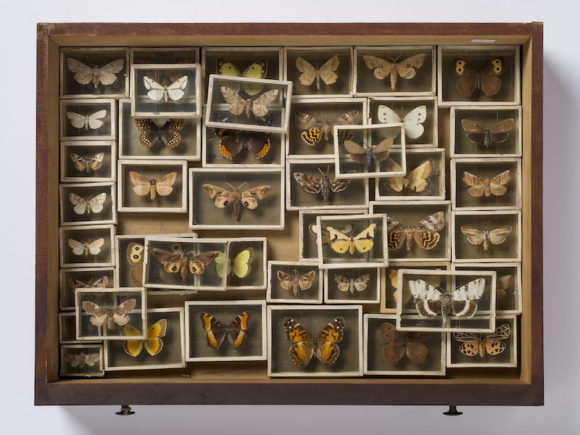
Drawer 1B, containing bird eggs collected by William L. Metcalf in Giverny and Grez-sur-Loing from Metcalf’s Naturalist Collection Chest, ca. 1885–1925. Mahogany wood drawer, 18 x 13 3/4 in. Florence Griswold Museum, Gift of Mrs. Henriette A. Metcalf

The consummate artist-naturalist of the Lyme Art Colony was Willard Metcalf. On view in Flora/Fauna is the cabinet housing his collection of specimens. One drawer contains thirty-eight glass-mounted moths, many with furry bodies and wings still displaying their original deep gold, bright yellow, or rosy pink pigments. A second drawer reveals thirty-two pink cigarette boxes containing the tiny eggs of such birds as the English Sparrow and the creamy blue eggs of a Redstart.

Metcalf translated his love of the natural world to his artwork. He painted Kalmia (Florence Griswold Museum) in 1905, the first summer he stayed at Florence Griswold’s boardinghouse with the keen observations of one very much attuned to their environment. In Kalmia, Metcalf captures the smooth, blue Lieutenant River reflecting the calm sky, while fluffy white and pink blossoms and green grasses appear to breathe in the spring air.

The exhibition concludes with the artist-naturalist tradition that persisted into the 20th century and still thrives today in the Connecticut River Valley. Roger Tory Peterson, who inspired the environmental movement with his activities as a naturalist, educator, and artist, purchased 70 acres of property in Old Lyme in 1954. Peterson published the first modern field guide, A Field Guide to the Birds; giving field marks of all species found in eastern North America in 1934 and developed the Peterson Identification System so that amateurs and professionals could identify species visually for close observation without hunting them.

Drawer 1B, containing bird eggs collected by William L. Metcalf in Giverny and Grez-sur-Loing from Metcalf’s Naturalist Collection Chest, ca. 1885–1925. Mahogany wood drawer, 18 x 13 3/4 in. Florence Griswold Museum, Gift of Mrs. Henriette A. Metcalf

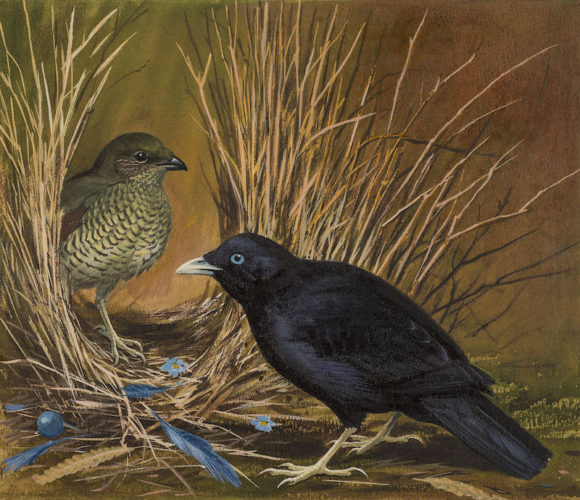
Satin Bowerbird, (Private Collection), created for reproduction in his 1964 bookThe World of Birds, is a simplified scene illustrating two birds interacting in their environment. These guides helped to popularize the pastime of bird watching and cultivate a national interest in wildlife.

Continued Awareness

When members of the Lyme Art Colony made nature the focus of their practice, they were drawing on an American tradition that began 100 years earlier with some of the country’s first artist-naturalists and explorers. Today, issues of climate change, land conservation, and preservation of endangered species and habitats have acquired new urgency in the 21st century, making the chronicling of America’s natural history through art more relevant than ever.

The Florence Griswold Museum remains dedicated to the pursuits of the artist-naturalist by fostering the understanding of American art with an emphasis on the art, history, and landscape of Connecticut.

Flora/Fauna: The Naturalist Impulse in American Art is accompanied by a fully-illustrated catalogue authored by the exhibition’s curator, Jennifer Stettler Parsons, Ph.D., with additional essays by Ellery Foutch, Ph.D. (Middlebury College), and Amy Kurtz Lansing (Florence Griswold Museum). Copies of the catalogue are available from the Museum’s website (www.florencegriswoldmuseum.org) or at the Museum’s Shop.

For related programming see FlorenceGriswoldMuseum.org.

The exhibition has been made possible with the generous support of The Hartford Steam Boiler Inspection and Insurance Company, Bank of America, the Rudolph and John Dirks Fund of the Community Foundation of Eastern Connecticut, the Nika P. Thayer Exhibition and Publication Fund, and the Connecticut Office of the Arts. Additional support has been generously provided by a group of individual donors that are helping to advance the Museum’s mission through special exhibitions.

Editor’s Note: The recipient of a Trip Advisor 2016 Certificate of Excellence, the Florence Griswold Museum has been called a “Giverny in Connecticut” by the Wall Street Journal, and a “must-see” by the Boston Globe. In addition to the restored Florence Griswold House, the Museum features a gallery for changing art exhibitions, education and landscape centers, a restored artist’s studio, 13 acres along the Lieutenant River, and extensive gardens. Its seasonal Café Flo was recognized as “best hidden gem” and “best outdoor dining” by Connecticut Magazine. The Museum is located at 96 Lyme Street, Old Lyme, Connecticut. 

Visit www.FlorenceGriswoldMuseum.org for more information.

It’s ‘National Learn to Row Day’ Today!

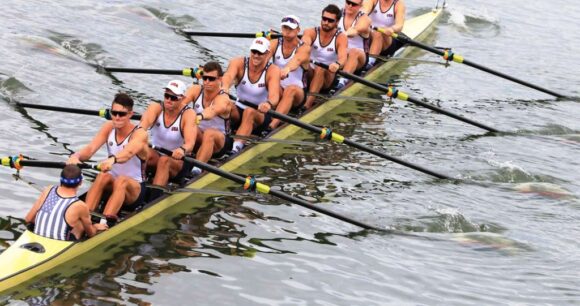
It all began with learning to row on Rogers Lake for Austin Hack (the stroke in this file photo), who ended up a member of the US Men’s Eight at last year’s Olympics! Photo courtesy of worldrowing.com

Tomorrow, Saturday, June 3, is National Learn To Row Day. For the fourth year, this event will be celebrated at the Fred Emerson Boathouse by opening our doors to everyone to try rowing at no cost.

Come to the boathouse located at the corner of Rte. 1 and Town Woods Rd. in Old Lyme between 10 a.m. and 1 p.m. to have land instruction on a rowing machine, and graduate instantly to a real racing shell, where you can row, with the help of capable oarsmen, for a short tour of Rogers Lake.
There is no charge for this event.
For more details, visit www.oldlymerowing.com.