
30 Plunge Into Frigid Sound to Help Save Plum Island

Plunging for Plovers: these brave souls charged into the freezing waters of Long Island Sound last Saturday to raise awareness of efforts to save Plum Island from sale and preserve the island’s outstanding flora and fauna. Photo by Judy Preston.

Saturday fundraiser brought together conservationists, students, elected officials

A long-planned “polar plunge”-style fundraiser at Old Saybrook Town Beach got a shot of drama from unexpectedly cold temperatures, strong winds, and high waves this weekend.

CFE/Save the Sound’s Chris Cryder, in seal costume, speaks at the press conference. Photo by Laura McMillan.

Students from Old Saybrook High School, area officials, and representatives of a regional environmental organization—some in costumes—packed into a heated school bus for a press conference Saturday morning before running into a frigid Long Island Sound to raise awareness and support for protecting Plum Island.

The “Plum Island Plunge for Plovers” has raised $3,700 for Connecticut Fund for the Environment and its bi-state program Save the Sound’s multi-year battle to save Plum Island from sale and private development. Donations are still coming in.

“I’ve met thousands of folks all around the Sound who want Plum Island preserved, but this is something else,” said Chris Cryder, special project coordinator for CFE/Save the Sound, decked out as one of the harbor seals that rest on Plum Island’s rocky shore. “To see dozens of people voluntarily turn out in weather like this to make a statement about the island’s importance is inspiring.”

Rosie Rothman, co-president of Old Saybrook High School’s Interact Club, speaks at the press conference prior to ‘The Plunge.’ Photo by Judy Preston.

Rosie Rothman, co-president of Old Saybrook High School’s Interact Club, explained that the plunge was a perfect fit for the Interact Club’s mission of community service and the Ecology Club’s mission of environmental protection.

“Afterwards, we couldn’t feel our toes for a while, but we still had fun,” she said. “With a windchill in the single digits, it was definitely a challenge, but our members still showed up. I think that speaks to our dedication to the cause. It is our hope that our legislators take decisive federal action to protect Plum Island from development that would be detrimental to the wildlife that depends on it, including 111 species of conservation concern.”

“I was very proud to see so many Old Saybrook High School students participate in the polar plunge, on a freezing March day, to support efforts to preserve Plum Island,” said Rep. Devin Carney (Lyme, Old Lyme, Old Saybrook, Westbrook). “Plum Island is an important natural resource for the Connecticut shoreline and Long Island Sound. By preserving it, these students, and many others, will be able to enjoy its natural beauty for many years to come.”
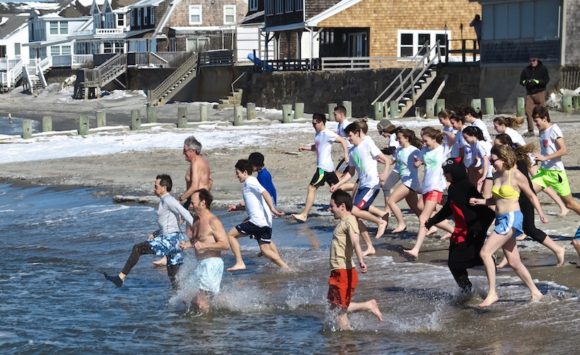
And they’re off! The plungers enter the bitterly cold water at Old Saybrook Town Beach. (Photo by Judy Preston)

Carl P. Fortuna, Jr., first selectman for the Town of Old Saybrook, joined the hardy souls jumping into the Sound. Addressing the assembled attendees, he reminded them of the region’s land conversation victory in saving The Preserve, and said, “The Town of Old Saybrook fully supports the conservation of Plum Island and its rightful place in the public domain upon the decommissioning of scientific activities. The importance of Plum Island as a flora and fauna host has been amply demonstrated. It is now time for our legislative and executive branches to swiftly put an end to any speculation that this resource will be privately developed. I applaud the bipartisan efforts to conserve Plum Island.”

These were some of the supporters, who braved the cold to cheer on the plungers. (Photo by Judy Preston.)

Senators Richard Blumenthal and Chris Murphy sent letters in support of the effort.

Plum Island, an 840-acre, federally-owned island in the eastern end of Long Island Sound, is home to threatened and endangered birds like the piping plover and roseate tern, as well as other rare species. Seventy Connecticut and New York organizations work together as the Preserve Plum Island Coalition, partnering with grassroots activists and champions in Congress to halt sale of the island. CFE/Save the Sound has also brought an action in federal court claiming that the government’s decision to sell the island violates numerous federal environmental laws.

Fundraising will remain open through the end of the month. Members of the public may donate to support CFE/Save the Sound’s work at www.bit.ly/plum-plunge.


Leif Nilsson to Donate Half Cost of Purchased Artwork to Lyme Land Conservation Trust Thru May 21

CAT# 3406 Hamburg Cove Oil 24 x 54 inches Leif Nilsson Summer 2016 ©

Acclaimed artist Leif Nilsson is donating half of the price of any painting in his Spring Street Studio in Chester to the Lyme Land Conservation Trust from now through May 21, 2017.

The most convenient way to proceed is to first view his work on the artist’s website and then either visit the studio or contact them by phone at (860) 526-2077 to arrange your purchase.

To be eligible for a tax deduction on 50 percent of the purchase price, payment must be made in two parts. You need to provide the Nilsson Studio with either a check payable to the Lyme Land Trust or your credit card information we can use to charge your account for half the price. The other half will be handled by Nilsson Studio.

The Spring Street Studio & Gallery is located at 1 Spring Street, Chester, CT 06412.

Stella Swoops in with Heavy Snow, High Winds … and then Rain?

First snow plow of the day … there surely will be many more.

Winter Storm Stella is here.

The Governor has declared a State of Emergency meaning a statewide travel ban is in effect. Lyme-Old Lyme Schools, Lyme and Old Lyme Town Halls and Libraries, the Lymes’ Senior Center and many businesses from the size of Pfizer, Inc. downwards are closed.  Events galore have been cancelled, including recycling and trash pick-up in Old Lyme. A parking ban is in effect on all town roads from 6 a.m. to midnight today.

To reach the Emergency Operations Center (EOC) in Old Lyme, call 860.598.0120.

The Respite Center at the Lymes’ Senior Center on Town Woods Road and/or the regional Emergency Shelter at the East Lyme High School will be opened if necessary. Information will be available through the EOC and on LymeLine.com, and also will be reported on the Town of Old Lyme’s website and Facebook/Twitter.

State and local officials urge residents to stay off the roads during the storm … and stay safe.

Latest weather reports, however, predict Southeastern Connecticut will not now experience the brunt of the storm with the snow turning first to sleet and then rain later this morning.

Letter From Paris: The ‘Centre Pompidou’ Turns 40            

Nicole Prévost Logan

The Musée National d’Art Moderne (MNAM), better known as the Centre Pompidou – that crazy structure  with tubes, exhaust pipes, chimneys and metal rods in bright primary colors – is celebrating 40 years of existence.  Its revolutionary architecture oriented toward multidisciplinary activities, which turned it into what virulent opponents called  a “supermarket for the arts,” scandalized visitors at first, but is now the benchmark for art museums around the word.

In 1969, President Georges Pompidou and his wife Claude, wanted to create an institution accessible to everyone, innovative enough to arouse the curiosity and the interest of the general public.  He wrote in Le Monde on Oct. 17, 1972, “It is my passionate wish for Paris to have a cultural center like the ones they have created in the United States, which have thus far been an unequalled success.  It would be one that is both a museum and a center of creation where the visual arts take residence with music, films, books, audiovisual research, etc.”

The project was conceived soon after the May 1968 student contest, which shook French society to the core.  A location was found in a vacant parking lot in the dilapidated working class district of Beaubourg.  Construction lasted five years from 1972 to 1977.

Young architects – Italian Renzo Piano and Englishman Richard Rogers along with Italian Gianfranco Franchini – won the international competition and designed a project breaking away from the tradition of solemn museums.  Their innovative design consisted of a metal structure with six levels of flexible and open-plan floors.

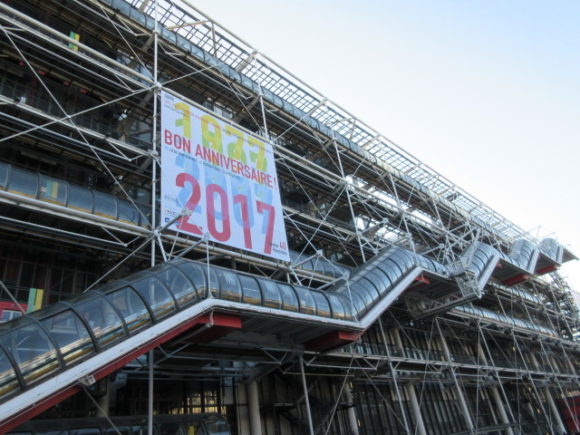
The Centre Pompidou features a revolutionary design, which includes the external escalator known as the “caterpillar.” Photo by Nicole Logan.

The anchor of the assemblage was a giant pillar supporting a network of metal beams and interlocking parts.  The external escalator, enclosed in glass, zigzags its way up to the roof-top like a caterpillar (hence its nickname) along the face of the building.  The color-coded functional pipes – blue for the air, yellow for electricity, green for water and red for circulation – give a playful appearance to the construction.

The idea was to integrate the museum within its urban environment.  The facade is all glass and there is no threshold between the outdoors and the Forum or heart of the center.  Whenever the exhibits are too large to be set up inside – as was the case with the 1979 Dali retrospective, which attracted 800,000 visitors – they spill over the gently sloping piazza or the nearby Stravinsky Fountain.

President Valery Giscard d’Estaing inaugurated the building on Jan. 31, 1977 with high officials and celebrities in attendance.  Adding to the pageantry , the Garde Republicaine arrived on horseback , holding Andy Warhol-creation-like banners. Forty eight hours later, the Centre Pompidou opened to the general public.

The 40,000 visitors could not hold their excitement as they rode the escalator to the upper terraces, well above the roofs of Paris.  The organizers were afraid the building would collapse with the unexpected size of the crowds.  Looking at the metal structure, someone supposedly commented, “Why didn’t they take down the scaffolding?”

The permanent collections of modern art, spanning the period from 1905 until the 1960s, are on the fifth floor.  The plan layout allows for the easy flow of visitors between rooms of all sizes.  The walls are stark white.  A wide hallway leads to huge windows opening on a reflecting pool and a free-standing, 25 ft. high mobile by Alexander Calder.  Montmartre is in the background .

The art lover will see just a sampling or five per cent of the phenomenal collections owned by the museum, which includes works by Sonia and Robert Delauney, Fernand Leger,  Mondrian, Matisse, Picasso, Yves Klein, Juan Gris, Goncharova,  Larionov and many others.  One room is dedicated to Marcel Duchamp and includes the famous bicycle on a kitchen stool (MOMA has another copy), and the hard-to-understand Neuf Moules Mâlic, (generally translated as Nine Malic Moulds) 1914, which was a preparation for la Mariée mise à nu par ses celibataires (the bride stripped naked  by her nine bachelors).

Contemporary art, starting in the latter part of the 20th century, is displayed on the fifth floor. At present an exhibit entitled “Kollektsia” includes 250 works from the USSR and the new Russia from 1950-2000, donated by the Vladimir Potanin Foundation.  Fascinating videos bring back the world of the 1960s in the Soviet era.

One video shows Nikita Khrushchev in a heated discussion about modern art with the public at the Manege. Another video shows  the government’s bulldozers  destroying the open-air exhibit hurriedly organized by the dissident Russian painters.

The Centre Pompidou, as an institution offering cultural activities at all levels, includes two special departments.  One is IRCAM (Institute for Research and Coordination of Acoustics and Music.)  Founded by composer Pierre Boulez, it is a research center, using advanced technology working on ways to visualize music.  On the other hand, the Public Information Library or BPI is an enormous facility with resources in a multiplicity of media.  It is open to all and offers wonderfully convenient free access to its shelves.

The production of the Centre Pompidou, during the past 40 years, has included major retrospectives establishing links between artistic capitals such as “Paris-Moscow” or “Paris-New York,” hundreds of monograph exhibits or surprising sights such as the grand piano of German artist Beuys made of felt hanging from the ceiling.

The $64,000 question is, will the Centre Pompidou be able to sustain this feverish pace or will it ultimately run out of steam?  There is no question that the curators are fully committed to ensuring that this latter scenario does not happen.

Editor’s Note: This is the opinion of Nicole Prévost Logan.

Nicole LoganAbout the author: Nicole Prévost Logan divides her time between Essex and Paris, spending summers in the former and winters in the latter. She writes a regular column for us from her Paris home where her topics will include politics, economy, social unrest — mostly in France — but also in other European countries. She also covers a variety of art exhibits and the performing arts in Europe. Logan is the author of ‘Forever on the Road: A Franco-American Family’s Thirty Years in the Foreign Service,’ an autobiography of her life as the wife of an overseas diplomat, who lived in 10 foreign countries on three continents. Her experiences during her foreign service life included being in Lebanon when civil war erupted, excavating a medieval city in Moscow and spending a week under house arrest in Guinea.

Musical Masterworks Mixes Mozart Originals with 20th Century Adaptations

Edward Aaron and Jeewon Park

Musical Masterworks favorites Jeewon Park, Tessa Lark and Dimitri Murrath join Edward Arron in a performance of Mozart’s piano quartets this afternoon at 3 p.m. in the First Congregational Church of Old Lyme.

Before each quartet, a late twentieth century work by a Soviet era composer will be performed

The concert opens with Mozart’s String Trio fragment in G Major, K. 562e, Anh. 66, followed by Arvo Pärt’s haunting Mozart-Adagio for Piano Trio (1992/1997), arranged from the slow movement of Mozart’s Piano Sonata, K.280.

This precedes Mozart’s Piano Quartet in G minor, K. 478.

Then Alfred Schnittke’s humorous salute to Mozart in Moz-Art à la Haydn for Violin and Viola (1977) is the prelude to Mozart’s Piano Quartet in E-flat Major, K. 493.

For more informatiion and to purchase tickets, visit http://musicalmasterworks.org/concerts/march-11-12-2017/