Nicole Prévost Logan
Two years after the “Je suis Charlie” massacre, how does it feel to be in France today with the threat of terrorism?
Numbers seem to speak for themselves: France, which is the most visited European country, saw a decrease last year of almost 50 percent in the number of tourists visiting – from 84 million to 42 million – while website commentaries lament empty hotels, restaurants and museums.
This observation is not quite accurate and, besides, does not take into account the complexity of the situation. In the first place, France has not become a dangerous war zone and people here still enjoy themselves: restaurants are full at lunch time, the new Paris Philarmonie orchestra is booked solid for months and there are more fantastic art exhibits – such as the Shchukin collection – than ever.
For the French, the threat of terrorism is not measured primarily by the dollar amount lost through a decrease in mass tourism (which is not the country’s vocation in any case.) There are many other serious considerations relating to the effects of terrorism on French politics and society, or the measures taken by authorities to protect the citizens.

The cover of ‘Charlie Hebdo’ two years after the horrific attack on the magazine’s office in Paris.
In recent years, the French have been deeply marked by terrorist attacks with 237 people killed between January 2015 and July 2016. These range tragically from the murder of cartoonists; the bombing of the Bataclan night club, several bistros and restaurants; a truck plowing through the crowd on the Promenade des Anglais in Nice on Bastille Day; to the gory assassination of 85-year-old father Jacques Hamel, whose throat was slit on the altar of his small Normandie church in front of two elderly nuns.
The impact on France’s national consciousness of the November 2015 terrorist attacks was enormous. As the two chambers of the parliament met in a joint session in Versailles, every single deputy stood up and sang the national anthem, La Marseillaise, a solemn event not seen since 1918.
François Hollande has been literally traumatized by the terrorist bombings. The president was immediately on the scenes of the attacks, even before the areas were made secure. For him, the defense against terrorism was a brutal awakening and a priority. The political price he had to pay was very high.
Under the intense pressure of the moment, he proposed a law on the déchéance de la nationalité (loss of nationality) for terrorists. This proposal caused havoc among the leftist segment of the French population. The president never recovered politically. Recently, when he announced his decision not to run again for another five years, Hollande declared, “I was wrong to make that proposal”.
The terrorist threat has become part of French people’s daily life. Alain Bauer, a professor of criminology, recently published a book titled, “How to Live in the Terrorist Era,” in which he gives practical advice on what to do in case of attack. Defense against terrorism is a major topic for the candidates in the upcoming presidential elections. .
France has come a long way since the affaire Merah in March 2012. The young Mohammed Merah had appeared all smiles on TV screens after killing seven civilians and military in the Toulouse area. At first believed to have acted as a “lone wolf,” he turned out to be part of a whole network of siblings, relatives and friends. During the past five years, the French authorities – Intelligence, police, judiciary and military both inside France and abroad – have made spectacular efforts to adjust to the terrorist threat, which is changing its modus operandi almost daily.
Today the police wear bulletproof vests, carry attack weapons, and not only have the right, but also the duty, to intervene in the case of a terrorist threat. The Direction Générale de Securiéte Interieure or DGSI (equivalent to the FBI) has stepped up its action, thwarting 90 percent of bombing attempts every year. In the past few months, it has dismantled sleeping terrorist cells in Marseille and Strasbourg.
France is the European country with the largest Moslem population. The latter is overwhelmingly considered to have nothing to do with radical Islam. However, subjects which used to be taboo before, such as the relationship between extremism and religion, are now openly debated. Recent books also contribute to the change in thinking.
Gilles Kepel, an authority on the Arab world and Islam, demonstrates in his book, La Fracture, (‘The Divide’) that the only way to understand extreme Islamists is to analyze in depth their ideology. One should make an effort to understand their strategy, which is to divide society, by teaching from a very young age, hatred against non-believers and the West, through brainwashing and conversion of an increasing number of people in both mosques and also in prisons. Keppel writes, “Prisons have become the ENA (Ecole Nationale d’Administration or French elite school ) for Jihadists.”
In the fall, journalist David Thomson published “Les Revenants” (those who returned) about the young men – and women – who joined ISIS or Islamist State in 2012 at the outset of the Syrian civil war. They would announce their plans openly on You Tube and traveled freely through Turkey toward their final destination of Rakka. In 2013 -14 their number grew exponentially. With the loss of territory in The Levant , ISIS has changed its strategy and many of the “revenants” have gone underground and become “Jihadists of the keyboard,” to use Thomson’s expression.
Is it the end of the tunnel ? Probably not and the threat remains, the experts concur. We can be thankful, however, that the Intelligence services and police have become more successful in cracking down on radical Islam.
Editor’s Note: This is the opinion of Nicole Prévost Logan.
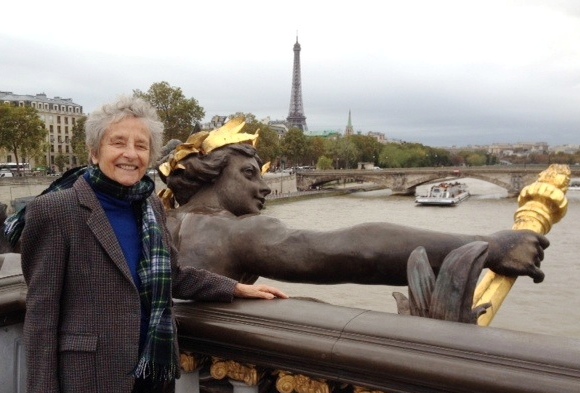
 About the author: Nicole Prévost Logan divides her time between Essex and Paris, spending summers in the former and winters in the latter. She writes a regular column for us from her Paris home where her topics will include politics, economy, social unrest — mostly in France — but also in other European countries. She also covers a variety of art exhibits and the performing arts in Europe. Logan is the author of ‘Forever on the Road: A Franco-American Family’s Thirty Years in the Foreign Service,’ an autobiography of her life as the wife of an overseas diplomat, who lived in 10 foreign countries on three continents. Her experiences during her foreign service life included being in Lebanon when civil war erupted, excavating a medieval city in Moscow and spending a week under house arrest in Guinea.