Celebrate Winter Today at Chester’s 26th Annual Winter Carnivale

Street entertainers delight the crowds at the Chester Carnivale. File photo by John Stack.

CHESTER — The townspeople of Chester are looking forward to their 26th annual winter celebration, Chester Winter Carnivale, on Sunday, Feb. 19.

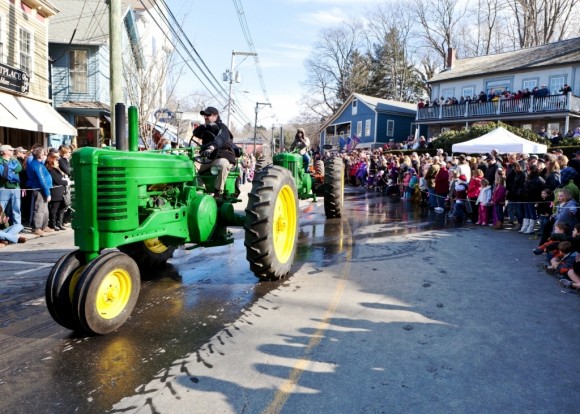
That’s when the picturesque small town of Chester is filled with people cheering on ice carvers as they create beautiful sculptures from blocks of ice, while laughing at the antics of street performers and applauding a long parade of new and antique tractors being driven down Main Street by their proud owners. All that, and food, music, art, and shopping too!

Bill Bernhart stands proudly beside his ice carving at the Chester Carnivale in this 2012 file photo by John Stack.

The day begins at 10:30 a.m. when the carvers get started on their ice sculptures. Both professional and student ice carvers will be hard at work, demonstrating their techniques to onlookers while they try to be finished by 1 p.m. for judging.

Meanwhile, the Chester Hose Company, Inc. is holding its annual “Chilly Chili Cook Off” fundraiser. From 11 a.m. to 1 p.m., go to the Chester Hose Company Fire House at 6 High Street and pay your $5 admission so you can taste all the different chilis cooked and dished out by restaurants, caterers and fire departments. You can vote for your favorite fire department chili, favorite restaurant chili, most original chili, and best dressed chili serving table.  Beverages will be sold. All proceeds go to the Chester Hose Company.

Still hungry? Pizza, hamburgers, hot dogs, sandwiches, soups, and lots more will all be available inside and outside the restaurants in town. Also, popcorn and kettle corn.

Just be sure to be back out on Main Street by 2 p.m. for the 15th Annual Chester Tractor Parade. Colorful and rusty, big and small, antique and new, decorated and plain – tractors are driven through the town center in an incredibly long parade. You never knew there were so many tractors in the Connecticut River Valley!

Free activities will keep the whole family entertained for the day. Colorful beads and balloons will be handed out throughout town all day and face painting is available. The Chester Museum at The Mill will be open at no charge, offering a place to explore Chester history. Galleries and shops will be open, many with special events.

Tractors and more tractors descend on Chester on Carnivale day for the Annual Tractor Parade. File photo by John Stack

Chester Winter Carnivale is held rain or snow or shine.  Main Street will be closed to traffic. Free parking is available in the commuter lot on Rte. 148 at the foot of Rte. 9 and in the Roto-Frank parking lot on Inspiration Lane (exit 6) and at Greenwald Industries on Rte. 154 (212 Middlesex Avenue). (Follow the signs.) All lots will be served by courtesy shuttle buses to the town center.

Tractor Parade at a previous year’s Chester Carnivale. File photo by John Stack.

For more information, visit facebook.com/chesterctwintercarnivale or https://finditinchesterct.wordpress.com/

Talking Transportation: Who Should Pay for Sound Barriers?

Sound barriers … great idea, but who should pay for them?

Building and maintaining our highways is expensive.  But here’s a quiz question:  on interstates 95 and 84, what costs a half-million dollars a mile to construct?  The answer:  sound barriers.

Why are we spending that kind of money to enshroud our interstates simply to protect the peace and quiet of its neighbors?  Didn’t they know that living that close to a highway came with the twin costs of increased noise and air pollution along with the benefits of proximity to the highways?

Do you have sympathy for people who live near airports and then complain about the jets?  Neither do I.  But the solution to highway noise is not to create a walled canyon paid for by others.

Sound barriers, in my view, are a waste of precious resources.  They don’t reduce accidents, improve safety or do anything about congestion.  And they’re a magnet for graffiti artists.  Three miles of sound barriers on both sides of an interstate would buy another M8 railcar for Metro-North, taking 100 passengers out of their cars.

Worse yet, sound barriers really just reflect the sound, not absorb it, sending the noise further afield.  But there are alternatives:

1)     Why not sound-proof the homes?  That has worked well for neighbors of big airports and would be a lot cheaper than miles of sound barriers.  Plus, insulation against sound also insulates against energy loss, saving money.

2)    Rubberized asphalt.  Let’s reduce the highway noise at its source, literally where the “rubber meets the road”.  Using the latest in rubberized asphalt some highways have seen a 12 decibel reduction in noise.  And rubberized asphalt, as its name implies, is made from old tires … about 12 million a year that would otherwise be junked.

3)    Pay for it yourself.  Create special taxing zones in noisy neighborhoods and let those home owners pay for their sound barriers.  They’re the ones who are benefiting, so shouldn’t they be the ones who pay?  And that investment will easily be recouped in increased property values.

4)    Penalize the noise makers.  Let’s crack down on truckers who “Jake brake,” downshifting noisily to slow their speed instead of using their real brakes.  And motorcyclists or those cars with busted mufflers, they too should be penalized.

5)    Go electric.  Electric cars are virtually silent.  And there are electronic ways of using noise cancellation technology that, on a large scale, can induce quiet at a lower price than building wooden barricades.

6)    Go absorbent.  Where there is room, erect earthen berms alongside the highway which will absorb the sound.  Or if you are constructing sound barriers, fill them with sound absorbing material, treating the noise like a sponge, not bouncing it off a hard, flat reflective surface.

Our interstates, especially I-95, are carrying far more traffic than they were ever planned to handle.  And there is no sign of it decreasing.  In Fairfield County the rush hour starts about 6 a.m. and runs continuously until 8 p.m. without a break.

If our state’s economy depends on these highways, we will have to live with the karmic cost of a little noise.  But if it’s too much to take, why ask others to pay for its remediation when they are the only ones benefiting from that spending?

Republished with permission of Hearst CT Media.

Jim Cameron


About the author:
 Jim Cameron is founder of The Commuter Action Group, and a member of the Darien RTM.  The opinions expressed in this column are only his own.  You can reach him at CommuterActionGroup@gmail.com

For a full collection of “Talking Transportation” columns, visit www.talkingtransportation.blogspot.com

Town of Old Lyme Sends 82 Pages of Comments on High Speed Rail Proposal to FRA

This past Monday, Feb. 13, Bonnie Reemsnyder, Old Lyme First Selectwoman, sent comments to the NEC Future Policy Advisor, Rebecca Reyes-Alicea, opposing the Old Saybrook, CT to Kenyon, RI bypass. The comments include in-depth remarks about many areas of concern, including

  • Environmental Issues
  • Geologic Features
  • Noise and Vibration
  • Artistic Significance of Old Lyme
  • Old Lyme Historic District
  • Historic Structures
  • Economic Issues.

As the proposed bypass can cause irreparable harm to the economic, cultural and environmental resources of Old Lyme and the other towns along its route, a strategy team was formed that tapped experts on all of these concerns.  The team comprised:

  • Bonnie Reemsnyder, First Selectwoman, Town of Old Lyme
  • Bennett J. Bernblum, Resident and Attorney (Old Lyme Board of Finance)
  • Michael Brown, Resident and Attorney
  • Jack Collins, Resident and Attorney (Town Attorney)
  • Catherine Frank, Executive Assistant to the First Selectwoman
  • Susan Saltonstall Duncan, Resident & Consultant (Rain Making Oasis)
  • David Duncan, Resident and Architect
  • John Forbis, Roger Tory Peterson Estuary Center
  • Sam Gold, Executive Director, Lower CT River Council of Governments
  • Russ Todd, Acoustical Scientist and Engineer, A∙ʹku∙stiks Consulting
  • Claudia Weicker, Roger Tory Peterson Estuary Center

The document includes a lengthy list of references to acknowledge these experts.

Read the cover letter from the Old Lyme First Selectwoman at this link.

Read the 82-page supporting report at this link.  Regarding the report, Reemsnyder notes, “We believe that this document will be a guide for the FRA and NEC Future Team to assure that all areas of concern are fully addressed in Tier 2 of the process.”

Local Lawmakers Urge State to Support ‘The Kate’ with Tourism Signage on Rte. 9 and I-95

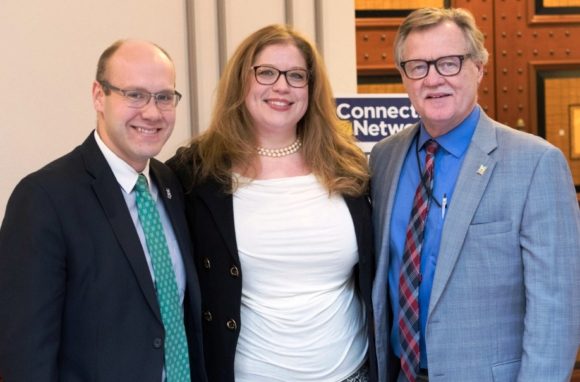
Rep. Carney (left), The Kate’s Director of Development Dana Foster (center), and Paul Formica (right) at the Jan. 29 public hearing on the proposal to install signs for The Kate on local highways.

Local lawmakers are urging the state legislature to help support the Katharine Hepburn Cultural Arts Center (‘The Kate’) by passing legislation that would allow tourism signage for the center to be placed on Rte. 9 and I-95.

Sen. Paul Formica (R-20th), Sen. Art Linares (R-33rd) and Rep. Devin Carney (R-23rd) submitted testimony in favor of House Bill 5574 and spoke before the Transportation Committee to urge fellow lawmakers to support the local theater. ‘The Kate’ is a theater in the Town of Old Saybrook that provides entertainment for the region and is named for Connecticut Hall-of-Famer, multiple Academy Award winner, and former Old Saybrook resident Katharine Hepburn.

“We believe that ‘The Kate’ deserves to have signage along both I-95 and Rte. 9 because it will attract tourists to the theater and create an interest for those passing by the signs,” the lawmakers said in their written testimony, adding, “Similar theaters have signage along various highways throughout the state due to their importance and popularity and ‘The Kate’ is no different.”

They continued, “It is a cultural hub with entertainment that draws people from across the state and the country. It is an economic engine, not only for Old Saybrook, but for the region as a whole and helps nearby businesses like the many restaurants and shops in town. Signage along the highway will only improve the number of tourists to town and we believe it is in the state’s best interest to promote this important theater with the signage suggested.”

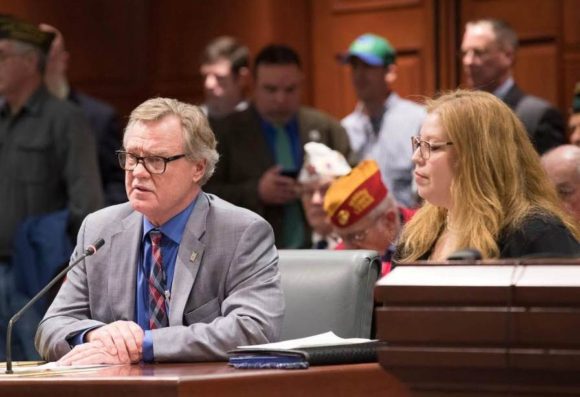
Sen. Formica and Dana Foster, Director of Development and External Relations at The Kate, testify before the Transportation Committee in favor of House Bill 5574 An Act Concerning Signs Indication the Location of the Katharine Hepburn Cultural Arts Center.

Sen. Formica testified in person with Dana Foster, Director of Development and External Relations, at ‘The Kate,’ on Jan. 31, before the Transportation Committee on which Rep. Carney is a ranking member.

Foster explained the importance of signage along the highways, saying, “Signage would help our growing audiences navigate the multiple exits to Old Saybrook and help to further attract additional tourists and others to our historical building, great exhibit, and incredible arts and programming.”

Letter From Paris: A European in Washington

Nicole Prévost Logan

On Jan. 27,  Theresa May was the first foreign leader to visit the White House during Donald Trump’s era.  The prime minister’s red dress matched the US president’s red tie and they both seemed  determined to cheer each other for the wonderful things they were about to accomplish together.

On the eve of Brexit, it was crucial  for the British visitor to obtain US support. For Trump,  it was a chance to welcome the UK as a “privileged” partner, to stress how the latter will benefit from Brexit and become a model for Europe in freeing itself from the “Brussels consortium.”

Actually, at this point, the US is not in a position to be much help for England. It is a matter that will have to be worked out directly between the UK and the European Union (EU.)   Beyond the posturing, the British prime minister was trying to reconcile her vision of a “global England” open to the world with the protectionism policies launched by Trump.

The task for May is incredibly complex since she has made clear her intention not to sever all ties with the continent while implementing  the “hard Brexit”and also to avoid a “cliff edge” situation.  She will need all her political acumen to surmount the obstacles coming from all sides and negotiate the best deal.
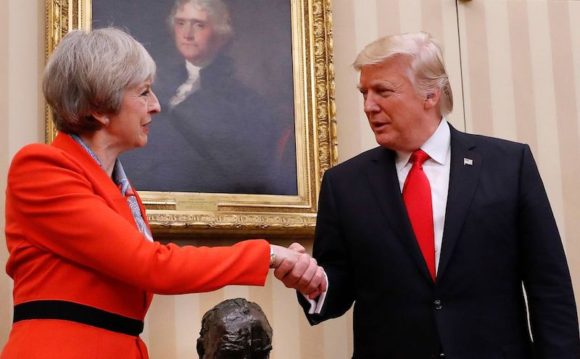
British Prime Minister Theresa May meets US President Donald Trump.

The “divorce” process has not even started and already dissenting opinions are being heard, even in her own camp.  On Jan. 3, Sir Ivan Rogers, the permanent British representative to the EU,  resigned after sending warning signals, and was immediately replaced  by “euro-skeptic” Tim Barrow, former ambassador to Moscow.  On Jan. 11, the Minister of Immigration, Robert Goodwill, proposed to impose a tax of 1,000 British pounds on EU workers. The business circles protested and the government backed down.  Andrea Leadson, Minister of Agriculture,  had to reassure farmers that the hiring of seasonal labor would not come to a stop.  Philip Hammond, Chancellor of the Exchequer disagreed  with the minister of Foreign Affairs Boris Johnson and proposed a departure “a la carte” from Europe. 

On Jan. 24, the British High Court voted by eight to three to route the Brexit process through parliament.  This decision created another hurdle for the prime minister. The House of Commons passed the text overwhelmingly.  The House of Lords will be next.    

The worst enemy of the UK in the Brexit process is the timetable.  Once triggered, Article 50 of the 2007 Treaty of Lisbon will take two years to be implemented and, of course, will have to be approved by all the EU members.  After that, it will take five or possibly 10 years for Britain to be legally able to conclude free trade bilateral agreements with other countries.

On Jan. 17, May gave a major speech at Lancaster House in which she spelled out the main points of her program.  This was followed a few days later by the publication of a White Paper containing a road map.  Control of immigration is a central preoccupation for the UK government.  It is understandable,  given the fact that that, from 2015 to 2016, 650,000 immigrants entered the country  (including 284,000 coming from the EU).  Britain had opted out long ago of the Schengen Zone, which allows for free circulation of goods, people, services and capital .

Right now Britain is a member of the European Customs Union and of the European single market. * Being a member of a single market like the EU, created by the 1957 founding treaty of Rome, comes with many constraints such as the harmonization of regulations, compliance with certain standards and the required contributions to the EU budget (Britain has already  committed 40 billion euros for the period 2016-2020.)  The European Court of Justice (based in Luxembourg) enforces those regulations and this explains May’s particular dislike for that institution.

In case of the departure of Britain from the EU,  there are alternatives to its present trade arrangements such as the ones used by  Norway, Iceland, Switzerland and Lichtenstein, which are not part of the European Customs Union.  Three of them are members of the European Free Trade Association (EFTA), which puts them close to the single market. Another example is Turkey, which is not part of the EU single market, but benefits from a special free trade agreement with Europe.  After her visit to Washington, May met with President Erdogan in Ankara to discuss these matters as well as a post-Brexit trade and military partnership.

One  of the most contentious issues of the Brexit is the future of The City.  For 30 years, it has been the financial hub of activities for the huge European market of 500 million people.  By leaving the single market, The City will lose its  “European passport”  and its say over the new regulations issued by Brussels every year.

Guy Verhofstadt, called “Mr. Brexit” at the European parliament, denounced the “illusion that it is possible to leave the EU while retaining its advantages.”

Michel Barnier has been appointed by Jean Claude Yunker, president of the European Commission, to head the negotiations with Britain.  This was a good choice.  Barnier is a man of consensus, experienced and pragmatic, according to The Telegraph.   Economist by training, he has held several posts as European Commissioner of various departments including finance, banking and defense. Interestingly, it was Barnier who supported the adhesion of Britain into Europe in 1972.

*for more on Cameron’s negotiations with the EU, which led to the June 23 referendum, see Logan’s article published by VNN on March 5, 2016.

Editor’s Note: This is the opinion of Nicole Prévost Logan.

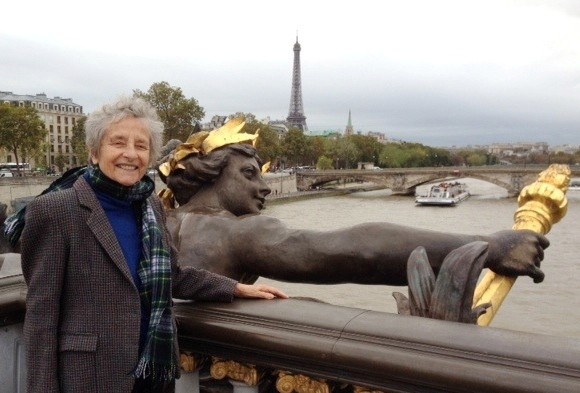
Nicole LoganAbout the author: Nicole Prévost Logan divides her time between Essex and Paris, spending summers in the former and winters in the latter. She writes a regular column for us from her Paris home where her topics will include politics, economy, social unrest — mostly in France — but also in other European countries. She also covers a variety of art exhibits and the performing arts in Europe. Logan is the author of ‘Forever on the Road: A Franco-American Family’s Thirty Years in the Foreign Service,’ an autobiography of her life as the wife of an overseas diplomat, who lived in 10 foreign countries on three continents. Her experiences during her foreign service life included being in Lebanon when civil war erupted, excavating a medieval city in Moscow and spending a week under house arrest in Guinea.