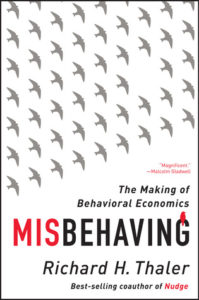
Reading Uncertainly? ‘Misbehaving: The Making of Behavioral Economics’ by Richard Thaler

This is the engaging story of the development and rise to practical significance of “behavioral economics,” the recognition that we “Humans” (as Professor Thaler calls us) are inevitably flawed in our dealing with finance and the market. It is also the personal biography of the author, along with many of the most important thinkers of the past 50 years.

The idea that our financial markets are “efficient,” as suggested by the “Econs,” the gurus we followed for many years, is destroyed by the realities of the human brain. First came Daniel Kahneman and Amos Tversky, who discovered our innate aversion to loss. Thaler notes that “ … losses hurt about twice as much as gains make you feel good,” noting, “Loss aversion has become the single-most powerful tool in the behavioral economist’s arsenal.”

But, Thaler also warns that, “… people who are threatened with big losses and have a chance to break even will be unusually willing to take risks, even if they are normally risk averse. Watch out!”

We need to be far more aware of the vagaries of the human mind when trying to guide ourselves and others toward the best balance of risk and reward: “The bottom line is that in many situations in which agents are making poor choices, the person who is misbehaving is often the principal, not the agent. The misbehavior is in failing to create an environment in which employees feel that they can take good risks and not be punished if the risks do not pay off.”

Unfortunately, we all tend to follow the herd: “It is better for reputation to fail conventionally than to succeed unconventionally.” Many years ago, IBM tried a better idea: it created a “Skunk Works” (from Al Capp’s L’il Abner cartoon) where employees with new and uncommon ideas could use corporate funds and help to work them out. If they succeeded, glory. If not, they could return, without blame, to their former employment.

Thaler’s sense of humor is always evident. Instead of watching our investment portfolios too closely, a uniformly bad habit, he suggests doing a crossword puzzle instead. He made a correct prediction about the collapse of the market in 2008: “Having made that one correct prediction, I am resolving not to make any more.”

And in American football, he urges teams to do the unexpected, such as “going for it” on fourth down. It changes the psychology on both sides echoing the, “And now for something completely different,” from Monty Python.

Thaler’s language is distinctly non-academic, a pleasure to read. He quotes Douglas Bernheim (2002): “As an economist, one cannot review the voluminous literature on taxation and saving without being somewhat humbled by the enormous difficulty of learning anything useful about even the most basic empirical questions.”

The last third of the book details the writing and reception of Nudge, the 2008 book he co-authored with Cass Sunstein. Their original title was “libertarian paternalism,” abbreviated, thank goodness, to “nudge,” the idea that we can encourage someone to do something that is in their best interests, by making it slightly easier.

At the end, Thaler asks “What Is Next?” He answers: “the only sensible prediction is to say what happens will surely surprise us.” Behavioral economics, the role of humans in what we do and how we live, is critical to both strategic and tactical planning.

And I did find a word I’ve never seen before: “corybantic.” It means frenzied, agitated, unrestrained: exactly how some human respond when their traditional beliefs and ideals are challenged.

Editor’s Note: ‘Misbehaving: The Making of Behavioral Economics’ by Richard Thaler is published by W. W. Norton & Co., New York 2015

Felix Kloman

About the Author: Felix Kloman is a sailor, rower, husband, father, grandfather, retired management consultant and, above all, a curious reader and writer. He’s explored how we as human beings and organizations respond to ever-present uncertainty in two books, ‘Mumpsimus Revisited’ (2005) and ‘The Fantods of Risk’ (2008). A 20-year-resident of Lyme, he now writes book reviews, mostly of non-fiction that explores our minds, our behavior, our politics and our history. But he does throw in a novel here and there. For more than 50 years, he’s put together the 17 syllables that comprise haiku, the traditional Japanese poetry, and now serves as the self-appointed “poet laureate” of Ashlawn Farms Coffee. His wife, Ann, is also a writer, but of mystery novels, all of which begin in a bubbling village in midcoast Maine, strangely reminiscent of the town she and her husband visit every summer.
$16 Million Gift From Old Lyme Sisters Benefits Birds, Animals and Environment

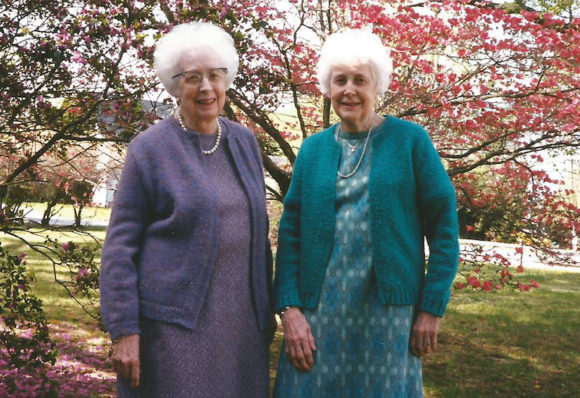
Sisters Mary Janvrin (right), who had lived in Old Lyme prior to her death in Chester, Conn., and Natalie Janvrin Wiggins of Old Lyme, whose $16 million bequest to two Community Foundations will benefit birds, animals and the environment.

Janvrin sisters’ legacy leaves $8 million each to two community foundations.

Mary Janvrin and Natalie Janvrin Wiggins shared a life-long love of ornithology and nature that eventually turned into a tremendous legacy.

Natalie, 88, who lived in Old Lyme, passed away in May 2010.  Mary, 91, had also previously been a resident of Old Lyme but was living in Chester, Conn., at the time of her death on Sept. 29, 2016. Upon Mary’s passing, her trust set into motion the establishment of two funds that will make lasting contributions to bird and animal welfare, and the preservation of their natural environment.

The Mary Janvrin and Natalie Janvrin Wiggins Fund for Birds, Other Animals and Nature will bring $8 million each to the Community Foundation of Eastern Connecticut (CFECT) and the Community Foundation of Middlesex County (CFMC). For generations to come, these funds will amplify the wildlife and environmental conservation efforts supported by these grantmakers.

“I greatly enjoyed working with Mary Janvrin, and also with her sister, Natalie Janvrin Wiggins, who passed away in 2010,” reflected attorney Suzanne Kitchings of Kitchings & Potter. “I feel privileged to have helped Mary create this important plan, which will carry out the sisters’ wishes to benefit birds, animals and the environment in perpetuity.”

Janvrin’s gift is the second largest for CFECT. Its largest gift was a $10 million bequest from Peter Letz in 2014, also to benefit animal welfare and the environment. Preserving the environment and advancing animal welfare are two of CFECT’s four strategic focus areas.

“Mary Janvrin’s generous bequest will help us have greater impact on the well-being of our region,” explained Maryam Elahi, President and CEO of CFECT. “Because this new fund covers all of Eastern Connecticut, we will be able to forge partnerships and tackle critical projects throughout our region, as well as in collaboration with CFMC.  

“Mary and her sister Natalie cared deeply about preserving the species and spaces that make Connecticut a wonderful place to live,” shared Moira Martin of Essex Savings Bank’s Trust Department, which serves as the executor of the Janvrin estate. “We in the Trust Department are tremendously proud to have been given the opportunity to work with such generous and passionate clients as Mary and Natalie, whose gift will both stimulate new conservation efforts and energize existing conservation programs for the wildlife, lands and people in our region.”

“For professional advisors like Suzanne and Moira, serving the interests of their clients is at the heart of the matter. When those interests include a generous legacy like the Janvrin sisters’, what an honor and delight for community foundations to put that thoughtful vision into action,” concluded Elahi.

Editor’s Note: Serving 42 towns and comprised of 465 charitable funds, the Community Foundation of Eastern Connecticut (CFECT) puts philanthropy into action to address the needs, rights and interests of the region. CFECT stewards an endowment of more than $60 million and has awarded more than $39 million in grants and scholarships to area nonprofits and students since its founding in 1983. To learn more, visit cfect.org.

New Year’s Day Hike in Hartman Park with Lyme Land Trust Postponed to Jan. 14

Take a hike in Hartman Park on Jan. 14.

12/29 UPDATE: This hike has been postponed to Sunday, Jan. 14, at 1 p.m. due to the inclement weather forecast for this coming weekend.

Start the New Year off with a refreshing walk in the woods. All are welcome.

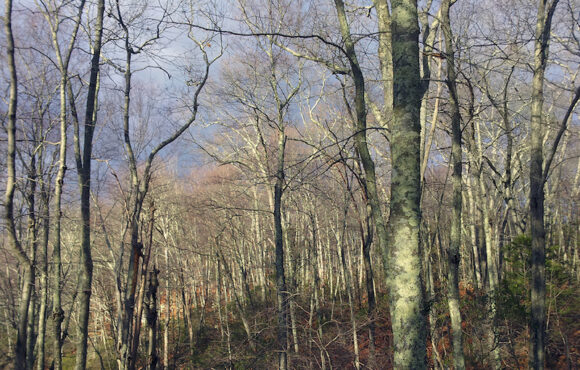
Hike a moderately easy 2.6-mile portion of the Goodwin Trail through the Nehantic State Forest and Hartman Park, led by Wendolyn Hill, Lyme Land Trust board member and Town of Lyme Open Space Coordinator. Hikers will visit old CCC camp foundations, pass ancient colonial ruins and pause to appreciate the view from the beloved Bald Nubble on the red trail at Hartman Park.

A snack will be provided. Bring water or something to drink. Don’t forget your walking stick.  It is anticipated the hike will last around two and a half hours.

Meet at the trailhead to the Goodwin Trail at Hartman Park, Gungy Road, Lyme (Lat. 41.43608 Long. 72.29009) at 1 p.m. to car-pool to the Holmes Road parking lot in East Lyme.

The Richard H. Goodwin Trail, overseen by the Eightmile River Wild & Scenic Coordinating Committee, is an extended 14-mile trail system crossing four towns: East Haddam, Salem, Lyme and East Lyme.

Inclement weather cancels. Check for updates at this link.

Directions from Rte. 156 in Lyme: Take Rte 156 to Beaver Brook Road. Travel about 2.7 miles on Beaver Brook Road. Turn left onto Gungy Road. Travel about 1.5 miles. Park along the road.

For further information, contact openspace@townlyme.org

High Speed Train Route Dominates Our 2016 Stories. LymeLine Opinion: Now It’s 2017, What Happens Next?

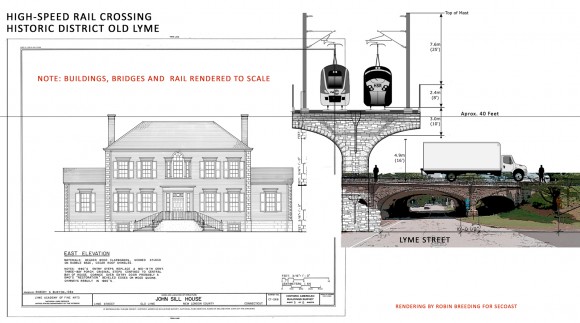
Rendering by Robin Breeding of the high-speed train in Old Lyme drawn/created to scale.

It’s a New Year, which brings an opportunity to review and reflect on the previous year, and to make plans for the new one. We have covered so many topics throughout 2016 that we decided to enlist the help of Google Analytics to determine which have generated the most interest among our readers.

Our ‘Top 20’ of “Most Viewed Stories” included those covering

But far and away the highest number of pageviews generated in 2016 came from stories related to the proposed high speed rail track. Seven of our ‘Top 20’ stories in 2016 were about one aspect or more of the Federal Rail Authority’s (FRA) high speed train proposal with our 2016 #1 story being Greg Stroud’s Op-Ed piece back in January, which, in our mind, really sparked the whole general awareness of the situation.  That single story generated almost 6,000 pageviews.

This widespread interest in the high speed train route culminated on Dec. 19, 2016 with the announcement by the FRA that, despite more than 1,000 letters of protest from residents of Old Lyme, their Preferred Route was, after all, through Old Lyme … but now in the form of a tunnel. The FRA has, however, also refused to eliminate the possibility of the aerial track that it originally proposed, which seems a likely fall-back position for the FRA since the organization, as far as we know, has done no — yes, that’s zero — research into the practicalities of digging a tunnel under the Connecticut River estuary.

The announcement of the Preferred Route on Dec. 16, 2016 brought with it a 30-day deadline for raising comments, but unlike the comment period that accompanied the initial draft proposal announced back in December 2015, the FRA has no obligation to respond to any of the comments raised.

We know that SECoast.org, the non-profit “organizing and educating the public to protect Southeastern Connecticut and the Lower Connecticut River Valley,” and the Connecticut Trust for Historic Preservation have together filed for an extension of the 30-day Comment Period by an additional 60 days taking it from Jan. 31 to April 1.  The extension is critical to allow more people to contact the FRA to express their concerns about the route and for more detailed analysis of the proposal to take place.  It is patently clear from the timing of the announcement of the Preferred Route (nine days before Christmas) that the FRA is hoping only a very limited number of people will bother to file comments this time, especially since the FRA is not required to respond to them.  Then they (the FRA) can argue that Old Lyme is not only placated but probably supportive of the proposal.

We also know that our elected representatives US Sen. Richard Blumenthal, US Congressman Joe Courtney, State Sen. Paul Formica (R- 20th), and State Rep. Devin Carney (R-23rd) have all been fully supportive of efforts to persuade the FRA to reconsider the Preferred Route and we are greatly appreciative of their actions.  Similarly, the first selectmen of Old Lyme, Old Saybrook and East Lyme along with some other local state senators and representatives have all publicly denounced the proposal and we much appreciate that too.

There has also recently been a considerable surge of interest and active concern expressed by organizations in Rhode Island.  These include The Nature Conservancy of Rhode Island and the Westerly (R.I) Land Trust.

But what has happened here in our own backyard in terms of specific actions to express concern to the FRA regarding the Preferred Route?  We are fully aware that a great deal is surely happening below the radar regarding train route negotiations and respect the need for that, but in the interests of our readers, we have some questions.

  • Have the boards of selectmen of Old Lyme, East Lyme and Old Saybrook also filed for a 60-day extension to the Comment Period and/or approved motions expressing their deep concerns about the proposed route?
  • Have the Connecticut branches of The Nature Conservancy and Audubon Society, the Roger Tory Peterson Estuary Center or the Connecticut Fund for the Environment and the Old Lyme Land Trust issued any sort of statement regarding the proposed route and/or requested an extension to the Comment Period?
  • And what about the Lyme-Old Lyme Chamber of Commerce and the numerous art and other non-profit organizations in town — have they each written and requested an extension to the Comment Period?

We do know that a team has been appointed by the Old Lyme First Selectwoman to study the impact of the Preferred Alternative, but we do not know who its members are or the nature of their work. We sense a Town Meeting in Old Lyme might be helpful for residents to come together and hear from the Old Lyme Board of Selectmen (BOS) about the work currently being undertaken by the team and how the BOS intends to respond to the FRA Preferred Alternative.

We continue to be passionate supporters of high-speed rail but each one of us is currently watching as, to quote State Rep. Carney, “a dark cloud” hangs over our beautiful and irreplaceable environment, our property prices drop and our town population declines. Therefore our overarching hope for 2017 is that we all pull together to defeat the current route proposal by openly sharing information and acting as a cohesive, effective force against what Sen. Richard Blumenthal has so aptly described as a, “frankly half-baked, hare-brained notion.”