Two Lyme-Old Lyme HS Seniors Sign National Letters of Intent to Play D1 Lacrosse

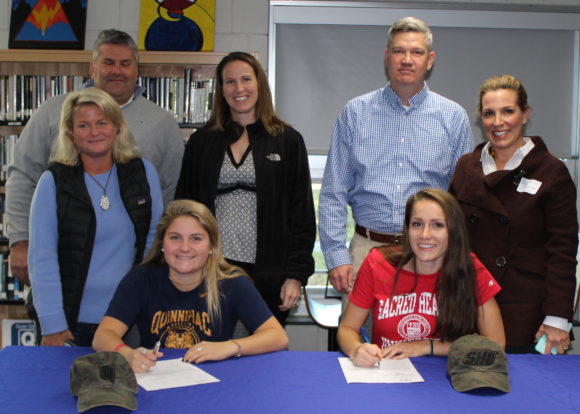
Proud parents Peter and Chrissy Cowell of Old Lyme watch as their daughter Sydney (left, seated) signs her National Letter of Intent to play lacrosse at Quinnipiac University after graduation from Lyme-Old Lyme High School. Similarly, John and Nancy Mesham of Old Lyme watch as daughter Anna (seated right) signs to play at Sacred Heart University. The girls Nor'easter club team coach (wearing black jacket) stands in the center.

Proud parents Peter and Chrissy Cowell (standing left) of Old Lyme watch as their daughter Sydney (seated left) signs her National Letter of Intent to play Division I lacrosse at Quinnipiac University after graduation from Lyme-Old Lyme High School (LOLHS) in June 2017. Similarly, John and Nancy Mesham (standing right) of Old Lyme watch as daughter Anna (seated right) signs to play Division I lacrosse at Sacred Heart University, also after her June 2017 graduation from LOLHS. The girls Nor’easter club team coach (wearing black jacket) stands in the center.

A ceremony was held Nov. 13 at Lyme-Old Lyme High School (LOLHS) when two seniors signed National Letters of Intent to play Division I lacrosse at colleges in the fall of 2017.

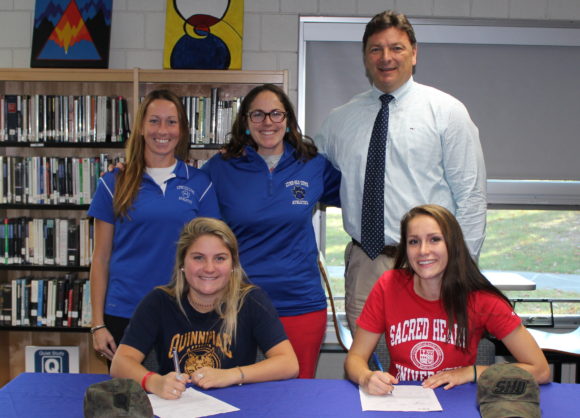
Sydney Cowell (seated left) and Anna Mesham (seated right) sign National Letters of Intent proudly watched by (from left to right) Lyme-Old Lyme High School (LOLHS) Athletic Director Hildie Heck, LOLHS Girls' Lacrosse Coach Emily Maciano and LOLHS Principal Jim Wygonik. standing,

Sydney Cowell (seated left) and Anna Mesham (seated right) sign National Letters of Intent watched by (from left to right, standing) LOLHS Athletic Director Hildie Heck, LOLHS Girls’ Lacrosse Coach Emily Macione and LOLHS Principal Jim Wygonik,

Sydney Cowell will play at Quinnipiac University and Anna Mesham at Sacred Heart University.

Congratulations, girls — what a well-deserved honor and achievement!

Death of Andrew Pfeiffer Announced

Andrew Pfeiffer of Old Lyme, Conn., died at home on November 19th with his family at his side.

He was born in 1917 in Port Jefferson, N.Y.  At a young age he excelled in music, and was sent to study piano under Leopold Stokowski at the New York School of Music.  He then attended the Ethical Culture School and Fieldston during his teens and graduated from Wells High School in Maine at the age of 16, where he developed his life-long affinity for coastal living in the family cottage in Ogunquit.

After graduation, Andrew came to Old Lyme and worked as a camp counselor at McCulloch’s “Camp Aladdin”, on Whippoorwill Road.  His first career job was as a wood carver and touring puppeteer for America’s Puppet Master – Tony Sarg.  He later took his carving and woodworking skills to local furniture maker, Stanley Davis, whose factory was on Mill Lane in Old Lyme.   

He always had a keen and inventive mind.  He possessed the rare characteristic of genius, coupled with tremendous dexterity — a mix of science and ingenuity that allowed him not only to determine the issue, but also to design and build tools to implement the solutions. His accomplishments were achieved with only a high school education.

During the early stages of WWII, Andrew worked in the aero-technology industry for Sikorsky helping in the production of Connecticut’s fighter plane the “Corsair” and later aided in the development of helicopters.  He then took his skill to the Manhattan Project with Westinghouse in Bloomfield, New Jersey.  There, he worked directly with a new metal known as Uranium, or as the machinists called it, “Tubealloy”.  It had strange properties that made it difficult with which to work.  It caught fire, galled during machining, and required special techniques to handle during the manufacturing process.   In the lab, Andrew worked on many of those difficulties, as well as several experimental projects associated with x-ray and electrolysis.  At the end of the war, while offered a research lab opportunity, Andrew chose instead to settle back in Old Lyme, build his home, and raise a family. 

Andrew married Marianne Goetze, whom he met at the McCulloch farm. They were married for 74 years.  Her family had emigrated from Germany in 1934. Her father was a professor of Babylonian and Near Eastern Studies at Marburg University and assumed a position at Yale on his escape from Nazi Germany.   Andrew and Marianne built their house and family farm on Whippoorwill Road and raised three children.  Andrew built a shop and laboratory attached to the house.  Pfeiffer Research Instruments continued designing specialized equipment for various research laboratories and academic institutions.  Andrew held several patents in diverse fields of medical research and communications.  Several times in his career, Andrew and Marianne took on an artistic and creative sideline, designing and producing various kinds of jewelry.  Pfeiffer Cloisonné and Silver Work reached many corners of the world and has even been owned by some world leaders.   

Working for himself at his home and shop permitted Andrew to spend valuable time with his family.  He and Marianne formed a genuine partnership.  Together they raised two daughters and a son.  Andy and his wife bestowed to them the love of music, art, natural studies, academics, engineering and mechanics, as well as a competitive spirit.   They lived and modeled a life of integrity and honor, emphasizing the importance of community service and making the world a better place. 

During his life in Old Lyme, Andrew served as a high school class tutor in Chemistry and Physics, was on the Board of Education, served in several capacities in Civil Defense, was a member of the American Amateur Radio League, the Archaeological Society of Southeastern Connecticut, and most importantly – a friend to many.

Andrew is survived by his wife Marianne;  son Ned Pfeiffer and wife Marga of Old Lyme; daughter Dianne Merrill of San Rafael, California; and three grandchildren  – Aubris and Dane Pfeiffer of Old Lyme; and Trevor Page of San Francisco, California.  He was predeceased by his daughter Merrily Page of San Francisco, California and beloved brother John E. Pfeiffer of New Hope, Pennsylvania.   Andrew will be missed but not forgotten.

At Andrew’s request, no services will be held. The family extends its grateful thanks to the staff and volunteers of Hospice and Palliative Care at Middlesex Hospital.

Nibbles: Turn Turkey Leftovers Into Turkey Chilli

turkey_chilliYou may be reading this column the day before Thanksgiving. If you are serving a feast for four or eight or maybe up to 20, just peruse this column. You have enough to do without reading this, but the recipe below may help you with turkey leftovers. (There is no clear segue here, but if you are hosting and see yourself in the weeds, e-mail me (leeawhite@aol.com) and we will work you through it.)

Many people make soup with the turkey carcass, although I have never loved turkey soup. To me, the flavor is gone after the gobbler has spent hours in the oven. My stepdaughter, Molly, makes a good turkey soup by roasting the bones at a high temperature in the oven and using the bones for the broth.  But I often use the leftover turkey for casseroles, enchiladas or even pad Thai.

Or chili.

This recipe calls for a pound of raw, lean ground turkey. Using it, it is the beginning of the recipe below. On the other hand, begin this recipe with the lightly sautéed vegetables After you add the broth, beans and tomatoes, add about a pound or more shredded turkey, and simmer, as the recipe explains. This recipe belongs to a friend’s daughter who adapted the recipe from Cooking Light. I doubled the recipe so it would feed more. I also changed the beans from garbanzo beans to kidney beans primarily because, if you’re on Weight Watchers, kidney beans have half the points as garbanzo beans.

Turkey Chili

Yield: Serves 8

2 tablespoons olive oil

1 (or more) pounds of lean ground turkey

3 cups chopped sweet onion, divided

2 cups chopped green bell pepper (or other sweet peppers)

4 (or more) cloves garlic, minced

2  (or more) tablespoons chili powder

4 tablespoons tomato paste

2 teaspoons cumin

2 teaspoons dried oregano

one-half teaspoon ground cinnamon

one-quarter teaspoon ground allspice

1 cup low-sodium chicken broth

2 15-ounce cans kidney beans

28-ounce can diced tomato, undrained

5 tablespoons chopped semisweet chocolate

one-half teaspoon salt

one and one-half cups (3 ounces) shredded sharp cheddar cheese

Heat a Dutch oven (like a Le Creuset pot) over medium-high heat. Add olive oil. When moderately hot, add turkey and cook for about 3 minutes, stirring to crumble. Add 2 cups onion, bell pepper and garlic; saute about 3 minutes. Stir in chili powder and next 5 ingredients (through allspice); cook 1 minute. Add broth, beans and tomatoes; bring to a boil, then cover, reduce heat and simmer 20 minutes, stirring occasionally.

Remove chili from heat and stir in chocolate and salt. Top with remaining 1 cup of onions and cheese. Stir immediately.

Old Lyme Board of Selectman Discuss Possibility of Instigating Historic Survey of Town, But No Vote Taken to Move Forward

At a Special Meeting of the Old Lyme Board of Selectmen last Friday morning, the selectmen discussed the possibility of conducting a study of historic properties in the town, which had  recently been requested in a motion by the Old Lyme Historic District Commission (HDC). 

Gregory Stroud, Executive Director of  SECoast, had similarly urged that such a survey be undertaken in an op-ed published by LymeLine.com Nov. 6, 2016, noting that Old Lyme’s current survey is some 40 years old and therefore, “shamefully out of date.” He pointed out, “A historic survey matters not just for high-speed rail, but because it will inform every state and federal infrastructure project heading our way …”

The selectmen invited the HDC Chair Dr. John Pfeiffer to join their discussion and he explained why the HDC felt a survey was necessary, saying, “A survey needs to be done to find out what’s out there — we know what’s in the Historic District, but not outside,” adding, “Only when you know what’s out there can you plan.”

Pfeiffer commented, “I hope the Connecticut [State Historic] Preservation Office (SHPO) would come out and make a presentation about the survey terms,” adding, “I don’t know what they have in mind.”  He said that the HDC had endorsed the proposal to have a new survey conceptually, but “want to know more about it.”  Pfeiffer said, “I would want to get a better handle on what they would do,” while also noting that $30,000 was currently “available” from the state to fund the survey.

First Selectwoman Bonnie Reemsnyder welcomed the idea of SHPO coming to Old Lyme to give a presentation about how they would conduct the survey as happened when the Sound View proposal was under discussion.  She expressed concern at the area which had been mentioned as the survey size related to this proposal — roughly a one-mile-swath from north to south through the center of town. She commented, “I wonder at the breadth of the survey — that’s a lot.”  Pfeiffer agreed, “It’s probably going to be a long-drawn out process.”

Selectman Arthur “Skip” Sibley, who joined the discussion by phone, said, “I thought there was an existing survey that we’re updating … I thought it was just the Historic District.”  Pfeiffer explained, “In the 70s we produced a pretty good map … the survey would define what’s outside.  The first step is [to find out] what is out there.”

Sibley then asked, “Would it make sense to have a town hall committee to head this up?” noting that there is “A lot of passion and energy for this topic.”


Pfeiffer responded in the negative saying, “Let’s get the survey started before we have another committee,”  adding, “I’m at a loss to figure out how rigorous they (SHPO) want to be … I don’t know what they have in mind.”

Selectwoman MaryJo Nosal said she was about to ask Pfeiffer what had “… compelled the HDC to support this [the motion to request a survey.]  She then answered her own question saying, “I like the answer that it’s looking at what’s outside [the Historic District.]  Nosal questioned whether the survey should be “a regional effort,” to which Pfeiffer responded firmly, “Yes.”  Like Sibley, Nosal said she also believed the survey involved, “… just updating current maps,” noting, “I think it makes really good sense to look outside the town and make it a regional effort.”

Stroud, who was present at the meeting in the audience but not at the table during the discussion, spoke during public comment to clarify several points.  He stressed that the initial $30,000 from the state, “Doesn’t require a match [from the town] and therefore is not wasting any taxpayer money.” Moreover, a further $15,000 is available from the federal government and significantly, “SHPO has expressed an interest in the project.”  He emphasized that the funds are “currently” available and that therefore there is “some element of a ticking clock.”

Regarding the issue of the scope of the survey, Stroud noted that Daniel McKay of the Connecticut Trust had “arrived at this scope based on the comments of Rachel Reyes- Alicia” at the Aug. 31 meeting held in Old Lyme.

Following up on comments related to the purpose of and time to conduct the survey, Stroud confirmed, “The survey does not entail national registration.  It’s a survey to determine eligibility.”  He explained his understanding that the survey would take “months, not years” to complete and noted the scope of the survey could be adjusted by the town as desired.  He also commented that the “rigor” of the survey, of which Pfeiffer had spoken is different from “scope.”

After the meeting, Stroud told LymeLine.com, “I don’t think anyone with any serious understanding of these issues questions the need for an updated historic survey. I just hope that rather than waiting another three or six months to begin a survey, we start the process when it can still be fully-funded by state, federal and private grants, and while it still can help shape the decisions of the CT DOT and the Federal Railroad Administration.”

He continued, “Let’s keep this process as fast, streamlined and effective as possible. A simple historic survey with wide geographic boundaries. No national registration. No bells and whistles.”

Reading Uncertainly? ‘The Invention of Nature’ by Andrea Wulf

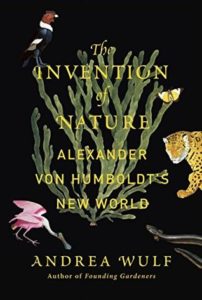
the_invention_of_natureFor those who attended this year’s Florence Griswold Museum-sponsored Samuel Thorne Memorial Lecture, which took place on Nov. 12, this month’s book review will ring significant bells. Not entirely by coincidence, we venture, our esteemed reviewer, Felix Kloman of Lyme, selected ‘The Invention of Nature’ as his book of choice this month and its author — Andrea Wulf — was the speaker at this year’s lecture .

Who was Alexander von Humboldt, the subject of this engrossing new biography? I must admit I had only a fleeting memory of his name, but for many in the 1900s, he was acknowledged as a major icon of the previous century in science and philosophy. Humboldt was a well-born Prussian, and Wulf’s story of his life is one of an intensely curious man whose travels, meetings and writings influenced many of the key thinkers of those years.

Consider these names: Johan von Goethe, Friedrich Schiller, Simon Bolivar, Thomas Jefferson, Charles Darwin, John Muir, Henry David Thoreau, Ernest Haeckel, Joseph Banks, and George Perkins Marsh. This biography is an exultation of interconnections!

And connectivity was the theme of Humboldt’s life: “Everything seemed somehow connected – an (early) idea that would come to shape his thinking about the natural world for the rest of his life.” Nature, to him, was a “web of life and a global force … with plants and animals dependent on each other.” This “urge to understand nature, globally, as a network of forces and interrelationships” generated “ferocious activity” for his entire life.

It began with his remarkable initial expedition to South America, including a climb to the top of Chimborazo, an inactive volcano in what is now Ecuador, a search for a link to the Amazon River, then walking in Mexico and Cuba, and, finally, a visit to President Thomas Jefferson in Washington. As a note on those times, it took Humboldt and his fellow traveler three and a half days to move from Philadelphia to the capital city.

While he yearned to travel again to South America, and then to Asia, and Africa, his shortage of funds allowed him only one other extensive tour, from Prussia to Russia and its border with China. But he never lost his curiosity, even while writing his journals, publishing a later masterpiece of his thinking, Cosmos, and forever trading correspondence and ideas with everyone he had met.

Wulf writes “comparison not discovery was his guiding theme,” and Humboldt issued an early warning of three ways in which the human species adversely affected the climate, based on his travels: deforestation, “ruthless irrigation,” and the “great masses of steam and gas produced in the industrial countries.” Almost two centuries later, we still have not learned …

Charles Darwin and Humboldt had frequent communication, in person and through letters. They shared, according to the author, a “flexibility perspective … telescopic and microscopic, sweepingly panoramic and down to the cellular levels, and moving in times from the distant geological past to the future economy of native populations.”

Humboldt was an outspoken critic of colonialism and slavery, but he had to be cautious as he remained under the financial support of Prussian royalty. Those years featured the turmoil of revolutions, as Europe and the Americas shifted from absolute despotisms to emerging democracies, and often back again.

Wulf’s entrancing biography is reading history through the vision of one extraordinary man who saw “harmony in diversity.” Would that we had listened more closely to his words …

Editor’s Note: ‘The Invention of Nature’ by Andrea Wulf is published by Alfred A. Knopf, New York 2015
Felix Kloman_headshot_2005_284x331-150x150About the Author: Felix Kloman is a sailor, rower, husband, father, grandfather, retired management consultant and, above all, a curious reader and writer. He’s explored how we as human beings and organizations respond to ever-present uncertainty in two books, ‘Mumpsimus Revisited’ (2005) and ‘The Fantods of Risk’ (2008). A 20-year resident of Lyme, he now writes book reviews, mostly of non-fiction that explores our minds, our behavior, our politics and our history. But he does throw in a novel here and there. For more than 50 years, he’s put together the 17 syllables that comprise haiku, the traditional Japanese poetry, and now serves as the self-appointed “poet laureate” of Ashlawn Farms Coffee. His wife, Ann, is also a writer, but of mystery novels, all of which begin in a bubbling village in midcoast Maine, strangely reminiscent of the town she and her husband visit every summer.