Stonewell Farm Hosts Two-Day Workshop on Dry Stone Wall Building, Sept. 24, 25

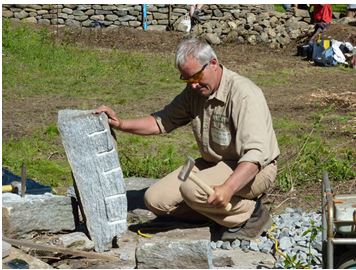
Andrew Pighill’s work includes outdoor kitchens, wine cellars, fire-pits, fireplaces and garden features that include follies and other whimsical structures in stone.

Andrew Pighill’s work includes outdoor kitchens, wine cellars, fire-pits, fireplaces and garden features that include follies and other whimsical structures in stone.

KILLINGWORTH — On Sept. 24 and 25, from 9 a.m. to 4 p.m. daily,  Andrew Pighills, master stone mason, will teach a two-day, weekend long workshop on the art of dry stone wall building at Stonewell Farm in Killingworth, CT.

Participants will learn the basic principles of wall building, from establishing foundations, to the methods of dry laid (sometimes called dry-stacked) construction and ‘hearting’ the wall. This hands-on workshop will address not only the structure and principles behind wall building but also the aesthetic considerations of balance and proportion.

This workshop expresses Pighill’s  commitment to preserve New England’s heritage and promote and cultivate the dry stone wall building skills that will ensure the preservation of our vernacular landscape.

This workshop is open to participants, 18 years of age or older, of all levels of experience. Note the workshop is limited to 16 participants, and spaces fill up quickly.

You must pre-register to attend the workshop.  The price for the workshop is  $350 per person. Stonewell Farm is located at 39 Beckwith Rd., Killingworth CT 06419

If you have any questions or to register for the workshop, contact the Workshop Administrator Michelle Becker at 860-322-0060 or mb@mbeckerco.com

At the end of the day on Saturday you’ll be hungry, tired and ready for some rest and relaxation, so the wood-fired Stone pizza oven will be fired up and beer, wine and Pizza Rustica will be served.

About the instructor: 

 Born in Yorkshire, England, Andrew Pighills is an accomplished stone artisan, gardener and horticulturist. He received his formal horticulture training with The Royal Horticultural Society and has spent 40+ years creating gardens and building dry stone walls in his native England in and around the spectacular Yorkshire Dales and the English Lake District.

Today, Pighills is one of a small, but dedicated group of US-based, certified, professional members of The Dry Stone Walling Association (DSWA) of Great Britain. Having moved to the United States more than 10 years ago, he now continues this venerable craft here in the US, building dry stone walls, stone structures and creating gardens throughout New England and beyond.

His particular technique of building walls adheres to the ancient methods of generations of dry stone wallers in his native Yorkshire Dales. Pighills’ commitment to preserving the integrity and endurance of this traditional building art has earned him a devoted list of private and public clients here and abroad including the English National Trust, the English National Parks, and the Duke of Devonshire estates.

His stone work has been featured on British and American television, in Charles McCraven’s book The Stone Primer, and Jeffrey Matz’s Midcentury Houses Today, A study of residential modernism in New Canaan Connecticut. He has featured  in the N Y Times, on Martha Stewart Living radio, and in the Graham Deneen film short  “Dry Stone”, as well as various media outlets both here and in the UK, including an article in the Jan/Feb 2015 issue of Yankee Magazine.

Pighills is a DSWA fully qualified dry stone walling instructor. In addition to building in stone and creating gardens, Pighills teaches dry stone wall building workshops in and around New England.

He is a frequent lecturer on the art of dry stone walling, and how traditional UK walling styles compare to those found in New England. His blog, Heave and Hoe; A Day in the Life of a Dry Stone Waller and Gardener, provides more information about Pighills.

For more information, visit www.englishgardensandlandscaping.com

Old Lyme Inn Owners Offer Unique Opportunity to an Experienced Chef/General Manager

Ken and Chris Kitchings are ready to welcome guests to the Inn's celebratory weekend.

Old Lyme Inn owners Ken and Chris Kitchings are looking for someone to take on the restaurant side of the business. (File photo.)

SIDE DOOR JAZZ CLUB AND INN REMAIN FULLY OPERATIONAL WHILE RESTAURANT OPERATIONS ARE RECONFIGURED 

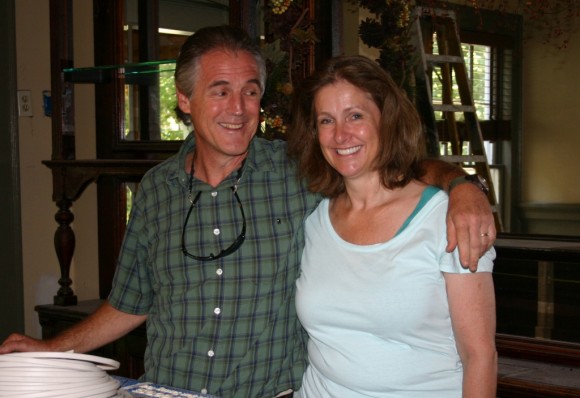
Almost on a whim, Ken and Chris Kitchings purchased the long-neglected Old Lyme Inn in 2011 and then spent a full year renovating the exterior of the main building while also updating and upgrading all systems and décor.  In April of 2012, they opened the restaurant and eight of the 13 rooms and the following year, they opened the remaining five rooms and The Side Door jazz club.

The property is significant covering almost two acres and, apart from the elegant rooms and the extremely popular jazz club, it also features a variety of dining areas. These include a beautiful patio shaded by a large maple tree (40 seats), a bar room (38 seats), a main dining room primarily used for special events (60+ seats) and a small private room (18 seats).

The Side Door is a 75-seat intimate space that includes a full-service bar and showcases world-class jazz musicians every Friday and Saturday night.  Having rapidly established a national reputation, it was a tremendous honor when Downbeat magazine recognized the club in February 2016 as one of the premier jazz clubs in the world.

The Old Lyme Inn is located just seconds away from the I-95 Exit 70 off-ramp.

The Old Lyme Inn is located just seconds away from the I-95 Exit 70 off-ramp.

The Inn enjoys a prime location  moments away from the foot of the I-95 Exit 70 off-ramp, placing it exactly two hours from both Boston and New York. The 13 guest rooms are sold out most weekends with wedding guests in the warm months and attendees of The Side Door jazz club during the remaining months.

With the club, restaurant and guest rooms — not to mention the outstanding central location — there is unquestionably vast potential in the property.  Moreover, the Inn is located directly across the street from the Florence Griswold Museum, which is recognized as the birthplace of American Impressionism.

This past August Ken and Chris were obliged to curtail restaurant service due to a lack of kitchen staff. Both The Side Door and the Inn remain fully operational — special events are being executed as planned, utilizing a skeleton crew of loyal staff.

Chris notes, “Ceasing normal restaurant operations was a very difficult but very necessary decision.”  She comments, “‘Google’ chef shortage and you will see that Connecticut and Southern New England are not alone in the current chef shortage dilemma. Restaurants here and abroad are experiencing difficulty in staffing their kitchens.”

Explaining how she and Ken are hoping to resolve the current situation, Chris says, “We are actively looking for a chef/general manager to take over management of the property. This could be an ideal opportunity for a chef/ manager from New York, Boston or any metropolitan area who would like to establish him or herself (with family) in a wonderful small community.”

But what makes this a unique opportunity for the right person is the “package” that Chris and Ken are offering.  Ken notes, “We are open to suggestions and creative concepts for utilizing this beautiful property. Ultimately, the Old Lyme Inn might become an establishment that is more than a restaurant and inn. The possibilities are limited only by the imagination.”

He concludes, “Our goal remains the same as when we purchased the property — to utilize and operate the entire property to the benefit of the community. We would like to think that the opportunity and support we can offer someone who is willing to work hard is greater than if they were to start a hospitality business from scratch on their own.”

Lyme-Old Lyme HS’s Bocian Joins Statewide Student Program to Increase Literacy Rates

Connecticut Voice's Executive Board gathers for a photo, From left to right (back row), Kelley Gifford, Haoyi Wang, Hannah Lamb, Priya Mistri, KaltenReese Hasankolli, Izzy King, Hailey Jimenez, Gary Bocian from Lyme-Old Lyme High School, Alexandra Chitwood, Evani Dalal; (front row), Isha Dalal (founder) and Stephen Armstrong (advisor).

Connecticut Voice’s Executive Board gathers for a photo. From left to right (back row), Kelley Gifford, Haoyi Wang, Hannah Lamb, Priya Mistri, Kalten Reese Hasankolli, Izzy King, Hailey Jimenez, Gary Bocian from Lyme-Old Lyme High School, Alexandra Chitwood, Evani Dalal; (front row), Isha Dalal (founder) and Stephen Armstrong (advisor).

Gary Bocian of Old Lyme, a sophomore at Lyme-Old Lyme High School, has been named a member of the executive board of a new, statewide, student organization called Connecticut Voice.  Katie Reid from LOLHS is also participating in the program.

A kick-off event to launch the program will be held in Hartford at the Capitol Building on Wednesday, Sept. 14. Secretary of the State Denise Merrill, Literacy Director for the State Department of Education Dr. Melissa Hickey, and Governor Dannel Malloy are just a few of the featured speakers at the event.

Founded by Trumbull High School senior, Isha Dalal, Connecticut Voice is an innovative program to give students in the state of Connecticut an opportunity to directly impact their community. More than 60 students from across the state are part of the program.

The goal of the program is for students to pass a law at the state level. This year, the program will focus on literacy rates to help close the education gap within Connecticut. At the event on Wednesday, students will be able to ask questions and learn more about why it is so important to give back to the community.

Not only is the group going to work towards passing legislation, but members will also start new community initiatives as well. For example, they will be holding a statewide book drive.

Dalal started this program while volunteering for New Haven Reads. After realizing that a large population of students exists, who are not afforded the same educational opportunities she has enjoyed, she was motivated to try and change that situation.

With interests ranging from legislation to neuroscience, Dalal created Connecticut Voice, a program that could encompass both. “To understand how to increase literacy rates, it is important to understand the brain as well as the community aspect. Before one can solve a problem, he or she must understand it first,” Isha stated when describing the program.

Working closely with Stephen Armstrong, the Social Studies Consultant for the State Department of Education, and with organizations such as the Trumbull Business-Education Initiative and the Trumbull ACE Foundation, Dalal was able to create this program. She met with the Secretary of the State’s Office, members of the State Board of Education, her superintendent, and the Commissioner of Education to garner support and create a solid foundation for Connecticut Voice

When asked why she created this program, Dalal said, “I want every student to know that they can make a difference despite their age, their background, or their interests. “

“The unique aspect of our program is that it is for students, by students. If someone has an idea and they are willing to work hard, they can do whatever they set their mind to. After reaching out to different leaders, I realized that there are so many people that care just as much as I do and, together, we can create a better world and help improve the lives of hundreds of people.”

Bocian is eagerly anticipating the launch of the program on Wednesday.  When asked in an email by LymeLine what he is most excited about with regard to the program, he responded, “Being involved with Connecticut Voice, I most look forward to making a difference in the community,” and “through our focus of illiteracy rates in Connecticut,” to help as many as students as possible.

Bocian continued, “Through Connecticut Voice, I hope to learn more about working with others on a shared goal. Even at the [first] Executive Board meeting, I was able to work with students from across Connecticut. I heard different perspectives from students because of where they are from. It really brings students ideas together. I also hope to improve on my leadership skills as this is a new opportunity to become involved in my community.”

Final Week to View “The Artist’s Garden” at Florence Griswold Museum

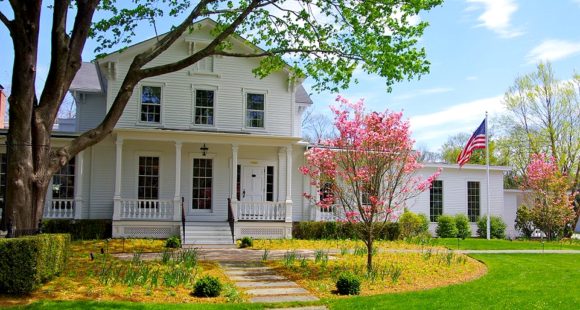
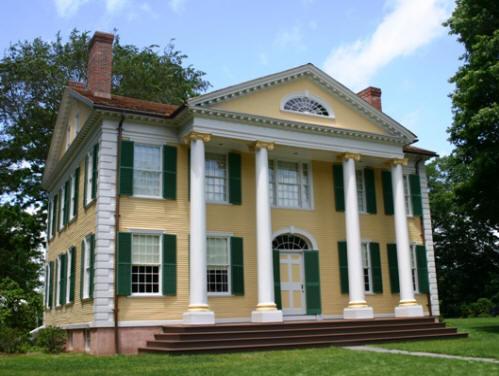
Exterior view of the Florence Griswold Museum, which hosts a Free Day for New London residents on Sunday.

Exterior view of the Florence Griswold Museum on Lyme Street.

This is the final week for the exhibition, The Artist’s Garden: American Impressionism and the Garden Movement, 1887–1920. The exhibition is on view through Sept. 18, and its presentation at this museum is supported by a grant from Connecticut Humanities.

Organized by the Pennsylvania Academy of the Fine Arts, The Artist’s Garden tells the story of American Impressionists and the growing popularity of gardening as a leisure pursuit at the turn of the 20th century. Paintings and stained glass from the Pennsylvania Academy are blended with paintings, sculpture, prints, books, and photographs from the Florence Griswold Museum’s permanent collection, as well as selected private loans. Drawing on new scholarship, The Artist’s Garden considers the role of artists and designers in defining a cultivated landscape in an era of new attitudes toward leisure, labor, and a burgeoning environmentalism.

The Artist’s Garden is the first exhibition to situate discussions of the growth of the Garden Movement within the politics of the Progressive era, with which it overlapped at the turn of the twentieth century. The Progressive era was marked by intense political and social change. Along with the surge of nationalism and patriotic optimism came growing concerns over mass immigration, women’s suffrage, and urbanization. The Garden Movement proposed that the creation of public parks and the hobby of gardening could provide beauty and balance within this fast-changing world.

The American Impressionist works in this exhibition demonstrate the profound impact of theGarden Movement on the American culture. “Not only is the Florence Griswold Museum an ideal venue for this exhibition because of its history as a boardinghouse for artists and its restored gardens, but also because Connecticut women like Old Lyme’s Katharine Ludington played an important part in Progressive-era causes such as women’s suffrage while also tending a much loved garden,” said Curator Amy Kurtz Lansing.   

Many American artists developed their interest in gardens from their travels overseas. The outdoors became a major subject for Impressionists as they embraced painting outside, or en plein air. Not only does Daniel Garber’s Saint James’s Park, London, 1905 (on loan from the Pennsylvania Academy of the Fine Arts – PAFA) demonstrate theImpressionists’ careful study of light and quick, loose brushwork, but an attempt to capture the tension within urban life between the realities of development and the desire for pastoral tranquility. Public parks like St. James’s were praised by critics as peaceful oases amid the hectic frenzy of city life.

The Progressive era was a time of important change for women. They became leaders of the Garden Movement who combined their creative interests in art and gardening with a passion for Progressive causes, such as women’s suffrage. By blending art, writing, and gardening in their careers, women like Anna Lea Merritt were at the vanguard of professionalizing women’s work. They used their public platform to engage social issues like environmental conservation and immigration through the metaphor and example of the garden.

Professional artists such as Cecilia Beaux, Violet Oakley, and Jane Peterson participated in these changes by coupling their interest in modern art with a love of the garden. Peterson wrote that she loved painting flowers for their “prismatic hues of therainbow.” In Spring Bouquet, ca. 1912 (on loan from PAFA) the steeply tilted perspective and sense of patterning inthe composition are variations on the stylistic principles of Post-Impressionism. Locally, practitioners like artist, gardener, and suffragist Katherine Ludington exemplified this trend.

The exhibition will include selections from FGM’s Ludington Family Collection that acknowledge the expression of the Garden Movement in Connecticut, as well as around the family’s other home base in Philadelphia, the epicenter of the Garden Movement.
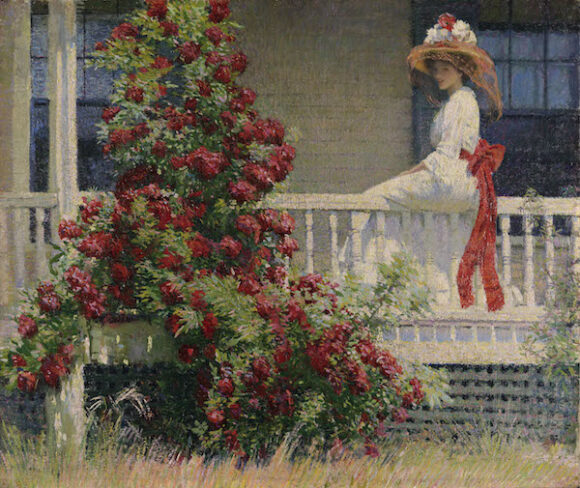
'Crimson Rambler' by Philip Leslie Hale is a signature paintings of the exhibition.

‘Crimson Rambler’ by Philip Leslie Hale is a signature paintings of the exhibition.

Even as women were making inroads towards more equal status and finding personal and professional expression through the venue of the garden, images that presented a sentimental and idealized vision of women posed decoratively in nature were still very popular. Philip Leslie Hale’s The Crimson Rambler, ca. 1908 (on loan from PAFA) embodies this simultaneous tendency to equate women with the beauty of flowers. He pairs a flowering vine with a women by adding touches of rose red to the lady’s hat and sash, and by draping each across the porch or trellis. Hale’s blooms are considerably larger than the flowers actually grow, suggesting that he idealized the fashionable plant as much as the woman beside it.

Hale’s painting also demonstrates his knowledge of gardening. Many artists combined their devotion to painting flowers with the practice of planting and tending gardens. “An artist’s interest in gardening is to produce pictures without brushes,” Anna Lea Merritt observed in her 1908 book An Artist’s Garden Tended, Painted, Described. Artists’ gardens were personal laboratories for Impressionist studies of light and color. They were outdoor classrooms where painters could teach their students about form and composition.

Special emphasis is given in the exhibition to the many ways Miss Florence’s garden served as a space for creative expression, both for her as a gardener and for the artists who painted and taught there. Paint was not the only medium used to translate nature’s vibrancy. Peony Window Panel, 1908-1912 (on loan from a private collection) by Louis Comfort Tiffany shows his appreciation for color and pattern. As a glass designer, his distinctive floral aesthetic defined the era and was perhaps cultivated in his own Long Island garden where he enjoyed painting.

The grounds of the Florence Griswold Museum provide the perfect accompaniment to The Artist’s Garden. After walking through the restored 1910 garden on the Museum’s campus, visitors will see first-hand in the galleries how artists captured nature’s fleeting beauty on canvas. “Miss Florence’s” lovingly tended garden was a favorite subject for many of the artists of the Lyme Art Colony who stayed at her boardinghouse.

One of the paintings on view in the exhibition, William Chadwick’s On the Piazza, ca. 1908 (collection of the Florence Griswold Museum) shows a female model posing on the side porch of the boardinghouse. Chadwick first visited Old Lyme in 1902 and soon became a central figure in this artist colony, along with Childe Hassam, Robert Vonnoh, and other painters who sought the colonial-era architecture and gardens of Old Lyme and their nostalgic suggestions of a simpler, earlier time, far removed from hectic, modern city life. A walk to the Lieutenant River, on the grounds of the Museum, provides further examples of vistas painted by the nature-loving artists.

Visitors can tour the historic boardinghouse – the 1817 Florence Griswold House – where the artists of the Lyme Art Colony lived, played, and worked. Paintings in the home continue the story of the artists’ love of the landscape. A new Guide to the Historic Landscape encourages visitors to walk where the artists created some of their most enduring paintings.

The recipient of a Trip Advisor 2015 Certificate of Excellence, the Florence Griswold Museum has been called a “Giverny in Connecticut” by the Wall Street Journal, and a “must-see” by the Boston Globe. In addition to the restored Florence Griswold House, the Museum features a gallery for changing art exhibitions, education and landscape centers, a restored artist’s studio, thirteen acres along the Lieutenant River, and extensive gardens. TheMuseum is located at 96 Lyme Street, Old Lyme, Connecticut. Visit www.FlorenceGriswoldMuseum.org for more information.
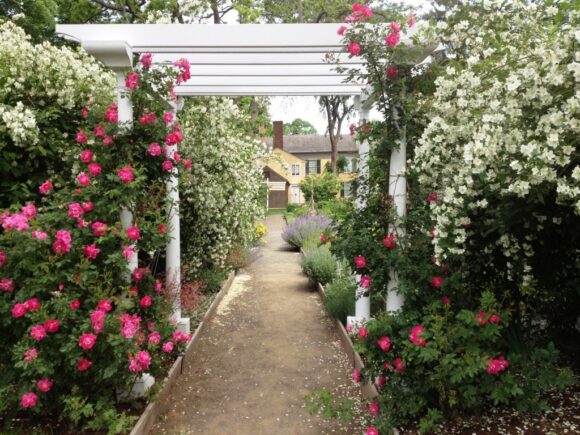
The Florence Griswold Museum in Old Lyme hosts a celebration of the site’s historic gardens featuring special events, displays, demonstrations, and family activities. From June 3 through 12, visitors can enjoy a wide variety of activities for all ages and interests.

The Florence Griswold Museum in Old Lyme hosts a celebration of the site’s historic gardens featuring special events, displays, demonstrations, and family activities. From June 3 through 12, visitors can enjoy a wide variety of activities for all ages and interests.

Garden lovers are invited to enjoy Café Flo Tuesdays and Saturdays from 11:30am-2:30pm and from 1-3:30pm on Sundays. Menu items are garden-fresh and family friendly. Dine on the veranda overlooking the Lieutenant River or pick up a basket and blanket and picnic along the river.

The Museum is located on a 13-acre site in the historic village of Old Lyme at 96 Lyme Street, exit 70 off I-95. Admission is $10 for adults, $9 for seniors, $8 students, and free to children 12 and under. For more information, visit FlorenceGriswoldMuseum.org or call 860-434-5542 x 111.