Old Lyme Residents Vote Tonight on Sound View Project Cost Increase, Joining Ledge Light at Special Town Meeting

Updated 09/27: 7:27am: The Old Lyme Board of Selectmen has announced a Special Town Meeting will be held on Tuesday, Sept. 27, at 7:30 p.m. in the auditorium of Lyme-Old Lyme Middle School to consider and vote on four items.

The first is to authorize approval of $911,100 for the construction cost of the Rte. 156 Bikeway/Sound View Improvements Project. Although $877,000 was approved by residents for this project in July of this year, according to an article by Kimberly Drelich published today (Sept. 24) on theday.com, “Reemsnyder said the bids for the project came in higher than expected” and an increase in the budgeted amount is now required.

This project has changed significantly since it was first introduced when it included bathrooms and a park (Sound View Green.)  Those items have been eliminated for cost reasons and the bikeway on Rte. 156 has also been dropped from the Sound View project since Rte. 156 is a state road, which means the project falls under the state’s jurisdiction. Editor’s Note: Selectwoman MaryJo Nosal has clarified (see ‘Comment’ below) that, “the DOT’s plans for the bike way, namely stripping and signage, remain the same. The route is currently listed on the CT State wide bicycle map.”  The map to which Nosal refers can be found at this link.

(See Editor’s Note below for related articles on the Sound View project.)

The second agenda item Tuesday is to authorize the Town to join the Ledge Light Health District (LLHD). Steve Mansfield from LLHD gave a presentation Aug. 29 at a Public Hearing attended by around 20 people, who were evenly divided in terms of being for or against the proposal. Mansfield will give another presentation prior to Tuesday’s vote.

Concerns raised by participants at the hearing included not having a Sanitarian readily accessible in Old Lyme thus creating the need to travel to New London to connect with a Sanitarian, a possible increase in wait times for inspections, and an increase in costs to users in some cases. An example of the latter is that in the case of restaurants, LLHD fees are based on classification whereas the Town of Old Lyme’s current fee structure relates to seating capacity.

The board of selectmen, which is supporting the proposal, cites benefits for the town, which include having the current health department employee based in Old Lyme for at least half her time initially to assist with the transition and the provision of a consistent range of services.  The selectmen also note that Ledge Light offers more officials, who individually specialize in different areas of expertise, and can provide the public with information and quality services in a timely manner.

If the motion is approved, the Town will have a two-year commitment to LLHD with the town’s representation on the LLHD Board based on the town’s population.

The third and fourth agenda items relate to the Town granting easements for entry and exit to a number of properties on Boston Post Rd. in the Rogers Lake area.

Editor’s Note:  Articles previously published on LymeLine.com related to the Sound View project include:
All Three Items Approved at Old Lyme Special Town Meeting; Sound View Construction to Start Later This Year   Published 07/18/16
Rte. 156 Bikeway/Sound View Improvements Proposal: The Case For and The Case Against Published 07/18/16
Presentation of Sound View Improvements Draws Praise, Criticism at Lively Meeting Published 04/28/16
Essex First Selectman Opposes State Takeover of Local Health Departments, Denounces New Cost to Small Towns; Lyme First Selectman Eno Agrees

The following is a press release from Norm Needleman’s campaign office that we received this morning:

Today, State Senate candidate and local businessman Norm Needleman spoke out against the yet-to-be-announced state takeover of local health departments. Needleman opposes the top-down, behind-the-scenes process which includes the elimination of local health departments, the loss of local control, and increased cost to towns in what amounts to a regional property tax.

The draft changes in Connecticut state statutes were distributed to town Health Directors as “draft Local Health Consolidation Statutes” by the Commissioner of Connecticut Department of Public Health Raul Pino.

“This secret state takeover plan is yet another example of the state barreling down the wrong path without input from towns,” said Needleman. “Forced regionalization is terrible policy and causes more unnecessary over-regulation of towns without any proven cost savings. This is a canary in the coal mine for more state and county control.”

Lyme Republican First Selectman Ralph Eno agreed with Needleman.

“I appreciate Norm’s attention to this key issue,” said Eno. “I agree with his position that this is an administrative overreach without any kind of formal hearing process. This is part of what is wrong with state government.”

The changes propose eliminating local health departments and consolidating them under one board and director for each county.

“In Essex we have an efficient and effective Health Department,” said Needleman. “In what world does it make any sense to turn a well managed town office over to the mess in Hartford?”

In addition, the changes propose that each town pay 1.5% of their budget to the new county health department. The draft legislation states: “towns, cities and boroughs of such district appropriate for the maintenance of the health district not less than one and one half percent of their previous fiscal year’s annual operating budgets.”

“As First Selectman of Essex I have kept our Health Department well under 1.5% of our annual town budget with a professionally managed team,” said Needleman. “This proposal will cost more for towns all across the region and amounts to a county tax. If elected State Senator I will fight foolish state overreach like this takeover.”

“The cost is a percentage of the town budget,” said Eno. “So this is a regional property tax to feed the state bureaucracy. Thanks to Norm for being out ahead on this issue and looking forward to his leadership in the State Senate.”

Norm Needleman is the founder and CEO of Tower Laboratories, a manufacturing business. As CEO, he has built the business over the past 37 years to become a leader in its segment, employing over 225 people. Needleman is in his 3rd term as First Selectman of Essex and was first elected as a Selectman in 2003.

“Norm understands the importance of local control as an experienced town leader,” said Campaign Manager Kevin Coughlin. “That is why he has been endorsed by both Republican and Democratic First Selectmen right here in the 33rd district.”

Needleman is the Democratic candidate for the 33rd State Senate District which consists of the towns of Chester, Clinton, Colchester, Deep River, East Haddam, East Hampton, Essex, Haddam, Lyme, Portland, Westbrook, and part of Old Saybrook.

Old Lyme Debate Sees Linares, Needleman Disagree Sharply on Some Issues, Agree on Others

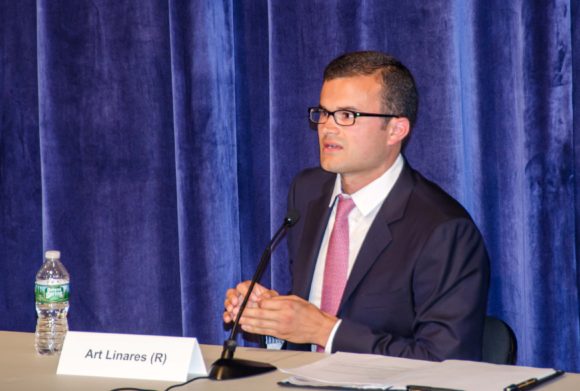
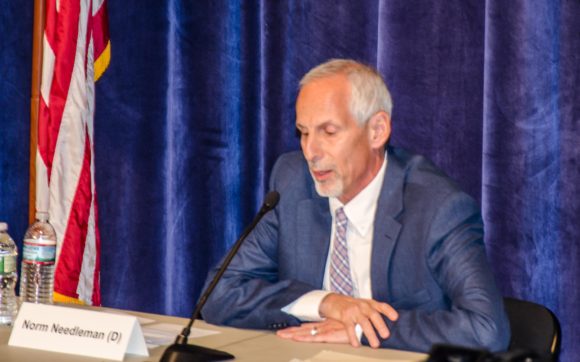
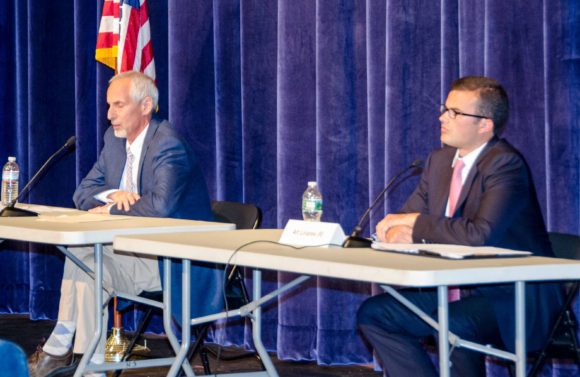
Norm Needleman (left) and Art Linares

Essex First Selectman Norm Needleman (left) and Sen. Art Linares answered questions on a variety of topics in last night’s debate.

The candidates vying for the 33rd State Senate District seat met last night in front of a relatively small audience of around 75 in the somewhat rarefied atmosphere of Lyme-Old Lyme High School (LOLHS).  Rarefied because not a single resident of Old Lyme can vote for either candidate since Old Lyme is part of the 20th State Senate District currently represented by Republican Paul Formica.

Nevertheless, The Day and the Eastern CT Chamber of Commerce selected LOLHS as the location for the first debate of the season in the high profile 33rd State Senate race.  Two-term incumbent Sen. Art Linares (R) faced off against challenger Norman Needleman (D), who is in his third term as first selectman of Essex, in a gentlemanly debate conducted entirely from seated positions.

Linares was first elected in 2012 to the 33rd State Senate District seat, which was held for two decades by the late former State Senator Eileen Daily of Westbrook. He won a second term in 2014, defeating Democrat Emily Bjornberg of Lyme on a 22,762-17,326 vote. Needleman was first elected as an Essex Selectman in 2003

Linares&Needleman

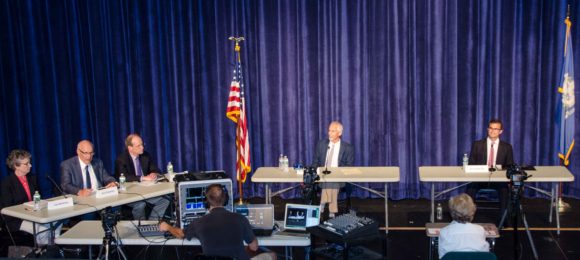
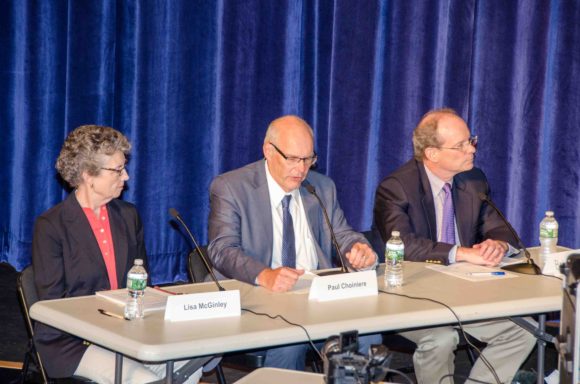
The Day’s Editorial Page editor Paul Choiniere (center in photo above) moderated the debate assisted by retired Day Deputy Managing  Editor Lisa McGinley and Day Staff Writer Brian Hallenback.

The constant theme of both candidates’ responses was the need for the state to control spending and to increase jobs, but they expressed different routes towards achieving that goal interspersed with regular jabs against their respective opponent.

1609_untitled_018

Linares, pictured above, opened the latter theme by saying, “Desperate people do desperate things,” when asked about charges from Needleman that he (Linares) had used constituent names and addresses inappropriately.  Linares said, “They [his opponents] want us to focus on desperate things,” rather than the state’s real problems such as, “Every day we have businesses leaving the state,” declaring emphatically, “I am ready to stand up and fight for you.”

A question about whether the candidates supported the Citizen’s Election Program (CEP) drew one of the most heated exchanges with Linares saying candidates should be encouraged to fund their own election campaigns because, “the CEP is running a deficit year after year.”  Needleman responded immediately, “That’s an absurd and ridiculous statement,” adding that the CEP has proved to be a “leveling-field.”

The issue of a third casino in Connecticut also showed a sharp difference in the candidate’s positions with Linares supporting the proposal in order to “intercept tourists on their way to [the new MGM casino in] Massachusetts,” which he predicted would otherwise take potentially up to $100 million out of state.  Needleman said unequivocally, “I would not support the expansion of casinos in Connecticut.”

Responding to a question about Linares’s March 2016 vote against a measure to reduce the state’s budget deficit, Needleman declared, “That vote pushed me over the edge to run,” and that he was “perplexed,” when he had determined that Linares was one of the three senators who had voted against the proposal.  Linares countered that he had, “stood up against that budget because I knew the next day it would be in deficit,” adding, “We didn’t make the kinds of structural change needed,” concluding firmly, “I’m proud that I stood up against Dan Malloy’s budget.”

1609_untitled_020

Needleman, pictured above, then accused Linares of being something Needleman confessed he had been described as himself when much younger by a teacher, namely, “A master of the obvious.” Needleman agreed, “We all know now we need structural reform,” but argued, “That stand needed to be taken,” long before the actual vote.

The candidates were in relative harmony regarding the recent Connecticut Supreme Court ruling that education funding needs to be more equitable, both agreeing, in Linares’s words, “The legislature must find a fair and concise way to fund education,” and, in Needleman’s, “The judge should not legislate from the bench.”

Similarly, Needleman and Linares found common ground on the subject of how the state should improve its fiscal position with the former saying that the state needed to “control spending and increase jobs,” while the latter added, “… and end wasteful spending.”

Asked which Presidential candidate they were voting for, Needleman mentioned first, “I’ve never seen an election like this one,” then said, “I support Hilary Clinton … albeit at times, reluctantly.” In turn, Linares stated, “I’m voting for Donald Trump,” adding, “I’m voting Republican down the line this year,” commenting, “Our country and our state needs to change direction.”

1609_untitled_007

The candidates responded to several further questions including ones about the ease with which the state can sell or swap state-owned land, how the state should create jobs and the state’s response to the opioid crisis.

In his closing statement, Linares said his goal was, “to take Connecticut to the top again,” since under six year of Malloy’s leadership, “”I have seen the state move backwards.”  He explained that Connecticut Republicans have a plan to achieve that objective called, “A Confident Future,” and urged the audience to review it.

Taking his turn, Needleman said, “I started as a cab driver in New York – I have paid my dues,” adding, “Relationships mean everything to me. I am always telling the truth and not reverting to scripted talking points.” He concluded, “Glory has no role for me.”

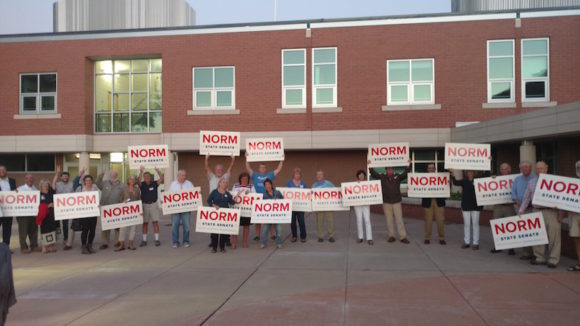
Norm Needleman had a significant crowd of supporters, who stood outside the High School prior to the debate.

Norm Needleman had a significant crowd of supporters, who stood outside the High School prior to the debate.

Editor’s Note: The 33rd State Senate District consists of the Town of Lyme along with the Towns of Chester, Clinton, Colchester, Deep River, East Haddam, East Hampton, Essex, Haddam, Portland, Westbrook, and part of Old Saybrook.

Learn All About ‘The Abduction from the Seraglio … According to Star Trek,’ 11am in Saybrook

Tenor Brian Cheney

Tenor Brian Cheney

OLD SAYBROOK — A witty lecture given by Old Lyme resident and internationally acclaimed tenor Brian Cheney with director Josh Shaw entitled “The Abduction from the Seraglio by Mozart … according to Star Trek” is slated for Saturday, Sept. 24, 11 a.m. at the Acton Public Library, 60 Old Boston Post Rd., Old Saybrook.

This free lecture is sponsored by The Guild of Salt Marsh Opera in partnership with the Acton Public Library.

For more information, call 860-388-2871.

Letter From Paris – No, Now It’s Essex!  A Brave, New Museum Opens in DC

Nicole Prevost Logan

Nicole Prevost Logan

Editor’s Note:  Our popular writer from Paris, Nicole Prevost Logan, is back in Essex, CT, for the winter.  She does not normally write for us from Essex, but this year, she is making an exception and will be continuing to contribute articles to ValleyNewsNow.com and LymeLine.com during the winter months.  Here is her inaugural column from Essex about the opening of  a very special museum in Washington DC.

The Grand Opening of the National Museum of African American History and Culture (NMAAHC) will take place in Washington DC this coming Saturday, Sept. 24.  The NMAAHC, the 19th and newest of the Smithsonian museums, was established by a bi-partisan Act of Congress in 2003.

The Smithsonian's National Museum of African American History and Culture, Nov. 6, 2015. (Photo by Michael Barnes from http://newsdesk.si.edu/photos)

The Smithsonian’s National Museum of African American History and Culture, Nov. 6, 2015. (Photo by Michael Barnes / Smithsonian Institution.)

The massive structure occupies a prime location next to the Washington Monument and contrasts with the 555 ft. slender obelisk.  The dark bronze-colored metal lattice that covers the ‘Corona” also stands out from the white marble classical architecture of most of the other museums standing on the National Mall.

It has been a long struggle for the supporters, such as Congressman John Lewis (D-Georgia), to make the project a reality.  They needed to overcome the resistance from several senators who advocated another location. The final approval  was more than a triumph — it might be considered a miracle.  It succeeded in making a strong statement as to the importance of Black history and culture in the American nation.

The lead designer was David Adjaye, son of a Ghanaian diplomat and the lead architect Philip Freehon, who died in 2009.  Founding Director Lonnie B. Bunch III is the visionary and driving force of the project.  During some of the many interviews he gave to the press and to a variety of audiences, including select ones like the Aspen institute, he explains the building process and his objective with a very contagious enthusiasm.

The NMAAHC is not intended to be a Holocaust museum, he explains . Its mission is to show the pain but also the joy and the creativity of African-Americans.  A daunting fund-raising goal of 450,000 million dollars had to be reached.

The three-tier effect of the construction incorporates elements from African culture, such as the Yoruban crowns from Nigeria.  Inside the building, high tech designs and the enormity of the space will make it possible to be versatile in organizing several exhibits simultaneously.

The collections had to be created from zero.  It required a treasure hunt into the attics, trunks and basements of the population.  To date 35,000 artifacts have been collected.  A segregated train from outside Chattanooga (TN) was lowered by crane and the museum built around it.  All traffic stopped on Constitution Ave. when an oversized truck delivered the control tower from a federal prison.

Artifacts showing the terrible fate of the slaves are very moving.  Such is an amulet created by the Lombi tribe in the form of a shackle.  More tragic still were the shackles for children.

But fun and the world of entertainment are also present in the displays , such as Louis Armstrong and his trumpet, Lena Horne or Marianne Andersen . The film archives will be essential to build up history, from Harriet Tubman to the human rights movements of the 1950s and 1960s.

According to Washington insiders , the opening of the new museum is the hottest event in a decade.  More than 150,000 special tickets have been distributed to dignitaries while long lines of visitors gather at the entrances of the building to purchase tickets for general admission after the opening.

Editor’s Note: This is the opinion of Nicole Prévost Logan.

Nicole LoganAbout the author: Nicole Prévost Logan divides her time between Essex and Paris, spending summers in the former and winters in the latter. She writes a regular column for us from her Paris home where her topics will include politics, economy, social unrest — mostly in France — but also in other European countries. She also covers a variety of art exhibits and the performing arts in Europe. Logan is the author of ‘Forever on the Road: A Franco-American Family’s Thirty Years in the Foreign Service,’ an autobiography of her life as the wife of an overseas diplomat, who lived in 10 foreign countries on three continents. Her experiences during her foreign service life included being in Lebanon when civil war erupted, excavating a medieval city in Moscow and spending a week under house arrest in Guinea.