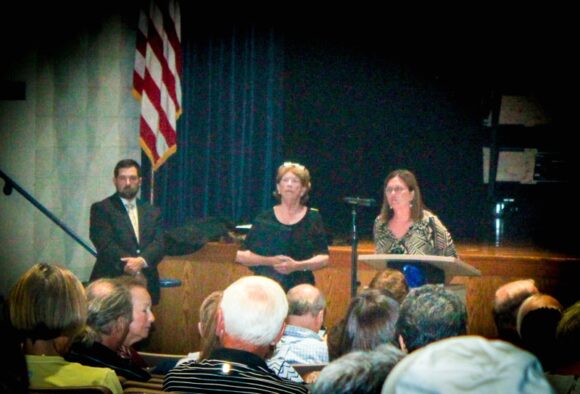
No Motion at OL Board of Selectmen to Express Formal Opposition to Train Route

There was significant discussion at the Old Lyme Selectmen’s meeting last Monday, July 11, regarding the meeting the previous week on July 7 in Old Lyme, which First Selectwoman Bonnie Reemsnyder had attended along with Connecticut Commissioner of Transport James Redeker; State Senator Paul Formica; State Rep. Devin Carney; Pamela Sucato, DOT; Rob Haramut, RiverCOG; Greg Stroud, SECoast; John Forbis; Bennett (BJ) Bernblum; and representatives from Sen. Blumenthal’s, Sen. Murphy’s and Rep. Courtney’s offices.

Neither of the Old Lyme Selectmen had attended and both expressed concern regarding the level of communication to the community. Selectman Arthur “Skip” Sibley said, “People are starving for information,” that it was time, “To start to make this thing more public,” and that he felt it was, “Better to get as much information out the public as possible.”

Reemsnyder said she would post a full account of the July 7 meeting on the Town website* as soon as it had been agreed by State Senator Formica — State Rep. Carney had already reviewed and agreed it.

Selectwoman MaryJo Nosal suggested they should have a motion to clarify to the public their opposition to the proposed railroad route.  Reemsnyder stated, “I’m opposed to the train going through Old Lyme — aerial or tunnel,” but Sibley noted, “We have a train through Old Lyme currently,” adding, “We shouldn’t have a vote when we don’t know what we’re voting against,” saying again that it was “more important” in his opinion, “to get the information out.”  Reemsnyder agreed, saying, “We have to be careful what we vote against.”  Nosal noted for the record, “I do agree with Senator Blumenthal – the proposal is hare-brained.”

Since the meeting, the letter mentioned above has been sent to the FRA by State Senator Formica, State Rep. Carney and Reemsnyder requesting, in part, a public meeting in Old Lyme.

*Also subsequent to the meeting, the account of the July 7 meeting has been posted on the Town website at this link.

“Celebrating Lyme’s Beauty” on View at LAA Through Aug. 26

“Reeds Landing” by George F. Bottume c.1850.

“Reeds Landing” by George F. Bottume c.1850.

The 4th Annual “Celebrating Lyme’s Beauty” exhibition, sponsored by the Lyme Land Conservation Trust and the Lyme Art Association (LAA), will be shown in the Goodman Gallery of the LAA

On view will be landscapes created in June 2016 during the “Celebrating Lyme’s Beauty” Paint-Out. The Paint-Out event continues the en plein air tradition established by the early American Impressionists, who founded the Lyme Art Colony over one hundred years ago.

The landscapes will highlight the historic and natural beauty of the Hamburg Bridge Historic District, and the Lyme Preserves that surround it, namely, the Hemlocks and the Czikowsky Preserve

State Senate Candidate Norm Needleman is First to Reach Fundraising Goal

Democratic candidate for the 33rd State Senate District, Norman Needleman

Democratic candidate for the 33rd State Senate District, Norman Needleman.

LYME — Democratic State Senate candidate Norm Needleman, who is running in the 33rd District, announced today that his campaign has reached the fundraising requirements needed to qualify for public financing in compliance with the Citizens’ Election Program. Needleman is the first to qualify for such financing in the 33rd District race.

“Since I began this campaign I have been overwhelmed by the outpouring of support,” said Norm Needleman. “Every day I meet more and more residents of the 33rd District who are ready to fix Hartford and bring a non-partisan, business approach to our state government. I am proud to have their support.”

Norm For Senate raised over $16,390 from 364 individual contributors, with 319 of those contributors coming from one of the 12 towns in the 33rd State Senate District (Chester, Clinton, Colchester, Deep River, East Haddam, East Hampton, Essex, Haddam, Lyme, Old Saybrook, Portland, and Westbrook). The campaign far outraised the required totals of $15,000 from 300 donors residing in the District.

Making good on fulfilling his promise to run a clean campaign without the influence of special interests, Needleman refused to accept donations from lobbyists. None of the 300-plus donors to the campaign are lobbyists.

Needleman is the founder and CEO of Tower Laboratories, an Essex-based manufacturing business that employs over 200 people, most of whom are local to the District. He also serves as First Selectman of Essex.

“Norm’s solution-focused, business-empowering message is really resonating throughout the twelve towns of the 33rd district,” said Campaign Manager Kevin Coughlin. “There’s a real groundswell around his candidacy from citizens across the spectrum.”

The Citizens’ Election Program is a voluntary system of public campaign financing that is designed to encourage citizen participation and limit the role of private money in politics.  The program was created under former Republican Governor Jodi Rell, after her predecessor, John Rowland, resigned amid corruption allegations. To qualify, candidates must raise small qualifying contributions and agree to adhere to spending limits and disclosure requirements.

All Three Items Approved at Old Lyme Special Town Meeting; Sound View Construction to Start Later This Year

From left to right standing, Rob Pinckney of the BSC Group, meeting moderator Attorney Marylin C. Clarke and Old Lyme First Selectwoman Bonnie Reemsnyder listen attentively to a question from the floor.

From left to right standing, Rob Pinckney of the BSC Group, meeting moderator Attorney Marylin C. Clarke and Old Lyme First Selectwoman Bonnie Reemsnyder listen attentively to a question from the floor.

More than 200 people crammed into the Lyme-Old Lyme Middle School auditorium Monday evening for the Old Lyme Special Town Meeting called by the board of selectmen to consider three agenda items. Under presiding moderator Attorney Marylin C. Clarke, all three were subsequently passed on voice votes, but not without leaving some residents questioning the result of the first motion.

That motion was to authorize approval for the construction cost of Rte. 156 Bikeway/Sound View Improvements Project in the amount of $877,000.  This total comprised $595,000 for construction; $151,000 for a combination of inspection and municipal services, plus a contingency amount; $65,500 for Department of Transport materials testing, administrative costs and audits; and an additional amount of $65,000 as a buffer to allow for higher than expected bids.

First Selectwoman Bonnie Reemsnyder explained that a federal grant being administered by the State Department of Transportation will cover 80 percent of the project construction costs of approximately $701,600, leaving a total cost to the town of $175,400.

In a presentation preceding the vote, Rob Pinckney of the BSC Group that served as project designers, noted the project would “employ the ‘complete street’ concept to accommodate all users and enhance safety.” He said it would provide 6 ft. wide sidewalks to the south of the bocce court on Hartford Ave., which are both safe and ADA compliant, adding that it would also allow for improved stormwater drainage and inclusion of “Sharrow BikeWays” for the whole length of Hartford Ave. These latter are lanes on which road markings are used to indicate a shared lane environment for bicycles and automobiles, which indicate, in Pinckney’s words, that “a bicycle has the right to be on the road.”

Pinckney said the proposal also provides for bumpouts, landscaping, banner poles, benches and bike racks.

Reemsnyder stressed that if the project were not approved, the Town would then be responsible for reimbursing $108,000 for charges the Town had already incurred for planning and design work on the project.  The Town had received a grant from the state that reimbursed 80 percent of these costs, but it was contingent on the project being passed.  She noted that if the project were approved, construction would begin in the fall of 2016.

When the moderator opened the floor to questions, the first was whether the project still included a bike route on Rte. 156.  Reemsnyder said that was not the case. The second question was how the implementation of sewers would affect the project. Reemsnyder replied that “new technology” would allow sewers to be installed without damaging the upper surface and that the engineer responsible for their implementation would “have to get the road back to how it was.”

Another questioner asked whether bathrooms were included.  Reemsnyder responded, “We thought they were when we started,” but she went on to clarify that it had transpired that the grant did not cover them to the extent originally envisaged.  Reemsnyder confirmed the committee was still “trying to find ways to address the issue,” which included discussions with the private beach associations.

A question was raised as to whether the vote would be by paper ballot or hand-count, to which no response was given. There were further questions regarding speed limits on Rte. 156 and Hartford Ave. and then Barbara Crowley asked, “What is the town going to do to encourage growth [in Sound View]?  Are there going to be any incentives to promote businesses?” Using the example of a recent report in Mystic where changes to sidewalks have promoted business growth, Reemsnyder stated, “I think this is supporting a better environment down there — both business and environmental.”

Some confusion reigned when the moderator took a voice vote on whether to call the question while a resident was indicating she still wished to ask a question.  With the voice vote approved to call the question, Clarke then rapidly moved to a voice vote on the proposal, which she immediately deemed a victory for the “Ayes.”

A significant number of those present left after the first vote, many pleased with the result but some unhappy about how the voting process had been handled.

The other two motions on the agenda — to authorize the acceptance of Queen Anne Court as a Town road and to appropriate an amount not to exceed $60,000 to cover excess costs of the Resident Trooper Department from the already approved municipal police budget — were both passed by voice votes.

Legal News You Can Use: Workers’ Compensation: How it Works

hph-workers-compensation-insurance-compressed
Sponsored Post:
The day begins like almost any other. You arrive at the workplace, spend a few moments interacting with your co-workers and begin the daily task. Maybe it’s a job that you’ve done a thousand times, or perhaps the demands of that day result in your performing an assignment for the first time. And then “it” happens ~ you feel a twinge in your back or shoulder; there is an ache in your hands that doesn’t subside; or there is an exposure to a substance that is foreign to you. What do you do then?

The origin of Workers’ Compensation
 in Connecticut dates over a century, the original Act becoming part of the Law in 1913. As the result of a “Contract of Employment” (whether written or implicit) with the employer, he/she/the business will cover medical benefits and lost wages for an employee who suffers an injury out of and in the course and scope of their employment. There are, essentially, three different types of injuries covered in Workers’ Compensation. They are:

(1) Accidental injuries. These are injuries that can be located in time and space; e.g., the lifting of heavy equipment, which results in an Employee screaming in pain.

(2) Repetitive trauma injuries. These are claims that arise not from one injurious situation, but are cumulative over time. Examples would include repetitive computer work with one’s hands, or kneeling on steel every day for years.

(3) Occupational disease/exposure. These injuries are those where there is a clear link between the workplace and substances to which the individual is exposed; e.g., asbestos in a shipyard; a dental hygienist contracting Hepatitis.

When an employee has sustained, or has reason to believe they have sustained, an injury related to their employment, what are the next steps?

(1) Report the injury. In accidental injuries and repetitive trauma claims, there is a one year Statute of Limitations for reporting of the injury. In Occupational Disease claims, the general rule is that the injury needs to 
be reported within three years of when the employee knew, or should have known, of the connection between the occupational exposures and the medical condition alleged.

The better approach is to report the injury to your employer at the first opportunity, or when you have reason to believe there is a connection between work activities and your injury. Employers and insurance carriers become increasingly skeptical about the validity of an injury claim when there is a delay in reporting an injury.

(2) Obtain medical treatment. Any significant injury requires treatment from a medical provider. Even if you have to use your own insurance at an initial appointment, treatment and opinions on causal connection should be obtained. Insurance companies can sort out the issues at a later date. Again, employers and insurance carriers are more likely to be skeptical about an injury if there is a significant delay in obtaining medical treatment.

(3) File notice of the injury. In Connecticut, the Form 30-C is the vehicle to place employers and their carriers on notice that an individual has suffered an injury or illness related to their employment. The Form 30-C should be sent via Certified Mail and is the ultimate protection for an injured worker. Also, note that Connecticut General Statutes Section 31-290a protects the injured worker from retaliatory actions or discrimination by an employer for asserting their rights to Workers’ Compensation benefits.

Now that the claim has been properly filed, what benefits are obtainable for the injured worker? Clearly, medical treatment is paid for by the employer or insurance carrier with no deductible for the injured worker. Other “indemnity” benefits may also be appropriate, including:

(1) Temporary total disability benefits. If an injury results in lost time from work, a weekly (or bi-weekly) monetary payment, based upon earnings in the preceding 52 weeks, is payable to the injured worker until they are able to return to their job, or some other work within their restrictions.

(2) Permanent partial disability benefits.  
If an injury results in permanent impairment to a body part; e.g., following a surgery, the injured worker is entitled to obtain a “rating” for their loss of use from their Attending Physician. Additional benefits
 are payable pursuant to Connecticut General Statutes Section 31-308b. In certain, specified situations, an injured worker may also be entitled to a disfigurement award, depending on the site of the injury.

(3) Wage loss benefits. If, as the result of
 a work-related injury, the injured worker is capable of work, but cannot perform the same job and there is a resulting loss of income, the injured worker is eligible for a period of wage loss. This, too, is controlled by the Connecticut General Statutes, and appears at Connecticut General Statutes Section 31-308a.

(4) Death benefits. Where an injury results in the death of the injured worker, benefits are payable to the surviving spouse and/or other dependents of the decedent.

Being pro-active in reporting an injury and obtaining medical care will be beneficial to any injured worker.

This article represents an overview of the Workers’ Compensation System. While the System was designed to be user-friendly, complexities often arise which may dictate hiring a Lawyer.

Attorney James P. Berryman

Attorney James P. Berryman

About the author: Jay Berryman is a Director at Suisman Shapiro Attorneys at Law in New London, CT, the largest law firm in eastern Connecticut. He concentrates in Workers’ Compensation Law and Social Security Disability claims. Attorney Berryman was named by “Bench- mark Plaintiff” magazine as a Local Litigation Star, and his department at Suisman Shapiro was selected by the 2013-15 editions of U.S. News – Best Lawyers® “Best Law Firms” among all law firms in Connecticut for Workers’ Compensation – Claimants.

For more information, visit www.suismanshapiro.com or call (860) 442-4416. Suisman Shapiro is located at 2 Union Plaza, P.O. Box 1591, New London, CT 06320.