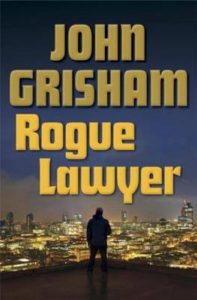
Reading Uncertainly? ‘Rogue Lawyer’ by John Grisham

Rogue_Lawyer_John_GrishamGrisham opens with a familiar sentence: “My name is Sebastian Rudd.”  See similarly Melville and Moby Dick’s: “Call me Ishmael” or the more recent: “Je suis Charlie.”

He gives us short, pithy sentences (no Proust here), replete with a sarcastic, cynical view of the underside of American society. A political screed, too: our legal system is all fouled up. The novel confirms the basic thesis of Dan Ariely’s ‘The (Honest) Truth About Dishonesty’ — that we are all basically and instinctively dishonest, at least to some degree, especially when we see dishonesty in others.

Few really likable characters and the entire scene is gloomy. Characters are also outlandish — a totally lesbian law firm; police, judges, prosecutors, jurors, defendants all easily bought; non-communication at dinner; a martial arts fighter gone berserk; a protagonist (hardly a “hero”), who himself slips into dishonesty.

And the scenes — a last-minute reprieve; a last-minute escape; militaristic police; a convoluted law case in which every string is pulled; and a protagonist who disappears into the ether at the very end, leaving many loose ends (including a son).

But, despite all these qualms, this is an utterly engrossing book for an evening reader!

Editor’s Note: Rogue Lawyer by John Grisham is published by Doubleday, New York 2015.
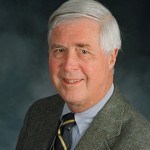
Felix Kloman_headshot_2005_284x331-150x150About the Author: Felix Kloman is a sailor, rower, husband, father, grandfather, retired management consultant and, above all, a curious reader and writer. He’s explored how we as human beings and organizations respond to ever-present uncertainty in two books, ‘Mumpsimus Revisited’ (2005) and ‘The Fantods of Risk’ (2008). A 20-year resident of Lyme, he now writes book reviews, mostly of non-fiction that explores our minds, our behavior, our politics and our history. But he does throw in a novel here and there. For more than 50 years, he’s put together the 17 syllables that comprise haiku, the traditional Japanese poetry, and now serves as the self-appointed “poet laureate” of Ashlawn Farms Coffee, where he may be seen on Friday mornings. His wife, Ann, is also a writer, but of mystery novels, all of which begin in a bubbling village in midcoast Maine, strangely reminiscent of the town she and her husband visit every summer.
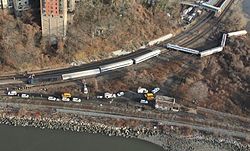

Talking Transportation: Infrastructure – Dangling by a Thread

The Spuyten Duyvil derailment in 2012 caused massive disruption.

The Spuyten Duyvil derailment in 2013 caused massive disruption on Metro North..

The recent fire under the Park Avenue viaduct in Harlem, which disrupted commutes of a quarter million Metro-North riders got me thinking:  our aging, crumbling and vulnerable transportation infrastructure is close to collapse, and the effects of such failure could be catastrophic.  Consider this track-record:

June 1983:  Inadequate inspections and repairs cause the collapse of the Mianus River Bridge on I-95 in Greenwich. Three people were killed and three others injured.  For almost five months, 80,000 daily vehicles had to detour through city streets.

March 2004:  An oil tanker crashes on I-95 in Bridgeport and the ensuing fire is hot enough to melt steel supports on the Howard Avenue overpass.  Traffic was disrupted for a week.

September 2013:  Con-Ed plans to replace a crucial electric feeder cable for Metro-North in the Bronx.  The railroad decides to forgo the $1 million cost of a temporary back-up cable and the main cable fails, disrupting train service for weeks, both on Metro-North and Amtrak.

June 2014:  Twice in one week the Walk Bridge in South Norwalk (built in 1896) won’t close, cutting all rail service between New York and Boston.  Cost of replacement will be more than $450 million.

May 2016:  Illegally stored chemicals and propane tanks at a gardening center under the Park Ave. viaduct catch fire.  The flames’ heat melts steel girders, cutting all train service out of Grand Central Terminal and stranding thousands.  Limited train service in the following days leads to subway-like crowding and lengthy delays.

Mind you, this list does not include fatal accidents and disruptions caused by human error, like the Metro-North crash at Spuyten Duyvil that killed four.

Our lives, our jobs and our economy rely on safe, dependable transportation.  But when the roads we drive and the rails we ride are museum pieces or go uninspected and unrepaired, we are dangling by a thread.

A single fire, whether caused by accident or act of terrorism, can bring down our infrastructure in an instant, cutting us off from work for days and costing our economy billions.

What can be done?  Safety inspections by engineers and fire departments looking to prevent disaster are obvious.  Better enforcement of speed limits and safety are as well.  But prevention of accidents cannot make up for decades of neglect in reinvestment in our roads, rails and bridges.

The American Society of Civil Engineers’ annual infrastructure report card gives the US a D+.  They estimate we will need to spend $3.6 trillion to get things back into good shape … less than the cost of the last 15 years of US fighting in the Middle East and Afghanistan.

As the old auto-repair ad used to say, “You can pay me now or you can pay me later”.  But sooner or later, we will have to pay.

Jim Cameron

About the author: Jim Cameron is founder of The Commuter Action Group, and a member of the Darien RTM. The opinions expressed in this column are only his own. You can reach him at CommuterActionGroup@gmail.com

For a full collection of “Talking Transportation” columns, visit www.talkingtransportation.blogspot.com

Learn How to Explore Your Family’s Ancestry: Educational Presentation This Afternoon by Local Genealogist

family_treeOld Lyme genealogist Monique Heller presents ‘Beyond “Ancestry.com”: Tools for Genealogical Research’ this afternoon at 2 p.m. at Lyme Public Hall. The program is free and open to the public.

Learn how you can expand your search for family history and genealogy to sources beyond familiar websites.

Heller became interested in genealogy after sifting through boxes and boxes of her paternal grandparent’s photographs and estate paperwork. She is a member of the Connecticut Professional Genealogists Council, Connecticut Society of Genealogists, and New England Historic Genealogical Society.

The Lyme Public Hall is located at 249 Hamburg Road (Rte. 156) in Lyme, Connecticut.

For more information visit www.lymepublichall.org, or call (860) 526-8886.

Lyme Church Hosts Spring Rummage Sale Today

Lyme First Congregational Church hosts its Annual Spring Rummage Sale today, Saturday, May 21, from 9 a.m. to 1 p.m. It is so large that three buildings are used to store all the treasures!

The church is located at the corner of Rte. 156 and Sterling City Road in Lyme across from the Subaru dealer.

For more information, call 860-434-0220.

Old Lyme Church Hosts Art Show This Weekend

paintbrush _on_canvasThe First Congregational Church of Old Lyme will host a “Member and Friends Art Exhibition” in the church’s Fellowship Hall on Ferry Rd. on Saturday and Sunday, May 21 and 22.  This exhibition is an opportunity for church members and friends to build community while celebrating the many gifts that are shared through works of art. 

Paintings, sculpture, paper art, photography, needlework, weaving, jewelry, woodwork and pottery are among the media that will be represented. 

The public is invited to the opening reception Saturday May 21, from 6 to 8 p.m. and to visit on Sunday, May 22, from 9 a.m. to 1 p.m. 

The church encourages you to share this special event with your neighbors.