
Country School Selected as Finalist in United Arab Emirates STEAM Initiative

finn_steam

Learning through STEAM (Science, Technology, Engineering, Arts and Math).

The Country School is one of three finalists selected to advise the United Arab Emirates (UAE) Ministry of Education as it seeks to implement a STEAM (Science, Technology, Engineering, Arts and Math) curriculum for all Kindergarten-3rd Grade students.

Following a global search, the UAE identified the independent Pre-School through 8th Grade school as one of its top three choices to assist with the planning and implementation of the nationwide STEAM initiative. If selected, The Country School will partner with SmartStart Education, an academic solutions company based in New Haven, to plan and oversee implementation.

“We couldn’t be more honored that our signature STEAM program may serve as a global model for 21st century learning,” said Head of School John Fixx. “For the past five years, Country School teachers have immersed themselves in this effort to inspire meaningful, deep, and lasting learning through integrated science, technology, engineering, arts, and math. We know it works on our campus, and we look forward to sharing what we have learned with others across the globe.”

Fixx said The Country School was also delighted to be partnering on this venture with SmartStart Education, a team of administrators, teachers, and academics committed to helping people reach their full potential. He commented, “Like The Country School, SmartStart is all about promoting excellence in teaching and learning.”

Founded in 1955, The Country School serves 200 students, ages 3-14, on its 23-acre campus in Madison. STEAM is one of several signature programs at The Country School; others include Elmore Leadership, Outdoor Education, and Public Speaking. Through STEAM, students are invited to tackle real-world problems that require them to ask challenging questions and work together to come to a solution.

By integrating all elements of the curriculum, STEAM engages all learners, and the hands-on, creative nature of a STEAM exploration means the learning will last. Perhaps most importantly, STEAM gives students the skills they need for success in the future—communication, collaboration, critical thinking, and creativity—and the inspiration to be tomorrow’s innovators.

Since adopting the STEAM model five years ago, The Country School has shared its learning in a variety of ways: during a summer teacher institute, through periodic teacher workshops, and through a series of STEAM events for area students and families. In addition, Country School teachers have been invited to facilitate STEAM workshops at outside conferences.

The Country School also hosts regular forums on the topics of parenting and education through its Teacher Institute-Partnering with Parents program. The next Teacher Institute-Partnering with Parents event will have a STEAM focus when, at 6:15 p.m. on Feb. 4, 2016, The Country School hosts a screening of Most Likely to Succeed, the acclaimed new film that invites us to reimagine education.  This has been brought forward from the previously announced 7 p.m. time to allow for a panel discussion and Q & A after the film.

Visit www.thecountryschool.org or contact communications@thecountryschool.org for more information.

For more about SmartStart Education, visit www.smartstarteducation.com.
An Open Letter to Old Lyme Land Use Commissions, Related Agencies Regarding Sanitary Wastewater

To the Editor:

An Open Letter to the Several Old Lyme Land Use Commissions and Related Agencies

Subject:  Sanitary Wastewater

It has come to the attention of this Commission that sanitary wastewater treatment in plants sanctioned by the State DEEP [Department of Energy and Environmental Protection] are discharging less than potable fresh water into our rivers flowing eventually to salty Long Island Sound.  The view of the DEEP seems to be based on their opinion that dilution is the solution to pollution.  The Connecticut River is closed to recreational shell fishing because they neglect to tell us, that the treatment plants they supervise are the source of much of this pollution.

With the name they give themselves, it seems to be odd that they, of all people, should control the very sewage treatment plants that pollute these waters.

“Seems to be” in the previous paragraph is there because it is difficult to document the culprit.  This Commission believes that the DEEP (formerly the DEP) [Department of Environmental Protection] is the fox in the henhouse.  They spend public money, but the results of their effort, is far from transparent.

Several years ago, one example came to our attention when an official of the DEP told Old Lyme representatives that a proposed sewage treatment plant in Old Saybrook would discharge treated water into the Connecticut River midway between the Amtrak and the Baldwin Bridges.  He told us not to worry because “The discharge pipe would be fitted with a diffuser.”  When asked what a “diffuser” was, he said, “So it doesn’t all come up in one place.”

For another example, the screens on the discharge at a plant near Middletown clogged up, and the plant operators opened the discharge directly to the River, and raw human waste arrived by tidal flow at Point O’Woods in Old Lyme a few days later.  In this instance, officials in Hartford had the unmitigated gall to say that this human waste originated in Point O’Woods where there are, and were then, no open sewers dumping raw sewage into nearby waters.  None.

One reason why this has been going on is that most people don’t relish talking about human waste.  Another reason is sewage discharges are often located in obscure places like the bottoms of rivers.  We believe the data is all there but “not available”.

There is no denying that in heavily industrialized or densely populated urban areas, conventional septic tank-leach fields are not adequate for the load, but even here the DEEP is abusing both the environment and home owners on lots which are too small for conventional septic tank-leach field treatment.  This is because of still another factor.  The DEEP in this state is in a turf war with the Connecticut State Health Department.  Here, the DEEP holds a monopoly on about all wastewater treatment, except for the old fashioned passive septic tank – leach field, presently the only wastewater treatment available to sanitarians who work under the guidance and rules of the State Health Department.  The result of this situation is that the local Health Directors and local Sanitarians cannot avail themselves of modern, proven systems now in use in Rhode Island and in Massachusetts to digest all septic waste on a small house lot.

So to win this turf war, the Connecticut DEEP resorts to another ploy.  They don’t test the soil.  They simply measure lot size and lump neighborhoods as those having houses too close together.  By a formula that they don’t make public, they declare a lumped discharge of 5000 gallons per day from several sources, and they claim jurisdiction, whereas the State Health Department is limited to control only the individual smaller discharges.  In Rhode Island and Massachusetts, such small individual discharges would get individual treatment with modern technology, thus avoiding the loss of fresh water to the ocean and the costs and hazards of sewage treatment plants and leaky sewers.

So who loses when we have unnecessary sewers?  First, the environment loses ground water.  We exhaust the aquifer and cause dug wells to dry up.  Taxpayers lose as we pay to move wastewater that could easily go back through leach fields into groundwater at no cost to the taxpayers.  Instead, they dump partially treated water into the ocean.

What must be done to correct this situation?  We must get the fox out of the henhouse.  The DEEP should not be permitted to monitor itself.  Data concerning sewage treatment plant discharges for both quantity and quality should be readily available for anyone to scrutinize.  The use of alternative technology for sewage treatment should be made readily available to any registered sanitarian or health director, without any interference by the DEEP.

When sanitary waste water is sewerized and discharged into a river we are throwing away a valuable resource that could, and should be, recycled efficiently to improve our environment and save money too.  Modern technology permits this, but the DEEP prohibits alternative technology for single home installations and hides the data which would indict them.

Sincerely,

The Old Lyme Shellfish Commission

Editor’s Note: This letter was submitted by Mervin Roberts, Old Lyme Shellfish Commission Chairman, on behalf of the commission.

Wilczewski, Hartmann Named Region 18 Superintendent’s Leadership Award Winners

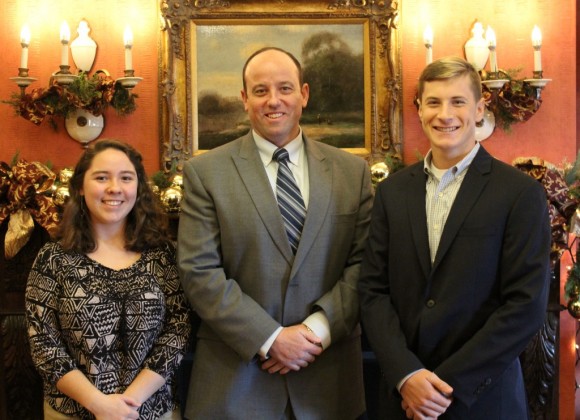
Region 18 Superintendent Ian Neviaser stands between Hattie and Brett Hartmann

Region 18 Superintendent Ian Neviaser stands between CAPPS Leadership Award winners Hattie Wilczewski and Brett Hartmann

Hattie Wilczewski and Brett Hartmann, students at Lyme-Old Lyme High School, have been awarded the Connecticut Association of Public School Superintendents’ (CAPSS) Superintendent/Student Recognition Award for leadership service to the school, academic prowess relative to ability, and service to others in the community at a ceremony held Dec. 7, at Saybrook Point Inn.

Ian Neviaser, Superintendent of Schools of Regional School District 18, made the presentation as part of a program designed by school administrators to recognize students who have served their schools and communities while maintaining good scholastic progress.

The Superintendent/Student Recognition Program awards a Certificate of Excellence at the discretion of the local superintendent of schools according to a distribution formula set for all state school districts. Awards are generally given during American Education Week in November in order to provide a meaningful focus for each school district and to enhance the quality of the certificate.

Hattie Wilczewski is a natural leader; she is a bright, curious, and well-rounded student who is committed to excellence on all levels.  She is self-directed and goal-oriented, combining rigorous academics with a great many extracurricular activities. A National Honor Society member and Saint Michael’s Book Award recipient, Wilczewski has consistently challenged herself with the strongest compilation of classes and has repeatedly been recognized with high honors and academic excellence awards.

She displays self- discipline and diligence when tackling difficult concepts in and out of the classroom.  Her approach to learning, as it is with everything, is to invest 110 percent. This energy and dedication have resulted in the achievement of an overall 99 weighted grade point average.

Wilczewski is a leader in her school and community holding positions like President of the Community Service Club and the Liaison Officer to the Kiwanis Club.  She is a contributing member of several other clubs, among them the Environment Club, the Spanish Club, and the Local History Club. 

As a responsible and articulate student, Hattie also helps produce the high school news on the WLYM morning news program. You may also catch her giving a spirited ukulele performance at the Nightingale Café in Old Lyme.

Wilczewski invests the same energy to her athletics, not only rising through the ranks with Kempo karate and mixed martial arts but as a dedicated member of the highly successful crew team. She has earned the Most Improved Player Award, the Scholastic Athlete Award, and been a contributor to both State and National Championship Regattas. Overall, Wilczewski displays integrity, character, and perseverance. 

Brett Hartmann is an accomplished student on every level and one of the strongest students who seeks the most rigorous challenges our school has to offer. A National Honor Society member, he has earned the prestigious Academic Letter and AP Scholar as well as numerous academic accolades.

Hartmann is one of the true student leaders in the school. He serves as a class officer and is an active member in many of our other student organizations. Without question, he is a “go-to” person who sees that things get done and done well. The entire Old Lyme community has benefitted from his drive and passion as he has served in many of the town’s events and programs. 

As a two-sport athlete, Hartmann shines on the baseball diamond in the spring and was elected co-captain of the boys’ soccer team this fall.

Above all, he is a true gentleman who cares about others and works hard to make the school and community a better place.

The Connecticut Association of Public School Superintendents is the statewide school superintendents’ professional organization and based in West Hartford. It provides professional development, personal support, statewide conferences, legislative information and educational services to its membership.

Old Lyme Conservation Commission Requests Publication of Rogers Lake Long-term Plan

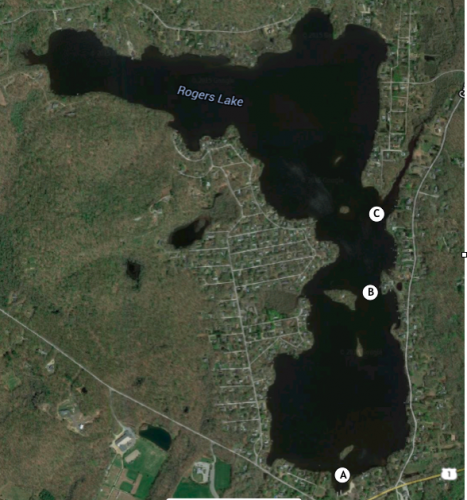
Targeted Areas of Acute Weed Infestation A. Hains Park/Rowing Docks B. Island Narrows C. Boat Launch Area

Targeted Areas of Acute Weed Infestation: A. Hains Park/Rowing Docks, B. Island Narrows, C. Boat Launch Area

The Old Lyme Conservation Commission regards Rogers Lake as one of the town’s most valuable resources  both for its recreational values and for its value as a source for two of the three main aquifers in Old Lyme. This is particularly important at a time when the Rogers Lake Authority plans to apply the herbicide Clipper to large areas of the lake for the very first time.

The Conservation Commission has asked us to publish the 2015 Rogers Lake Long-term Plan:

  1. Reduce the presence of waterfowl around the lake … 40 geese x 3 pounds per day x 365 days = 43,800 pounds of fertilizer per year
  2. Reduce the septic system pump-out frequency to three years and include Lyme lake residents in the program. Consider a local sewer system for Old Lyme’s lake residents.
  3. Encourage the Inland Wetlands Commissions of Lyme and Old Lyme to establish a monitoring system to assure that state law restricting phosphate in lawn fertilizer around water bodies is enforced.
  4. Greatly increase the use of benthic mats, including use of large mats to cover the worst patches of invasive weeds, especially in shallow water motorboat channels (Figure 1).
  5. Establish silt ponds at the mouths of the five largest streams feeding Rogers Lake and maintain them every year by removing the nutrient rich sediment and sell it.
  6. Plan a major fall drawdown (six feet) and plan to deepen boat channels and the worst areas of weed infestation. Establish dewatering areas. Sell the dredged sediment to pay for the operation. Bring in the Connecticut Water Company to provide a local water company to provide water for shallow well owners, permitting major draw-downs and ensuring year round potable water for lake residents.
  7. Establish special zoning regulations for the 500 acre drainage area on the southeast side of the lake to reduce nutrient runoff.  Re-engineer the dam at Ogle Pond so that it can control 3 – 5 inch rain events and prevent flooding of Boston Post Road and Grassy Hill Road.
  8. Assess the area to the north of the lake for nutrients entering the lake during major rain events.  Take steps to reduce this source of nutrients using dams and silt ponds.
  9. Create an email database for all residents of the Rogers Lake basin in order to keep the residents informed and to permit them to play an active role in lake management.
  10. Redevelop Hains Park, including the new boathouse project, community room, pavilion, swimming area and appropriate parking to help integrate and invest the townspeople in the life and affairs of the lake community.
  11. Continue an invasive plant education and monitoring program at the State boat launch to help prevent the introduction of additional invasive species into the lake.
  12. Seal lake bottom sediment in key areas with alum to prevent the release of phosphorus each time the lake becomes anoxic (usually in Autumn).  Even small increases in the levels of phosphorus result in greatly increased weed growth.
  13. Establish a long term plan to dredge the lake. Establish dewatering locations around the lake and establish a specific location nearby to deposit the spoils. Small quantities of material can be annually dredged from the lake without undergoing the extensive and expensive state and federal permitting process.  The Commission suggests that the town take advantage of this opportunity to target specific areas on the lake (See map of Rogers Lake above).

Old Lyme Fire Department Hosts Toy, Giving Drive This Morning

Old Lyme First Selectwoman Bonnie Reemsnyder was out collecting in last year's Toy Drive.

Old Lyme First Selectwoman Bonnie Reemsnyder (right) was out collecting donations with this appropriately dressed elf in a previous year’s Toy Drive.

The Old Lyme Fire Department (OLFD) is holding a Toy and Giving Drive on Sunday, Dec. 13, from 9 a.m. to 12 p.m.  Old Lyme firefighters will be collecting monetary donations, food and toys at both the Lyme St. Fire Department and on Halls Rd. near Big Y.

All donations will be distributed to Lyme/Old Lyme families in need.  This event is sponsored by OLFD with assistance from the Old Lyme Police Department and Lymes’ Youth Services Bureau (LYSB).

Lymes’ Youth Services Bureau wishes to thank their friends in the OLFD for supporting our youth and families during the holiday season and throughout the year.

To learn more about the Holiday Giving Program, visit the LYSB website at www.lysb.org