Peck Receives Positive Feedback from Boathouse Committee to New Design Concept for Hains Park

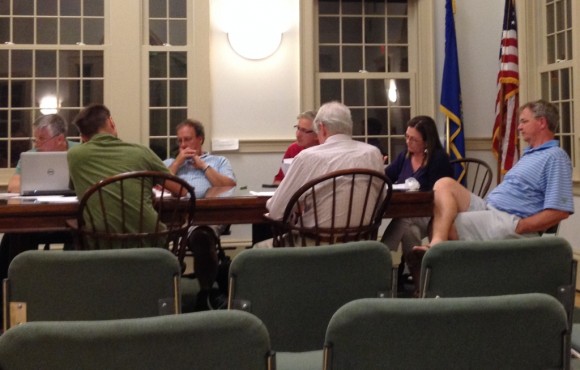
Members of the Hains Park Boathouse Improvement Committee consider the new design proposal.

Members of the Hains Park Boathouse Improvement Committee consider the new design proposal.

Architect Nina Cuccio Peck presented her updated designs to the Hains Park Boathouse Improvement Committee (HPBIC) at a meeting held last Thursday, June 11, in the Old Lyme Town Hall. Although the committee had voted (albeit not unanimously) at its last meeting to discard the idea of retaining the current boathouse as a storage facility and adding a second building to provide bathrooms, flex-space and more, Peck nevertheless included a design featuring those concepts.

Explaining that she had decided that the, “best way,” to move the, “dysfunctional [HPBIC] committee,” forward was, “to listen between the lines and try to please everyone,” she offered a new design ‘E’ in addition to the four (A to D) already previously considered.  Moreover, she stated that this new design allowed, “the town to enjoy some of its money,” and was her “personal favorite,” adding that the two buildings would, “relate to each other architecturally.”

Noting that she “really liked the elevation of the building,” Peck said that this proposal offered, “attractive buildings that would benefit everyone,” and could be, “useful in a multitude of ways.” She emphasized the need for the committee, “to come together,” pointing out that, in her opinion, the various options, “are all going to cost the same … [and] at least this way, the town gets something out of it.”

Apparently pleased with the presentation of the new “E” option, the small audience broke into applause at this point and, in some cases, gave vocal support to the concept.

Peck summarized the five options under consideration all of which eliminate the originally proposed second floor and the first four of which expand the current boathouse to include new bathrooms and a flex-space.  The fifth (new) design removes the bathrooms and flex-space into a new “mini” multi-purpose building with a cathedral ceiling and beams leaving the current boathouse to be upgraded using primarily the existing foundation.

Paul Fuchs, co-chairman of the HPBIC, wondered if Peck’s A-D proposals could be modified to leave the flex-space inside the boathouse and just move out the bathrooms.  Peck agreed that would represent another viable option.

Region 18 Facilities Director John Rhodes asked, “If there’s a separate building, how would we manage it … clean it?” clarifying his question as, “How are we going to manage this thing?” First Selectwoman Bonnie Reemsnyder responded, “The costs of cleaning the parks must be included in the cost of running the parks.”

Parks and Recreation Committee Chairman Robert Dunn commented enthusiastically on Peck’s new proposal, “[It} sounds wonderful,” noting, “This way maximizes storage,” in the boathouse. The HPBIC Secretary Brian Schuch was similarly supportive saying, “I really like what Nina did,” adding a particular note of appreciation for “the handsome building in the center,” but expressed again his concerns regarding the safety of the driveway in respect of both vehicles and pedestrians, the latter of whom frequently cross Rte. 1 to reach businesses located opposite the park.

Reemsnyder agreed saying she hoped the opportunity would be taken to try and resolve these traffic issues in Hains Park, which relate in part to the fact that there are currently two park entrances both of which are two-way, rather than one being an entrance and the other an exit. Reemsnyder hoped a traffic expert might be engaged to help develop a solution.

Ex-officio HPBIC member and Old Lyme Building Inspector John Flower agreed to explore building code issues with the state regarding the new two-building concept to determine if and how they might impact the proposal

Similarly, Rhodes offered to discuss the viability of the two-building proposal as opposed to the single building with the Region 18 rowing coaches.

The committee voted unanimously to request Peck to proceed with developing plans from which estimates can be prepared for Option A (an expanded boathouse including flex-space and locker rooms plus upgraded bathrooms in the existing bathhouse facility) and Option E (a boathouse used solely for boat storage plus construction of a smaller building to include bathrooms, locker rooms and flex-space.)

Peck is expected to present her revised plans at the next HPBIC meeting.

Op-Ed Revised: Old Lyme Conservation Commission’s Position on the Use of Pesticides in Rogers Lake

Editor’s Note: This is a revised version of the document we published yesterday. A member of the Old Lyme Conservation Commission (OLCC) sent us this version when it was realized that we had inadvertently been sent a version, which did not contain the final edits. We have not edited this document ourselves other than to remove the underlines. This version was approved by the OLCC for publication.

The fundamental purpose of the Old Lyme Conservation Commission is to protect the natural resources of the Town of Old Lyme. We believe that Rogers Lake is one of the most important natural resources we have and that it deserves the attention of not just those taxpayers who live around the lake, but the attention of the entire town. Clean water is a precious resource that should be preserved. Rogers Lake is the next best thing we have to a reservoir.  Because deep deposits of porous sand and gravel underly much of Rogers Lake,  lake water supplies many of the shallow wells not only in the Rogers Lake area but also in the Lieutenant and Blackhall River watersheds to the south. The Commission opposes the use of pesticides in Rogers Lake.

The situation:

The Selectmen of the Towns of Lyme and Old Lyme favor applying pesticides to kill vegetation in the lake, as does the majority of the Rogers Lake Authority and a number of lakeside homeowners.  It may appear to be an expedient way to answer the complaints of swimmers and boaters, who are bothered by the burgeoning growth of both 27 natural species of plants as well as by two new invasive plants.

 First time for pesticides

This will be the very first time that a pesticide is applied to the lake.  Forty-three acres have been identified for treatment or about 17 percent of the lake.

The history of this problem:

Over the last twenty years, the Old Lyme Conservation Commission has  supported the Rogers Lake Authority (RLA) for their efforts to improve conditions in and around the lake. These efforts have included an aggressive program to reduce the number of water fowl that yearly account for a rather startling amount of raw sewage.  RLA has used minor drawdowns, raking, harvesting, even scuba divers in attempts to control weeds.  One of their most successful methods has been the use of benthic mats which block the sunlight so that the invasive plants die out.  All of the techniques did what they were advertised to do, but the weeds returned, and now we have two new invasive weeds to deal with.

So, after various efforts over twenty years at a cost of about $400,000, Rogers Lake appears to be worse off than before.

Addressing the problem:

To face the new challenge, the Towns of Lyme and Old Lyme in 2014 formed a committee which included a professional ecologist.  They  then hired a Massachusetts environmental firm (NEE) that has recommended using the pesticide Clipper (flumioxazin) as the most effective approach to killing the weeds. The stated cost is $405. per acre.

The problems with this approach are:

  • This chemical quickly disperses, forming two metabolites (by-products) APF and THPA. These byproducts “tend to leach into the soil and may become persistent over time.”
  • While Clipper is not supposed to be very toxic to humans and “moderately to highly” toxic to fish, there have been no comprehensive tests for toxicity or bioaccumulation on the two metabolites (as of 2012).
  • Rogers Lake is considered a trophy trout lake. The DEEP has recently stocked the lake with unusually large trout attracting fishermen from near and far. In the past their boats probably brought the two invasive species of weeds to the lake in spite of a RLA boat inspection program.
  • In addition, the DEEP has a salmon egg project at the Lower Mill Pond. The newly hatched fish are then placed  in cold water streams like Roaring Brook in the hope of creating a future salmon run.
  • The DEEP has fish ladders at both the lower and upper mill ponds as well as at the Rogers Lake dam. Clipper is “moderately to highly “ toxic to fish. No one can predict with certainty that Clipper will not impact these valuable programs.
  • Killing 17 % of the lake’s vegetation can have a negative impact on the whole ecosystem essential to a healthy lake which normally requires 20 to 40% vegetation. NEE representatives admitted that treatment with pesticides would probably have to be repeated for the foreseeable future. It is not a solution.

In addition to the unresolved long term effects of using pesticides to kill weeds, there remain other major concerns, especially the source of the yearly contribution of nutrients that make lake vegetation thrive:

  • There are a large number of houses on very small building lots around Rogers Lake. Almost all of these started out as  summer cottages. Now it is estimated that more than half of these cottages are being used year round, putting additional loading on septic systems that were marginal even during two months of use.
  • To try to head off pollution from these marginal systems, the Old Lyme Health Department has maintained an active program that requires residents to adhere to a schedule of septic system pump-outs, inspections, and repairs. Thirty or so homes are due for pump-out this year. Three septic system failures at the lake were recently reported. Because the Town of Lyme does not have a comparable program, there is no way of knowing whether or not homes around the north end of the lake are adding pollutants.
  • Every year, five streams that flow into Rogers Lake flood the lake with fresh nutrients during major rain events, contributing lawn fertilizer and soil nutrients to assure a new healthy crop of weeds. Silt ponds need to be constructed and maintained to reduce nutrient levels in the lake from this source.
  • There has been a gradual increase in year round waterfowl around the lake. Currently, forty to fifty Canada geese average three pounds of feces per day! Do the math and be shocked at the amount of raw sewage that enters the lake from just this one source! Swans and ducks add to this input of nutrients.

Conclusion

The members of the Old Lyme Conservation Commission side with the ecologist on the Rogers Lake Committee who voted against applying Clipper to 43 acres of the lake. It is a stop-gap measure that solves none of the long term problems facing the lake. We seek a comprehensive long term management program for this extremely valuable natural resource.

Op-Ed: Old Lyme Conservation Commission Explains Its Disagreement With Lyme, Old Lyme Selectmen’s Rogers Lake Herbicide Proposal

The fundamental purpose of the Old Lyme Conservation Commission (OLCC) is to protect the natural resources of the Town of Old Lyme.  We believe that Rogers Lake is one of the most important natural resources we have and that it deserves the attention of not just those taxpayers who live around the lake, but the attention of the entire town.

The OLCC is the first to admit that Rogers Lake presents a host of problems, the greatest of which is invasives entering the lake.  We are convinced that there are other viable methods to be tried, before resorting to the ongoing application and expense of using questionable chemicals.

Clean water is a precious resource that should be preserved scrupulously.  Rogers Lake is the next best thing to have to a town reservoir.  Porous sand and gravel underlie much of Rogers Lake, so lake water supplies many of the shallow wells in the Rogers Lake area and in the Lieutenant River and Black Hall River watershed to the south.

The Position of the Old Lyme Conservation Commission:

The OLCC is against the current proposal to apply herbicides to Rogers Lake vegetation before other options are thoroughly explored.

The situation:

Currently, the use of herbicides to control growth in the lake is being promoted.  The Selectmen of the Towns of Lyme and Old Lyme favor this approach, as do many lakeside homeowners.  It may appear to be an expedient solution to the complaints of swimmers and boaters, who see the burgeoning growth of both natural as well as invasive plants in the water.

However, the OLCC believes that there are other viable solutions that should be explored.  Before any final decision is made, the townspeople of Old Lyme and Lyme should understand options, provide input and ask questions before being taxed for the ongoing and ever-rising expenses.

This will be the very first time that a pesticide is introduced to the lake.  Once the chemistry of the lake is changed, there will be no way to retreat from this plan.  It is long-term.

While some people dismiss the application of a pesticide as nothing more than what they apply regularly to their lawns,  much of these lawn chemicals quickly drain into the lake, and continue to support plant growth in the lake.

The history of this problem:

Over the last 20 years, the OLCC has applauded the Rogers Lake Authority (RLA) for their efforts to improve conditions in and around the lake. These efforts have included an aggressive program to reduce the number of water fowl that yearly account for a rather startling amount of raw sewage. The RLA has used minor drawdowns, raking, harvesting, even scuba divers in attempts to control weeds.  One of their most successful tactics has been the use of benthic mats which block the sunlight so that the invasive plants die out.  Each of the techniques did what they were advertised to do, but the weeds returned, and now we even have two new invasive weeds, as well as green algae.

So, after various efforts over 20 years at a cost of about $400,000, Rogers Lake is worse off than before, according to Rogers Lake Authority and George Knocklein of Northeast Aquatics.

Addressing the problem:

To face the new challenge, the Towns of Lyme and Old Lyme formed a committee in 2014.  A Massachusetts firm provided input, and, in the end, recommended using the pesticide Clipper (flumioxazin) as the most effective approach to killing the invasive weeds (what weeds?)

The problems with this approach are:

  • This chemical quickly disperses, forming two metabolites APF and THPA (by-products).
  • While Clipper is not supposed to be very toxic to humans and “moderately to highly” toxic to fish, there have been no tests for toxicity or bioaccumulation on the two metabolites as of 2012.
  • Rogers Lake is considered a trophy trout lake. The state Department of Energy and Environmental Protection (DEEP) annually restocks the lake, which attracts fishermen and tournaments.  In addition, the DEEP salmon project on Lower Mill Pond raises salmon eggs.  The DEEP has recently constructed a fish ladder on Town Woods Road to introduce alewife fish.  It’s possible that yearly applications of Clipper may impact these programs.
  • New England Environmental, Inc. (NEE) admitted that they didn’t have a lot of experience with Clipper, and they readily admit that treatments with the herbicide will have to be repeated regularly for the foreseeable future.
  • New England Environmental, Inc. has not established a dollar cost for the first treatment.

In addition to the unresolved effects of chemicals, these questions remain:

  • To help curb additional growth in Rogers Lake, the Old Lyme Health Department has maintained an active program that requires residents to adhere to septic system pumpout and inspection. However, why doesn’t the Town of Lyme have any requirements like this?
  • Has NEE thoroughly explored the feasibility of a major drawdown of the lake? This would provide an opportunity to remove muck along the shoreline.  This would expose the sand and gravel bottom, which is a poor host to vegetation.
  • Even more important, has NEE identified the sources of the nutrients entering the lake each year? These nutrients nurture unlimited growth of vegetation.  An example of this is Uncas Lake, just one mile north, which is regarded as one of the cleanest lakes in Connecticut.  There is almost no weed growth, and very few houses.  Compare this to Rogers Lake’s growing beds of vegetation.
  • Five streams flood Rogers Lake with fresh nutrients, which contribute to this rich crop of weeds. Has this committee explored establishing silt ponds at each stream’s entrance, which will reduce the inflow of phosphorous from lawn and garden fertilizers in the larger watershed.
  • Building lots around the lake were divided when owners used small homes only during summers. Many septic systems near the lake may be substandard, and those in Lyme are not inspected or pumped out on a regular basis.
  • Additionally, many lake residents live year-round, putting additional strain on septic systems.
  • There’s an increase in waterfowl, and now they remain through the winder. These 40-50 Canada geese average three pounds of feces per day….more than a human!  Do the math and be shocked at this amount of raw sewage!
  • And, primarily, why don’t the two towns consider hiring a manager, one who would have a long-term personal investment in establishing good water quality in Rogers Lake, as well as arrange improved and continuing education for residents to be conscious stewards of the water resource?

Rogers Lake is important for several reasons:

  • It is the major source of drinking water for the Town of Old Lyme;
  • Its watershed extends for miles beyond Old Lyme into East Lyme and into Long Island Sound.
  • Its presence and availability provides added value to nearby homes. This also provides added tax revenue to both towns.

Conclusion:

While the current problem of vegetative growth is serious, the OLCC sees this as an opportunity to educate residents and raise awareness of the long-lasting effects of human convenience on the environment, for both the present moment and for the future.

The OLCC is prepared and willing to assist in carrying out solutions that will address these issues, as well as treat the current need to control vegetative growth.

Lyme-Old Lyme HS 1st Boy’s Four in US National Final Today, Varsity Four Boats Sweep National School’s Championship

06/14 Update: The Lyme-Old Lyme High School Boy’s Varsity Four boat has qualified for the US Rowing National Youth Championship final today at Sarasota, Fla., at 1:01 p.m. The boat’s crew is Liam Corrigan (stroke), Josh Swanski, Jeremy “Remy” Newton and Harry Godfrey-Fogg with Thomas Crisp (cox). The race will be broadcast live on US Rowing’s YouTube channel.

GO LYME-OLD LYME!!

An extraordinary feat -- every Lyme-Old Lyme HS rower who went to the National regatta won a gold medal.

An extraordinary feat — every Lyme-Old Lyme HS rower who went to the National School’s Championship Regatta won a gold medal.

It was not only a perfect day on June 7 in terms of the weather when the crews of the Lyme-Old Lyme High School (LOLHS) men’s and women’s 1st and 2nd varsity four boats competed in the National School’s Championship Regatta — but the result were perfect too.  In an extraordinary result for undoubtedly the smallest school competing — and a public one at that – all four boats won gold medals.

The crew of the girl's second boat celebrate their win.

The crew of the girl’s second boat celebrate their win.

The regatta, held in Fairfax County, Va., on the Occoquan River, is for school rowing programs that qualify from various regional and state competitions to race for a national scholastic title.  Clubs representing 13 states qualified and competed this year.

The boy's second boat in action.

The boy’s second boat in action.

Four LOLHS crews (20 athletes) qualified to represent Connecticut based on their State Championship at the Connecticut Public Schools Regatta in May.

The girls 2nd boat pose with their coach Steve Baranoski and their medals. From left to right, Lauren Dolishny,  Alexis Kolar, Caleigh O'Neil, Hannah Wilczewski and Francesca Melluzzo (cox).

The girls 2nd boat pose with their coach Steve Baranoski and their medals. From left to right, Lauren Dolishny, Alexis Kolar, Caleigh O’Neil, Hannah Wilczewski and Francesca Melluzzo (cox).

The girls 2nd boat, stroked by Hannah Wilczewski, defeated winning crews from Massachusetts, New Hampshire and Kentucky in the finals to take the gold with a time of 5:39.1 for the 1500m course.

The boys second boat stand with their coach Louis Zubek and their medals. From left to right, Peter Fuchs, Adam Drummond, Julia Morrison (cox) Brandon Green and Jacob Olson.

The boys second boat stand with their coach Louis Zubek and their medals. From left to right, Peter Fuchs, Adam Drummond, Julia Morrison (cox) Brandon Green and Jacob Olson.

The girl’s win was followed with the boy’s 2nd boat, stroked by Peter Fuchs, who were victors over crews from Massachusetts, Virginia, New Hampshire, and Pennsylvania in the finals to take the gold with a time of 5:01.6.

The girl’s first boat (at rear in photo) taste victory at the winning line.

The crew of the girl's first boat proudly display their medals. From left to right, Steve Baranoski (coach), Christiana Congdon, Hannah Paynter, Claudia Mergy (cox), Allison Murphy and Maria Boyle.

The crew of the girl’s first boat proudly display their medals. From left to right, Steve Baranoski (coach), Christiana Congdon, Hannah Paynter, Claudia Mergy (cox), Allison Murphy and Maria Boyle.

After winning the qualifying heat in the morning, the girl’s 1st boat, stroked by Christiana Congdon, won with a time of 5:32.1 against crews from Pennsylvania, Maryland, Massachusetts, and Virginia.

The crew of the boy's first boat show their determination to reach the winning line first.

The crew of the boy’s first boat show their determination to reach the winning line first.

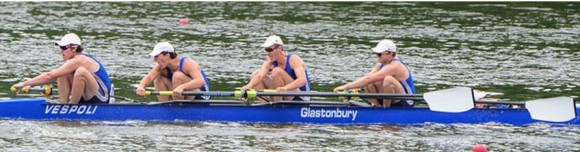
Similarly, after advancing through the qualifying heats in the morning, the boy’s 1st boat (borrowed from Glastonbury, as the Old Lyme boat was on a trailer to Florida), stroked by Liam Corrigan, completed the sweep by defeating crews from New Hampshire, New Jersey, Washington (D.C) and Massachusetts, with a winning time of 4:55.4.

The boy's first boat gather for team photo with coach Louis Zubek and their gold medals. From left to right standing are Josh Swanski, Liam Corrigan, Jeremy "Remy" Newton and Harry Godfrey-Fogg with Thomas Crisp (cox) in front row.

The boy’s first boat gather for team photo with coach Louis Zubek and their gold medals. From left to right standing are Josh Swanski, Liam Corrigan, Jeremy “Remy” Newton and Harry Godfrey-Fogg with Thomas Crisp (cox) in front row.

The boys 1st boat has now arrived in Florida to represent LOLHS this weekend at the US Rowing National Youth Championships — the premier sprint race for Under 19s in the country.

Go Wildcats!

Lyme Farmers Market is Open for Summer Season, Saturdays

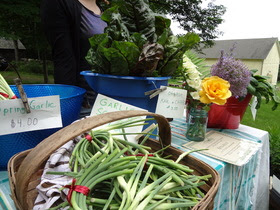
Fresh vegetables are always one of the big draws of the market.

Fresh vegetables are always one of the big draws of the market.

The perennially popular Lyme Farmers Market at Ashlawn Farm in Lyme opens again Saturday from around 9 a.m. until 12:30 p.m.

But the sad news this year is that the irrepressible, larger-than-life impresario of the market, Chip Dahlke, has announced this will be his last season with the market, “Unless…” and this is Chip’s endearing dry humor rising to the surface, “… a deranged individual or some goody two-shoes organization wants to take on the burden.”

In his ever upbeat, positive spirit, however, Chip urges, “Let’s make this summer one to remember.  The field should be full of vendors and the entertainment the best of what we’ve had for the last 12 years,” adding with his usual sharp wit, “There’s still not going to be eggplant carving contests, erotic vegetable displays, or god forbid poodle parades.”

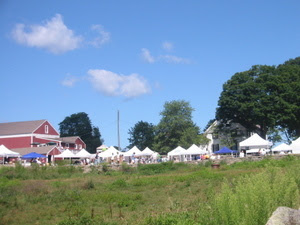
tentsThe big draw of farmers’ markets is, of course, the fresh, local produce.  What makes the one in Lyme  so special is that it’s held on a real farm.  And since this is the Lyme countryside, it’s as a pretty as a picture.  In fact, Ashlawn Farm is a magnet for local artists who are attracted by its beauty—the old white homestead, the red barns, and the stone walls crisscrossing the pastures. An original member of the Connecticut Farmers Market Trail, Ashlawn Farm is located at 78 Bill Hill Rd. in Lyme.
The farm is celebrating its 126th anniversary this year.  Ray Harding, a dairy farmer, bought Ashlawn in 1909.  Today his grandson Chip lives there with his wife Carol and their three children.  By profession, Chip is a portfolio manager and Carol runs her popular coffee-roasting business in one of the old barns on the property.

As always, Dahlke has lined up a stellar selection of vendors, which includes:

TALK Seafood
Four Root FarmflowersThe vendors change week by week but you can be certain that every Saturday morning from June to October, tents will go up in front of barns and local purveyors will sell vegetables, fruit, breads, cheese, meat, soaps, chicken, fish, fiber, specialty food, crafts, flowers, herbs, eggs, seafood and more.  Music will be played — Dogbite are performing on Opening Day –and Chip will surely spring a few Saturday surprises!Before the Market opens, Ashlawn Farm Yoga will be held at 8 a.m. each Saturday on the grass beyond the parking field for all levels. The class is taught by Lisa Tompkins Nasser. Drop in for only $15, which includes a free Ashlawn Farm cup of Coffee.

Sign up for Chip’s entertaining weekly e-newsletter here

Like Lyme Farmers Market on Facebook hereAnd, most of all, follow Chip’s advice to make it a summer to remember at the Market — see you there!

Editor’s Note:
 Extracts of this article are taken from one written by Linda Ahnert that was originally published on LymeLine.com  in June 2009.