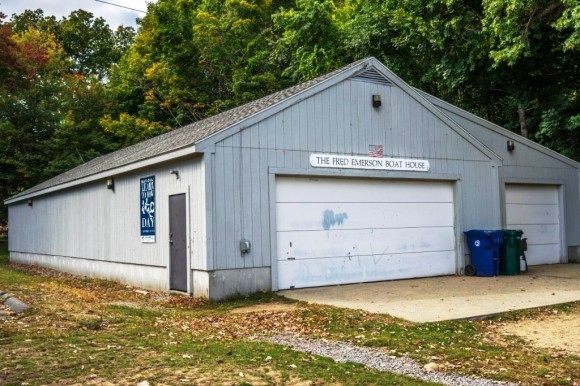
The boathouse at Hains Park on Rogers Lake.
Although Old Lyme residents approved $405,000 to be taken from the Town’s surplus account in early October 2014 and added to a grant of $478,000 from the state’s Small Town’s Economic Assistance Program (STEAP) to build a new, two-story boathouse at Hains Park, no shovel has yet gone into the ground. At the time of the vote, it was intended that construction would start prior to the winter of that year.
The Hains Park Boathouse Improvement Committee (HPBIC), which is responsible for developing and implementing the plans to build the boathouse at the park on Rogers Lake in Old Lyme, met Thursday evening in Old Lyme Town Hall to review the status of the project and continue to try and move it forward.
The original design for a two-story building, which was approved by the voters, was shelved in late October when it was determined that the design needed to comply with Educational Occupancy Standards, which could not be done in a cost effective manner. The bidding process already underway was therefore cancelled.
Around the same time, the Old Lyme Parks and Recreation (P & R) Committee requested some representation on the HPBIC since the P & R Committee is charged with management of all parks in the town, which include Hains Park. The board of selectmen agreed to add P & R Chairman Robert Dunn and the town’s P & R Director, Don Bugbee, who is an ex-officio (non-voting) member of the P & R Committee. John Flower, the town’s building inspector and a P & R member, was also added to the HPBIC by the board of selectmen, but as an ex-officio member, as was John Rhodes, the Region 18 Facilities Director.
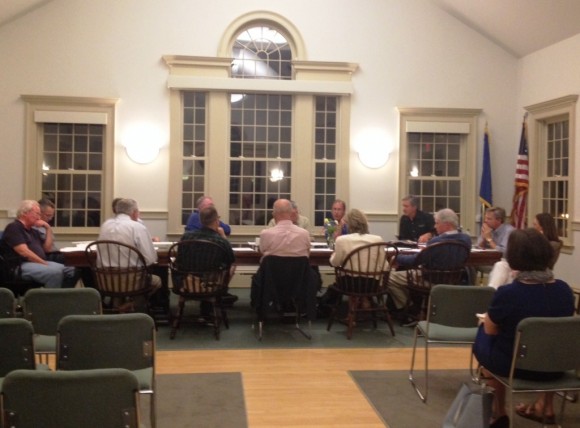
The Hains Park Boathouse Improvement Committee at work.
Since that time, a lively discussion has ensued as the three stakeholders in the proposed boathouse and surrounding park — the Parks and Recreation Department, Region 18 Schools and the Old Lyme Rowing Association (OLRA) — have worked towards creating a plan that is acceptable to them all. This led to some highly charged discussions Thursday evening regarding the needs of the OLRA members (who oversee the high school program as well as running the adult and youth Blood Street Skulls club rowing programs), the Region 18 student rowers (Valley Regional and Old Saybrook High Schools also use the facility) and the community members of Old Lyme (who, excluding the funds from the STEAP grant, are funding the project through their taxes.)
Citing concerns he had heard expressed in the community regarding the lack of balance on the HPBIC (in terms of the prevalence of members with rowing affiliations) and hence its objectivity, Dunn proposed that all HPBIC members should declare in writing in the interests of “transparency with the public” any association, past or present, with the OLRA. During an extended, fairly contentious discussion, HPBIC Co-Chairman Paul Gianquinto declared that he did not accept, “The notion that someone who is a member of the Old Lyme Rowing Association is going to benefit from the project,” adding, “Anyone in town who wants to participate [in rowing] can benefit.” By way of example, he stated that, in contrast, he receives, “no benefit” from the Town Woods soccer fields.
First Selectwoman Bonnie Reemsnyder also stated the proposal was, “overkill,” arguing that each member had already noted their affiliations when they submitted an application to be on the HPBIC, though Dunn countered, “Not everyone associated with the Old Lyme Rowing Association declared their interest.” When a vote was finally taken, the motion ultimately passed. Four members proceeded to declare an association with the OLRA while four said they had none. Two voting members were absent from the meeting.
The next agenda item of the budget update aroused similar passions. Dunn shared two concerns he had regarding the budget with committee members. Firstly, he said it had come to his attention that the STEAP grant would not cover consultant expenses, which did not relate specifically to this project, for example, the architect’s fees for the first (now rejected) design. Reemsnyder noted that, at this point, “You can’t assess what’s going to be eligible,” because parts of the first design may ultimately be included in the final, accepted design.
Dunn’s second concern was that he had been told by the state that, “Any requirements for District 18 [regarding the boathouse] would not be refunded by STEAP,” meaning the town would not qualify for reimbursement from the STEAP grant for expenses specifically associated with the school program. Co-chairman Paul Fuchs responded, “Some of those [school] requirements may be requirements of the Old Lyme Rowing Association and the [HPBIC] committee.”
Another item that drew conflicting opinions was whether the building needed to be open to the public all the time, which was Dunn’s interpretation of information from the state, whereas Reemsnyder said it must be, “Open to all people,” which could mean rowers, and therefore, “It does not have to be an open building to the public.”
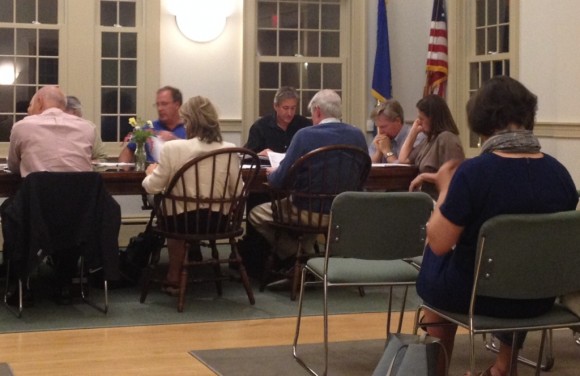
HPBIC members discuss a point Thursday evening.
Moving to the final agenda item, Giaquinto introduced it saying, “We’ve been struggling for weeks,” to meet the varying requirements of the stakeholders. Dunn then reminded the committee that its stated mission is, “To oversee the expansion of the Boathouse and Hains Park improvements as supported by the recent STEAP grant award.”
Architect Nina Cuccio Peck of Old Lyme expressed her frustration with the situation, saying, “I would like this committee to get its act together,” stressing that she needed to know details of what she was being asked to design before she could present another design. Reemsnyder commented that “District 18 had listed all their requirements — knowing that they could not all be met,” causing Dunn to comment, “District 18 is one stakeholder — there are others.”
Peck followed up with the question, “What does the Town feel that they’re not getting?” Flower responded that at the informational meeting preceding last October’s vote, “The public was told they would have a public meeting room and bathrooms.” Fuchs stressed, “We have to pay attention to educational requirements … student bathrooms have to be separate from public bathrooms,” causing Dunn to note, “District 18 is not providing any funds for this [project] … only Old Lyme taxpayers.”
The issue of where the bathrooms would be located developed into a major discussion point along with whether a pavilion should be added to the park. This interfaced with review of whether the proposed “flex-space” (multi-use space not designated for boat storage) in the boathouse should be open to the public, which committee member Brian Schuch supported, while Fuchs said it should be exclusively for the rowers. This decision, in turn, affects whether one or two buildings are constructed — if the flex space is taken out of the boathouse and opened to the public in a second building, the boathouse would become basically a storage facility.
The committee eventually passed a motion to keep the flex space and bathrooms in the boathouse and then settled on two designs for the architect to progress. Dunn expressed concern that the motion had, “Eliminated the most cost-effective option,” (a storage facility for the boats and a second building with flex-space and bathrooms open to both public and rowers) but committee member Gregory Hack stepped up with a compromise. He proposed that the committee add to the existing motion a request that the architect should also design a pavilion and significant upgrades to the existing bathrooms.
This motion passed unanimously and the small audience immediately broke into loud applause.
During a short period of public comment, Nancy Hutchinson requested clarification of the terms “public” and “general public” in the context of whether, with respect to the STEAP grant, rowers are considered the “public.” Stephen Dix proposed the HPBIC reconsider both the new technology of rolling racks for boat storage, which could increase the capacity of the storage without a corresponding increase in space, and also the location of the proposed pavilion/bathroom complex. Then Candace Fuchs noted it is ‘National Learn to Row Day’ on June 6, indicating that rowing as a sport, “is not exclusive at all,” and invited all present to “come down and learn to row.” Finally, it was agreed that the next meeting would be held Thursday, May 21, at 7:30 p.m.
After the meeting, Hack told LymeLine with a chuckle, “It’s great to see so much passion about rowing,” adding on a more serious and optimistic note, “I’m sure we’re going to find a way to work together for the benefit of the community.”