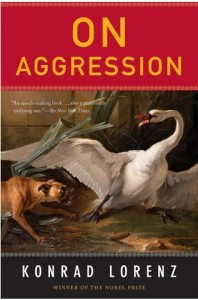
Reading Uncertainly? ‘On Aggression’ by Konrad Lorenz

On_Aggression_book_coverAre we naturally “aggressive?”  What a way to greet the spring!  Today’s headlines seem to indicate that we simply cannot avoid creating friction among human beings.  This sent me backwards in time to re-read Konrad Lorenz’s monumental On Aggression, first published in German in 1963 and in English in 1966.

Lorenz defines aggression as, “the fighting instinct in beast and man, directed against members of the same species.”  The forms, objectives and examples of aggression include:

  • behavior
  • preservation of the species
  • physiology of instinctual motivation
  • the process of ritualization
  • how instinctive impulses function
  • mechanisms evolution has “invented” to channel aggression to harmless paths
  • social organization (“anonymous crowds”)
  • bonds of “love and friendship”
  • the “virtue of humility”
  • counter-measures against the malfunctions of aggression (including examples among fish, birds and four-legged mammals).

He concludes: “aggression . . . is really an essential part of the life-preserving organization of instincts.”  And our own-species aggression is “essential for its preservation.”

The “principle of the bond” seems to require some degree of aggressive behavior: we apparently need something in common to be defended against outsiders, such as territory, brood, opinion and, most dangerously, ideology. Aggression thus becomes “necessary to enhance the bond.”

And “ the danger to modern man arises not so much from his power of mastering natural phenomena as from his powerlessness to control sensibly what is happening today in his own society.”

Is there a ray of hope?  Lorenz thinks it is possible.

First, our, “insatiable curiosity is the root of exploration and experimentation …  a linking of cause and effect … the conscious foreseeing of the consequences of one’s action.”  This “unrelenting demand for causal understanding” may well lead to a “scientific enlightenment [that] tends to engender doubt in the value of transitory beliefs long before it furnishes the causal insight necessary to decide whether some accepted custom is an obsolete superstition or still an indispensible part of a system of sacred norms.”  Our inquiring minds may often be too far ahead of how we react!

And why are our young so often at the center of disruptive behavior?

Lorenz suggests an answer.  “During and shortly after puberty, human beings have an indubitable tendency to loosen their allegiance to all traditional rites and social norms of their culture, allowing conceptual thought to cast doubt on their value and to look around for new and perhaps more worthy ideals … At the postpuberal age some human beings seem to be driven by an overpowering urge to espouse a cause and, failing to find a worthy one, may become fixated on astonishingly inferior substitutes.”  Shades of the Middle East today, one might venture …

But he is, nevertheless, optimistic  — Lorenz suggests some preventive steps to counter our natural aggressive instincts.  First, he reiterates the famous Chilton/Socrates admonition to “Know thyself,” acknowledging some obstacles:

  1. unawareness of our evolutionary origin
  2. reluctance to admit that our “behavior obeys the laws of natural causation” (there is no “free will!”)
  3. a heritage of “idealistic philosophy”

His conclusion: “Truth, in science, can be defined as the working hypothesis best fitted to open the way to the next better one.”  Nothing is “absolute!”  And, finally, allow humor to play a major role: do not take ourselves too seriously.

There is nothing quite like stepping back in time to re-read some earlier thoughts …

HFK_headshot_2005_284x331About the author: Felix Kloman is a sailor, rower, husband, father, grandfather, retired management consultant and, above all, a curious reader and writer. He’s explored how we as human beings and organizations respond to ever-present uncertainty in two books, ‘Mumpsimus Revisited’ (2005) and ‘The Fantods of Risk’ (2008). A 20-year resident of Lyme, he now writes book reviews, mostly of non-fiction that explores our minds, our behavior, our politics and our history. But he does throw in a novel here and there. For more than 50 years, he’s put together the 17 syllables that comprise haiku, the traditional Japanese poetry, and now serves as the self-appointed “poet laureate” of Ashlawn Farms Coffee, where he may be seen on Friday mornings. His wife, Ann, is also a writer, but of mystery novels, all of which begin in a bubbling village in midcoast Maine, strangely reminiscent of the town she and her husband visit every summer.

Nibbles: Now is the Time to Bake a Spice Cake

On Sunday, March 1, I decided that winter was done. That afternoon, though, I drove to the Ward’s home in Madison to celebrate Zimmy’s 90th birthday. There would be around 40 of us and the food promised to be yummy. I had bought my Coca-Cola Cake and a slow-cooker full of Cincinnati four-way chili. Both were good but Eugenia’s baked rigatoni along with chopped liver, potatoes Lyonnaise and Norma’s  gorgeous jelly roll, 18-inches long ringed with beautiful berries were even better.

It was snowing as I drove my car out of the garage and the light precip turned into serious snow (I’d worn real shoes instead of the knee-high mukluks’ I lived in for more than a month.) By the time I got to Madison, there was an inch on the ground. The party was fabulous, but by late afternoon, people began to head home.

When I got into my car, it was a serious snowstorm, and I had “miles to go before I sleep,” as Robert Frost wrote. The usual 45 minutes tuned into two and a half hour, never seeing a white or yellow line. All I could do was follow the cars in front of me. Fortunately, I made it home safe and sound.

Obviously, my decision that winter was over made God laugh. Once home I made a cup of tea and warmed my toes with a blanket. After watching “Downtown Abbey,” my new decision would be to make a spice cake the next day.

Old-Fashioned Spice Cake

Adapted from Linnea Rufo, Bee & Thistle Inn, Old Lyme, CT

Yield: serves 10 to 12 people

old_fashioned__spice_cake1 cup sugar
One-half cup (1 stick) butter
One-half cup currants or raisins or dried cherries (optional)
One-half cup candied ginger, chopped
2 eggs
2 tablespoons molasses
2 cups flour
1 teaspoon baking soda
1 teaspoon cinnamon
One-quarter teaspoon cloves
One-half teaspoon ginger
One-teaspoon salt
1 cup milk

  1. Preheat oven to 350º F. Grease a 10-inch tube pan.
  2. Cream butter and sugar until light and fluffy. Beat in eggs, one at a time, blending well after each addition.
  3. Whisk together flour, baking soda, cinnamon, cloves, ginger and salt. Stir dry ingredients into egg mixture alternately with milk, beginning and ending with dry ingredients.
  4. Pour batter into prepared tube pan. Set on the middle rack of the oven and bake for 1 hour and 5 minutes, or until cake pulls away from sides of pan and a tester inserted in the center comes out clean.
  5. Cool cake in the pan, set on a rack, for 10 minutes. Remove cake from pan and spread on icing at once, while cake is still warm.

Espresso Icing

1 and one-half cups of confectioners’ sugar
1 tablespoon of espresso
1 tablespoon milk

Whisk icing ingredients together.

Popular Antiques Appraisal Event Takes Place Today, Benefits OL Historical Society

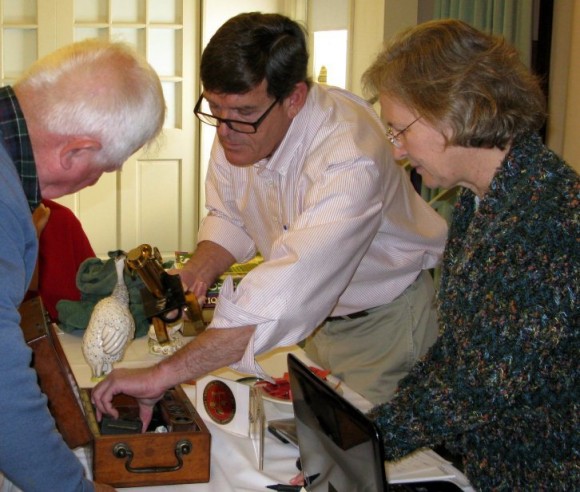
Norm & Linda Legassie, generalists

Old Lyme residents Norman and Linda Legassie (center and left in photo respectively) will be in hand next Sunday to give appraisals at the Old Lyme Historical Society’s ‘Vintage!’ event.

Vintage! the Old Lyme Historical Society’s  antiques appraisal event will take place today from 1 to 4 p.m. at the Old Lyme Town Hall, 52 Lyme Street, Old Lyme. Each verbal appraisal costs $5 per item with a three item limit per person.

Appraisers will be available with expertise covering a broad range of antiques specialties including books, toys, textiles, farm tools, precious metal jewelry, and artwork. If you’re a fan of the “Antiques Roadshow” or if you’ve been wondering what some of your vintage items are worth, this event is for you!

This year’s appraisers are Norman and Linda Lagassie of Stepping Stones Antiques, Steven Lutar of the Guilford Coin Exchange, Curt Wendler, an expert in books, autographs and photos, Billy Messina of the Clinton Antiques Center, Joy Hanes of Hanes and Ruskin Antiques, and Nancy Hoffman, a long-time antiques dealer specializing in textiles and early country items.

Proceeds from this event will benefit the Old Lyme Historical Society’s scholarship fund. Each year a scholarship is awarded to an Old Lyme senior who plans to major in history in college. Students living in Old Lyme, including those who attend schools elsewhere, are eligible to apply.

To make a donation, send a check to OLHS, PO Box 352, Old Lyme, CT.

For information on how to apply for the scholarship, email info@oldlymehistorical.org.

For further information about the “Vintage!” event, contact the Old Lyme Historical Society at 860-434-0684.

Lyme-Old Lyme’s ‘Techno Ticks’ Score High in Recycle Rush® to Win FIRST at Waterbury

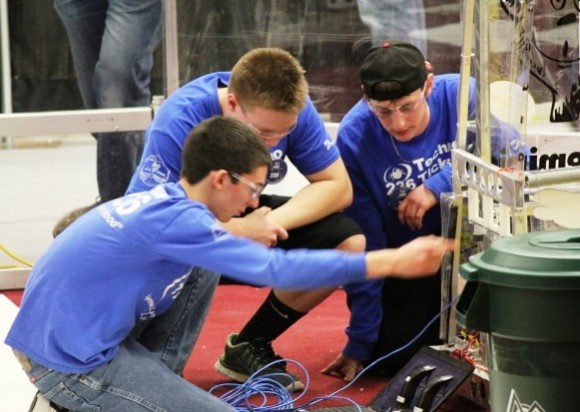
Drive Team Captain Jared Di Carlo makes some final adjustments to the robot during the contest with team members Hayden Hendrix and Nate Bersing.  All photos by Sarah Crisp.

Drive Team Captain Jared Di Carlo makes some final adjustments to the robot during the contest with team members Hayden Hendrix and Nate Bersing. All photos by Sarah Crisp.

The Techno Ticks, Lyme-Old Lyme High School’s FIRST Robotics Team, brought home the winner’s trophy in a hard-fought weekend of competition over Feb. 28-March 1.

Team 236 competed against 34 teams from across Connecticut and as far away as New Jersey, in a two-day competition at Wilby High School in Waterbury, Conn.  This was the first competition of the season and the Tick’s unrivalled “autonomous” play and “Big 6” ability saw them rack up the highest points of any game to leave them as clear leaders after the first day’s 62 qualifying rounds.

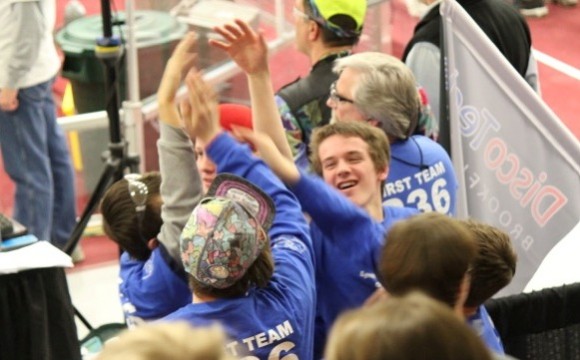
Team 236 members Aiden, Norm and Ethan celebrate as the Techno Ticks win their final game to take home the Waterbury District Championship

Team 236 members Aiden, Norm and Ethan celebrate as the Techno Ticks win their final game to take home the Waterbury District Championship

With the storm closing in, organizers ran the first day late so there were just six qualifying matches on Sunday and the Ticks held on to their substantial lead, going into the quarter-finals as Alliance Leaders.  They chose two teams to play with in their “Red Alliance”; Team 230 the Gaelhawks from Shelton, CT and Team 3464 Sim-City from Simsbury, CT.

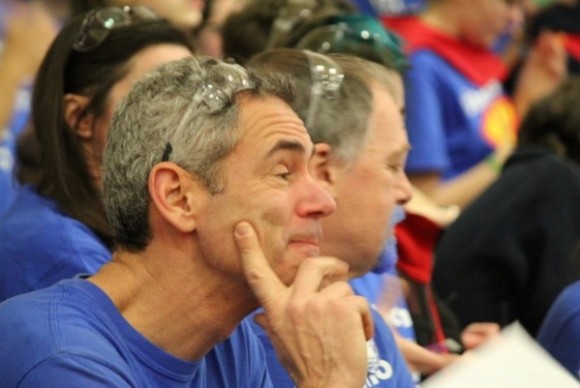
An ever-present Bill Derry - Tech Ed teacher, long term mentor and co-founder of the Techno Ticks - watches as the team produce another “big six” stack.

An ever-present Bill Derry – Tech Ed teacher, long term mentor and co-founder of the Techno Ticks – watches as the team produce another “big six” stack.

After exciting quarter and semi-finals, the Tick’s Red Alliance was pitted against Team 237, Black Magic, Team 558 Robo Squad and Team 4557 – the FullMetal Falcons from Middletown, Conn.  The Red Alliance came home champions in a hard-fought best-of-three match, which was a close call to the last second.

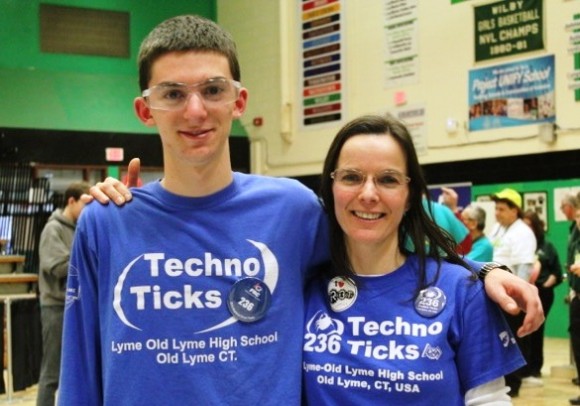
Senior Jared Di Carlo who has been a four year starter on the Techno Ticks as well as a three year starter on FIRST Lego League Middle School Team the Luna Ticks, with Mom and team Mentor Ellen, an electrical engineer at Electric Boat.

Senior Jared Di Carlo who has been a four year starter on the Techno Ticks as well as a three year starter on FIRST Lego League Middle School Team the Luna Ticks, with Mom and team Mentor Ellen, an electrical engineer at Electric Boat.

As well as taking home the winner’s trophy, the team was also honored to be awarded the Motorola Quality Award.  The Techno Ticks have won this award for two years running for the robustness of their design and the quality of their engineering.

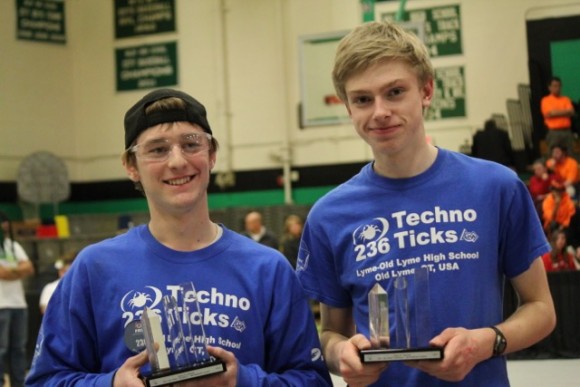
Drive Team member Nate Bersing and Scouting Captain Tom Crisp collect the Motorola Quality Award on behalf of the team.

Drive Team member Nate Bersing and Scouting Captain Tom Crisp collect the Motorola Quality Award on behalf of the team.

The FIRST Robotics Competition is an international program; For Inspiration and Recognition in Science and Technology.  It brings together high school students from across the world with mentors who have wide experience in all forms of engineering, manufacturing, business and education.

Each January, FIRST launches a new game, giving teams just six weeks to decide on a game-play strategy and then design, build and test a life-size robot to compete against other teams at District, Regional and International levels.  It is known across the world as “The Sport of the Mind”.

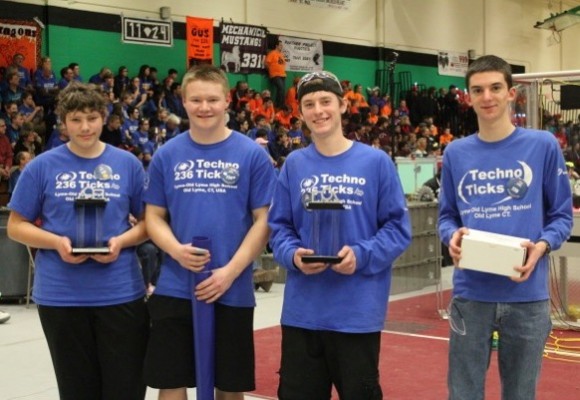
Members of the Drive Team collect their well earned awards: Sam Winter, Hayden Hendrix, Nate Bersing and Jared Di Carlo.

Members of the Drive Team collect their well earned awards: Sam Winter, Hayden Hendrix, Nate Bersing and Jared Di Carlo.

This year’s game is called Recycle Rush® and demands precision engineering as robots collect and stack totes and recycling cans as well as “litter” from the field (in the form of green pool noodles).  Each game lasts two minutes and 30 seconds and the first 15 seconds are played in “autonomous” mode where the robots are pre-programmed to carry out a series of moves to score points.  In the following two minutes and 15 seconds, the drive team use a computer to control the robot to score the maximum number of points they can for their alliance.  If you want to see the Techno Ticks robot in action, click here.

Any individuals or organizations interested in helping Team 236 should contact Jon Goss (jgoss@region18.org).  Support comes in many forms; sponsorship, mentoring, organizing and coming to games to support the team.

The Techno Ticks are grateful for their main sponsors Dominion Millstone Power Station as well as support they have received from the Administration and staff at Lyme-Old Lyme High School, the Region 18 Board of Education, Lyme-Old Lyme Education Foundation, Brooks Engineering and Aerocision Engineering

Old Saybrook Student Takes First Place in Southern CT Science & Engineering Fair

Andrew Pan (right) stands on the podium with the other winners at the Southern Connecticut Science and Engineering Fair.  Photo credit: www.scisef.org

Andrew Pan (right) stands on the podium with the other winners at the Southern Connecticut Science and Engineering Fair. Photo credit: www.scisef.org

In a remarkable achievement, Old Saybrook High School senior Andrew Pan won first place in the Health and Medicine category at the Southern Connecticut Science and Engineering Fair on Feb. 7 for his research project entitled, “Elevated Levels of Interleukin-8 in Non-Small Cell Lung Cancers induce Cell Survival During Chemotherapy.”

Pan’s first research experience was the summer before his junior year when he went to intern with the drug development company his father works for in Shanghai called Astrazeneca. “It was my first exposure to research,” said Pan. “It was a lot of fun and it really intrigued me.”

After his summer with Astrazeneca, he knew he wanted to continue on with his scientific research the summer before his senior year. “One of my friends who is a year above me had done research at Yale over the summer the year before and recommended it, so I contacted Professor Rong Fan because his work looked really interesting to me.” Professor Fan’s work, which has been garnering a lot of attention, involves helping to detect variations between various cells to help aid the diagnosis of diseases like cancer. Pan added, “Cancer is really fascinating scientifically because it’s a very complex, intricate micro environment working together against yourself – I’m curious about these types of things.”

“Researching under Professor Fan’s direction was great – he’s a very relaxed and quiet person. I worked with Jonathan Chen, a grad student who was studying non small cell lung cancer for his thesis project and under his direction, I was investigating a variant of lung cancer which affects smokers and nonsmokers equally,” said Pan. Specifically, he focused on a type of protein called interleukin-8 which affects how cancer cells move and grow.

Pan continued, “At first I was assigned a small sub project. It took me awhile to figure out what I wanted to study, but while Jon was gone for a couple weeks working with a lab from another school, I started to focus on a sub-population of cells emitting comparatively higher rates of interleukin-8 by comparing 2,300 individual cell samples – it was really tedious, but fun.”

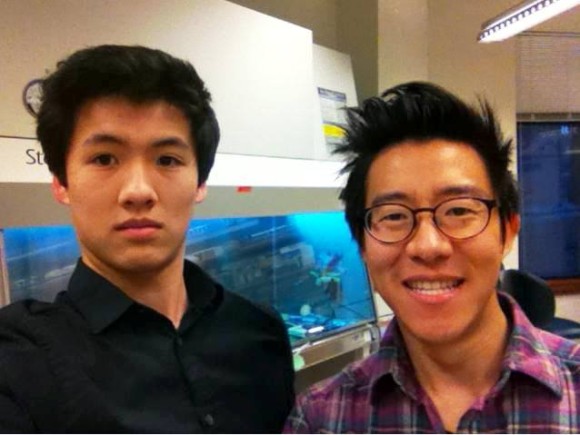
Andrew Pan (left) stands with his mentor on his winning project, Yale graduate student, Jonathan Chen.

Andrew Pan (left) stands with his mentor on his winning project, Yale graduate student, Jonathan Chen.

He continued, “What I found was that the high producers of interleukin-8 were potentially serving as tumor drivers, something several other studies have confirmed experimentally.” He went on to explain that blocking interleukin-8 in particular cells had the potential to help prevent cancer and improve upon the current delivery method so that treatments would work faster. “I’m hoping my research will help to identify targets for treatment,” said Andrew.

It was this research that he presented to the judges of the Southern Connecticut Science and Engineering Fair. “I had a poster, and I talked for 15-30 minutes about my research and answered some of the questions the judges had,” said Pan. “The whole process was a lot of fun, but I never thought I’d win. There were so many great projects, and it was so interesting seeing the research other students were doing.”

As for winning, he said, “It was really fun to present to the judges; my favorite part of the whole process was presenting my research and being able to share and learn – and it was nice to get recognition not just for myself, but for Old Saybrook High School as well.”

“On its own, my research is one small factor and won’t revolutionize anything, but hopefully building on it will help cancer research progress in the future,” said Pan, adding, “I’m really thankful to my friend for mentioning his research and encouraging me to try it, to the Professor for allocating time and resources for me, to my teachers for letting me leave school early so I could get to the lab on time, and especially to Jon for letting me tag along on his project – he used a lot of time to train me.”

As for what he’ll do next, Pan noted, “I’m going to present my research again at UConn, as well as Quinnipiac University for the next portion of the competition called the Connecticut Science and Engineering Fair that’s statewide, and I’m planning on either writing a research paper or co-authoring one with Jonathan.”

He is also starting a Research Initiative Program to encourage rising juniors and seniors in Old Saybrook High School who are interested in experiencing hands-on experience scientific research. “Everyone else at the competition came from schools with established research teams, so I’d love to be able to set something up like that for Saybrook so more people can have the experience I had,” said Pan.

Pan’s longer term plans involve him continuing to research a wide variety of things. “I’m really interested in engineering – specifically, nanotech applied to medical technology, as well as designing devices for microfluidic platforms for the detection and diagnosis of cancer. I’m also interested in drug development, and potentially tissue engineering or ophthalmology, but the main diseases I’d like to focus on are cancer, HIV, and neurodegenerative diseases because my family has been personally impacted by them. I’d also love to work with Jon again and investigate some questions previous research brought up.”

Laughing, he added, “It’s really hard to condense everything I’m interested in into a short list.” One is left with the clear impression that this extraordinary young man will have a long ‘To Do’ list for quite a while!