

Letter from Paris: The Magic of Merkel

Angela Merkel

Angela Merkel

She has been the German chancellor for 13 years, longer than any of her predecessors since the creation of the country in 1949.  Forbes magazine puts her #1 on the world’s list of powerful women.

The key to understanding Angela Merkel and the successful way she runs her government lies in her upbringing.  She was born in 1954 in Hamburg.  When she was three, her father – a Lutheran pastor – moved the family east of Berlin in order for him to head a home for mentally disabled children.  Growing up in one of the most repressive countries in the world, she always feared being spied on by the East German State Security Service – commonly known as the ‘Stasi’ – and was careful not to put the life of her family in danger.  No wonder the wire-tapping of her cell phone last July hit a raw nerve.

Between a distant father and the dreary atmosphere of East Germany, she found security and stimulation in hard scientific work.  She obtained a doctorate in physics and wrote her thesis on quantum chemistry.  She also became an excellent Russian speaker — a skill she has used in her relations with Putin.  Her Polish ancestry – her mother came from Gdansk (formerly Danzig) – will undoubtedly make her close to the new president of the European council, Donald Tusk.

She is a shrewd politician, pragmatic enough to adjust to changes.  She likes consensus and has accepted a coalition between her Christlich Demokratische Union (CDU – Christian Democratic Party) with the Sozialdemokratische Partei Deutschlands (SPD – Social Democratic Party).  She treats politics like a science , taking a long time before reaching a decision, thus giving a comforting stability to her performance.  She wants power, but hates being in the spotlight.  This is why she preferred the “Merkozy” (Merkel-Sarkozy) days to being alone in dealing with the European Union.

Merkel has a difficult task to accomplish.  Her obsession with the rule of balanced budgets is creating austerity, which many members of the Euro zone now reject.  Her policy is increasingly being criticized by economists.  Emmanuel Macron, the new French Economic Minister, and Wolfang Schäuble his German counterpart, strongly disagree with her positions and think that growth is more important than austerity.  Marcel Fratzscher, professor of macro economics and finances at the university of Humboldt, also thinks that the priority is to invest in the crumbling German infrastructure.

Germany is perceived abroad, and particularly by the US, as carrying Europe financially.  However, this assessment should be corrected by keeping  in mind that the European Central Bank capital is made up of the contributions from the national banks.  The Deutsche Bundesbank contributes 19.99 percent, Banque de France 14.1 percent, Banca d’Italia 12.3 percent and so on. The burden of the debt is shared by all the countries of the Euro zone.

On Dec. 10, 2014, Angela Merkel was reelected by an astounding 99 percent of the votes as head of the CDU, which she has led since 2000.   After a 10-minute-long standing ovation, the party members proceeded to enjoy three more days of the Cologne Congress.  Today, an overwhelming  64 percent of  Germans would like her to run for a fourth mandate as chancellor in 2017.
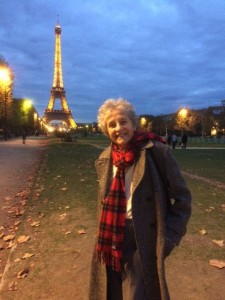
Nicole Prevost Logan

Nicole Prevost Logan

About the author: Nicole Prévost Logan divides her time between Essex and Paris, spending summers in the former and winters in the latter.  She writes a regular column for us from her Paris home where her topics will include politics, economy, social unrest — mostly in France — but also in other European countries.  She also covers a variety of art exhibits and the performing arts in Europe.  Logan is the author of ‘Forever on the Road: A Franco-American Family’s Thirty Years in the Foreign Service,’ an autobiography of her life as the wife of an overseas diplomat, who lived in 10 foreign countries on three continents.  Her experiences during her foreign service life included being in Lebanon when civil war erupted, excavating a medieval city in Moscow and spending a week under house arrest in Guinea.
Join – or Listen to – a Messiah Singalong at ‘The Kate’ This Afternoon

logoParticipate in the sounds of the season this afternoon at 4 p.m. when Cappella Cantorum presents what has become a holiday tradition at the Katharine Hepburn Cultural Arts Center, “The Kate,” in Old Saybrook.
The event is open to all who want to sing-along and combines CappellaCantorum’s professional soloists with a chorus of talented volunteers.  Sit in the back and listen or sit down front and participate!

Bring your Messiah Scores if you have them or they will be provided.  Singers call time is 3:30 p.m. for rehearsal.  There is a $10 fee.

Click here for more information.

Foster Caddell’s Widow Gifts $250,000 to Lyme Art Association

Foster Caddell’s particular fondness for the Lyme Art Association has led his widow in Voluntown to give a $250,000 gift from his estate to the Old Lyme-based organization.

The association’s South Gallery will be renamed the Foster Caddell Gallery at a dedication ceremony in May set to coincide with the 94th annual Elected Artist Exhibition …

Read the full article by Elizabeth Regan and published in the Norwich Bulletin on Dec. 18, 2014, at this link : http://www.norwichbulletin.com/article/20141218/News/141219562#ixzz3MSAWey9J

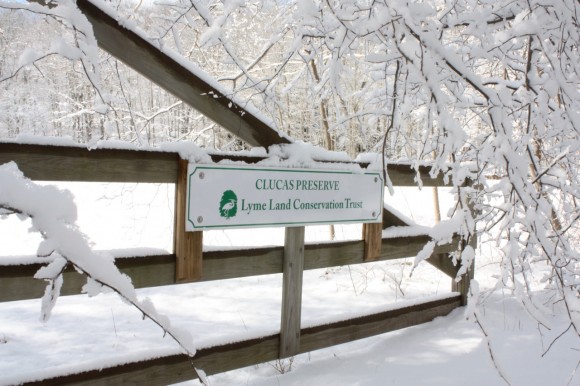
Lyme Land Conservation Trust Earns National Recognition

IMG_5744
The Lyme Land Conservation Trust has been awarded accreditation by the Land Trust Accreditation Commission, an independent program of the Land Trust Alliance.

“This accreditation demonstrates our commitment to permanent land conservation that benefits the entire community,” said Land Trust President John Pritchard in making the announcement. “Our land trust is a stronger organization today having gone through the rigorous accreditation program.”

The Lyme Land Conservation Trust was awarded accreditation this December. It is one of only 285 land trusts in the country that have been accredited by the Land Trust Accreditation Commission. There are more than 1,700 land trusts nationwide.

LTAC_seal_green“Accreditation provides the public with an assurance that, at the time of accreditation, a land trust has met high standards for quality and that the results of their conservation work are permanent,” explained Commission Executive Director Tammara Van Ryn.

Each accredited land trust submitted extensive documentation and underwent a rigorous review. “Through accreditation land trusts conduct important planning and make their operations more efficient and strategic,” said Van Ryn. “Accredited organizations have engaged and trained citizen conservation leaders and improved systems for ensuring that their conservation work is permanent.”

Accredited land trusts are authorized to display a seal indicating to the public that they meet national standards for excellence, uphold the public trust and ensure that conservation efforts are permanent. The seal is a mark of distinction in land conservation.

“This round of accreditation decisions represents another significant milestone for the accreditation program; the 285 land trusts now accredited account for three quarters of the more than 20 million acres currently owned in fee or protected by a conservation easement,” said Van Ryn.

The Lyme Land Conservation Trust was founded in 1966 and currently manages more than 3,000 acres of forests, farms and marshes that are preserved as wildlife habitat and productive agricultural land for the enjoyment and benefit of future generations.

In making the announcement, Pritchard thanked the many volunteers and staff who work to maintain the properties under Lyme Land Trust management and singled out those who spent hundreds of hours preparing the Land Trust’s accreditation application.

He personally thanked Environmental Director Lisa Niccolai, who led the Land Trust’s accreditation team, as well as Vice President Don Gerber, Treasurer Andy Baxter, Executive Director George Moore, and former President Linda Bireley for the hundreds of hours they worked in preparing and organizing the Land Trust’s records and operations documentation to meet the exacting standards of the Accreditation Commission.

Pritchard also thanked and recognized the Lyme community leaders who have served as officers and board members of the Land Trust during its almost half century of preserving the town’s bucolic farms, wetlands, and back country.

“They were the leaders, the visionaries,” said Pritchard. “What Lyme has achieved today in preserving its beauty and natural environment was made possible by earlier generations of Lyme civic leaders who were committed to conservation.”

According to the Land Trust Alliance, conserving land helps ensure clean air and drinking water; safe, healthy food; scenic landscapes and views; recreational places; and habitat for the diversity of life on earth.

In addition to health and food benefits, research has shown that conserving land increases property values near greenbelts, saves tax dollars by encouraging more efficient development that require less public service infrastructure, and reduces the need for expensive water treatment facilities.

Across the country, local citizens and communities have formed land trusts to save the places they love. Community leaders in land trusts throughout the country have worked with willing landowners to save over 47 million acres of farms, forests, parks and places people care about, including land transferred to public agencies and protected via other means.

Strong, well-managed land trusts provide local communities with effective champions and caretakers of their critical land resources, and safeguard the land through the generations.

Editor’s Notes: The Land Trust Accreditation Commission, based in Saratoga Springs, N.Y., awards the accreditation seal to community institutions that meet national quality standards for protecting important natural places and working lands forever. The Commission, established in 2006 as an independent program of the Land Trust Alliance, is governed by a volunteer board of diverse land conservation and nonprofit management experts from around the country. See a complete list of all recently accredited land trusts online at http://www.landtrustaccreditation.org/newsroom/press-releases. More information on the accreditation program is available on the Commission’s website, www.landtrustaccreditation.org.  The Land Trust Alliance, of which the Lyme Land Conservation Trust is a member, is a national conservation group that works to save the places people love by strengthening conservation throughout America. It works to increase the pace and quality of conservation by advocating favorable tax policies, training land trusts in best practices and working to ensure the permanence of conservation in the face of continuing threats. The Alliance publishes Land Trust Standards and Practices and provides financial and administrative support to the Commission. It has established an endowment to help ensure the success of the accreditation program and keep it affordable for land trusts of all sizes to participate in accreditation. More information can be found at http://www.landtrustalliance.org