Lyme-Old Lyme HS is First in State to Receive Safe Sports School Award

Lyme-Old Lyme High School Athletic Director Bill Buscetto.

Lyme-Old Lyme High School Athletic Director Bill Buscetto.

Lyme-Old Lyme High School (LOLHS) is the recipient of the National Athletic Trainers’ Association (NATA) Safe Sports School award for its Wildcats athletics program.  It is the first school in Connecticut to receive the award. The award champions safety and recognizes secondary schools that provide safe environments for student athletes.  It also reinforces the importance of providing the best level of care, injury prevention and treatment.

“Lyme-Old Lyme High School is honored to receive this 1st Team recognition from the NATA, and we remain committed to keeping our student athletes safe during physical education classes, team practices and games so they can accomplish their own goals of great competition, winning records, fair sportsmanship and good health, ” said Bill Buscetto, LOLHS Athletic Director.

He continued, “Our goal is to provide our athletics program with the highest safety standards for our players.  It is a testament to the high quality of care provided by our athletic trainer, Aubrey Davis, and all of our coaches.”

Physical activity is very important for today’s youth, according to NATA president Jim Thornton, MS, ATC, CES.  “There has been an increase in competitive sports, which are, unfortunately, not without risk.  Brain injury/concussion, cardiac arrest, heat illness, exertional sickling, cervical spine fractures along with other injuries and illnesses are potentially life-threatening.”  Proper planning with proper equipment and personnel is vital to the safety of student athletes today, he notes.

In order to achieve Safe Sport School status, as Lyme-Old Lyme has done, athletic programs must demonstrate the following:

  • Create a positive athletic health care administrative system
  • Provide or coordinate pre-participation physical examinations
  • Promote safe and appropriate practice and competition facilities
  • Plan for selection, fit function and proper maintenance of athletic equipment
  • Provide a permanent, appropriately equipped area to evaluate and treat injured athletes
  • Develop injury and illness prevention strategies, including protocols for environmental conditions
  • Provide or facilitate injury intervention
  • Create and rehearse a venue-specific Emergency Action Plan
  • Provide or facilitate psychosocial consultation and nutritional counseling/education
  • Be sure athletes and parents are educated of the potential benefits and risks in sports as well as their responsibilities

For more information, visit www.athletictrainers.org.

 

Letter to the Editor: A Hearty Thank You to Lyme From Lyme Library Book Sale Organizers

To the Editor:

On behalf of the Friends of the Lyme Public Library, I’d like to thank everyone who came to our Book Sale this weekend.  Additional and very special thanks go to our wonderful volunteers who sorted, stored, priced, and sorted some more.

Because of our new library construction, this turned into a wonderfully shared community event: we coordinated with Lyme Land Trust on the date so we didn’t conflict with the Tour de Lyme; we held the sale at the Lyme Public Hall; we used the Lyme Ambulance shed to store our books all winter; we borrowed Lyme Fire Company’s sturdy tables and we parked at the Lyme Congregational Church!

We are so fortunate to live in this extraordinary community.

Sincerely,

Anne Clement
2014 Lyme Public Library Book Sale Chair

Talking Transportation: America’s Interstate Highways

The 47,000 miles of highways that comprise America’s interstate highway system are nothing short of an engineering marvel, surpassed only by what China has built in the last few years.

We take them for granted, but when they were designed almost 60 years ago these super-highways presented both great opportunity and vast challenges.  The US wasn’t the first with super-highways. Those bragging rights go to the Germans, whose Reichsautobahn saw cars zooming along at 100+ mph in the 1930’s.

Most credit President Eisenhower, whose troops rode the Autobahn in WWII, for seeing the military value of an American equivalent, though engineering such a complex across the US was far more difficult.

Of course, by 1940 the US already had the Pennsylvania Turnpike and, by 1954, the NY State Thruway, but private toll roads were just the beginning.

To build a road expected to last, in 1955 the federal government, AAA and automakers first built a $27 million seven mile test road near Ottawa, Illinois.  Half was concrete, the other half asphalt.  The 836 separate sections of highway had various sub-surfaces and 16 bridges.  For two years army trucks drove night and day, seeing which road designs would hold up.

Weather and traffic dictated different designs:  in desert areas the highways need be only a foot thick, while in Maine the tough winter and freeze-thaw cycles required that I-95 would be five feet thick.

Construction of the highways required moving 42 billion cubic feet of soil.  To expedite construction of I-40 in California, there was even a plan to use nuclear bombs to vaporize part of the Bristol Mountain range.

As author Dan McNichol writes in his excellent book, “The Roads that Built America”, “VIP seating was even planned for the event.  The (nuclear) bombing was to produce a cloud 12,000 feet high and a radioactive blast 133 times that of Hiroshima.”  Needless to say, the mountains were moved using more conventional explosives.

Outside of Greenbelt, Md., another site tested the design of road signs … white lettering on a black background, white on blue (already adopted by the NY Thruway) or, what proved to be the winning model, white on green.

Just 5,200 of the original 41,000 miles of Interstates were to be built in urban areas, but those few miles accounted for almost half of the $425 billion total cost.  By 1992 the system was deemed “completed”.  Bragging rights for the longest of the interstates goes to I-90 running 3,020 miles from Boston to Seattle and our own beloved I-95, which runs 1,920 miles from the Canadian border to Miami, Fla.

As anyone who drives on I-95 in Connecticut knows, the interstates have far surpassed their expected traffic load and are in need of billions of repairs.  Little did we know 60 years ago what our automotive future might bring.

Jim Cameron

Jim Cameron

Jim Cameron has been a Darien resident for 22 years.  He is the founder of the Commuter Action Group and also serves on the Darien RTM.  The opinions expressed in this column are only his own.  You can reach him at CommuterActionGroup@gmail.com

Lanier to Primary on Aug. 12 for Republican Candidacy of 23rd District

Vicki Lanier

Vicki Lanier

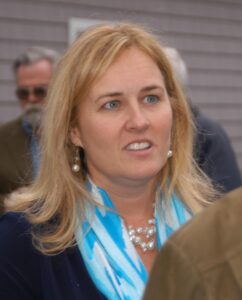
Vicki Lanier (R) of Old Lyme has announced her intention to primary in August to be the Republican candidate for the state assembly seat of the 23rd District, which will be vacated by Marilyn Giuliano at the end of this year.  Giuliano, who has represented the district since 2003, announced in February that she would not seek a seventh term.

In six weeks of active fundraising, Lanier has exceeded the required amount of funds and number of donors to qualify for public campaign funds to be used both in any primary efforts and ultimately in her race against any Democratic candidate this November.  Lanier’s donors have come from both statewide and the four towns with areas in the 23rd District, namely Old Lyme, Lyme, Old Saybrook and Westbrook.

Lanier commented, “First, I offer congratulations to my Republican opponent [Devin Carney] for the result at the convention, which was not unexpected. The convention is the first part of our process in selecting a candidate to represent the Republican Part this November.”

She continued, ” I am reminded of a time 12 years ago when a strong candidate named Marilyn Giuliano, who lost the convention, felt compelled to let the full membership of the Republican Party make a choice about who would be the best qualified to not only defeat the Democratic opponent, but most importantly, effectively serve the people of the 23rd district.”

Lanier concluded, “As Marilyn emphasized at the Holbrook Dinner last Friday night, it was her practical experience that enabled her to be so successful in the legislature.  I am confident that the voters in the Republican Party will choose a candidate equally equipped with the life experience, professional skill set, energy, and proven track record to be our next representative. ”

For additional information on Lanier, contact vickilanier2014@gmail.com, visit her page on Facebook at “Lanier2014″ and her website at www.lanier2014.com.

State Senate Candidate Emily Bjornberg Addresses Nominating Convention of Rep. Joe Courtney

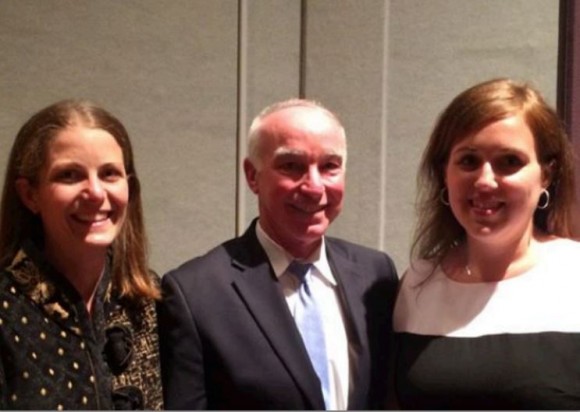
From left: Emily Bjornberg, Rep. Joe Courtney, State Rep. Mae Flexer (D-Killingly) at Courtney's nominating convention earlier this week.

From left: Emily Bjornberg, Rep. Joe Courtney and State Rep. Mae Flexer (D-Killingly) at Courtney’s nominating convention earlier this week.

Emily Bjornberg of Lyme, Democratic candidate for the State Senate in the 33rd District, addressed the nominating convention of U.S. Rep. Joe Courtney (D-2nd) on Wednesday evening at Asnuntuck Community College in Enfield.

The 33rd District includes Lyme and also covers Chester, Clinton, Colchester, Deep River, East Haddam, East Hampton, Essex, Haddam, Old Saybrook, Portland and Westbrook.

“Joe Courtney has amassed a stellar record of fighting hard for education, defense, agriculture and small business.  He holds true to the values that matter most to Eastern Connecticut, and we are proud to call him our representative,” said Bjornberg.

Courtney is seeking a fifth term in the U.S. House of Representatives.

“It has been an honor to serve the people of the second district of Connecticut for more than seven years, and I am looking forward to running again.  I am grateful for the strong support displayed at our convention, which demonstrates the importance of the work we will continue to do in Connecticut and in Washington,” said Courtney in a prepared statement.