Nicole Prévost Logan
The presidents of the United States and of China were in Europe this week. It was the first visit of a Chinese president to the European Union’s (EU) headquarters since 1975. He will meet with the presidents of the Council, Herman Van Rompuy, of the Commission, Manuel Barroso and of the Parliament, Martin Schuls, showing a nascent interest in Europe as a political entity.
However, Europe has been the largest trade partner of China for a decade, with German leading the pack. Why then did president Xi Jinping choose France as one of his four stops in Europe in spite of that country’s small trade and investment with the Middle Kingdom ? The reasons are historical, cultural, the Chinese’s attraction to gastronomy and good wine, and, finally, the desire to acquire more areas of French “savoir faire” and state of the art technology, heretofore unexplored.
Xi Jinping and his beautiful star singer wife Peng Liyuan opened his three-day state visit in Lyon, the French silk capital, and announced his intention to promote a “new Silk Road.” Started with French King Francis I, the silk-making industry in Lyon was flourishing by the 17th century. In the 1920s cultural ties developed between China and France. Chinese students entered French universities, among them several future political leaders. In 1964 General Charles de Gaulle was the first Western chief of state to establish full diplomatic relations with the Middle Kingdom.
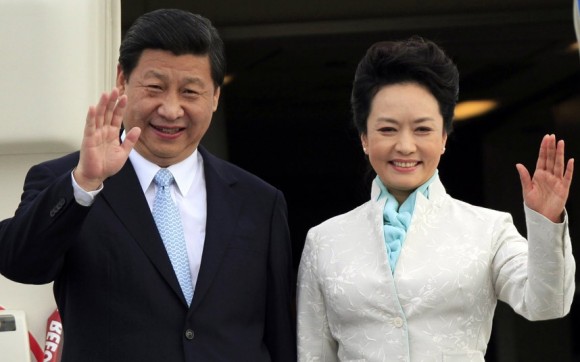
In this file photo, Xi Jinping and his wife Peng Liyuan wave to the crowd.
Mutual interests in literature, cinema and art have created special bonds between Chinese and French intelligencia. Chinese fans of the “Nouvelle Vague” films (new wave) are sometimes more knowledgeable about the names of the directors that the French themselves. The 1992 film “l’Amant‘”(the Lover), directed by Jean Jacques Annaud, based on the 1984 novel by Marguerite Duras, was a huge success in France. The plot is the affair a “Chinaman” struck with a young French girl on a ferry boat crossing the Mekong river. French readers cheered on the high school “Joueuse de Go” (Go player) character created by author Shan Sa, whose courage symbolized the determination of the Chinese population fighting against the impending invasion of Manchuria by the Japanese in 1931.
But the objectives of the Chinese president and of his cohort of businessmen and investors who accompanied him were more down to earth: they were here for serious business. Both by making inroads into the French industry and by opening their own market to French goods in order to tilt the massive trade deficit between the two countries. The car company Dongfeng just acquired 14 percent of the PSA’s (Peugeot-Citroen) shares. The Chinese have been trying to take over 46 percent of Club Med’s (touristic villages) capital.
Whether it is nuclear energy or aeronautic technology, automobile industry, or fast trains, the transfer of technology has always been a touchy point for the French. The most striking example of this situation is the TGV (Train à grande vitesse) or fast train which was designed by Alstom in France in the 1970s and was further developed jointly with other Western countries. Now the Chinese network is ten times longer than the French and in July 2013 “Harmony Express” surpassed the speed of the French trains.
On a televised program, a spokeswoman for the Chinese government was asked the question about transfer of technology. She said that the Chinese now are pretty much caught up, ( which is certainly true with telecom giants like Huawei and ZTE) and that now their policy was veering toward “partnership and cooperation” – language to be expected from a government spokeswoman.
The Chinese love France. Millions of tourists speed through the most famous halls of the Louvre. The growing middle class and the wealthy are increasingly fascinated by luxury goods. They are not satisfied anymore by the pirated brands one finds all over the world. Now they can find the real stuff 72 percent cheaper in France thanks to the system of “detaxe” and by avoiding import duties into China.
During the many years we lived in Africa with the American Embassy, in the 1960s and 1970s, I had a chance to observe that, in those days, the Chinese lived in spartan compounds totally secluded from the local population , working on Guinea tea plantations or building a soccer stadium in the Gambia. They have come a long way. To-day they visit France to do their spring shopping and buy Chambertin ou Chateau Lafitte wine, Hermes silk scarves or Vuitton bags.
Agribusiness is a field where improvements would be welcome. One remembers the problems China suffered a few years ago with contaminated powder milk. The Chinese are very fond of foie gras and cheese. They have just discovered the “Jambon de Bayonne.” It takes many hours of preparation and manual work to prepare the dark red ham meat. The traditional “savoir faire” has existed since the 13th century in the south west of France. Its commerce is labeled “IGP” (Indication Geographique Protegéee) or geographically protected. Pork is one of the main food staple in China and there the huge market is promising. Will the transfer of “savoir faire” be followed by the loss of the brand?
During the elegant dinner at the Elysees palace and the following night at the Opera Royal of the Chateau de Versailles, what was president François Hollande thinking of — 18 billion euros of new contracts or the difficult political situation he is in right now after the disastrous (for him) recent local elections?
 About the author: Nicole Prévost Logan divides her time between Essex and Paris, spending summers in the former and winters in the latter. She will write a regular column for us from her Paris home where her topics will include politics, economy, social unrest — mostly in France — but also in other European countries. She also will cover a variety of art exhibits and the performing arts in Europe. Logan is the author of ‘Forever on the Road: A Franco-American Family’s Thirty Years in the Foreign Service,’ an autobiography of her life as the wife of an overseas diplomat, who lived in 10 foreign countries on three continents. Her experiences during her foreign service life included being in Lebanon when civil war erupted, excavating a medieval city in Moscow and spending a week under house arrest in Guinea.
 Lymes’ Youth Service Bureau (LYSB) hosts ‘A Community Forum’ this coming Thursday, April 3, at 7 p.m. at Lyme-Old Lyme High School to present results from the most recent Lyme-Old Lyme Youth Survey.