Barbara Eckhardt-Goodwin, Lyme Artist, Dies at 92

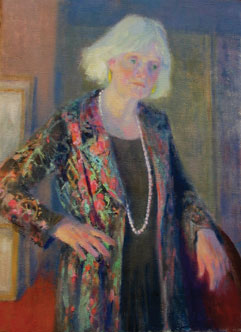
Self portrait by Barbara Eckhardt Goodwin.

Self portrait by Barbara Eckhardt Goodwin.

Barbara Eckhardt-Goodwin, artist, died Wednesday, December 4, at age 92.  She leaves her daughter, Georgiana Goodwin of Lyme, and granddaughter, Sophia Harvey of New York City.  She was predeceased by her husband, Harold Goodwin.

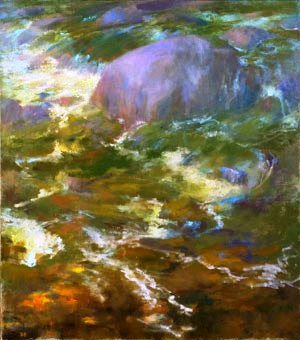
Born in Philadelphia on February 3, 1921, to Minette Robb Eckhardt and George Waldvogel Eckhardt, Barbara studied at the Art Students League in New York City, where she met and married fellow artist Harold Goodwin and dedicated her life to painting.  A sensitive and serious artist, her work has been collected internationally, appeared as murals, and reproduced on book jackets.  Her painting “November Water,” a landscape depicting Lyme’s Eightmile River, is part of the Florence Griswold Museum’s permanent collection.

Barbara began her career in New York and then moved to Montreal where, during the war, she painted and showed at the Montreal Museum of Art.  Post-war she and Harold returned to New York City, painting and running a portrait business.  When their daughter, Georgiana, was four, they purchased a home on Grassy Hill Road in Lyme from Impressionist painter Frank Vincent DuMond.

November Water by Eckhardt Goodwin.

November Water by Eckhardt Goodwin.

Barbara lived and worked from her home on Grassy Hill for more than 50 years. Harold painted there as well, also working as an artist/illustrator, serving as the first chairman of the board of the Lyme Academy of Fine Arts, and teaching drawing and History of Art. Harold passed away in 2001.

Last summer, after opening her studio for the Lyme Library’s Artists’ Studio Tour, part of the library’s centennial celebration, Barbara sold her Grassy Hill house and moved to her daughter’s house on Joshuatown Road, where she continued to paint daily until falling ill in late November.

Barbara died in the hospice unit at Middlesex Hospital.  There will be no public service but a celebration of her life and work will be held at the Florence Griswold Museum’s Marshfield House on December 28 from 3-5 p.m.

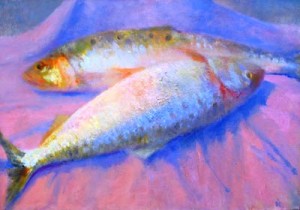
'Fish' by Eckhardt Goodwin.

‘Fish’ by Eckhardt Goodwin.

In her essay “A Long Look Back”, published in the Fall 2013 edition of the Florence Griswold Museum’s Ledger, Barbara wrote, “I honor the long, ever-changing tradition of Realism.  I must trust my thoughts about what I see.  And what I see is color.  As Proust said, we age upon the rising stilts of our past – until we fall.  So far, so good.”

College Hosts Nationally Acclaimed Artist/Author Sharon Louden Tonight

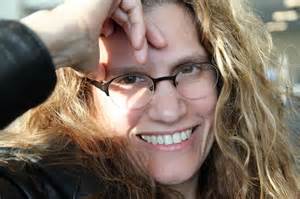
Sharon Louden

Sharon Louden

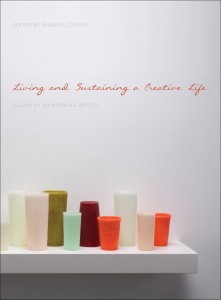
Lyme Academy College of Fine Arts hosts nationally acclaimed artist and author Sharon Louden, who will give a talk and a book-signing at the College on Tuesday, Dec. 10.  Louden will discuss her new book, ‘Living & Sustaining a Creative Life: 40 Artist Essays,’ at 7 p.m. after a reception with wine and hors d’oeuvres at 6 p.m.

Louden’s talk will take the form of a conversation when she chats with faculty in front of the audience before a question and answer portion open to all in attendance.  Michael Waugh, a faculty member at the Rhode island School of Design and a contributor to the book, will also be joining Louden.  A book signing by both Louden and Waugh will follow.  Tickets are $10 per person.  All are welcome.

A refreshing and honest look at the reality of sustaining a creative practice over time, Louden’s book is already in its second printing – the first sold out almost immediately.  The book is a collection of essays from 40 artists who share their approach to juggling their creative lives with making a living.  All are unique stories with the same common thread of sustaining a creative life in and outside the studio.

living_and_sustaining_a_creative_life_book_cover“It’s the truth of the day-to-day living that I am after in this book…” says Louden in the preface to her book.  She continues, “The power of creativity does not just lie in an artist’s work, but also in how he or she continues to create regardless of the obstacles life places in the way.”  Hear Louden share stories of sustaining a creative practice by turning obstacles into opportunities at this event.
Louden received her BFA from the School of the Art Institute of Chicago and an MFA from Yale University, School of Art.  Louden’s work has been exhibited in many museums and galleries worldwide and is in numerous permanent collections including the National Gallery of Art, Whitney Museum of American Art and the Museum of Fine Arts, Houston. Louden lives and works in Brooklyn, NY.

Seating for this event is limited and by reservation only.  For reservations, contact Ann de Selding at 860.434.3571 ext. 117 or email her at adeselding@lymeacademy.edu by Dec. 5.

Lyme Academy College is located at 84 Lyme Street, Old Lyme CT 06371.

Popular LBS Christmas Luncheon Meeting to be Held Today

The Ladies Benevolent Society of the First Congregational Church of Old Lyme, 2 Ferry Rd, will host its popular Christmas luncheon at noon on Tuesday, Dec. 10, in the Fellowship Hall.  The Lyme-Old Lyme High School Select Singers will entertain with holiday music.

Items from the Elephants in Winter Sale will also be on sale. All are welcome to attend, however, reservations are necessary.

The cost is $5 with a donation of a nonperishable food item to the Food Pantry. Call the church office to make a reservation at 860.434.8686.

New Executive Director Has Big Dreams, Plans for Connecticut River Museum

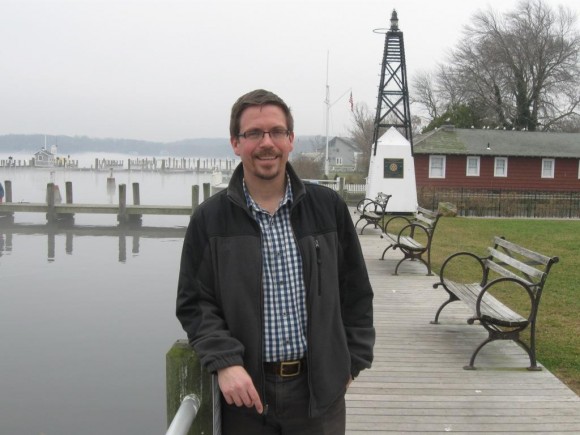
Chris Dobbs, the new Executive Director of Connecticut River Museum.

Chris Dobbs, the new Executive Director of Connecticut River Museum.

Imagine if you will, a vintage, side-wheeler steamboat tied up smartly at the Steamboat Dock of the Connecticut River Museum.  Imagine as well that, on given days, this old, classic steamboat carries modern day passengers up and down the Connecticut River on both educational and pleasure cruises.

This is just one of the ambitious dreams held by the Connecticut River Museum’s new Executive Director, Christopher I. Dobbs (he prefers to be called “Chris.”)  Dobbs recently replaced the museum’s former Executive Director, Jerry Roberts.

A resident of Deep River, the 42-year-old Dobbs comes to his new post at the Connecticut River Museum after a nine year stint as Executive Director of the Noah Webster House & West Hartford Historical Society in West Hartford.  Prior to that, he was the Associate Director of Education at the Mystic Seaport Museum of America and the Sea.  Dobbs has an M.A. in Museum Studies from the State University College of New York, Cooperstown, N.Y.

To help him secure the Connecticut River Museum’s top job, Dobbs submitted to the search committee an impressive, three-paged, single-spaced, small-type resume, setting forth his previous experience and multiple accomplishments in the museum field.  For example, his resume notes that as head of the Noah Webster House & West Hartford Historical Society, he “Developed and completed a $1.2 million capital campaign (raised 20% more than goal.)”

Also, noted is that in his previous position he, “Acted as the chief fundraiser by working with individual donors, foundations, city government, and State of Connecticut legislatures and agencies, and that he, “Increased endowment 45 per cent.”

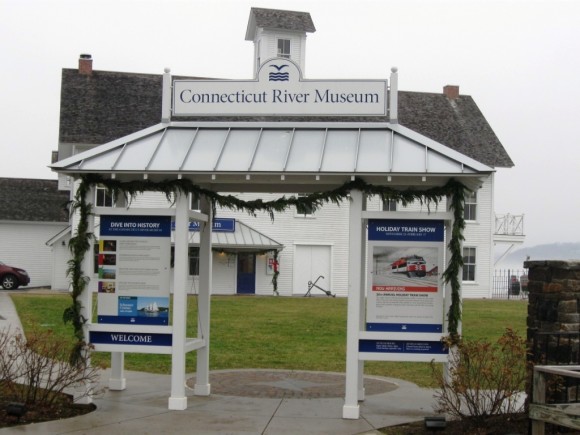
“Conversational” billboard entrance to the Museum
It is highly likely that the new Executive Director’s fundraising skills did not go unnoticed by the Connecticut River Museum’s search committee for a new Executive Director.  Further evidence of Dobbs’s successful fund raising was that he managed and fundraised for a 250th Birthday celebration for his previous employer’s namesake, Noah Webster.

The Dream of a Steamboat Tied Up at Steamboat Dock

In a recent interview, Dobbs demonstrated that he is a person who can dream big.  For example, he suggested that, at some future date, the Connecticut River Museum might acquire a fully working, side-paddling steamboat.  With this historical coincidence in mind, the new steamboat would be docked at the Steamboat Dock of the Connecticut River Museum.  In the 19th century, the Steamboat Dock was a frequent stop for steamboats operating along the river.

As for the present availability of old steamboats, Dobbs said, “There are some of them still around for sale.”  Dobbs asks what could be more appropriate than to have a working steamboat tied up at the Steamboat Dock of the Connecticut River Museum.

This does not mean that the museum’s present sailboat, the “Mary E,” which seasonably carries paying passengers on short cruises up and down the Connecticut River, would be replaced immediately.  However, the new Executive Director feels that having a working steamboat at the Steamboat Dock would be uniquely consistent with the Connecticut River Museum’s mission and history.

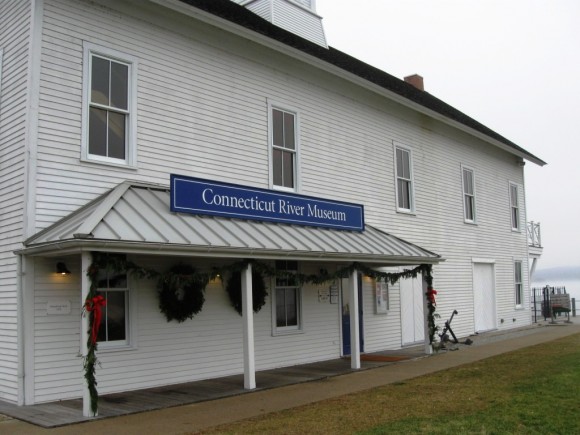
The unadorned entrance of the Connecticut River MuseumThe unadorned entrance of the Connecticut River Museum.
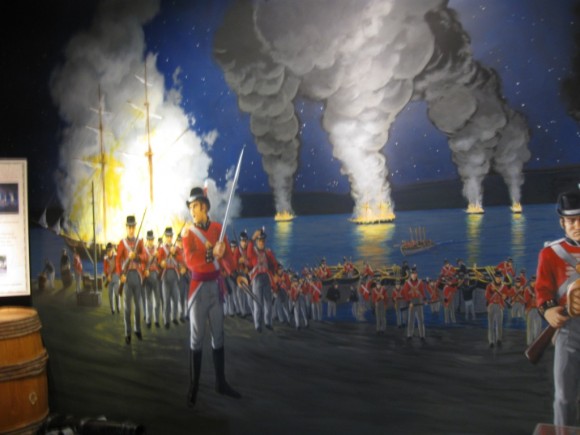
This talk of steamboats does not mean that Dobbs is not completely on board in commemorating next year’s 200th anniversary of the 2014 burning of the American ships in Essex by British forces during the war of 1812.  However, Dobbs clearly feels that this one-time historic event should not be the principal focus of the Connecticut River Museum.

Tying the Museum to the Entire Connecticut River

Rather, the central mission of the museum, in Dobbs’s view, is that it should focus on the full length of the Connecticut River.  As Dobbs puts it, “This is, after all, the Connecticut River Museum, and, therefore, the entire length of the river from the Canadian border down to the river’s mouth on Long Island Sound is what this museum should be all about.”  It should be noted that the Connecticut River is 407 miles long and begins just below the Canadian border and runs down to its mouth on Long Island Sound in Connecticut between Old Saybrook and Old Lyme.

Artist rendering at the Museum of 1814 British attack on Essex Artist rendering at the Museum of 1814 British attack on Essex

Activities that the museum might sponsor could be canoe excursions on the upper Connecticut River between Vermont and New Hampshire.  In addition, the new Executive Director envisions joining the fight against pollution in the Connecticut River, as well as children’s programs about animal and aquatic life along the Connecticut River, including teaching young and old how “to hold a fish and touch a crab.”

Dodd also raptures that the Connecticut River is, “America’s First Blue Way.”  Also, like many environmentalists, he is grateful that the mouth of the Connecticut River between Old Saybrook and Old Lyme “has not been spoiled by development.”

In sum, Chris Dobbs, the new Executive Director of the Connecticut River Museum, takes a broad and exciting view of his new position.  He states conclusively, “We are the Connecticut River Museum, and that is the Connecticut River, and that is what we are about.”  He continues, “That means that the museum is entwined with the river, every single mile of it.”

Friends of the Conte National Fish & Wildlife Refuge Honored; 66 Acres Added to Refuge This Year in Lyme

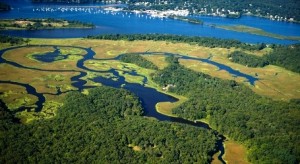
Aerial view of the Connecticut River.

Aerial view of the Connecticut River.

A coalition dedicated to the well-being of New England’s iconic Connecticut River and its watershed has been recognized with a prestigious national land protection award.

The U.S. Fish and Wildlife Service Division of Realty has awarded its 2013 National Land Protection Award to the Friends of the Silvio O. Conte National Fish and Wildlife Refuge, a partnership of more than 50 local, regional and national organizations from across the river’s four-state watershed.

The Conte Refuge was established in 1997 to conserve the abundance and diversity of native plants and animals and their habitats in the 7.2-million-acre Connecticut River watershed in Connecticut, Massachusetts, New Hampshire and Vermont. It is the only national wildlife refuge dedicated to a river’s entire watershed.

“The Friends of Conte is an example of how successful conservation through land acquisition is accomplished in this current age,” said A. Eric Alvarez, Chief of the U.S. Fish and Wildlife Service Division of Realty. “The group’s partnership with the Service is what has made the Conte Refuge what it is today.”

Andrew French, project leader for the Conte Refuge, said the Friends of Conte has played a crucial role in supporting the vision of Massachusetts Congressman Silvio O. Conte, for whom it was named.

“Congressman Conte spoke about having his children and grandchildren continue to enjoy the outdoors as he had, and the work of the Friends of Conte has been instrumental to many achievements, contributing toward that vision,” French said. “Their work continues to demonstrate their incredible collaborative approach and ability to integrate conservation actions into recreation, education and economic opportunities sustaining a large and healthy working landscape.”

The Friends of Conte is a diverse coalition of organizations that works to support the recreation, education and conservation work of the Conte National Fish and Wildlife Refuge. The Nature ConservancyThe Trust for Public Land and Audubon Connecticut are among the coalition’s members.

“The Friends of Conte are honored to have had the opportunity to help protect habitat in this great watershed and for this great Refuge,” said Patrick Comins, Director of Bird Conservation for Audubon Connecticut and President and former Chair of the Friends of Conte for four years ending in November 2013.  “Conserving the amazing places that make this watershed so special will benefit all of the more than 2 million residents of the watershed and also help to protect the water quality of the Long Island Sound estuary.”

The National Land Protection Award is given annually to private citizens, groups, organizations, corporations, public agencies and their employees, or volunteers outside the U.S. Fish and Wildlife Service for their significant contributions to land protection in partnership with the Service.

Since 1997, partners have helped protect more than 35,700 acres that are administered by the Conte Refuge. The Friends of Conte has been supporting this work since it was founded in 2005.

The collaboration between the Friends of Conte and the Conte Refuge is also one of the key reasons the Connecticut River Watershed was designated as the United States’ first National Blueway in 2012.  The National Blueways System recognizes stakeholder partnerships, working watershed-wide to promote recreation, education, conservation and sustainable economies.

“This award is much-appreciated recognition for the many, many people, organizations and agencies that, for decades, have remained committed to the betterment of watershed,” said Kim Lutz, Chair of the Friends of Conte and Director of The Nature Conservancy’s Connecticut River Program. “Working together, we’ve achieved a great deal and can—and must—achieve a great deal more.”

This year, the Conservancy worked with the Service to add 66 acres of tidal marsh and coastal lands along Whalebone Cove in Lyme, Conn., to the Refuge’s protected area. In Massachusetts, this year, the Conservancy partnered with the Service to protect 125 acres in the Westfield River watershed, which is part of the larger Connecticut River system.

“The Trust for Public Land is honored to have helped complete the body of conservation work that led to this award,” said Clem Clay, Connecticut River Program Director for The Trust for Public Land. “The Fish and Wildlife Service appreciates our assistance and makes the process of partnering with a federal agency as painless as possible.”

The Trust for Public Land, the 2012 recipient of the same award, has partnered with the Service on Conte Refuge acquisitions valued at over $6 million and served as a leader in the Friends of Conte since its inception.

Clay commented that it is particularly gratifying to see that with its land purchases, the Service is not only protecting critical habitat, but also welcoming visitors and providing new recreational opportunities, including a wheelchair-accessible trail under construction in Hadley, Mass.

The U.S. Fish and Wildlife Service Division of Realty has given the National Land Protection Award since 2001.

This year’s award was presented this fall at the annual Land Trust Rally in New Orleans.  The Land Trust Rally is the largest gathering of organizations dedicated to land conservation in the country, attended by hundreds of organizations and more than 1,500 individuals.

The Nature Conservancy is the leading conservation organization working around the world to conserve the lands and waters on which all life depends. The Conservancy and its more than 1 million members have protected nearly 120 million acres worldwide. Visit The Nature Conservancy on the Web at www.nature.org/connecticut.

The mission of the U.S. Fish and Wildlife Service is working with others to conserve, protect, and enhance fish, wildlife, plants, and their habitats for the continuing benefit of the American people. We are both a leader and trusted partner in fish and wildlife conservation, known for our scientific excellence, stewardship of lands and natural resources, dedicated professionals, and commitment to public service. For more information on our work and the people who make it happen, visit www.fws.gov.

Founded in 1972, The Trust for Public Land is the leading nonprofit working to conserve land for people. Operating from more than 30 offices nationwide, The Trust for Public Land has protected more than three million acres from the inner city to the wilderness and helped generate more than $34 billion in public funds for conservation. Nearly ten million people live within a ten-minute walk of a Trust for Public Land park, garden, or natural area, and millions more visit these sites every year. Visit The Trust for Public Land online at www.tpl.org.

Now in its second century, Audubon connects people with birds, nature and the environment that supports us all. Our national network of community-based nature centers, chapters, scientific, education, and advocacy programs engages millions of people from all walks of life in conservation action to protect and restore the natural world. Visit Audubon online at www.audubon.org.