Cuban Rhythms Come to Old Lyme

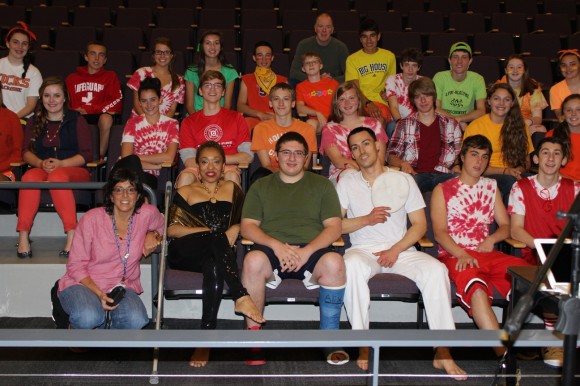
Hunter_Yesenia_Jeanne_and_the_students_1296

Lyme-Old Lyme High School Spanish teacher Jeanne Manfredi (front row, left) sits next to Yesenia Selier, who is one half of Global Rhythms-Cuba. Her partner in the venture, Hunter Houde, is seated third from right. They are surrounded by students from the school.

Editor’s Note: On Friday, April 26, Yesenia Fernandez-Selier and Hunter Houde, co-founders of Global Rhythms-Cuba, presented two sessions on the history of Cuban dance and music, which included a combination of lecture, dance instruction and dance performance, to students at Lyme-Old Lyme High School.  Our intern, Lindsey Knepshield, was in the audience — this is her personal account of the experience. 

The United States is not the only melting pot in the world and, after watching the workshop presented by Global Rhythms-Cuba, I am not even sure it is the best one.  Last Friday, speakers Yesenia Selier and Hunter Houde deftly showcased Cuba’s rich and varied culture—most specifically, their dance culture in a presentation to students studying Spanish at our school.

With both African and Spanish roots intertwined so closely, a new identity has been shaped, one unique to Cuba itself. Many people know the electric slide, or the cha cha, or the salsa, but how many know the history behind them?  A history that, you guessed it, begins in Cuba.

And that’s the goal of Global Rhythms-Cuba, and, more specifically, of its creators—to educate the public on Cuban culture and dance.

Yesenia Selier, is not only a superb dancer; she is also a phenomenal educator.  Born in Havana, Cuba, Selier attended her city’s university to achieve a B.A. in Psychology before going to New York University and receiving an M.A. in Latin American Studies.  She has taught dance to students ranging in ability from beginner to expert, and is both passionate and erudite about Afro-Cuban culture.

Hunter Houde, whose mother works in Lyme-Old Lyme High School, went to the University of Vermont (UVM) with a strong martial arts background.  While at UVM, he joined their Salsa and Swing Society, sparking a passion for Latin dance.  Moving to New York City to teach dance, he met Yesenia at an Afro-Cuban workshop she was conducting.  Shortly thereafter, they began to work together.

Recently they created Global Rhythms-Cuba as a vehicle to bring their passion for Afro-Cuban dance to a wide audience.  And that brings us to last Friday, when I attended their workshop at Lyme-Old Lyme High School.

Beginning with the African slave trade that brought her ancestors to Cuba and ending with pictures of modern Cubans dancing the Rumba in their neighborhoods, Selier was able to condense a country’s history into a PowerPoint presentation that kept her audience interested and informed.

Then it was time to dance.

Selier and Houde taught us easily followed — but not easily done — salsa steps.  Students and faculty alike began with a struggle and an awkwardness that eventually gave way to a semi-adept understanding, though not without some missteps and giggling.

Next, Selier and Houde performed a variety of traditional Afro-Cuban dances, including the Oshan-Yoruba dance celebrating a deity (known as an Orisha) of the Yoruba religion.  Oshan is the spirit of love, intimacy, beauty, wealth and diplomacy.  Selier had the entire room transfixed as she danced in the traditional yellow dress favored by Oshan-Yoruba performers.

In the final minutes of the workshop, one brave student raised his hand after the performances had garnered its well-deserved applause.  “Can we dance more?” he asked, prompting cheers from classmates.  Selier laughed. “Of course!”

And so we danced.

More from the editor:  Global Rhythms-Cuba is a dance and cultural organization whose mission is to use Afro-Cuban music and dance as a means to bridge the cultural past and present.  By offering education about the traditional Afro-Cuban roots of many popular dances, they hope to create a better understanding of the source of inspiration for the music and dance and ultimately a stronger connection between cultures.  The lecture at Lyme-Old Lyme High School was presented in Spanish, challenging the students’ listening and comprehension skills.

Students learned about the blending of cultures on the island nation of Cuba throughout its history. After more than 200 years of Spanish colonization, the English captured Havana during the eighteenth century and began the cultivation of sugar cane. The demand for labor to operate sugar and tobacco plantations and livestock farms led to the growth of African slavery and eventually to the resulting unique mix of cultures that created Afro-Cuban music and dance.

Students watched films of traditional Cuban folkloric dances and learned the significance of those dances to the people who practice them. To illustrate the development of modern popular dances, students viewed films of Cuban music and dance leading up to the present day with a clip of a Rhumba dance that has elements very similar to modern hip-hop dance. 
Presentation on Eastern Cougars in Old Lyme Tonight

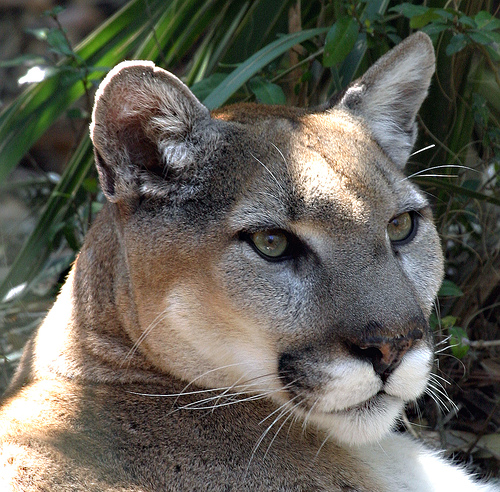
Eastern Cougar Headshot
Potapaug Audubon presents “Eastern Cougar” this evening,  Thursday, May 2, at 7 p.m. with guest speaker, Bill Betty, in the Fellowship Hall at the First Congregational Church of Old Lyme, 2 Ferry Rd.,  in Old Lyme.

There will be a 90 minute PowerPoint presentation with “Show & Tell” items.

This is a free program.  All are welcome.

For more information, call 860-710-5811

Linares Presents State Citation to Lyme-Old Lyme Science Olympiad Team

Sen. Art Linares (center) reads an official state citation recognizing the accomplishments of the Lyme-Old Lyme Science Olympiad team for winning the State Championship.  To Sen. Linares’ left is Science Teacher Shannon Glorioso, and at right is Principal Christopher Pomroy.

Sen. Art Linares (center) reads an official state citation recognizing the accomplishments of the Lyme-Old Lyme Science Olympiad team for winning the State Championship. 
To Sen. Linares’ left is and at right is Principal Christopher Pomroy.

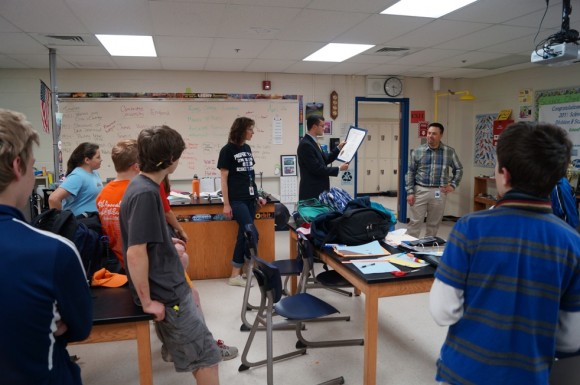
Senator Art Linares (R-33rd), whose District includes Lyme, visited students at Lyme-Old Lyme Middle School last Friday to present an official state citation to the Lyme-Old Lyme Science Olympiad team for winning the State Championship in March.

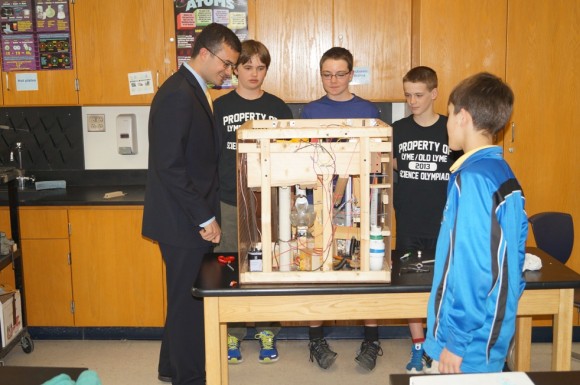
Sen. Art Linares talks with students about their Science Olympiad project, Mission Possible, a complex Rube Goldberg device.  From left to right:  Sen. Linares, builder: Sam Frankel, builder: Ryan Ramella, Ethan Harris, and Sam Fuchs .

Sen. Art Linares talks with students about their Science Olympiad project, Mission Possible, a complex Rube Goldberg device. From left to right, Sen. Linares, builder: Sam Frankel, builder: Ryan Ramella, Ethan Harris, and Sam Fuchs .

The students are currently preparing to compete in the National Science Olympiad, which will be held on May 17-18 in Dayton, Ohio.

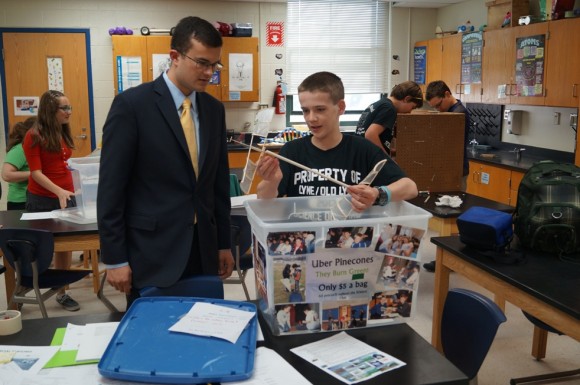
Sen. Art Linares (left) listens while Lyme-Old Lyme Middle School student Ethan Harris describes his elastic-propelled helicopter.

Sen. Art Linares (left) listens while Lyme-Old Lyme Middle School student Ethan Harris describes his elastic-propelled helicopter.

“It was great to be able to commend these students on their achievements and to wish them well,” Linares said.  “Their projects are innovative, and the students are so enthusiastic about their work.  Their success is a testament to the excellent job being done by the dedicated teachers here.”

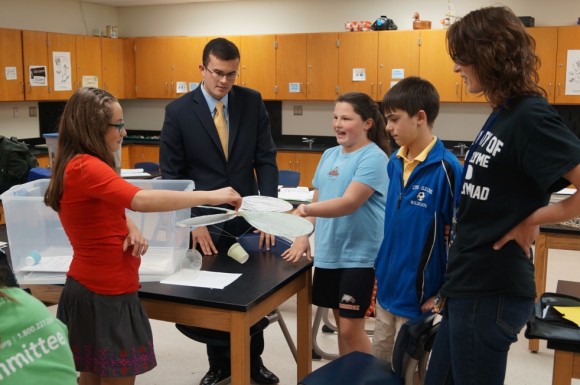
Attached photo 2: Students at Old Lyme Middle School show Sen. Art Linares one of their Science Olympiad projects, a rotor egg-drop, during Sen. Linares’ April 26 visit to Lyme-Old Lyme Middle School.  From left to right:  Brynn McGlinchey, Sen. Linares, Claire Britton, Sam Fuchs, and Science Teacher Shannon Glorioso.

Students show Linares one of their Science Olympiad projects, a rotor egg-drop, during his visit to Lyme-Old Lyme Middle School. From left to right, Brynn McGlinchey, Sen. Linares, Claire Britton, Sam Fuchs, and Science teacher Shannon Glorioso.

Linares represents the 33rd Senate District, which also includes Chester, Clinton, Colchester, Deep River, East Haddam, East Hampton, Essex, Haddam, Old Saybrook, Portland, and Westbrook.

Talking Transportation: High Speed Rail – Updates

Small_Color_JC[1]

Jim Cameron

Time for a quick update on the good and not-so good news about high-speed rail around the world:

CHINA:          The high-speed train between Beijing and Shanghai just passed the 100 million passenger ridership mark after less than 2 years of operations.  The sleek trains depart every 15 minutes carrying 1,000+ passengers at 200+ mph, covering the 819 mile distance (comparable to NYC – Atlanta) in 4 hours.

China also recently opened a new 1,400 mile long high speed line from Beijing to Guangzhou (comparable to NYC to Key West FL).  Travel time, 8 hours.  That puts high speed rail just 100 miles from Hong Kong.

U.S.A.:           America’s fastest train, Acela, while a tinker toy compared to true high-speed rail in China and Europe, is becoming a victim of its own success.  Acela has captured over 50% of the NY to DC and NY to Boston market with hourly departures but an average speed of only 75 mph.  Trains are sold out (with 3.4 million passengers a year) and, at least on paper, highly profitable.  But when Amtrak looked at adding an extra car to each train to capitalize on this popularity, they concluded it would be too expensive.

But Amtrak has been experimenting with increasing Acela’s speed from 125 to 160 mph on a few stretches of track in NJ and RI.  Some $450 million in work will be needed but the hope is the faster speeds could be achieved by 2017.  Today Acela accounts for a quarter of all Amtrak revenues nationwide.

FRANCE:      If it worked for the airlines, why not high speed rail?  France’s government run railroad is about to launch a no-frills, discounted subsidiary branded “OuiGo”.  Using rebuilt double-decker TGV equipment, the trains will be super cheap but with few amenities (think Southwest Airlines on rails).  All ticketing will be online.  Extra bags will cost you $8 in advance, $65 if you wait til the last minute.  There are no café or bar cars on the trains.  A seat near an electric outlet is extra.  You have to arrive 30 min before departure, and OuiGo only uses suburban, not downtown, stations (appealing to the car-centric suburbanites near Paris).  But for a little hassle, you can get to Marseille (on the Mediterranean) in three hours for as little as $13.

NETHERLANDS – BELGIUM:     Not all high-speed rail in Europe is a smashing success.  Witness “Frya”, the private rail service between Brussels and The Netherlands (in planning since 2004) that was to cut travel time by one-third using sleek new V250 trains (ironically named “The Albatross”) built in Italy.  While lowest bidder Ansaldo Breda had a great track record building trams and commuter trains, when their V250 finally ran this Winter, ice build-up began ripping plates from beneath the trains.  (See… Metro-North isn’t the only railroad with equipment problems in the Winter!).  The V250 cars were declared unsafe and taken out of service while the lawyers go at it.

Editor’s Note: Jim Cameron has been a commuter out of Darien for 22 years.  He is Chairman of the CT Metro-North / Shore Line East Rail Commuter Council, and a member of the Coastal Corridor TIA and the Darien RTM.  You can reach him at CTRailCommuterCouncil@gmail.com or www.trainweb.org/ct .  For a full collection of “Talking Transportation” columns, see www.talkingtransportation.blogspot.com