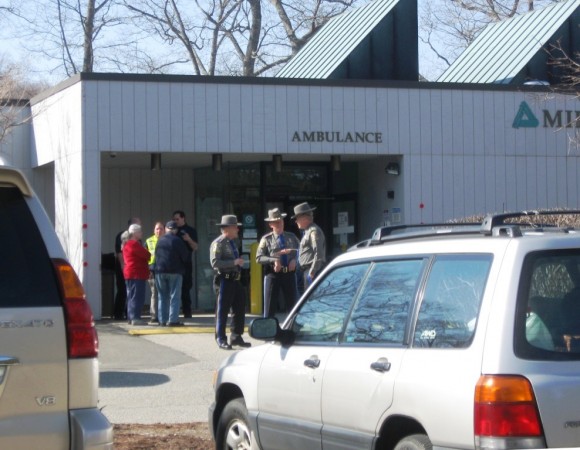

First Selectwoman Bonnie Reemsnyder is interviewed after the historic wastewater vote by News Channel 3.
Updated 04/12. More than 100 residents attended the Special Town Meeting in Lyme-Old Lyme Middle School Tuesday evening to learn about two separate matters, both of which affected the beach area of town. The first was the Old Lyme Board of Selectmen’s proposals for a feasibility study to consider all the options for wastewater management in a coastal section of the town and the second was a plan to change the payment method and layout of parking in Sound View.
A presentation by First Selectman Bonnie Reemsnyder and representatives of the engineering firm of Woodard and Curran about the background to the wastewater issue and the options for moving forward was followed by an extended period of questions from the public. This earlier article published on LymeLine.com on March 27 covers much of the detail of the presentation.
The stated aims of the proposed feasibility study are to:
- secure federal Clean Water Grant funding
- identify appropriate land for wastewater effluent
- perform soil testing within the time frame dictated by DEEP (April-May 2013)
- determine feasibility of a community based solution
- determine wastewater needs in project areas (basically the shoreline up to White Sand Beach)
- evaluate local wastewater treatment alternatives
- evaluate local wastewater collection alternatives
- confirm regional wastewater management alternative
- develop recommended plan and implementation schedule
- allow the best opportunity to work as one community to address the town’s wastewater needs
The costs of the feasibility study is $185,000 of which all but $18,000 is eligible for 55 percent reimbursement from the Clean Water Fund.
Questions raised included who was going to give final approval to the project to which Reemsnyder’s response was “Anybody from our community can vote on this.” Nancy Hutchinson asked whether this proposal was going to “open the door to developers to come in and build more high density housing.” Reemsnyder said no, adding, “The purpose of this is to address our water pollution issues and keep it under control.” Another resident asked who was going to represent the case for sewers – Reemsnyder assured her that all alternatives – including sewers – would be considered as part of the feasibility study. Milton Allen also wanted to know who will make the final decision on the project to which meeting moderator, Attorney Marilyn Clarke, responded “The voters of the town.”
Stephen Anderson, who noted he was a part-time resident of Old Lyme, asked the engineers whether there had been any successful similar wastewater installations in the state. One of the Woodard and Curran representatives responded with a long list of locations, but also commented, “There have been some critical failures as well.” Anderson requested a commitment from the selectmen to “look at all the options, not just a community septic susytem.” Reemsnyder assured him that was the case, pointing out that to be eligible for the grant, “We don’t have a choice.”
Former Old Lyme First Selectman Tim Griswold recalled the DEEP has not always been cooperative with previous proposals the town has made, for example, at Beach Farms, and asked whether the selectmen had “a feel for whether the DEEP has had a change of mindset?” Reemsnyder responded firmly, “We have made it very clear we want them to work with us and not against us.”
Lori Sulmasey wondered how a superstorm like Sandy would affect the proposed community septic system. The response was that it was a matter that would have to be addressed and “there would be a back-up plan.”
The questions continued with one regarding how compliance of existing systems would be assessed (by the DEEP), another as to whether a referendum on the proposal could be guaranteed (No) and why, since there are sewers in towns on either side of Old Lyme, this study was not considering them (it is.)
Jennifer Hillhouse appeared to speak for many in the audience when she stated, “It doesn’t make any sense to me to send water out of Old Lyme. I would like Old Lyme water – clean or dirty – to stay in Old Lyme. I don’t want to have to buy water like Ledyard and Groton [are now having to do.]”
Finally, Attorney Clarke asked for a motion to be made and then called for a hand vote, which was meticulously counted by Selectmen Arthur ‘Skip’ Sibley and Mary Jo Nosal. Clarke subsequently announced to loud applause a resounding victory in favor of the feasibility study with the Ayes polling 106 votes to just 7 Nays.
The Sound View proposal related to the “pay to park” situation and had been prepared to deal with concerns that arose last summer when Old Lyme Town Rangers collected parking fees on Hartford Ave. in person. This led to problems when rangers were not immediately available to be paid and safety issues. The proposal made was to purchase two self-pay parking kiosks and to reconfigure the parking.
Questions from the audience centered primarily on the loss of around 30 parking spaces. Reemsnyder stressed that the intent was to make the area safer, improve its tone, offer more options to parking patrons and support business in the area. She noted that when the Sound View Conceptual Plan is implemented in full – likely in late 2014 – an additional kiosk will be purchased.
The vote on this motion was more contentious since the significantly reduced audience permitted a voice vote. Clarke declared, “The Ayes (who were supporting the realignment of parking spaces and installation of parking kiosks) have it,” but a number of residents at the rear of the auditorium, who had shouted vigorous ‘Nays’, openly questioned, “What about the hands?” referring to the hand count in the previous vote.