Metro North’s Huge Price Increase Stems from Malloy

The Malloy ‘Tax’ On Commuters

If a mugger came up to you on the street and said “I’m going to poke your eyes out!”, but then he only kicked you in the groin, would you think better of him?

That’s what Metro-North commuters are asking themselves now that CDOT has decided on 15.25% fare hike spread over the next three years instead of the 16.4% hike first proposed.  Are we supposed to be grateful?

To their credit, CDOT held eight public hearings around the state to gauge commuter response to their plan.  Hundreds turned out, 99% of them saying there was no justification for a fare increase in light of worsening service.  But having asked the public for their views, the CDOT chose to ignore them.

Mind you, this fare hike is not really coming from the CDOT.  It’s actually a creation of Governor Malloy and his budget team.

At every monthly meeting over the past two years, the CT Rail Commuter Council asked CDOT if there were plans for a fare increase.  Each month they said “no”, until this spring during the budget process.

When the Governor’s concessions package was initially rejected by state employees, Malloy came out with “Plan B”, a painful collection of service cuts and fee increases (including a fare hike) that hit everyone in the state.  That got the state workers to reconsider and eventually they agreed to concessions and avoided layoffs.  But when the unions said yes, “Plan B” didn’t go away, especially the Metro-North fare hike.

So these fare increases are not to cover the cost of running the railroad but to balance the state budget.  What they amount to is nothing less than a “tax” on commuters, an attractive target with few alternatives.

Our fares are already the highest of any commuter railroad in the US.  Now they’ll be even higher.  Even the railroad’s own computer models suggest these higher fares will reduce ridership.

There are plenty of ways for Metro-North to save money without a fare hike, likecollecting all the tickets on the trains.  For years the CT Rail Commuter Council has been asking the railroad to get conductors to do their job.  By their own estimates, the railroad acknowledges millions of dollars in lost revenue from uncollected fares.

Instead of collecting all the tickets, the railroad adopted new rules which make tickets expire sooner, leaving many riders with tickets that are now worthless.  Buy a ten-trip ticket and it’s worth zero in six months if you haven’t used it.  Meanwhile, passengers board trains at Stamford every day and get a free ride to Bridgeport because conductors aren’t doing their job. Their free ride is paid for by those with tickets.

Remember:  Metro-North works for the CDOT.  Why the state chooses to look the other way while the railroad abuses passengers in this way is a question best answered by Governor Malloy, the CDOT’s boss.

At a time when the state should be doing all it can to create and keep jobs in the state… and keep taxpayers from moving to NY or NJ… it’s astounding that Governor Malloy chooses instead to make the cost of commuting more expensive, not less. 

This fare hike is just another nail in the coffin of Connecticut’s economic growth.

© 2011  Cameron Communications Inc.

JIM CAMERON has been a Darien resident for 20 years.  He is Chairman of the CT Metro-North / Shore Line East Rail Commuter Council, and a member of the Coastal Corridor TIA and the Darien RTM.  The opinions expressed in this column are only his own.  You can reach him at CTRailCommuterCouncil@gmail.com  orwww.trainweb.org/ct  Read his column on LymeLine every other Monday.  

Saving Money Going to NYC

Whether you’re a daily commuter, an occasional day-tripper or have friends visiting this summer, everyone can save money when you go into NYC by following this time-tested advice:

TRANSITCHEK:  For commuters, see if your employer subscribes to this fabulous service, which allows workers to buy up to $230 per month in mass transit using pre-tax dollars.  If you’re in the upper tax brackets, that’s a huge savings.  A recent survey shows that 45% of all New York City companies offer TransitChek which can be used on trains, subways and even ferries. 

GO BY TRAIN OFF-PEAK:  If you can arrive at Grand Central on weekdays after 10 a.m. and avoid the 4 to 8 p.m. peak return hours, you can save 15 to 20 per cent.  Off-peak’s also in effect on weekends and holidays.  Your train will be less crowded, too.

BUY TICKETS IN ADVANCE:   If you buy your ticket with cash on the train you’ll pay the conductor a $5.75 – $6.50 “service charge”… a mistake you’ll make only once!  There are ticket machines at most stations, but the cheapest tickets are those bought online.  And go for the 10-trip tickets to save an additional 15 per cent.  They can be shared among passengers, even those traveling together in a group.

LOOK OUT FOR NEW TICKET RULES!:  Watch out!  Metro-North changed its ticket rules last year in what many consider a hidden fare hike.  One way and round-trip tickets which used to be good for months are now valid for only 14 days.  Even ten-trip tickets are now valid for only six months.  And forget about getting a refund on an old ticket, even if it hasn’t expired.  Refunds cost $10.

KIDS, FAMILY & SENIOR FARES:  Buy tickets for your kids (ages 5 – 11) in advance and save 50 per cent over adult fares.  Or pay $1 per kid on board (up to four kids traveling with an adult, but not in morning peak hours).  Seniors, the disabled and those on Medicare get 50 per cent off the one-way peak fare.  But you must haveproper ID and you can’t ride in the morning rush hours.

FREE STATION PARKING:   Even rail stations that require parking permits usually offer free parking after 5 p.m., on nights and weekends.  Check with your local town. 

Once you’re in NYC, you can save even more money.

AVOID CABS:  I have nothing against taxis, but they’re getting mighty expensive:  $2.50 when you enter the cab, $0.40 for each minute or one-fifth of a mile.  Add on a $1 surcharge from 4 – 8 p.m. weekdays, $0.50 after 8 p.m. and a state-mandated $0.50 per ride anytime, not to mention a tip … and it all adds up.  Instead, take the bus or subway.  Or try walking.

METROCARDS:  Forget about the old subway tokens.  The nifty Metrocard can be bought at most stations (or combined with your Metro-North ticket) and offers someincredible deals compared to the $2.25 cash fare:  put $10 on a card (bought with cash, credit or debit card) and you get a 7% bonus.  Swipe your card to ride the subway and you’ll get a free transfer to a connecting bus, or vice versa.  You can buyunlimited ride MetroCards for a week ($29) or a month ($104).  There’s now even anExpressPay MetroCard the refills itself like an EZ-Pass.

CHEAPER TO DRIVE?:  Even being a mass transit advocate, I’ll be the first to admit that there may be times when it’s truly cheaper to drive to Manhattan than take the train, especially with three or more passengers.  You probably know how to avoid Triboro (RFK) bridge tolls by taking the Major Deegan to the Willis / Third Ave. bridge, but I can’t help you with the traffic you’ll have to endure.  But do check outwww.bestparking.com to find a great list of parking lots and their rates close to your destination.   Or drive to Shea Stadium and take the #7 subway from there.

The bottom line is that it ain’t cheap going into “the city.”  But with a little planning and some insider tips, you can still save money.  Enjoy!

JIM CAMERON has been a commuter out of Darien for 19 years.  He is Chairman of the CT Metro-North / Shore Line East Rail Commuter Council, and a member of the Coastal Corridor TIA and the Darien RTM.  Read his column on LymeLine every other Monday.  You can reach him at Cameron06820@gmail.com or www.trainweb.org/ct.  For a full collection of “Talking Transportation” columns, see  www.talkingtransportation.blogspot.com

Talking Transportation

The CT Rail Commuter Council’s “Winter Crisis – Commuter Summit” last week was a big success.  Dozens of commuters turned out to share their horror stories about trying to ride Metro-North this winter… no heat, no information, no seats and in many cases, no trains!

Metro-North and the CT Dept of Transportation made the usual excuses and apologies, which placated few… “we’re doing the best we can”… ‘it’s not our fault the trains are so old”… and the classic, “be patient, the new M8 cars are coming.” 

All of these are true.  But it was in trying to explain the many delays in the delivery and testing of the new M8 cars that things got heated.

As any reader of this column knows, we’ve been waiting since 2005 for new cars to replace our decrepit fleet.  Designed and built by Kawasaki, the new M8 cars look great.  But they’re 15 months late into service with no real explanation as to why… or when they’ll be ready for passengers.  It was time for answers.

The CT Rail Commuter Council, a creation of the legislature, has neither a budget nor much power.  But the one thing state statutes say is that we may request “and shall receive” any assistance we want from the CDOT in understanding what’s going wrong with Metro-North operations.

So, to get to the bottom of the M8 delays, we requested that CDOT bring to our meeting someone from Kawasaki and from LTK (the consultant that’s been paid $27 million to oversee the M8 testing program).  To our dismay, they refused.  No explanation, just a “no”.

We turned to Governor Malloy’s office for help, but they didn’t even return our phone calls.  So much for the first test of the Governor’s promise of open, transparent government.

Why the cover-up?  What do CDOT and the Governor know about the M8 delays that they wanted to keep the experts away from our questioning?  What are they hiding?

At our meeting on February 16th we submitted a list of 32 specific questions about the M8 program and got few replies.  But among the facts we did learn:

–       The testing program has been underway for a year.

–       The cars are showing not just “software problems” but hardware issues as well.

–       Kawasaki doesn’t get paid until the cars prove they can work.

–       The mandatory 4000-mile test run of the prototype cars has been started and restarted several times as new problems were identified.

–       Metro-North still thinks they can fix the M8 problems and get as many as 80 into service by the end of 2011, two years behind schedule.

When a commuter asked the Interim-Commissioner of the CDOT why he wasn’t speaking specifically about the identified engineering problems with the M8 he was told that “people wouldn’t understand” them.  In other words, because we’re not civil or electrical engineers (though many commuters are!), the CDOT thinks it better to just explain away this $866 million railcar as having “software problems”.

I told the Commissioner that I found his attitude insulting and condescending.  Commuters on Metro-North are not stupid and we don’t need to have things “dumbed down” to be understood.

The CT Rail Commuter Council has done what it can to find the truth about the M8 delays.  We’ve sent our questions along to the Transportation Committee of the state legislature.  Maybe they can get some straight answers.

JIM CAMERON has been a commuter out of Darien for 19 years.  He is Chairman of the CT Metro-North / Shore Line East Rail Commuter Council, and a member of the Coastal Corridor TIA and the Darien RTM.  Read his column on LymeLine every other Monday.  You can reach him at Cameron06820@gmail.com or www.trainweb.org/ct.  For a full collection of “Talking Transportation” columns, see  www.talkingtransportation.blogspot.com

A New Face for a New Future

I recently read an astonishing news story about a surgical first in the U.S. It was datelined Boston.      

Dallas Wiens, 25, a construction worker in Texas had been given a new face at Brigham and Women’s Hospital.  Not a simple face lift, which is common now. He got a total face transplant.

The surgeons had removed the face of another person—dead, of course—and sewed it onto his face.  No word what the donor had died of or who he was.  The operation was done for the best of reasons.  To give him a new life.  A better future.

Now about this man in Texas, Dallas Wiens.  He was severely burned in a power line accident in 2008.  He lost his eyesight and his face was turned into a horrendous nightmare.  He looked so awful that it’s easy to think he might have thought of ending it all.

A plastic surgeon in Boston came to his rescue.  In fact, it took a whole team.  The operation lasted 15 hours and was enormously complex.  They gave him a new nose, new lips, new eyebrows, new cheeks, new skin. They had to make everything fit right.  And they had to connect all the muscles and nerves that make facial features move and that convey sensation.

The surgeon, Dr. Bohdan Pomahac, had had to wait until a face came along that would be a good match.  Finally he located one.  The tension of it all can last long after the operation.  The body can reject the transplanted pieces.

Nothing on our body identifies us as clearly as does our face, of course.  Many of us feel it important to change it, in little ways and big ones.  Often  for good reasons.  We get a new hairdo.  We dye our hair.  Get a wig or a toupe.  Grow a beard.  Change the color of our eyes through contacts.  Get tattoos.  Re-shape our eyebrows or shave them and paint on new ones.

Tan our cheeks under the sun or under a machine.  Or we lighten our skin a shade or two to pass more easily in our race-sensitive society.  We Botox our wrinkles away or have our nose straightened or our chin pushed in or pushed out..

Sometimes for nefarious reasons.  It may get done because somebody wants a new identity to escape the clutches of the law.  Some people have their finger tips changed, for instance.  Different tips mean different fingerprints.

It’s surprising how much surgery gets done to change how we look.  We make our breasts bigger or smaller.  Have body fat sucked off.  Convert our sexual parts to male or female.

We are familiar with many transplants.  I remember the first heart transplant—in South Africa.  Sorry, I don’t remember the name of the surgeon, or the patient, a man.  Surprised that I don’t remember.  That was front-page all over the world, of course, and that was only right.

Many other transplant surgeries were developed.  Some are routine now– lung transplants, kidney  transplants, other organ transplants, hair transplants, even hand transplants.  As we know, these parts are taken from one person and placed in another or moved from one of the body to another.  Skin and fat, for instance.

Sadly nothing could be done to restore Mr. Wiens’ eyesight.

It was just a year or two ago that I read of the world’s first face transplant.  What drama!  A new face was put on a woman in France whose face had been horribly damaged.  Of course that was headlined all over the world.  Apparently she has recovered and is enjoying her new face.  Let’s hope so.

These two face transplants were done to make these two people look better.  Be more comfortable in the presence of their loved ones and families and even strangers.  Make it possible to earn a living in plain view again—not having to find a job that keeps them out of sight.

Reading this story about Mr. Wiens, I immediately flashed back to a man who could use such an operation.  A woman, too.  Honest — if I had a face like those two poor souls, l’d high-tail it to Dr. Pomanac, too.

They had truly hideous faces.  The worst faces I have ever seen.  My sister Lucie felt the same way.  She was with me.

It was an evening six years ago in Shanghai.  We were there for the wedding of a Chinese friend, Wu.  The two of us were on a Metro train heading downtown.  The rush hour was over.  There were just a few passengers on board.  Lucie and I were sitting on a bench facing the center aisle, which ran through the car.

I heard the door on the left end of the car open and I looked up.  A woman was entering from the car behind ours.  I was shocked.  She had no nose.  Just a gaping hole where it was supposed to be.  No lips. Awful.  No eyebrows.  Yes, I was shocked.  So was Lucie.  It was terrible.  Impossible to describe how bad.

As she approached, she had a cup and held it out to this passenger and that one.  She was begging.

Right behind her came a man.  Just as hideous.  No nose.  No lips.  No eyebrows.  Hideous.  He was doing the same thing, begging.

They made their way so quickly that I had no time to react.  No opportunity to dig into my pocket for money if I wanted to.  Lucie reacted the same way.  We followed them with our eyes as they moved past us.  They had good-looking bodies.  Athletic and fit.  In their 30’s, it seemed.  Appeared to have no problem.  But very few people gave.  The two disappeared into the next car.  Must have been ready to cry with disappointment.

Right away Lucie and I turned to one another.  “What was that all about?!” I said.  She shook her head. “No idea. But how awful!”

My words shot out. “I never, never saw anybody like that before.”  The awe was all over her face.  “Me, either.  Two monsters.”

The next morning we kept our appointment with Wu.  He had come from his office to have lunch with us.  He is an engineer–the international marketing director of an  electronic products company.  He and I met seven years ago in Africa.  We’ve been friends ever since.

The minute I could, I brought up the two monsters.  Yes, monsters.  It’s the word that said it best.  I told him the story.  Lucie kept supplying awful details.

I said, “What was all that about, Wu?”

He had grown up in Shanghai.  If anybody knew, he would.  I was eager to hear it all.  Lucie was all ears.

He shook his head.  “I have heard of such people.  But I have never seen any.  There are not many.”

“Well, what do you think?”

“I have heard stories.”

“Please tell us!”

“There are parents who do this to their children.  When they are young.  They do it with acids.  Maybe with a knife.”

“How awful.  But why?”

“The parents need money.  They want their children to go out on the street and beg.  To become professional beggars.  People will  be horrified and will give.  Will be merciful.   But John,  you said not many gave.  Maybe it does not work.”

We were disappointed, of course.  What a story.  The parents.  The life of these children.  Their terrible life now approaching horrified people and begging.

I had it on mind all through lunch.  I’m sure that when he left, Wu passed on our story to everybody he ran across.  Such an awful story.  So incredible.

As I read Mr. Wiens’ story, I imagined what the last two years must have been for him, so disfigured.  And I imagined what these two poor folks working the Metro riders in Shanghai would go to to get a decent new face from a surgeon like Dr. Pomanac .

Can you imagine how good Dr.Pomahac and his team must feel to have accomplished a miracle like that?

Oh, one more thing. Dr.Pomahac said that Mr. Wiens would not look like he used to, and not like the unidentified donor.  He would look somewhere in between.

That’s appropriate.  His new face is giving him a new life.  A new future.  Wonderful.  Why shouldn’t he enter it happily and excitedly with a nice new—and different–face?

Maybe a clever surgeon will find a way to give him new eyesight.  Maybe by transplanting new eyes into him.  Don’t rule it out, as crazy as it sounds.

I hope so. 

John Guy LaPlante is a veteran writer and journalist.  His award-winning columns and articles were previously published in the Main Street News.  He is the author of two books, “Around the World at 75. Alone! Dammit!” and “Asia in 80 Days. Oops, 83! Dammit!”  He completed his service as a Peace Corps Volunteer in Ukraine in early 2010 after a 27-month tour of duty.  John always welcomes comments on his articles.

Squeezing Every Possible Mile Out of a Tankful of Gas

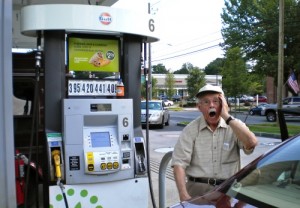
No wonder John is shocked! He remembers buying gas for 26.9 a gallon.

I’ve set a new record for myself on the road. I achieved 24.8 miles per gallon of gas in my Hyundi Sonata in a test!

I’m sure this does not sound like much for you in your Prius. But for me, not bad. I’m accustomed to lower mileage.

I obtained my driver’s license at 18 and I looked forward to this test last week-a feat to cap my 64 years at the wheel. I was excited when I started the final arithmetic. But I admit I was disappointed with the 24.8 result. I had been driving with such constant care throughout the test of nearly 400 miles that I expected a more dramatic score. After all, I had used every trick I knew to maximize that result.

That 24.8 was for my mileage over 13 days. I re-did the arithmetic to make sure my answer was correct.  It was. I had been hoping for 30 miles per gallon. I had gone online. My Sonata is a four-door 2010. For it the Hyundai website claims 24 city/35 highway miles per gallon.

My driving was a combo, in fact leaning toward the highway driving. My heaviest driving was in New London on two visits, but I also made a round trip to Hartford.

I have the highest regard for Hyundai, but I believe reaching that claimed 35 mpg is as realistic as breaking the sound barrier. I’d love to talk to anybody who has ever gotten more than 30!

I have owned some 30 cars. I have driven hundreds of thousands of miles—more than a million, I figure. This is my best mileage ever, I believe, as modest as it is. It comes when gas prices are the highest I’ve ever coughed up. More than $4 per gallon!

I paid 27 cents a gallon when I got my first car in 1950 and that hurt my pocketbook so bad that I remember it to this day.

That was a snappy Terraplane coupe, by the way. Vintage ’38. Two doors; a single bench. I was a junior in college. It cost $100. My father gave me $50 and I scrounged the other $50 from my Aunt Bernadette. What a nice memory.

I remember when the price dropped to a wonderful 17.9 in a gas station war. Those wars sprang up like wild fire. They were wonderful for us consumers. Hated to see them end. I haven’t seen a real gas war in years. It makes me think there may be collusion now. How does it happen that gas stations in a whole neighborhood seem to display basically the same prices every day?

Anyway, I have become a careful driver and frugal. I consider it dumb not to be. I admit that during these stratospherically spiraling gas prices I’ve been even more watchful.

Everybody I know is complaining about these astonishing, numbing prices. It’s right near the top as our biggest topic of the day.

Truth is, I hear more about the day’s gas prices at the coffee shop than I do about Iraq and Afghanistan, which are much more serious.

And know what? Despite these incredible prices, I am astounded to see so much dumb driving on the road. Driving that wastes gas and that means money. Crazy!

Yes, I take pride in wrangling my dollar’s worth. It’s this habit that accounts in part for my untroubled financial life these many years.

Oh, I didn’t tune up my Hyundai Sonata for this trial. Didn’t check my tire pressures, which is recommended for top performance. No special preparations of any kind.

The idea to run a test hit me on the morning I paid $4.14 per gallon for a fill-up. Incredible! What American over the age of 30 ever expected to see such prices?

I immediately set my odometer at zero. And I did not use any new-fangled driving tricks. I used the same old tricks I have used for years. Some are known to many savvy drivers. You probably use some. But I think a couple are my own—things I’ve picked up by myself on the road.

Some are more effective than others, of course. But they all wring out more miles per tankful. I believe this although my close friend Woody strongly disagrees. I’ll tell you about him in a minute.

Interested in how I did it? Well, see how my tricks check out against yours.

First, I must tell you about an exciting experience eight years ago. My Uncle Jack—91 at the time—was a patient at the Rhode Island Veterans Home in Bristol, R.I. I visited him once a month. It was108 miles to Bristol, with two stops on the way. One in Westerly for a quick walk around beautiful Wilcox Park downtown—it’s also a superb arboretum. And a stop for coffee half an hour later down the road.

Oh, I am a shun-piker. Important for you to know this. I drive on our Interstates as little as possible. So to visit my uncle, I traveled on I-95 only to Rte. 234 beyond Mystic. I rode 234 into Westerly. Then Rte. 1 into Rhode Island, turning east on Rte. 138.

Then down the long hill to gorgeous Narragansett Bay and over the two great bridges across it to the eastern shore —the Jamestown Bridge to Conanicut Island, and  then the massive Senator Pell Bridge. Then dense stop and go traffic on 138 for about 15 miles to the old and narrow but graceful Mount Hope Bridge across scenic Mount Hope Bay. Then five miles or so of slow driving to my uncle’s.

So, quite a variety of roads.

It was exciting because I was trying a new game I made up. I got myself two rolls of pennies—100 in all. I wasn’t sure how many I’d need. And I put an empty tin can on the floor to my right. The idea was this: I would drop a penny into the can every time my foot touched the brake pedal. My goal was to get to the hospital with as few pennies in the can as possible.

A wonderful game. A game of skill and anticipation and fun. Yes, fun! My Rule Number One was: no risky chance taking! Do nothing to impede other drivers! Safety first! 

Rule Number Two—obey the law. Drive within the posted speed limits—well, reasonably so (who ever respects every limit?) Do not run a red light. Stop at every stop sign. Do not cross a solid white line.

My score that first time for that 108 miles was 38 pennies.  And I was vigilant. It turned out to be so much fun and so instructive that I wrote a column about it. Later several readers told me they tried it. Very gratifying.

I played that game every time I headed to Bristol. My best score was 19. But there was a bigger pay-off. That game sharpened my driving skills. Anticipate and react. Again and again. That was the essence of the game. What’s about to happen and what should I do about it? I now anticipate at the wheel as a regular thing. It’s a wonderful habit.

Here’s an example. I’m coming around a curve and I see a green light a quarter mile ahead. Now, a quick decision! Should I speed up to make sure I’ll cruise through before it turns red? Or should I slow down (naturally, without braking!)  to glide to a halt in front of the light if it does turn red? Other cars going my way complicate the game. Of course, luck is a factor, as it is in so many aspects of life.

That 108 miles to Bristol presented many variations of this challenge.

One helpful trick I learned the hard way many years ago. One evening, backing up in the dark, I hit a lamp post. Just a gash on the pole, but a $500 accident to my car. Lesson learned!

Backing up is a dangerous maneuver even in broad daylight. We all have three rear-view mirrors but it’s impossible to view all three all the time. And the view is limited. Think of the many times you’ve read about a car backing up and hitting a child, for instance.

Besides, backing up is a total waste of energy…gas. I plan my driving for as few back-ups as possible. As we know, nearly every parking spot at every supermarket and shopping plaza in the country makes it necessary for us to pull into it and park. Then back out.

I search for a spot to park where I won’t have to do that. Easy. Every such parking lot is designed in double rows with cars parking nose to nose. If possible, I choose a row where two nose-to-nose spots are empty. I drive through the first spot and into the second one and park there. Later, in leaving, I drive out forward. Couldn’t be easier.

It’s essential always to drive with a light foot—light on the gas pedal and light on the brake. Besides, my kind of driving is much kinder to the brakes. Nice and steady; no wild spurts up and no frantic braking.

Another trick is to limit my speed to 60 mph on Interstates. These days only a terrible slowpoke does that. Like me. Very difficult to stick to 60—80 is usual now. Well, I’ll accelerate to 65 if a heavy-footed demon is tailing me.

These roads are designed for faster travel, which means higher speeds. But it’s surprising how fuel efficiency fades at higher speeds. It’s the old law of diminishing returns that comes into play.  Driving at 60 is more economical. And safer for sure. 

Another is to make as few trips as possible. This means consolidating errands. Another is to not run the engine a minute longer than usual.  If I’m on my Rte. 154  in Centerbrook and I see our Scenic Steam Train approaching and tooting and the highway gates about to come down, I stop and turn off the ignition. I re-start only once the gates are back up.

Another is to tank up on gas every time and re-fill only when the gauge is approaching Empty. Stops for four or eight gallons at a time are wasteful in time and money. When possible, tank up in cooler temperatures, usually evening—you get more gas for your money. So I’ve read. Never make a special trip just to buy gas.

I practiced all these religiously during my test.  As I said, knowing Hyundai’s boast of 35 mpg on the highway for my car, I expected an even better result.

I told you I’m a shunpiker. I like to enjoy the ride. Like to look around. See everything. Shunpiking is a natural instinct for me. Some 10 years I drove solo to California in my Dodge Ram camping van. But not shunpiking. I used Interstates nearly all the way. So many boring miles!

Getting ready to return home, solo again, I got the idea of making the drive back with as few Interstate Highway miles as possible.

I studied the map and plotted a route.  Getting out of Los Angeles took me more than three hours! And that’s how difficult much of the trip was. In some stretches, everybody uses the Interstates! There seems no reasonable alternative. But I persisted and found my way.

Often I was all alone on narrow old roads for many miles. Through the West and the Midwest and the Great Plains. But I did see some incredible sights. No space here to tell you about all that. Well, I rode all the way across the country into New York State without a single mile on an Interstate! Then, how ironic.

Entering my Connecticut, failure! Without warning and without opportunity to turn off, I was led onto I-84. This happened twice! I succeeded for some 3,600 miles, then my accomplishment faded in the final 150 miles. But it was fun trying. I wrote an article about that also.

Now, about my friend Woody Boynton in Old Say brook. He’s a retiree like me and a fellow former Peace Corps Volunteer. A smart guy…a fount of info about a wide range of things, including mechanical engineering. He astonishes me every time.

I told him about this test of mine. And here is the shocking thing: he told me I was all wet!  He pooh-poohed many of my tricks. He said, “You may save a teeny bit. But all those tricks are largely insignificant. They don’t add up to much. What’s important is steady acceleration. And deceleration.” This part I agreed on. But he said it all with such authority that I was crestfallen.

Chagrined.

Hah! I hate to admit it but he may be right. Maybe that’s why my result of 24.9 was not better. If he is right, there was not much point in my being so diligent and fixated. Maybe I was being dumb in my own way.

Please help me. If you are an expert in this big subject of the day, please advise me. Is Woody right? E-mail me at johnguylaplante@yahoo.com. I thank you in advance, and will do so again in a personal reply to you.

If I come up with good info from you and others, I’ll share it with our readers.

There’s one thing I will not change my opinion about. I love my penny game. It has made me a better driver. Kept me more alert. And given me a lot of fun. Try it once. It doesn’t have to be pennies, of course. Many other things will work. Use silver dollars if you like. Let me know. Talk others into trying it. 

Maybe together we’ll save a few gallons.
John Guy LaPlante is a veteran writer and journalist.  His award-winning columns and articles were most recently published in the Main Street News.  He is the author of two books, “Around the World at 75. Alone! Dammit!” and “Asia in 80 Days. Oops, 83! Dammit!”  He has just completed his service as a Peace Corps Volunteer (PCV) in the Ukraine where his 27-month tour of duty began last fall.  John always welcomes comments on his articles.