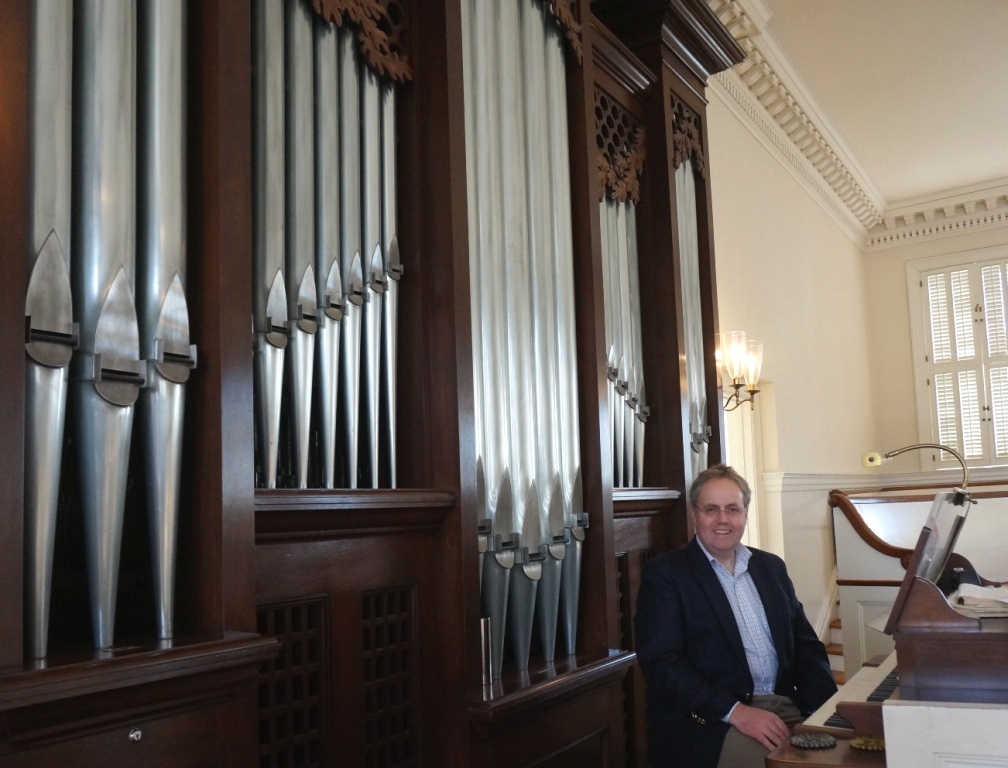
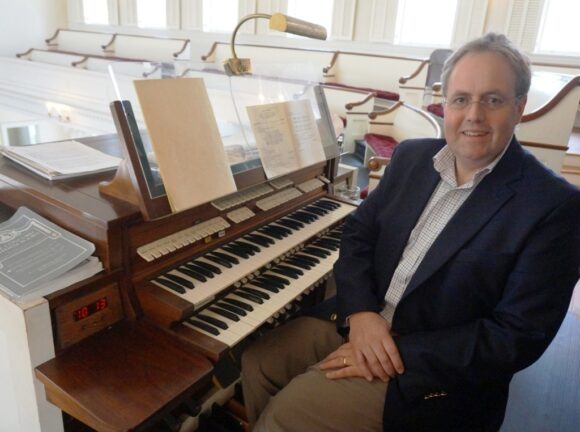
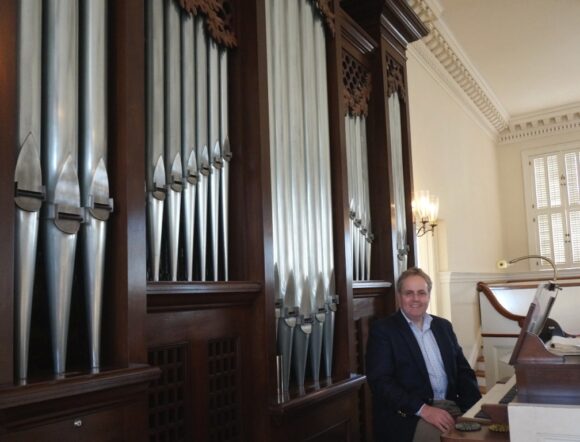
Gifted professional organist Simon Holt, pictured above, will give the recital on Sunday. He is not only the Church’s Director of Music but also the Artistic Director & GM of Salt Marsh Opera and Executive Director of United Theatre in Westerly, R.I.
Throughout 2015, the First Congregational Church of Old Lyme is celebrating 350 years of history. A series of concerts and a talk on the historic landscape of Lyme Street will commemorate the rich legacy of the past and ongoing connections that link the church and the larger community.
On Sunday, Feb. 8, at 4 p.m., the church’s Director of Music Simon Holt will give an organ recital titled, “Spanning 350 Years of Organ Music.” The concert includes works by seven composers originating from five European countries and written in three different centuries.
In a remarkable program demonstrating the versatility and musical complexity of the majestic instrument, the concert opens with J.S. Bach’s Prelude and Fugue in E minor (BWV 548), features Léon Boëllman’s Suite Gothique for organ and Edward Elgar’s Imperial March, and concludes with Charles-Marie Widor’s Toccata in F Major.
Holt comments, “The program not only reflects differing styles of organ music written over the last 350 years, but also features great organ composers, who themselves were musical giants blazing compositional trails, much like the numerous inspirational leaders over the years at the First Congregational Church of Old Lyme.”
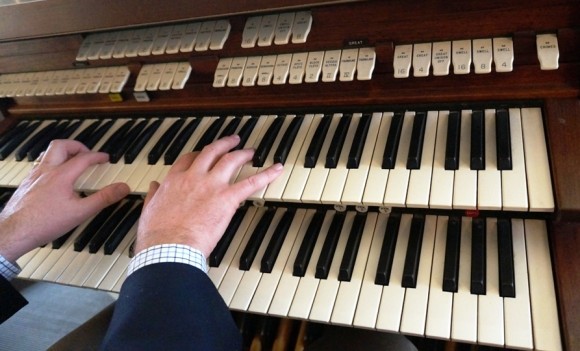
A special feature of the concert will be the installation of a camera to project the image of Holt’s hands and feet, while he is playing, onto large screens at the front of the church.
There will be a reception following the concert in the church’s Fellowship Hall. All are welcome.
Holt began his musical training at St. Michael’s College, Tenbury Wells, a choir school in the heart of England. In 1979, he moved to Malvern College (an independent high school) and by 17 years of age had obtained his performing diploma (ARCM).
He began a graduate degree course at the Royal College of Music in London in 1984, as well as becoming a scholar at the Royal College of Organists. At the end of the three-year-course, he graduated with a teaching diploma (Dip. RCM) and his graduate degree (GRSM, Hons.) The following year he studied at Goldsmiths’ College, University of London, for his Postgraduate Teaching Certificate, which he obtained in 1988.
While living in the United Kingdom (UK), Simon gave organ recitals in Westminster Abbey, St. George’s Chapel, Windsor Castle, numerous Cathedrals and the Royal Albert Hall, London. His discography includes a cassette of solo organ music and three CDs, two as an accompanist and the third conducting the Bristol Cathedral School orchestra.
He has also performed several times on national UK radio and television, including a live performance in the Albert Hall, London, while still at The Royal College of Music. He has also toured Europe widely and his performances have included recitals in Notre-Dame and Sacré Coeur in Paris, France, as well as St. Mark’s in Venice, Italy. He has also performed in Holland, Austria, Germany, the Czech Republic, Belgium and Switzerland.
In May 1999, Holt and his family moved to Stonington, Conn., where he became Director of Music at Calvary Church. In September 2000, he collaborated with Calvary Church in founding Calvary Music School and, in the same year, he founded Salt Marsh Opera Company and is now its Artistic Director and General Manager.
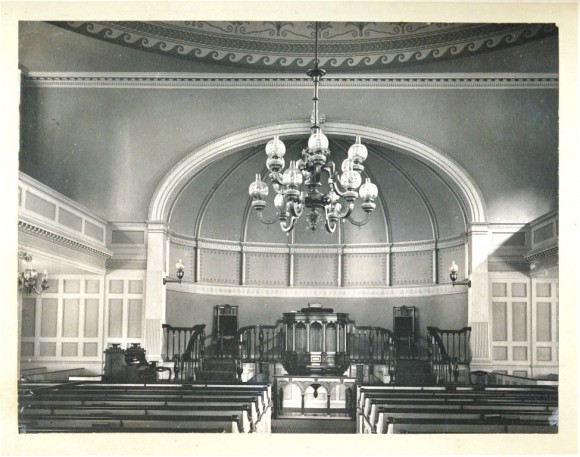
A view of the interior of the church in 1887.
Holt was appointed Director of Music in School at St. Thomas Choir School in New York City in September 2007, He was subsequently named Chair of the Fine Arts Department and Head of Music at Saint James School in Hagerstown, Md., (the oldest Episcopal boarding school in North America), where he spent two years. Holt returned to Connecticut in 2012 and is currently Executive Director of The United Theatre in Westerly, R.I. and Director of Music at the First Congregational Church of Old Lyme.
Since moving to the United States, Holt has given many concerts including organ recitals at St. Ann’s in Old Lyme, Harkness Chapel at Connecticut College, Park Church in Norwich, Christ Church in Westerly, R.I., Peacedale Congregational Church in Peacedale, R.I., the Pequot Chapel and St. James Church in New London, and Christ Church in Charlotte, N.C.
A donation of $10 per person is suggested. All proceeds will benefit church programs and missions.
For more information, visit www.fccol.org or call the church office at (860)-434-8686.
The First Congregational Church of Old Lyme is located at the intersection of Ferry Road and Lyme Street in Old Lyme, CT.
PROGRAM DETAILS;
Prelude and Fugue in E minor, BWV 548 The Wedge
Johann Sebastian Bach (German) 1685-1750
Largo, Allegro, Aria & Two Variations
Michael Christian Festing (English) 1705-1752
Thema met variaties
Hendrik Andriessen (Dutch) 1892-1981
Suite Gothique for Organ
- Introduction-Chorale
- Menuet Gothique
- Prière à Notre-Dame
- Toccata
Léon Boëllman (French) 1862-1897
Adagio in E major
Frederick Bridge (English) 1844-1924
Imperial March
Edward Elgar (English) 1857-1934
“Humoresque” L’Organo Primitivo
Pietro Yon (Italian) 1886-1943
Toccata in F major
Charles-Marie Widor (French) 1844-1937
A Brief History of the First Congregational Church of Old Lyme
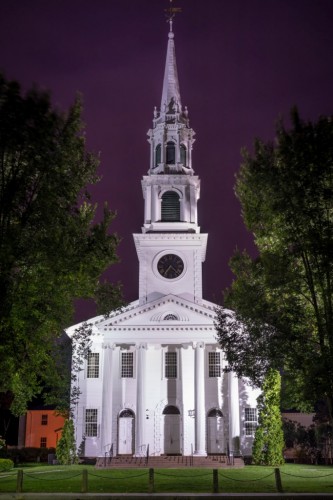 Public worship began on the east side of the Connecticut River in 1664 when the Court acknowledged that there were “thymes and seasons” when inhabitants could not attend Sabbath meetings in Saybrook and ordered them to agree on a house where they would gather on the Lord’s Day.
A year later, Articles of Agreement defined a “loving parting” that created a separate “plantation” on the river’s east side, which would soon be named Lyme.
The first three meetinghouses stood on a hill overlooking Long Island Sound. After a lightning strike destroyed the third of those structures in 1815, the church was relocated to its present site closer to the village.
Master builder Samuel Belcher from Ellington was hired to design a fourth meetinghouse beside the town green and the cornerstone was laid on June 10, 1816. That stately white church with its graceful steeple and columned façade, painted repeatedly by the country’s most prominent landscape artists, burned to the ground on July 5, 1907, in what was almost certainly an act of arson.
Rebuilt to replicate Belcher’s design after a community-wide, fund-raising campaign, the fifth meetinghouse, dedicated in 1910, remains today as both a vibrant center of faith and fellowship and the town’s most important historic landmark.