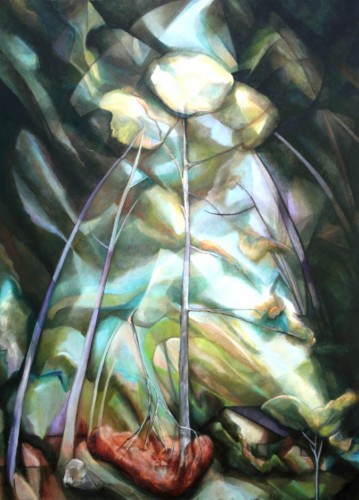
Broken Branch III is one of Forrest Bailey’s works featured in the new exhibition at the diane birdsall gallery.
The diane birdsall gallery’s new exhibit: Space * Time * Memory, opens this evening with an artist’s reception this evening from 5 to 7 p.m. The exhibit includes the distinctive woodland paintings of Forrest R. Bailey and the sculpture constructions of William Vollers.
Bailey’s oil paintings create a sense of place that may feel familiar if you have trekked our regions preserved woodlands. In the ‘Broken Branch’ series, Bailey handles the reflection and movement of light to create a cathedral like setting, affecting a moving, touching, stirring and poignant nostalgic memory. The paintings range in size up to 66 x 48 inches.
Bailey, paints from a cumulation of recorded photographs and returns to the studio to invent the landscape he wants to paint from a sense of space, time and memory.
In a second series titled ‘Cut Branches,’ Bailey has prominent diagonal lines criss-crossing in front of our eyes as a mesmerizing obstacle. The pile of branches is handled as a beautiful object.
Three works in oil are dominated by large rock surfaces depicted in geometric form. In this series titled Joshua Rock III, IV, V, Bailey uses a full spectrum of color, primarily using blue and violet hues. “ Rocks are such a part of Connecticut. They intrude upon my paintings. I use light to accelerate movement.” Forrest Bailey
Early in his career Forrest Bailey taught Art and Painting Methods and Materials at the University level, at Michigan Sate University, University of Minnesota and University of Iowa. He returned to school to attend the prestigious Cooperstown Graduate Program in Conservation studying under Caroline and Sheldon Keck.
Forrest Bailey came to Old Lyme in 1999 from Kansas City, where he had been the Resident Conservator at the Nelson Atkins Museum of Kansas City Missouri from 1973-1998.
The American painting collection includes the largest collection open to the public of works by Thomas Hart Benton, who lived in Kansas City.
Diane Birdsall asked him what it was like to work as conservator, on the paintings of an important American Painter like Thomas Hart Benton.
Question : Tell me what you understood or saw when working on Thomas Hart Benton’s art.
Answer: Movement through space and the Mannerist forms were what interested me in Benton’s work. The subject matter wasn’t as relevant to me. Jackson Pollock, who was a student of Benton, pushed movement through space to a personal, logical conclusion.
Question: Is there another restoration/ conservation experience you can share with me that may have had a profound effect on you?
Answer: My most challenging project was working on a painting by J.M.W. Turner … that and a painting by Grant Wood. I remember that working on a painting by John Constable was a revelation. You really learned what painting was about conserving works by great masters..
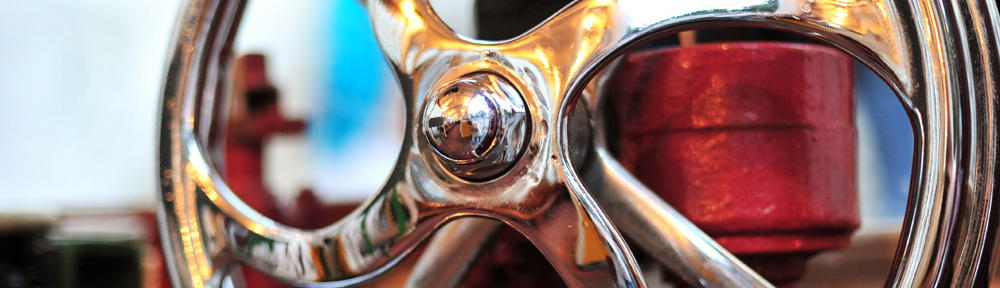
In conjunction with the woodland paintings of Forrest Bailey are sculpture constructions by William Vollers.
Vollers has been a resident of Chester, Conn., where his home studio- gallery have been open to the public. Vollers creates wall mounted and free-standing sculpture. He has been involved in this art form for 10 years. Previously, William Vollers, was a successful graphic designer and Art Director in New York City winning awards from the Art Directors’ Club in three different states.
Vollers has a zen like approach to his work. He often refers to the definition of Wabi Sabi. which can be defined as : Japanese world view or aesthetic centered on the acceptance of transience and imperfection.
Vollers collects elements of once useful working parts, tools, games, metal and wood. He combines these pieces to create his art/constructions. They are both rough and smooth with the surface of age and time retained in its found condition. It is the bringing together of these bits and pieces that reflects his sensitive regard to design, shape and balance. Vollers engages his acute sense of selection and balance to create an entirely new work of art.
This exhibit, which runs through May 18, illustrates two artists in two very different mediums who work with the elements of nature in their living and transforming stages.