
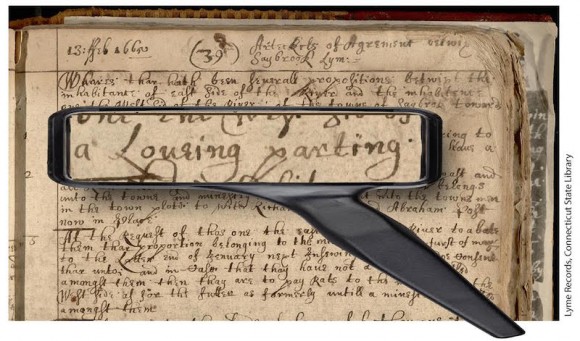
A section of the Loving Parting document, 1665. Lyme Records, Connecticut State Library.
An exhibit, The Town of Lyme in the 1600s, will be on view at the Lyme Public Hall from Friday, July 3 through Sunday, July 5. Starting with the establishment of East Saybrook in 1665, this exhibit explores the early English settlement of Lyme through primary documents, and maps from the period as well as examples of items that might have been in a seventeenth century household.
The exhibit is planned to mark the 350th anniversary of the Loving Parting in 1665 when representatives from the east and west sides of the Connecticut River signed an agreement confirming the separation of the new “plantation” of East Saybrook from its parent Saybrook Colony. Before long the new settlement took the name of Lyme.
A special focus of the exhibit is the settlement of the northwest section of Lyme which is today the Town of Lyme. The exhibit highlights early families such as the Elys, and Brockways who gave their names to places in present day Lyme. The settlement of the area by Indian groups and the later interaction of Sachem Joshua and the town are also examined.
Exhibit hours are Friday, July 3 from 2 to 5 p.m. Saturday, July 4, from 9 a.m. to 1 p.m. and Sunday, July 5, from 2-4 p.m. Admission is free.
On Friday, July 3, from 2 to 5 p.m. photos will be taken for the Lyme Local History Archives of descendants of Lyme’s seventeenth century settlers. Families with names like Marvin, Brockway, Luther, and Beckwith are still in the local area, and there are many others. Visit www.lymepublichall.org and look at the Archives posts for the names of these first settlers. Descendants can stop by the Hall any time Friday afternoon to participate in this project and should bring their cameras as well. For more information, contact Leslie at 860 526-8886.
The Lyme Public Hall is located at 249 Hamburg Road (Route 156) In Lyme, Connecticut. For more information go to www.lymepublichall.org
The Lyme Public Hall Association is dedicated to the appreciation of Lyme’s history, culture,and community through the preservation and use of the historic hall, its archives and historical programs.